RFID Cards
T5577 Cards
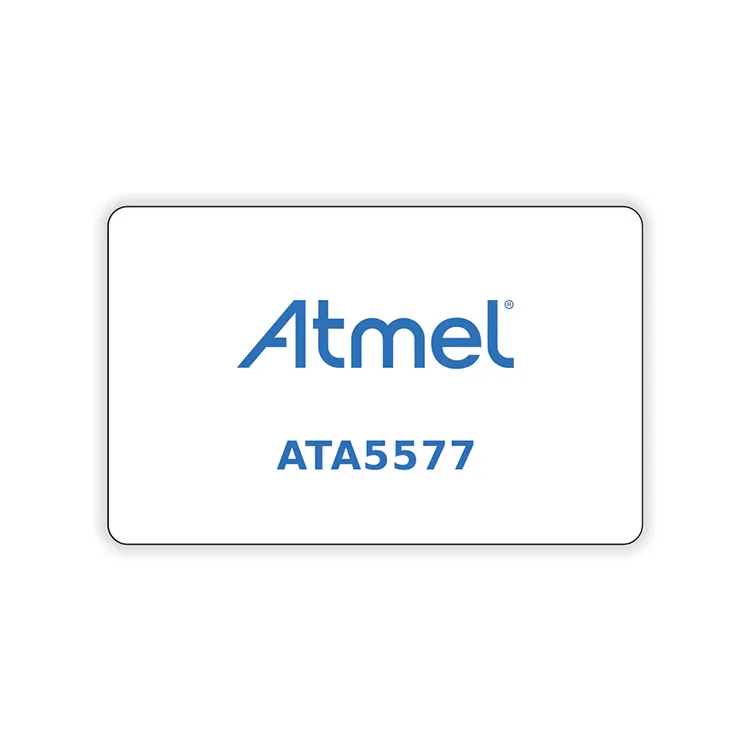
Proud Tek's T5577 cards are rewritable 125 kHz RFID cards on genuine Microchip ATA5577C chips, for legacy access-control migration and card reissue. The chip emulates common low-frequency credential formats, including EM4100, and offers password and lock-bit memory protection. Lock bits protect the card's memory, not the credential it sends: the T5577 has no cryptographic authentication, so proven cloning resistance needs an assessed DESFire workflow. Samples are tested on the target reader before bulk order.
Our T5577 cards carry Microchip's genuine ATA5577C (originally an Atmel part), the 125 kHz read/write chip whose configuration block sets the modulation (Manchester, Bi-phase, FSK, PSK or NRZ), the data rate and the number of blocks sent, so one blank can be set up for different LF credential formats, the EM4100 format among them. The encoder settings and reader specification decide which card is right.
Ask for blank or printed cards and specify any pre-encoding requirement. Include your reader and writer models with the RFQ so sample testing matches the system you will deploy.
Free standard samples · Quotation within one business day
Product details
How the T5577 differs from the EM4305
Like the EM4305, the T5577 is a rewritable 125 kHz chip, yet an encoder built for one does not necessarily program the other. Microchip's ATA5577C datasheet shows where the T5577 differs:
- Maker: Microchip, whose ATA5577C came from Atmel (the current datasheet replaces an Atmel edition). It is compatible with the T5557/ATA5567, whose configuration register it shares, and replaces the e5551/T5551 in the most common operating modes. It is the chip in every T5577 card we produce.
- Memory: 363-bit EEPROM in 11 blocks of 33 bits, each 32 data bits plus a lock bit. Page 0 holds the configuration block and seven user blocks (224 bits), block 7 doubling as the 32-bit password; page 1 holds two traceability blocks and the analog front-end option register.
- Configuration: the configuration block chooses the modulation (Direct/NRZ, Manchester, Bi-phase, FSK1, FSK2, FSK1a, FSK2a, PSK1, PSK2 or PSK3) and one of eight data rates from RF/8 to RF/128. Extended mode adds any even data rate from RF/2 to RF/128, differential bi-phase and inverted output. The EM4305 offers just Manchester and Bi-phase. Mind the names when copying an EM4305 set-up: what EM calls Bi-phase (extra mid-bit change on a 0) is this chip's differential bi-phase, while its plain Bi-phase puts the change on a 1.
- EM4100 format: configured for Manchester at RF/64 with max block 2 and no sequence terminator, the chip sends blocks 1 and 2 over and over: 64 bits, the length, coding and data rate of the EM4100 frame shown on the EM4200 card page. Microchip does not state this set-up; it follows from the datasheet, so prove it on a programmed sample. An EM4305 can carry the format too.
- Protection: in password mode, programming and direct access need the 32-bit password; a lock bit write-protects its block for good against RF reprogramming; an OTP option write-protects every block. In Answer-On-Request mode the chip stays silent until a wake-up command carries the right password, which also lets a reader pick one tag from several in the field. Block 7 is an ordinary data block, so in password mode max block has to stay below 7 or the chip transmits the password; the EM4305's password word is write-only.
- Animal ID: configurable for ISO/IEC 11784/11785. The datasheet's FDX-B example uses differential bi-phase at RF/32 with max block 4, the 128-bit telegram in blocks 1 to 4, while the chip ships as Manchester at RF/32 with max block 2, so FDX-B needs configuring first; the EM4305 arrives already in its FDX-B coding. Microchip describes the chip for the 125 kHz or 134 kHz band, the antenna and chip together forming the tag, and ISO animal-ID readers work at 134.2 kHz, so a 125 kHz card is not an animal tag as supplied (the EM4305 card page explains the device rules).
- Write endurance: at least 100,000 erase/write cycles (a datasheet minimum, against 1,000 in the EM4305's datasheet), and data kept for at least 10 years at 55 °C.
Password and lock bits protect the memory, not the credential: the T5577 has no cryptographic authentication. For when each writable chip fits, next to the read-only and HITAG options, see 125 kHz RFID cards.
T5577 card selection
| Selection point | What to check |
| Chip | Microchip ATA5577C; if your integrator has approved a chip, check that it is this part. |
| Frequency | 125 kHz card; Microchip’s ATA5577C IC supports the 100–150 kHz range. |
| ATA5577C memory | 363 bits total, including control and lock bits. Seven 32-bit user blocks include the optional password block; total memory is not all application payload. |
| Configuration | Data rate, modulation, encoding and operating mode must match the reader. |
| Programming | Use an LF writer and software that support the ATA5577C. |
| Finish | Specify blank or printed card, material, size, numbering and any additional features. |
Inside the T5577: pages, blocks and the configuration register
What the chip sends, and how, is not fixed in silicon: it is held in the configuration block, which is why one T5577 part can behave like several different LF credentials. The structure below follows the Microchip ATA5577C datasheet.
| Area | Contents |
| Page 0, block 0 | Configuration register: data rate, modulation, PSK sub-carrier, the number of blocks to transmit (max block), password and Answer-On-Request bits. Not transmitted in a normal read. |
| Page 0, blocks 1–7 | User data blocks that carry the credential payload; block 7 optionally holds the 32-bit password. |
| Page 1, blocks 1–2 | Traceability data: a unique ID built from Microchip's lot, wafer and die numbers, programmed and locked during production testing (the datasheet states this for sawn-wafer-on-foil delivery). |
| Page 1, block 3 | Analog front-end option register: detection levels, clamp and modulation voltage, downlink protocol. Not transmitted in a normal read. |
| Lock bit (per block) | Once set, the block and its lock bit cannot be reprogrammed through the RF field, even with the correct password. |
In a normal read the chip sends blocks 1 up to the max block value and then starts again, so the transmitted length matches the emulated format; the page 1 traceability blocks are sent only after the reader issues the page 1 opcode. Settings and data are written over the 125 kHz field by an LF writer that supports the ATA5577C, one 33-bit block per command.
T5577 blanks and credential copying
The T5577 can be configured for supported legacy LF credential formats. For authorised replacement or migration work, the encoder must support the chip, modulation, data rate and credential format required by the system. In a fixed-ID configuration, the transmitted credential data has no cryptographic authentication. A device that can capture and reproduce that format may copy the credential onto another compatible blank; password protection or write-locking the original card does not prevent that. Verify the programmed sample on the actual reader rather than assuming every LF reader or writer supports the same format.
For projects requiring cryptographic credential authentication, assess a MIFARE DESFire card with the system integrator. Protection depends on compatible readers, application configuration, key management and the checks the system performs; choosing a chip alone does not eliminate credential copying. Agree the T5577 delivery state, including any password protection or permanent block locks, against the system owner’s specification. We do not duplicate credentials from systems a buyer does not administer.
What to include in a T5577 card RFQ
- Exact chip requirement, reader or lock model, encoder model and the required data format.
- Blank or pre-encoded delivery; numbering, configuration and password or lock requirements.
- Card dimensions, material, printed artwork, quantity and any visible serial number or barcode.
- Destination and target delivery date, plus whether you need samples for a new system or repeat orders for an approved specification.
T5577 sample approval checklist
- Confirm the sample can be detected and programmed by your encoder.
- Check the issued number and format in the actual access or membership application.
- Test the agreed protection and re-issuing workflow, including after a reader restart.
- Approve print quality, card dimensions and reading performance on the installed equipment.
Programming a T5577: what to verify
- Confirm that your LF writer and software support the ATA5577C itself, not only "125 kHz".
- Set and record the configuration block: modulation, data rate, the sub-carrier where PSK is used, the sequence terminator, and the max-block value for the target format.
- Write the data blocks, then read the card back and check the output on the actual reader or lock, not only on the writer.
- Apply agreed password protection only after the format is proven. Set permanent block locks only after sample approval and explicit confirmation that future RF rewriting of those blocks is not required; then check the card on the target reader again.
- Keep the configuration and any password with the approved sample so repeat orders reproduce the same specification.
Compare related LF credentials
Compare the writable chips on the 125 kHz RFID cards page, read the EM4305 card page if your writer supports that chip, or use the read-only EM4200 card when a fixed factory number is enough. See hotel key cards when the lock-system specification determines the credential.
Technical reference: Microchip ATA5577C datasheet. The finished-card specification is confirmed in the quotation.
Match T5577 cards to your reader
Discuss your specification →Frequently asked questions
Can a T5577 card carry an EM4100 ID?
Yes, when it is configured for it: Manchester at RF/64, max block 2 and the sequence terminator off, with the 64-bit EM4100 frame written to blocks 1 and 2. That configuration is derived from Microchip's datasheet rather than stated in it. Readers differ in the data rates they accept and in the ID length and byte order they pass to the controller, so a card that reads on one EM-format reader can fail on another; test a programmed sample on the installed reader and controller.
Do I need a special writer for T5577 cards?
You need an LF writer and software that support the exact chip and configuration being supplied. A reader that displays a card number may be read-only and unable to program the card.
Does a T5577 card provide advanced encryption?
No. The T5577 has no cryptographic authentication: its password and lock bits protect the chip's memory, not the credential it sends. If the project needs cryptographic mutual authentication, ask your integrator to select a credential technology that provides it, such as an authenticated 13.56 MHz card.
How much data can I store on a T5577 card?
For ATA5577C, the 363-bit total includes control and lock information. Seven 32-bit user blocks include the optional password block, so the application payload depends on configuration. Confirm the memory use against your encoder specification.
Can you supply blank or pre-encoded T5577 cards?
Yes. Name the delivery state in the RFQ with the required format, configuration and numbering, and approve a programmed sample first. Each card we program is read back once the data is written, and every encoded order is delivered with a data report. Numbered cards also get a file in Excel, CSV or XML listing each card's chip ID beside its printed number; the RFID encoding service page has the details.
What is stored in page 1 of a T5577?
Blocks 1 and 2 hold traceability data, a unique ID built from Microchip's lot, wafer and die numbers, programmed and locked during production testing; the datasheet states this for chips delivered as sawn wafer on foil, so confirm it for the part supplied. Block 3 is the analog front-end option register. Your credential and the configuration live in page 0, and a reader reads the traceability blocks only with the page 1 command.
Can a T5577 be locked so it cannot be re-cloned?
Password protection and block locking are separate. In password mode, protected commands require the correct 32-bit password. Setting a block’s lock bit permanently prevents that block, including its lock bit, from being reprogrammed through the RF field, even with the correct password. Neither setting prevents a fixed-ID credential from being read and reproduced on another compatible device. If your application needs cryptographic authentication, assess MIFARE DESFire with your integrator; the reader, key management and application checks must all support it.
Is the T5577 compatible with the T5557 or ATA5567?
Microchip designed the ATA5577C to be compatible with the T5557/ATA5567: the configuration register has the same structure, and the Basic and Extended modes are both available. It also replaces the e5551/T5551 in the most common operating modes, but Microchip says each replacement must be evaluated in its application, so test a programmed sample on your writer and reader.
Buyer guides
- How RFID Cards Work: Antenna, Chip and the Tap Handshake How RFID cards work, explained for buyers: the antenna and chip inside, the passive tap handshake, the standards involved, and which chip suits which job.
- RFID Data Encoding and Memory Structures RFID memory and data encoding explained: UID versus user memory, chip capacities from EM4305 to DESFire and UHF EPC banks, NDEF, and encoding control.
- How to Read an RFID Tag Quotation, Line by Line What decides RFID card and tag prices, and how to compare quotations line by line: unit-price basis, tooling, encoding, samples, freight and Incoterms.
Ready to specify your order?
Send the product, quantity and application so we can confirm the options and pricing for your project.