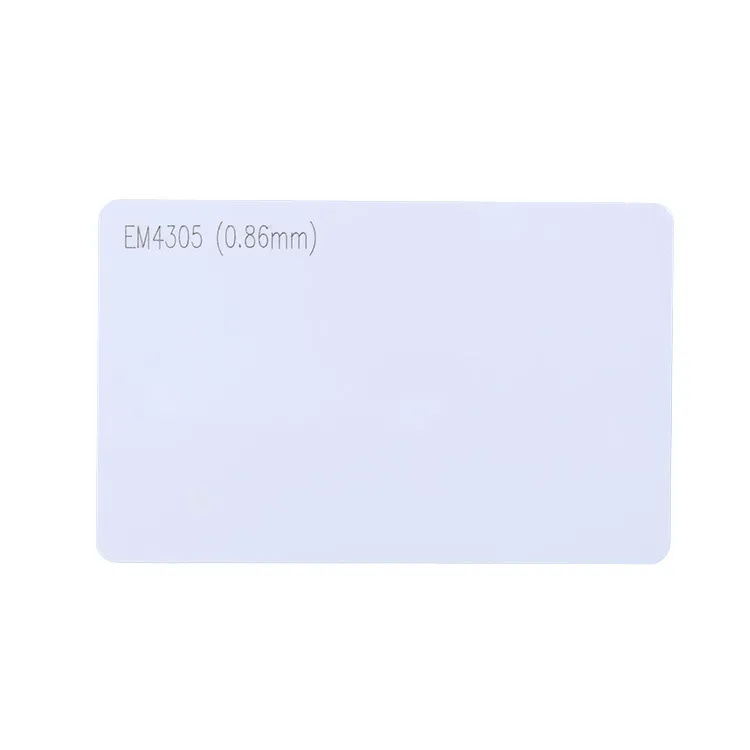
RFID Cards
EM4305 Cards
The EM4305 is EM Microelectronic’s 512-bit read/write 125 kHz chip — the fixed-function alternative to the multi-format T5577 — chosen when a lock or encoder system names it explicitly.
EM4305 cards carry a genuine EM Microelectronic 512-bit read/write 125 kHz chip: Manchester or Bi-phase output, a 32-bit password that cannot be read out, read and write login, per-word write protection and Reader Talk First. Choose it when your encoder or lock system names the EM4305, and specify the data format so the cards can be tested with your installed readers.
Choose blank cards for your own encoding or ask about pre-encoding, printing and numbering. Confirm the card construction and programming specification with a sample before a volume order.
Free standard samples · Quotation within one business day
Product details
How the EM4305 differs from the T5577
The EM4305 and the T5577 are both rewritable 125 kHz chips, but they come from different makers, are programmed with different commands and suit different systems. What sets the EM4305 apart, according to EM Microelectronic's EM4205/4305 datasheet:
- Maker: EM Microelectronic, which also makes the EM4100-family read-only chips. The EM4305 is the member of its EM4205/4305 family with enlarged pads for connecting a coil directly and a 330 pF capacitor option; its commands follow the EM4469/4569 protocol.
- Memory: 512-bit EEPROM in 16 words of 32 bits, with a factory-programmed 32-bit UID. Up to nine user words (288 bits) form the default read, and Words 0 and 3 can hold data that is read only on command.
- Output: Manchester or Bi-phase only, at RF/8, RF/16, RF/32 or RF/64, plus RF/40 on the 330 pF version. There is no FSK or PSK output. In EM's Bi-phase a 0 carries the extra mid-bit transition; the T5577 datasheet names that coding differential bi-phase.
- Protection: a 32-bit password that cannot be read out. The configuration word can require it before command reads, before writes, or both, protection bits lock individual words against writing, and Reader Talk First keeps the chip silent until the reader sends a command; the T5577's nearest equivalent, Answer-On-Request, wakes only on a command carrying the password.
- Animal ID coding: EM states ISO 11784/11785 compliance and lists FDX-B animal identification among the chip's uses; as delivered, it is already set to the coding, data rate and length of its FDX-B mode. Animal-ID systems operate at 134.2 kHz, so this is a chip ability, not a finished animal tag (see below).
- Write endurance: a datasheet minimum of 1,000 write cycles, with 10 years' data retention at 55 °C. That is ample for issuing and re-issuing a card; if a card is rewritten at every use, compare it with the T5577's 100,000 cycles.
Neither chip authenticates itself to the reader, so for access where copying has real cost, plan an authenticated 13.56 MHz credential such as a MIFARE DESFire card. The 125 kHz RFID cards page sets out when to choose each chip, alongside the read-only and HITAG options.
EM4305 card specifications
| Selection point | What to specify |
| Chip and frequency | EM4305 (EM Microelectronic), rated 100 to 150 kHz; this card is intended for 125 kHz LF projects. |
| Memory | 512-bit EEPROM in 16 words of 32 bits; the total includes identification, password, configuration and protection words. |
| Identification | Factory-set 32-bit chip UID; distinguish it from any programmed application number. |
| Data format | Manchester or Bi-phase at RF/8 to RF/64, with the data rate and application format agreed for the reader. |
| Protection | 32-bit password with read and write login, and per-word write protection. |
| Chip endurance | 1,000 write cycles and 10 years' data retention at 55 °C (datasheet minimums). |
| Card finish | Specify dimensions, material, blank or printed finish, and visible numbering. |
These are chip selection points, not a guarantee of finished-card performance. Antenna design, card construction and your reader determine the practical reading distance.
Inside the EM4305: 512-bit EEPROM
Only part of the 512 bits is free application memory: several words hold the chip's identity, password, configuration and protection. The layout below follows the EM Microelectronic EM4205/4305 datasheet.
| Word | Contents |
| Word 0 | Chip type, resonant-capacitor version and customer code, set at manufacture; the user can overwrite it with other data, read only by command. |
| Word 1 | 32-bit unique identifier (UID), fixed at manufacture; read by command. |
| Word 2 | 32-bit password; write-only, and changed only after a successful Login. |
| Word 3 | User data, read only by command. |
| Word 4 | Configuration word: data rate, encoder, Delayed On, last default-read word, read and write login, Disable, Reader Talk First and pigeon mode. |
| Words 5–13 | User data (288 bits); the default read runs from Word 5 to the last word set in Word 4. |
| Words 14–15 | Protection words: one bit per word write-protects Words 0 to 13; changed only by the Protect command. |
The reader writes over the 125 kHz field with five commands: Login, Write Word, Read Word, Protect and Disable. A successful Login stays valid until the chip next powers up. With Write Login set, writes and protection changes need that Login; with Read Login set, so does reading any word other than Words 0 and 1 with the Read Word command. Read Login does not stop the default read: only Reader Talk First silences the chip until the reader sends a command. Disable, if allowed in Word 4, stops the chip until its next power-up. That is how an EM4305 can be issued blank, programmed on your own encoder, then locked.
EM4100 and EM4102 emulation
A 125 kHz reader simply demodulates whatever the card sends. The EM4100 format is a 64-bit, Manchester-coded frame at RF/64, laid out on the EM4200 card page. An EM4305 set to Manchester at RF/64, with Word 6 as the last default-read word, sends the 64 bits of Words 5 and 6 in a continuous loop, so an identifier written there in the EM4100 layout reproduces what legacy EM-format readers expect. A site that runs EM4100 readers can therefore re-provision cards in the field rather than order a fresh read-only batch each time. Compatibility still has to be proven: the reader must accept the exact format and data rate you program, so test a configured sample on the installed reader before a volume order.
ISO 11784/11785 (FDX-B) animal identification
EM Microelectronic describes the EM4205/4305 as ISO 11784/11785 compliant and lists animal identification to ISO FDX-B, pigeon races and waste management (BDE) among its applications. Its FDX-B mode sends Words 5 to 8 (128 bits) in Bi-phase at RF/32, and EM's FDX-B example also sets the Delayed On option, which follows ISO 11785. Bi-phase at RF/32 with Word 8 as the last word read is the chip's delivery state, so a tag maker writes the telegram to Words 5 to 8 and sets Delayed On if the reader needs it, whereas a T5577 has to be configured for FDX-B first.
Chip compliance does not make this card an animal tag. Animal-ID systems to ISO 11784/11785 operate at 134.2 kHz, and the EM4305 is powered through a resonant circuit formed by its coil and on-chip capacitor, so an animal tag is built for that frequency; this card is made for 125 kHz readers. The standards cover four device types (injectable transponders, ear tags, ruminal boluses and tag attachments), and ICAR certifies devices as conforming, lists registered manufacturers that have signed its code of conduct and names the competent authorities for companion animals and livestock. For an official animal ID, check the competent authority's rules. For 125 kHz access and identification, the EM4305 is used as described above.
Match the card, encoder and access system
For an EM-format installation, send the reader model and required credential format. A readable number on an existing card does not establish its encoding or prove that an LF desktop writer can program EM4305. The encoder must support this chip and the system’s required configuration.
For fixed-number credentials, review the read-only EM4200 card; for when to choose each writable chip, see 125 kHz RFID cards.
What to include in an EM4305 card enquiry
- Reader and encoder brand, model and firmware, plus the application: access, membership or another LF system.
- Blank or pre-encoded cards; the required output format, numbering rules and whether protection is needed.
- Quantity, card dimensions and material, print artwork, numbering or barcode requirements.
- Destination country and target delivery date.
Approve a sample before the bulk order
- Read and, where required, encode the sample using your actual equipment.
- Enrol it in the application and test normal use, re-issuing and any agreed protection settings.
- Check both printed and electronic numbers against the approved format.
- Approve the finished-card appearance and operating distance at the installed reader.
Supply and related formats
Proud Tek manufactures RFID cards in Shenzhen for integrators and distributors. When we encode EM4305 cards we read each one back afterwards and send a data report with the order; for printed numbering, a file in Excel, CSV or XML pairs every card's chip ID with the number on its face (details on the RFID encoding service page). Agree the construction and any printing or encoding work in the quotation. If the user carries keys instead of a wallet, browse RFID key fobs and the access-control selection guide.
Chip reference: EM Microelectronic EM4205/EM4305 datasheet, version 6.0 (2018).
Specify your EM4305 card configuration
Discuss your specification →Frequently asked questions
Will EM4305 cards work with my existing 125 kHz readers?
Compatibility depends on the configured data format and the installed system. Share the reader and encoder models, then test a sample through enrolment and normal use. A shared frequency alone does not establish compatibility.
Can I rewrite an EM4305 card after delivery?
Yes, when its configuration and protection settings permit writing and your encoder supports EM4305. The datasheet minimum is 1,000 write cycles. Confirm whether you need blank, pre-encoded or write-protected cards before sample approval.
Is the EM4305 chip UID the same as the access-card number?
Not necessarily. The factory-set chip identifier and the application number programmed into memory serve different purposes. Specify which number your software reads and which number should appear in print.
Should I choose EM4305 or T5577?
Follow the encoder or lock specification first, because the two chips use different programming commands. Pick the EM4305 when your encoder is built for EM chips or the password must never be readable from the card; pick the T5577 when the credential uses FSK, PSK or NRZ, or when cards are rewritten often (100,000 cycles minimum against 1,000). Either can be set up for the EM4100 format. Test samples on the actual equipment; the 125 kHz RFID cards page compares all the LF chips.
Can EM4305 cards be used for ISO FDX-B animal ID?
Not these cards. The EM4305 chip is ISO 11784/11785 compliant and is delivered in the Bi-phase, RF/32, 128-bit coding of FDX-B, but animal-ID systems operate at 134.2 kHz and the chip works through a resonant circuit with its coil, so an animal tag is built for that frequency; these cards are made for 125 kHz readers. ISO 11784/11785 devices are ear tags, injectable transponders, ruminal boluses and tag attachments; ICAR certifies them as conforming, and the competent authority sets the rules for an official animal ID.
What information helps you quote printed EM4305 cards?
Send the quantity, dimensions, material, artwork and visible numbering, together with any encoding requirements and delivery destination. These details let us confirm a suitable sample and an accurate quotation.
How much data can I store on an EM4305 card?
The EM4305 has 512 bits of EEPROM in 16 words of 32 bits, but Words 1, 2, 4, 14 and 15 hold the UID, password, configuration and protection register. User data fits in Words 5 to 13 (288 bits), which can be sent in the default read, and in Word 3, which is read only by command; Word 0 can also be reprogrammed. Confirm the words your application needs against your encoder's specification.
Does the EM4305 support FSK or PSK output?
No. The EM4205/4305 configuration word offers Manchester or Bi-phase encoding at RF/8, RF/16, RF/32 or RF/64 (RF/40 only on the 330 pF version); it has no FSK or PSK output. For a credential that uses FSK or PSK, consider a T5577 card, and verify the programmed sample on your reader.
Buyer guides
- NFC vs RFID: The Difference Between NFC and RFID Explained NFC vs RFID explained for buyers: NFC is a 13.56 MHz subset of RFID. Compare range, modes, smartphone support and standards, and choose the right one.
- How RFID Cards Work: Antenna, Chip and the Tap Handshake How RFID cards work, explained for buyers: the antenna and chip inside, the passive tap handshake, the standards involved, and which chip suits which job.
- RFID Frequencies Explained: LF vs HF vs UHF RFID frequencies explained for buyers: LF vs HF vs UHF, their read range, coupling, standards and materials handling, and how to choose the right band.
Ready to specify your order?
Send the product, quantity and application so we can confirm the options and pricing for your project.