How Proud Tek manufactures RFID and NFC products
Proud Tek (legal entity Proud Tek Co., Limited) has manufactured RFID and NFC products for integrators and distributors since 2008 at its own factory in Shenzhen, China. Our strength is the combination of strong chip supply channels, broad material purchasing and our own production and quality control, planned around your product specification, quality requirements, order quantity and delivery need.
For each order we select the chip and confirm its availability through our chip channels, purchase the materials for the card, tag or label, then print, laminate, encode and inspect the goods in our own production before dispatch, as the product requires. Because chips and materials are bought for each specification rather than taken from whatever is on a shelf, we can offer competitive factory pricing while holding stable quality and reliable lead times. The final price depends on the specification, quantity and quality requirements of a particular order.
We manufacture the media and supply desktop encoders from established reader makers for programming and testing; we do not supply the access reader, lock or software. Cards and tags ship unencoded unless you ask us to pre-program a serial, a URL or an NDEF record, so encoding stays under your keys. Test the product you select in the intended system before a bulk order; contactless behaviour depends on the full reader, lock and configuration, not the card alone.
Product families we make and supply
We manufacture five product families across low, high and ultra-high frequency and supply a sixth, desktop readers and encoders, from established reader makers. Each category page carries the chip options, physical formats and personalisation choices for that family; start there and narrow to a specific product.
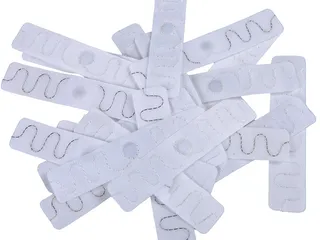
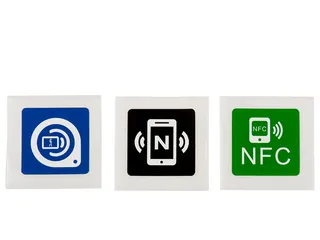
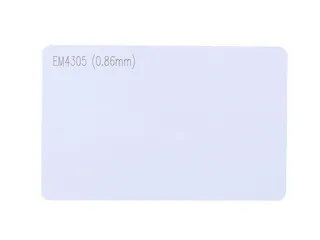
Commercial priority products, where inquiries move fastest, are RFID laundry tags, NTAG 213 NFC stickers, NTAG 424 DNA labels, EM4305 cards, T5577 cards, MIFARE DESFire cards and MIFARE Plus cards. That is a commercial focus, not a claim that every variant suits every system.
| Category | What it covers | Start here |
|---|---|---|
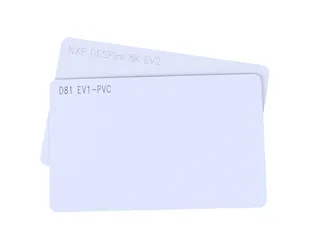
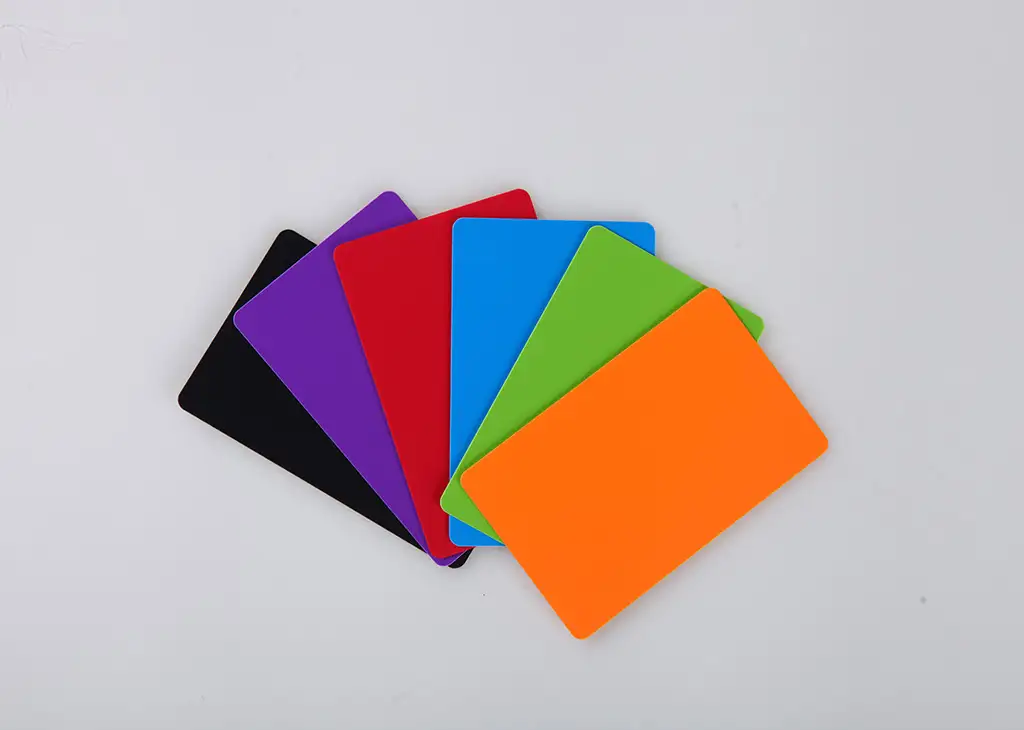
| RFID cards | ISO/IEC 7810 ID-1 cards in PVC, wood, PLA, paper and metal, on LF, HF and UHF chips | MIFARE Plus, DESFire, EM4305 |
| RFID key fobs | ABS and epoxy fobs for access control and identification | Proximity fobs, RFID key fob |
| RFID tags | Hard tags, on-metal and anti-metal tags, laundry and specialty tags | Laundry tags, Windshield tag |
| RFID labels | Paper and PET stickers, inlays and NFC labels, printed and optionally encoded | NTAG 213 sticker, NTAG 424 DNA label |
| RFID wristbands | Silicone, fabric and disposable wristbands for events and access | Silicone wristbands, Event wristbands |
| RFID readers | Desktop encoders and reader/writers for programming and testing | ACR122U, NFC reader/writer |
Chip families by frequency
The chip decides which reader accepts the product, so specification starts there. The table lists the chip families we supply by frequency band and air-interface standard, with a product page where one exists. Where a family has no product page, it is specified per project; send the chip name and version and we confirm the available options.
Two rules cut through most of the choices. First, the reader or lock picks the chip: an installed reader accepts a defined list of chips, so confirm that list before choosing. Second, on new HF access work, MIFARE Classic is legacy: its Crypto-1 cipher has been publicly broken since 2008, so new estates should specify MIFARE Plus or DESFire, which use AES-128.
For three common families we name the exact silicon: our MIFARE Classic cards carry genuine NXP MIFARE Classic EV1 chips, not a compatible chip; our T5577 cards carry Microchip's ATA5577C; and our EM4305 cards carry genuine EM Microelectronic EM4305 chips.
| Band and standard | Chip families | Where it fits | Product pages |
|---|---|---|---|
| LF 125 kHz (134.2 kHz for ISO/IEC 11784/11785 animal ID) | EM4200 (read-only); EM4305 (EM Microelectronic) and T5577 (Microchip ATA5577C), both read/write; HITAG | Access fobs, animal ID, legacy site codes | EM4305, T5577, EM4200, HITAG 2 |
| HF 13.56 MHz (ISO/IEC 14443) | NXP MIFARE Classic EV1 1K/4K (MF1S50/MF1S70), MIFARE Plus, DESFire EV2/EV3, Ultralight | Access control, hotel keys, transit, membership | MIFARE Plus, DESFire, Classic 1K, Classic 4K |
| HF NFC (ISO/IEC 14443, NFC Forum Type 2/4) | NTAG 213/215/216, NTAG 424 DNA | Marketing taps, product authentication and anti-counterfeit | NTAG 213 sticker, NTAG 424 DNA label, MIFARE / NTAG stickers |
| HF vicinity (ISO/IEC 15693) | ICODE | Library media, longer-range HF labels | Specified per project |
| HF regional | LEGIC advant (ISO/IEC 14443A/15693), FeliCa (JIS X 6319-4) | Regional access and transit ecosystems | LEGIC, FeliCa |
| UHF 860 to 960 MHz (EPC Gen2v2 / ISO/IEC 18000-63) | NXP UCODE, Impinj Monza, Alien Higgs | Item-level retail, logistics, asset and vehicle ID | Windshield tag, RFID tags |
How an order runs
The order path front-loads the cheap, reversible steps so a production budget is only committed once the product has read cleanly on your own equipment. We reply to an inquiry within one business day and provide a quotation within one business day of receiving a workable specification.
- RFQ. Send the product or application, chip or reader details, quantity and delivery country. We confirm the chip and the available options for your case.
- Quotation. You receive written pricing and terms within one business day of a workable specification. Payment terms are stated in the quotation.
- Samples. Standard product samples are free. A setup fee applies to customised samples. Sample quantities and dispatch are confirmed for your product and destination.
- Pre-production approval. For a customised order we confirm the physical sample, artwork and any encoding before the run, so unit one and the last unit match.
- Production. Standard products generally run in 2 to 3 weeks. Customised-product lead times and large-order schedules are confirmed individually in the quotation.
- Outgoing inspection. The batch is checked against the agreed specification before dispatch. Every card or tag we encode is read back after encoding, and each encoded order ships with a data report.
- Shipping. Method, cost and transit time depend on the destination and shipment and are confirmed for your destination. The 2 to 3 week lead time is not a guaranteed arrival date.
Customisation: printing, encoding, materials and formats
Most orders are customised in at least one respect. OEM and ODM are both available. Tell us which of the following the product needs so the sample and quotation match.
- Printing. Full-colour CMYK, spot colours, numbering or barcodes, signature panels, hot stamping and laser engraving on suitable materials. Supply artwork in CMYK with bleed.
- Encoding. UID reading, sector or application setup, and NDEF records (URL, vCard, Wi-Fi) written before shipping when you want it. Keys and secure personalisation stay with your system unless a scheme is agreed in writing; cards ship blank by default. For printed or numbered pieces we supply a file in Excel, CSV or XML that maps each UID, TID or EPC to its printed number; the RFID encoding service covers the details.
- Materials. PVC as the standard body; recycled PVC (PVC sheet containing recycled PVC); PET, PETG, ABS and polycarbonate; wood and bamboo veneers; paper; PLA, a corn-starch-based plastic that biodegrades under industrial composting conditions (European Bioplastics), though the chip and antenna inlay are not PLA; metal for premium cards.
- Formats. ISO/IEC 7810 ID-1 cards (85.6 by 54 mm), key fobs, disc and coin tags, on-metal and anti-metal tags, stickers and inlays, and wristbands. Laundry and industrial items need the model-specific wash, temperature and mounting requirements confirmed on the sample.
Quality and documentation
Our ISO 9001, ISO 14001 and ISO 45001 certificates, and the OEKO-TEX Standard 100 certificate for our woven laundry tag, are shown below. Full-resolution copies are available on request.
Material and compliance documentation is provided per quoted product: RoHS and REACH as material-level documents for the quoted product, and a product test report where one exists for the quoted model. Laundry tags have no model-level wash test reports. Where a laundry tag's product page gives a wash-cycle count, that count comes from real laundry use and Proud Tek guarantees it under the conditions stated with it; temperatures and pressures given there are field experience and are not guaranteed. A sample run through your own wash process is still the surest check. Other warranty terms are agreed per order and stated in the quotation, and the FAQ covers claims and returns.
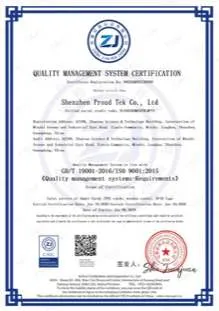
ISO 9001 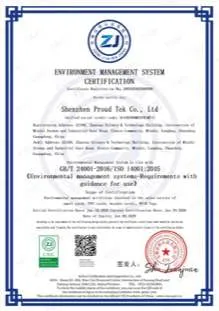
ISO 14001 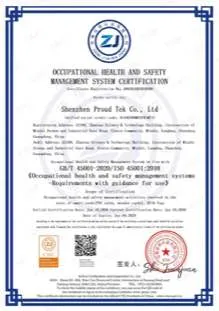
ISO 45001 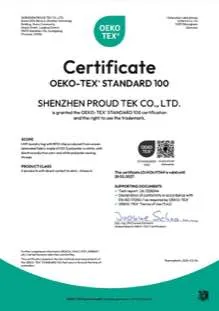
OEKO-TEX Standard 100
How to evaluate an RFID card manufacturer or supplier
Whether you are comparing us or anyone else, the same questions separate a supplier who owns the outcome from one who forwards an order. Use the first checklist to qualify a supplier, and the second to build an RFQ that gets you an accurate quotation the first time.
- Do they confirm the chip against your reader? A good supplier reads your sample or reader details and confirms the chip before quoting, rather than assuming a brand name is enough.
- Are samples available before the bulk order? You should be able to test the actual product on your own equipment first. Standard samples from us are free.
- Is the specification locked before production? Chip, material, artwork and any encoding should be approved on a sample so the run is repeatable.
- Is the documentation specific to the quoted product? Certificate scope, and RoHS, REACH or test reports, should be for the product you are buying, not a generic pack.
- Are the commercial terms written down? Price, lead time, payment and how quality issues are handled belong in the quotation, not in a verbal promise.
- Send us for an accurate quote: the product reference or application; the chip, frequency or a working reader/lock model; required quantity and any tiers; artwork or logo files; encoding requirements; material and format; delivery country and target date; and any documentation you need.
Published 2026-09-16 · Updated 2026-10-03