RFID Cards
LEGIC Card
LEGIC is the Swiss access-control ecosystem — advant and CTC chips specified by the integrator, initialised by the system owner — for projects where the card must come from an approved LEGIC supply chain.
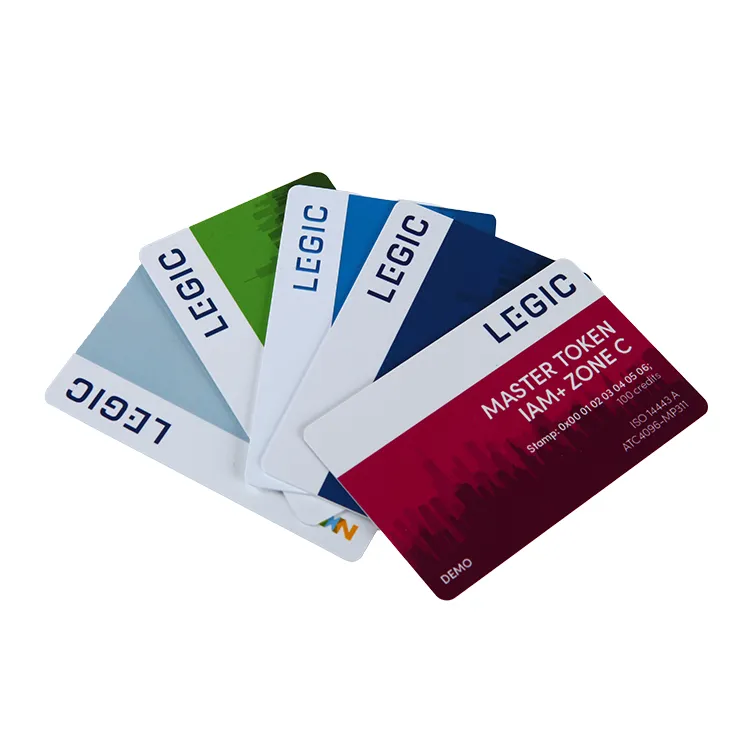
LEGIC advant, CTC and legacy prime cards, key fobs and tags built on the exact chip your integrator specifies, printed to your artwork and supplied for your system owner to initialise. Send the chip type, format and quantity for a quotation within one business day.
Free standard samples · Quotation within one business day
Product details
What is a LEGIC card?
A LEGIC card is a 13.56 MHz contactless card, key fob or tag built around a smartcard chip from LEGIC Identsystems AG of Wetzikon, Switzerland. LEGIC is used widely for employee access control, time and attendance, canteen and vending payment, lockers and hotel locks, above all in German-speaking Europe. The selection rule is simple: order the exact LEGIC chip that your readers and system owner specify, not just "a LEGIC card", because LEGIC advant, CTC and legacy LEGIC prime chips are not interchangeable.
Proud Tek produces the physical credential in its Shenzhen factory: the specified chip built into the card body, printing and visible numbering, with quality control before dispatch. Its chip supply channels cover current LEGIC parts and legacy parts where still available, and the quotation prices the exact chip, format and quantity for your project at a competitive project price. Initialising the card requires your system owner's authorisation (their master token, a delegated sub-master token, or the LEGIC Key Service where used); Proud Tek supplies cards uninitialised unless otherwise agreed in the quotation. Proud Tek is an independent card manufacturer.
LEGIC advant vs LEGIC prime: which generation do you need?
| Criterion | LEGIC prime | LEGIC advant |
| Status | Legacy generation; LEGIC lists MIM256-MN and MIM1024-MN under its legacy ICs | Current generation; LEGIC's current IC list includes ATC4096-MP311, ATC4096-MP313 and CTC4096-MM410 |
| Air interface (13.56 MHz) | Proprietary LEGIC RF | ISO/IEC 14443 A (MP chips) or ISO/IEC 15693 (MV chips); CTC chips add LEGIC RF |
| Transfer encryption | Proprietary | 3DES (ATC4096-MP311); 3DES or AES-128 (ATC4096-MP313); AES-128, Grain128a or proprietary by interface (CTC4096-MM410); Grain128a (ATC256-MV410); ALG55 (ATC1024-MV110, legacy) |
| Storage encryption | Proprietary | AES, 3DES, DES or LEGIC encryption, depending on the chip |
| Usable memory | 234 bytes (MIM256) or 1,002 bytes (MIM1024) | 224 bytes to 4,096 bytes, depending on the chip |
| Applications / segments per chip | Up to 32 segments (MIM256) or 127 segments (MIM1024) | 12 to 127 applications, depending on the chip |
| Maximum read range stated by LEGIC | Up to 20 cm | Up to 8–10 cm on ISO 14443 A chips; up to 20 cm on ISO 15693 chips |
| Key and authorisation management | Master-Token System-Control (MTSC) | MTSC; ATC4096-MP313 also supports the LEGIC Key Service |
| When to order it | Repeat orders for installed prime readers that have not yet been migrated | New installations and sites that have migrated to advant readers |
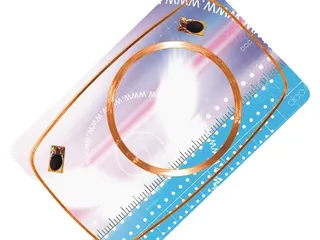
Read ranges are LEGIC's maximum figures for the chip. The range you see depends on the reader and on the antenna that fits the format, so a key fob or small tag reads at a shorter distance than an ID-1 card with the same chip.
Which LEGIC chips can you order?
| Chip | Generation | Interface | Memory | Typical order |
| ATC4096-MP311 | advant (current) | ISO/IEC 14443 A | 4,096 bytes, up to 127 applications | New advant installations with ISO 14443 A readers |
| ATC4096-MP313 | advant + MIFARE DESFire EV3 (current) | ISO/IEC 14443 A | advant 4,096 bytes + DESFire EV3 3,520 bytes | Sites running LEGIC and DESFire readers side by side, or moving between them |
| CTC4096-MM410 | Cross-technology (current) | ISO/IEC 14443 A, ISO/IEC 15693 and LEGIC RF | advant 2,984 bytes + prime 1,002 bytes | Step-by-step migration from prime to advant |
| ATC1024-MV110 | advant (listed as legacy by LEGIC) | ISO/IEC 15693 | 944 bytes, up to 59 applications | Repeat orders for installed ISO 15693 advant systems |
| ATC256-MV410 | advant (listed as legacy by LEGIC) | ISO/IEC 15693 | 224 bytes, up to 12 applications | Repeat orders for installed ISO 15693 advant systems |
| MIM1024-MN | prime (legacy) | LEGIC RF | 1,002 bytes, up to 127 segments | Repeat orders for prime systems |
| MIM256-MN | prime (legacy) | LEGIC RF | 234 bytes, up to 32 segments | Repeat orders for small prime systems |
Chip figures are taken from LEGIC's smartcard IC comparison. LEGIC publishes further variants, and availability of legacy parts changes over time, so the quotation names the exact part offered and its availability for your quantity. If your integrator names a chip that is not in this table, send the full designation and it is checked before any sample is made.
How does LEGIC security work, and can a LEGIC card be copied?
LEGIC controls who may write to a card through Master-Token System-Control (MTSC). Administrative rights are tied to physical master-token cards held by the system owner rather than to passwords or keys typed into software. The master token governs how the card is structured into segments (prime) or applications (advant), and which readers and encoding stations may create, read or change each one. The same hierarchy lets a canteen operator or locker supplier manage its own application on the staff badge without any access to the door application.
- Blank LEGIC cards are initialised under the system owner's authorisation, on an encoding station authorised with their master token or a delegated sub-master token, or through the LEGIC Key Service on chips that support it, such as ATC4096-MP313.
- Proud Tek does not copy working credentials. A replacement or additional card is a new blank card of the same chip type, enrolled through your system with its own chip serial number. On LEGIC advant, applications are protected with MTSC-managed authorisation and AES or 3DES, and LEGIC designs the system so that a card is not duplicated by reading and rewriting it. The proprietary security of legacy LEGIC prime was publicly shown to have weaknesses in 2009, which is one reason LEGIC recommends migrating to advant.
- A card supplier cannot load your access application without the system owner's authorisation, and Proud Tek does not offer to do so.
- What the supplier is responsible for: the correct chip, the card body, the print and visible numbering, each confirmed in the quotation. For enrolment, we list each numbered card's chip serial number (UID) next to the number printed on it, in an Excel, CSV or XML file.
This is different from MIFARE systems, where keys are typically loaded into readers or a SAM and a supplier can pre-encode cards when the key holder shares the keys. For the chip families that Proud Tek pre-encodes before shipping, see the RFID encoding service.
How do you migrate from LEGIC prime or to MIFARE DESFire?
Three common migration situations each have a different card answer. Agree the target system and the migration order with your integrator first, then order the card that bridges the old and new readers.
- LEGIC prime to LEGIC advant: CTC chips such as CTC4096-MM410 answer to prime and advant readers, so readers can be replaced area by area instead of all at once. LEGIC's CTC4096 flyer states that, once migration is complete, the LEGIC RF interface can be permanently disconnected if the system owner chooses to.
- LEGIC alongside or towards MIFARE DESFire: ATC4096-MP313 carries a LEGIC advant area and a DESFire EV3 area on one chip. If the target system will run on DESFire alone, compare MIFARE DESFire cards for the new credential.
- LEGIC plus a 125 kHz proximity credential: where older LF readers remain in service, a combi card with two separate chips in one card body is an option. Confirm the chip combination and how both readers behave with the combi card before ordering.
Many current LEGIC reader modules are multi-technology and can also be configured to read ISO/IEC 14443 A credentials such as MIFARE DESFire. Whether yours do depends on the reader model, firmware and system configuration, so confirm it with your system provider.
Which formats and materials are available for LEGIC chips?
| Format | Typical use | What to specify | Related page |
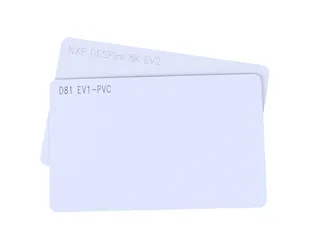
| ISO ID-1 card (85.60 × 53.98 mm); PVC as standard, PET-G or polycarbonate confirmed in the quotation | Staff badges, campus cards, hotel keys | Body material, finish, print, slot punch, magnetic stripe | Printed RFID cards |
| Wooden card | Hotel keys and badges for low-plastic programmes | Wood species, laser engraving or UV print, epoxy covering for water resistance | Wooden RFID card |
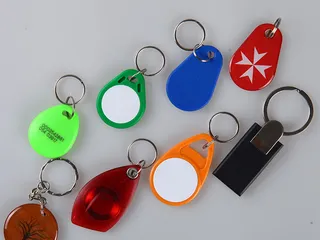
| Key fob | Residents, lockers, fleet and machine authorisation | Shell style, colour, logo; expect a shorter read range than a card | RFID key fob |
| Tag or sticker | Adding a LEGIC chip to an existing badge, phone case or equipment | Size, adhesive, whether it will be mounted on metal | Confirm size and mounting surface in the inquiry |
| Wristband | Pools, spas, fitness and ski resorts | Band style, sizing, water and chemical exposure | RFID silicone wristbands |
Availability of each format for the exact LEGIC chip is confirmed in the quotation. Because smaller formats carry smaller antennas, test samples of the final format on your installed readers before approving a batch.
What printing and personalisation can LEGIC cards have?
The options below are available on standard card bodies; which of them apply to your LEGIC chip, format and body material is confirmed in the quotation.
- Full-colour print on one or both sides, in gloss, matt or frosted finish, with your artwork and colour references.
- Visible numbering printed or engraved on the card.
- Magnetic stripe, signature panel and slot punch for lanyards or badge reels.
- Blank white cards for in-house photo printing on a direct-to-card or retransfer printer; state the printer model so the card surface can be matched.
- Wooden cards in cherry, sapele, bamboo, beech, birch, black walnut, basswood or maple, personalised by laser engraving, UV printing, hollow carving (see-through cut-outs) or die-cutting to a shape, with an epoxy covering for water resistance.
Which hotel locks use LEGIC key cards?
Some hotel lock systems offer LEGIC reader heads, particularly on installations in Germany, Switzerland and Austria. The RFID hotel key card guide maps the main lock brands to the card technologies they accept, including Häfele Dialock, whose terminals can be ordered with LEGIC (advant or prime) reader heads as an option alongside MIFARE; confirm the reader head and approved chip with your lock supplier. The lock decides the chip: check whether each door, furniture and locker terminal has a LEGIC or a MIFARE head, and which LEGIC chip the lock supplier approves, before ordering card stock.
Wooden LEGIC cards can be encoded for hotel locking systems whose locks accept the chip; encoding is done at the hotel's front-desk encoder under the lock system's authorisation. For MIFARE-based locks, see hotel key cards.
How do you check LEGIC compatibility before ordering?
- Get the exact chip designation from your integrator or the reader configuration sheet, for example ATC4096-MP311 rather than "LEGIC 4K".
- Check the reader generation and interface. Prime-only readers need prime or CTC chips. MP chips (ISO 14443 A) and MV chips (ISO 15693) are both advant, but a reader or site configuration may accept only one of them, so order the one your system is set up for.
- Confirm who holds the master token and who will initialise the cards, and that their encoding station is ready for the delivery date.
- Check the memory against the application plan, so that access, time recording, a canteen purse and locker applications all fit on the chosen chip.
- Test samples in the final format on the installed readers, particularly for key fobs, tags and wristbands.
What should you send for a LEGIC card quotation?
| Item | Why it matters |
| Exact chip type from your integrator | advant, CTC and prime chips are not interchangeable |
| Memory and application plan, and who owns it | Shows the chip size needed and who will initialise the cards |
| Format and material | Card, wooden card, key fob, tag or wristband; PVC as standard, other body materials confirmed in the quotation |
| Print and numbering | Artwork, sides, finish, numbering, magnetic stripe or slot punch |
| Delivery state and data | Whether a chip serial-number list is needed for enrolment |
| Quantity, schedule and destination | Needed to schedule the order and confirm freight for your destination |
| If the chip is unknown | Reader model, a photo of an existing card and any part number printed on it or on the last order |
Proud Tek replies within one business day and sends a quotation within one business day of a workable inquiry. MOQ, unit price and freight are confirmed in the quotation for your quantity and destination. Send the details through the contact page.
Samples, lead time and ordering
Standard product samples are free. Customised samples, such as your artwork or a special shape, carry a setup fee that is confirmed in the quotation. To evaluate card bodies, finishes and formats, request the sample pack. Standard products generally have a lead time of 2–3 weeks; for LEGIC cards the availability of the specified chip is confirmed in the quotation, and large orders are scheduled individually.
Our ISO 9001, ISO 14001 and ISO 45001 certificates are shown on the manufacturer page.
LEGIC, LEGIC prime and LEGIC advant are trademarks of LEGIC Identsystems AG. MIFARE and MIFARE DESFire are trademarks of NXP B.V. Häfele and Dialock are trademarks of their respective owners. Proud Tek is an independent card manufacturer and is not affiliated with or authorised by LEGIC or NXP.
Frequently asked questions
What is the difference between LEGIC prime and LEGIC advant?
LEGIC prime is the original generation, using the proprietary LEGIC RF interface and proprietary encryption; LEGIC now lists its prime chips as legacy. LEGIC advant is the current generation, built on ISO/IEC 14443 A or ISO/IEC 15693 with DES, 3DES or AES storage encryption and up to 4,096 bytes of memory. CTC chips answer to both, which is how sites migrate without replacing every reader at once.
Can you copy my existing LEGIC card?
No. Proud Tek does not copy credentials. A replacement is a new blank card of the same chip type, initialised under your system owner's master-token authorisation and enrolled through your system. On advant chips the applications are protected under that authorisation; the older LEGIC prime generation was publicly shown to have weak security in 2009, which is one reason LEGIC recommends migrating to advant.
Do LEGIC cards arrive programmed for my access control system?
Not by default. The cards are supplied uninitialised with the specified chip, print and numbering, and your system owner or integrator initialises them with their master token or a delegated sub-master token, or through the LEGIC Key Service on chips that support it, such as ATC4096-MP313. Confirm the delivery state in the quotation; numbered cards arrive with a list of chip serial numbers matched to the printed numbers, for enrolment.
Which LEGIC chip does my system use?
Ask your integrator or check the reader configuration sheet or the last card order, which normally names the chip, for example ATC4096-MP311, CTC4096-MM410 or MIM1024-MN. If only a working card is available, send the reader model, a photo of the card and any part number printed on it, and confirm the result with your integrator before ordering.
Can a LEGIC reader also read MIFARE DESFire cards?
Many current LEGIC reader modules are multi-technology and can be configured to read ISO/IEC 14443 A credentials such as MIFARE DESFire, but this depends on the reader model, firmware and system configuration. A DESFire-only reader cannot read the LEGIC application. The ATC4096-MP313 chip carries both a LEGIC advant area and a DESFire EV3 area for mixed sites.
Can a smartphone read a LEGIC card?
A phone with NFC may detect an advant card as an ISO 14443 A or ISO 15693 tag and show its serial number, but it cannot read the encrypted LEGIC application without the system's authorisation. A LEGIC prime card uses the proprietary LEGIC RF interface and is not detected by phone NFC at all. Phone-based access in LEGIC systems uses LEGIC's own mobile credential services, set up through the system owner.
Are LEGIC key fobs, stickers and wristbands available?
LEGIC chips can be requested in ID-1 cards and, depending on the chip, in wooden cards, key fobs, tags or stickers and silicone wristbands; whether your exact chip is available in the format you need is confirmed in the quotation. Smaller formats read at a shorter distance, so test samples on your installed readers first.
Is Proud Tek affiliated with LEGIC?
No. Proud Tek is an independent manufacturer of cards, fobs and tags built on the LEGIC chip your integrator specifies. System rights, master tokens, readers and application software come from LEGIC and your system integrator, and initialising the cards requires the system owner's authorisation; Proud Tek supplies them uninitialised unless otherwise agreed in the quotation.
Buyer guides
- How to Read an RFID Tag Quotation, Line by Line What decides RFID card and tag prices, and how to compare quotations line by line: unit-price basis, tooling, encoding, samples, freight and Incoterms.
- RFID RFP Template: Questions to Ask Every Supplier An RFID RFP template for distributors: the supplier questions that produce comparable quotes, and how to read the replies against one specification.
- RFID MOQ, Explained: How Minimums Form and How to Discuss Them How RFID MOQ forms from chip lots, inlay rolls, print sheets and setup — and how buyers can discuss a smaller pilot or first order honestly.
Ready to specify your order?
Send the product, quantity and application so we can confirm the options and pricing for your project.