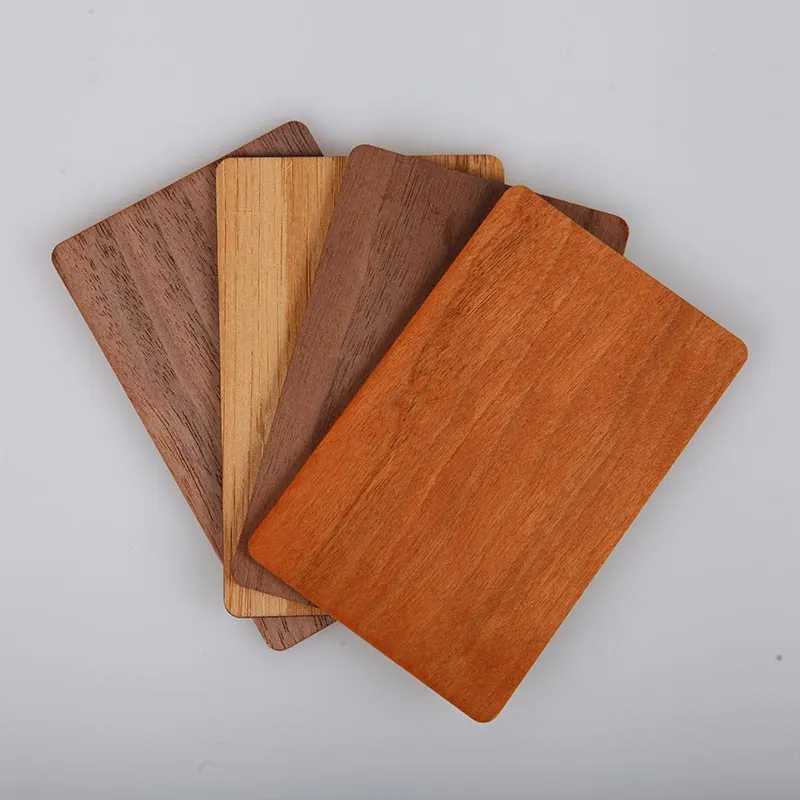
RFID Cards
Wooden RFID & NFC Card
Wooden RFID and NFC cards in eight wood species, with MIFARE, NTAG or ICODE chips for hotel keys, membership and tap-to-URL cards, and other chips on request. Match the chip to your lock or reader first, then choose the wood, engraving or UV print and finish, and test free standard samples.
Free standard samples · Quotation within one business day
Product details
What is a wooden RFID card?
A wooden RFID card is a contactless card with a real-wood body and an RFID or NFC chip and antenna laminated inside. It is chosen by hotels, membership programmes, event organisers and brands that want a card with a natural look and feel instead of printed PVC, and it carries the same chips as a plastic card. The selection rule is simple: the reader, lock or phone decides the chip, and the wood species and finish decide the look, so confirm the chip against your system first and choose the wood second.
Proud Tek produces wooden cards in its Shenzhen factory in eight wood species, with laser engraving, UV printing, hollow carving, die-cut shapes and an epoxy covering for water resistance, and supplies them blank, pre-initialised or encoded for hotel locks and NFC applications whose readers accept the chip. Standard samples are free, so you can test a card in your own lock or reader before placing an order.
Wooden RFID card specifications at a glance
| Item | Options | What to confirm |
| Wood species | Cherry, sapele, bamboo, beech, birch, black walnut, basswood, maple | Species and grain choice; natural colour varies from card to card |
| Card size | ID-1 card size (85.6 × 54 mm, the bank-card format), smaller formats, or a custom die-cut shape | Small format and custom shape sizes are confirmed per build; smaller shapes need a smaller antenna, which shortens read distance |
| Thickness | Typically thicker than a 0.76 mm PVC card: around 1.3 mm for a natural finish, slightly more with an epoxy covering | The exact thickness is confirmed per build; check encoder slots, dispensers and in-room switches |
| 13.56 MHz chips | Common: MIFARE Classic 1K, NTAG213, MIFARE Ultralight, ICODE SLIX. Other chips on request: NTAG215/216, MIFARE Plus, MIFARE DESFire EV2/EV3 | The exact chip your lock, reader or app accepts; availability of an on-request chip in a wooden build is confirmed in the quotation |
| 125 kHz chips | On request: EM4200, EM4305, T5577 for legacy proximity readers | The reader's LF format; availability in a wooden build is confirmed in the quotation |
| Personalisation | Laser engraving, UV printing, hollow carving, die-cutting, serial numbers, QR codes; gold or silver hot stamping on request | Artwork per side, variable data and proof approval; hot stamping availability is confirmed with the proof |
| Finish | Natural oiled or lacquered surface, or an epoxy covering for water resistance | Service conditions: dry wallet use, splashes, outdoor events |
| Encoding | Blank cards in the state your lock system expects, UID lists, NDEF URLs on NTAG, or encoding where the lock system and its data format allow it | Data format, keys and who performs the final encoding |
| Samples and lead time | Free standard samples; standard products generally 2–3 weeks | Customised samples carry a setup fee; custom-order schedules are confirmed in the quotation |
Which wood species should I choose for an RFID card?
All eight species carry the same chip inlay, so the choice is about appearance, how the surface takes engraving or print, and what suits your brand. Wood is a natural material: grain, knots and tone vary between cards and between batches, and that variation is part of the product rather than a defect. If your programme needs closely matched colour across thousands of cards, approve a sample batch before production.
| Wood | Look and tone | Where it suits |
| Cherry | Warm reddish-brown with a fine, even grain that deepens with age | Premium hotel keys, membership and gift cards |
| Sapele | Reddish-brown with a striped, mahogany-like figure | Luxury hospitality, executive business cards |
| Bamboo | Pale golden straw colour with fine linear grain; strictly a grass, pressed into laminated sheet | Resorts, events and programmes that want a pale natural-material look |
| Beech | Pale pinkish-cream with a fine, uniform grain | UV-printed logos and colour artwork on a calm background |
| Birch | Light cream with subtle grain | Full-colour UV printing and high-contrast engraving |
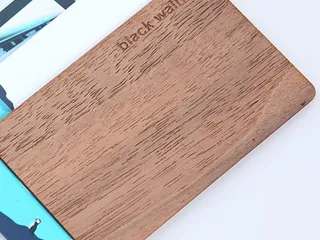
| Black walnut | Dark chocolate brown with strong grain | Premium, understated designs; engraving shows as a darker tone, so contrast is lower |
| Basswood | Very pale, soft and even-textured | Crisp engraving and printed artwork where the wood should stay in the background |
| Maple | Light cream with a tight grain | Clean corporate designs, fine text and QR codes |
Light species give the strongest engraving contrast and the most faithful UV colours; for small text or QR codes on dark wood, ask for a proof or consider white UV ink.
How is a wooden RFID card made?
A wooden card is a laminated build. Thin wood veneer faces are bonded on either side of a core layer that carries the chip and its antenna, then the sheet is pressed, cut to size and finished. Some builds use several wood layers with the inlay set between them. Because the chip and antenna sit inside, they are protected from handling and the wood surface stays free for engraving or print.
- Thickness: wooden cards are typically thicker than a 0.76 mm ISO/IEC 7810 ID-1 plastic card because the veneer needs strength; see the specification table above. Thinner builds may be possible for some species and are confirmed per build.
- Core material: the chip and antenna sit on an inlay carrier between the wood layers; the carrier material depends on the build and is stated in the quotation. If your programme requires a PVC-free card, say so in the inquiry and we confirm whether a PVC-free core is available for your species and chip before quoting.
- Antenna tuning: the antenna is sized for the card outline and the chip, and the build is checked on a reader. A dry wood body has little effect on 13.56 MHz or 125 kHz performance, so read distance follows the inlay antenna and the reader rather than the wood; cut-outs and small die-cut shapes reduce the antenna and the distance.
Which chip should a wooden RFID or NFC card use?
Choose the chip from the system that will read the card, not from the card material. The table covers the common choices; the individual product pages explain each chip in more detail. Chips other than MIFARE Classic 1K, NTAG213, MIFARE Ultralight and ICODE SLIX are supplied on request, and their availability in wood is confirmed per order.
| Use | Typical chip | Why |
| Tap-to-URL, digital business card, review link | NTAG213/215/216 | Most current phones (iPhone XS and later, and NFC-enabled Android phones with NFC switched on) open the stored link without an app; NTAG213 holds a typical web address |
| Hotel key cards on established lock systems | MIFARE Classic 1K or MIFARE Ultralight | Still accepted by a large installed base of locks; Classic security is publicly broken, so use it only where the lock requires it |
| Hotel keys and access on upgraded or new systems | MIFARE Plus (in Security Level 3) or MIFARE DESFire EV2/EV3 | AES-based security when the system runs the card in its AES mode and its firmware supports it |
| Legacy proximity access readers | EM4305, EM4200 or T5577 | 125 kHz formats read by older LF access readers |
| Library or ISO 15693 systems | ICODE SLIX | Longer-range vicinity reading on HF systems built for ISO/IEC 15693 |
Trademarked systems are a compatibility question, not a certification: we supply wooden cards for systems that accept the chip and format you specify, and the final check is with your system provider or lock vendor. If you are unsure which chip your readers use, send a working card from the site and we will check which chip family it reports where the card can be read, before quoting.
How can wooden RFID cards be personalised?
| Method | What it gives | Notes |
| Laser engraving | A permanent burned mark in the wood surface: logos, text, serial numbers, QR codes | Does not wear off; strongest contrast on light species |
| UV printing | Full-colour artwork printed directly onto the wood | The wood tone shows through light colours; a white underbase can be used where the design needs it |
| Hollow carving | See-through cut-outs of a logo or pattern | Cut-outs must stay clear of the antenna path, so the antenna layout is planned with the artwork |
| Die-cutting | Shapes other than a rectangle: rounded, key-tag, logo outlines | Smaller outlines reduce antenna area and read distance |
| Epoxy covering | A clear resin layer over the face | Adds water resistance for splashes and a glossy, wipe-clean surface; adds thickness |
| Hot stamping | Gold or silver foil for logos and text | On request for some builds and confirmed with the proof; suits smooth, even-grained species |
| Variable data | Individual numbers, names or QR codes per card | Engraved or printed and matched to the encoded chip UID or data where required |
Other options, such as a drilled hole for a lanyard or key ring or a HiCo or LoCo magnetic stripe for hotel systems that still use one, are available on some builds and confirmed with the proof. Send vector artwork (AI, PDF or SVG) for engraving and cutting; we return a digital proof showing the wood, the artwork position and any cut-outs before production.
Can wooden cards be used as hotel key cards?
Yes. Hotel key cards are one of the main uses for wooden cards. The lock decides the chip: a wooden card only opens the door if it carries the chip family and configuration your lock firmware accepts, exactly as a PVC card would. Our hotel key card guide explains how to identify the chip your locks use and compares wooden cards with PVC and paper keys.
- Send the lock details: lock brand, model and system version, plus a current guest card if you have one.
- Check the thickness: wooden cards are thicker than a 0.76 mm PVC card (see the specification table). Most front-desk encoders are flat pads and read them without trouble, but card dispensers, kiosk slots and in-room energy-saving switches can be designed around 0.76 mm cards. Test a sample in each device.
- Agree who encodes: wooden cards can be encoded for hotel locking systems whose locks accept the chip. Where the lock vendor issues cards through its own encoder at the front desk, we supply cards in the blank state the system expects.
- Test before ordering: encode a sample at your front desk and open a room with it before approving the order.
Because a wooden key costs more than printed PVC, decide up front whether it is a reusable key collected at checkout or a keepsake guests take home; that decision drives quantity and artwork.
Are wooden RFID cards waterproof and durable?
Wood absorbs moisture, so a natural-finish wooden card is made for dry, everyday use: wallets, key holders, desk and door use. It is not suitable for washing, soaking, dishwashers or saunas, and it should be kept away from prolonged heat and direct sun, which can dry and warp the veneer. Bending a thin wooden card can crack it along the grain.
Where cards will meet splashes, pool areas, rain at an outdoor event or frequent cleaning, specify the epoxy covering. It seals the face against splashes and allows the card to be wiped clean. It is a water-resistant finish rather than a rating for immersion; if a card will be worn in water, a silicone RFID wristband is the better format.
What is a wooden RFID card made of?
The card faces are natural wood veneer (bamboo is a grass pressed into sheet) in place of the printed plastic faces of a conventional card. The chip, the antenna and the carrier that holds them are not wood, so a finished wooden RFID card is not described as compostable, biodegradable or recyclable, and we make no forest-certification claim for the wood. Plan its end of life as a small electronic item.
- Material details: ask us to confirm the wood species, the finish and the inlay carrier material in the quotation. Tell us any environmental wording your programme plans to use and we will say whether it matches what we state for the material.
- PVC-free requirement: state it in your inquiry; whether a PVC-free core is available for the build is confirmed in the quotation.
- Other bodies: compare the eco RFID card page for PLA cards (a plastic body made from corn starch; the page explains what its composting statement covers) and the RFID paper card for high-volume, low-cost programmes.
Our quality and management-system certificates are shown on the manufacturer page; they certify our management systems and are not environmental claims about a card.
How do I order wooden RFID cards and samples?
Standard product samples are free, which lets you check the feel, the wood tone and the read performance in your own reader or lock; request them through the sample pack. Customised samples with your artwork, shape or encoding carry a setup fee, confirmed in the quotation. Each order is produced and inspected in our factory to the confirmed specification, so the quotation states the chip, wood, thickness, finish and packing exactly.
To get a comparable quotation quickly, include the following. We reply within one business day and send a quotation within one business day of a workable inquiry.
- Application and the reader, lock or phone that will read the card, with brand and model
- Chip, if known, or a sample card from the existing system
- Wood species, card size or shape, and any thickness limit
- Personalisation for each side, variable data and artwork files
- Finish (natural or epoxy) and extras such as a hole, hot stamping or magnetic stripe
- Encoding required: UID list, NDEF URL, or the card initialisation your lock system specifies, via our encoding service
- Quantity, destination and target delivery date
Standard products generally have a lead time of 2–3 weeks; customised wooden cards and large orders are scheduled individually, and the schedule, MOQ and freight for your destination are confirmed in the quotation. Cards are packed individually in OPP bags; box and carton quantities, or custom packing, are confirmed in the quotation. Send your inquiry to start with a sample or a quotation.
Plan the application
Frequently asked questions
Do wooden RFID cards work with hotel door locks?
Yes, provided the card carries the chip family and configuration your lock accepts. The wood does not change compatibility; the chip does. Send the lock brand, model and a current guest card, and test an encoded sample at your front desk and on a door before ordering.
Can an iPhone or Android phone read a wooden NFC card?
Yes, when the card uses an NFC Forum Type 2 chip such as NTAG213, NTAG215 or NTAG216 encoded with an NDEF record. Most current phones (iPhone XS and later, and NFC-enabled Android phones with NFC switched on) open the stored web address with a tap and no app. MIFARE Classic cards are not reliably readable on every phone, so choose NTAG for tap-to-URL uses.
Does the wood reduce the read range compared with a PVC card?
A dry wood body has little effect on 13.56 MHz or 125 kHz signals. Read distance depends mainly on the antenna, the chip and the reader, so a wooden ID-1 card reads at a distance comparable with a PVC card with the same chip and antenna inlay, typically a few centimetres on a lock, desktop reader or phone; long-range ISO 15693 readers read further. Cut-outs and small die-cut shapes reduce the antenna and the distance.
Are wooden RFID cards waterproof?
A natural-finish wooden card is for dry use and should not be washed or soaked. An epoxy covering seals the face and makes the card water-resistant and wipeable for splashes and outdoor events, but it is not rated for immersion. For wear in water, choose a silicone RFID wristband instead.
Is a wooden RFID card biodegradable?
The faces are natural wood, but the chip, the antenna and the carrier that holds them are not, so the finished card is not described as compostable or biodegradable; plan its disposal as a small electronic item. Ask us to confirm the materials of your build in the quotation.
Is a bamboo RFID card different from a wooden RFID card?
Bamboo is strictly a grass pressed into a laminated sheet, but a bamboo card carries the same chip inlay and is built, finished and encoded like the other wooden cards. Its pale golden surface gives good contrast for laser engraving and UV printing, and the same moisture guidance applies: natural finish for dry use, epoxy covering for splashes.
How thick is a wooden RFID card, and will it fit my encoder or dispenser?
Wooden cards are typically thicker than a 0.76 mm standard plastic card, around 1.3 mm with a natural finish and slightly more with an epoxy covering; the exact thickness is confirmed per build. Flat pad encoders usually read them without trouble, but test a sample in any slot-fed dispenser, kiosk or in-room power switch.
Can each wooden card have its own number, name or QR code?
Yes. Serial numbers, names and QR codes can be laser engraved or printed on each card and matched to the chip UID or to data encoded in the chip. You also get a list of every card's UID against the number engraved or printed on it, as an Excel, CSV or XML file, and any encoding is confirmed by a read-back of each wooden card before dispatch, with a data report in the delivery; the RFID encoding service has the details. Supply the variable data as a spreadsheet with the artwork, and approve a proof before production.
Buyer guides
- RFID Hotel Key Cards: Chips, Lock Compatibility and Encoding Buying RFID hotel key cards? Match the chip to your locks, understand who encodes the card, choose the body and print, and pilot samples before ordering.
- RFID Wooden Cards: Wood Types, Finishes and NFC Chip Options Buying wooden RFID or NFC cards? Compare wood and bamboo bodies, laser and print finishes, NFC chip options, and how to verify a sample before ordering.
- How to Read an RFID Tag Quotation, Line by Line What decides RFID card and tag prices, and how to compare quotations line by line: unit-price basis, tooling, encoding, samples, freight and Incoterms.
Ready to specify your order?
Send the product, quantity and application so we can confirm the options and pricing for your project.