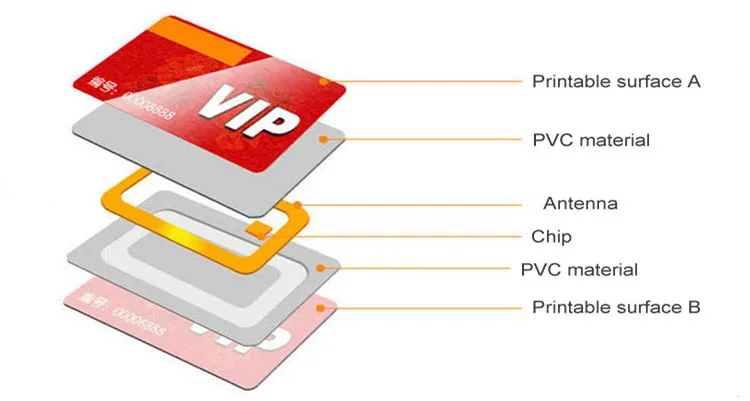
An RFID hotel key card is a passive contactless card that a door lock reads when a guest holds it close. It carries no battery: the lock’s reader powers the chip through a 13.56 MHz field over a few centimetres, following the ISO/IEC 14443 standard. What makes the card open a door is not the plastic but the data written into it, and that data is controlled by the lock system, not the card.
Because of that, the buying decision starts with the lock, not the card. Send Proud Tek the lock brand and model, a working sample card and your artwork, and confirm the chip before ordering. Browse hotel key cards or read the hotel key card solution guide for the full selection and testing sequence.
Table of Contents
How the card and the lock work together
At check-in, the front-desk encoder writes a room number, a valid stay window and an access profile (guest, housekeeping, maintenance) into the card’s memory. Those records are protected by keys that only the lock system holds. Most hotel locks are offline: they do not talk to a server, they trust what the card carries because it was written with the right keys, and they keep their own clock to enforce the stay window. Online locks add remote cancellation and an audit trail, but the card itself behaves the same way.
The memory layout and the keys are defined by the lock vendor. A card is only useful if its chip and configuration match what that vendor’s encoder expects, which is why every hotel key card question comes back to the installed lock.
Chip choices for hotel locks
Most hotel installations use one of a small set of NXP chip families. The table below summarises where each is used and where it stands on security. Confirm the exact part against your lock vendor’s accepted list before you order.
| Chip | Typical use | Security |
|---|---|---|
| MIFARE Classic 1K / 4K | Existing estates whose locks read only Classic | Crypto-1 cipher, publicly broken |
| MIFARE Plus | Migration from Classic on upgraded locks | AES-128 in security level 3 |
| MIFARE DESFire EV2/EV3 | New builds and security-relevant uses | AES-128, multiple applications |
| MIFARE Ultralight / Ultralight C | Disposable single-stay cards, cruise, conferences | Ultralight C adds 3DES |
| NTAG 213/216 | Guest-information and marketing NFC cards | Not usually accepted as a door credential |
Some older locks read 125 kHz low-frequency proximity credentials instead of 13.56 MHz. If your locks are that generation, confirm the exact low-frequency format with the lock vendor; a card that shares a frequency is not automatically the right credential.
MIFARE Classic’s Crypto-1 cipher was reverse-engineered in 2008, and attacks published since then, including a 2015 attack on the hardened MIFARE Classic EV1, recover its keys and let cards be cloned; the hotel key card solution guide sets out that history with its sources. Classic remains serviceable for an existing estate, but NXP marks MIFARE Classic EV1 as not recommended for new designs and, for security-relevant applications, refers customers to its MIFARE DESFire and MIFARE Plus families (NXP MIFARE Classic family page). In line with that guidance, specify MIFARE Plus (security level 3) or DESFire EV2/EV3 for a new build where the locks support them.
Migrating away from MIFARE Classic
You can move an estate off Classic without locking guests out, provided the order of work is right. Upgrade the lock firmware first so the readers accept both the old chip and the new one. Issue the new chip to arriving guests while cards already in circulation keep working through their stay. After a defined sunset window, disable Classic on the locks. Hold both card stocks during the transition, and agree in advance who owns the AES keys, because the lock vendor’s key management, not the card, is what makes the new chip secure.
MIFARE Plus is designed for this path: it can run in a Classic-compatible mode during the transition and switch to AES afterwards. DESFire is the cleaner end state where the locks support it.
Card body, print and encoding
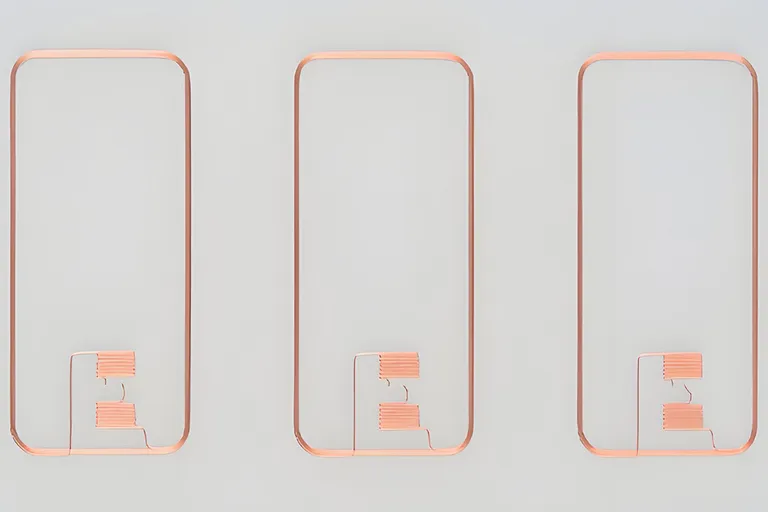
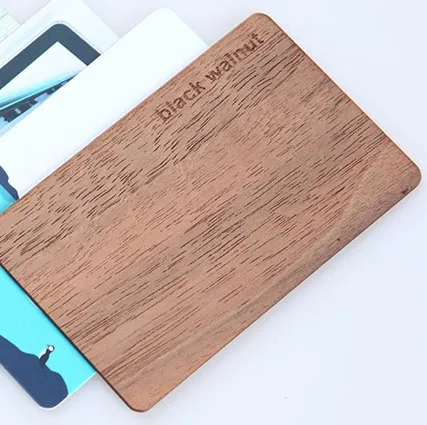
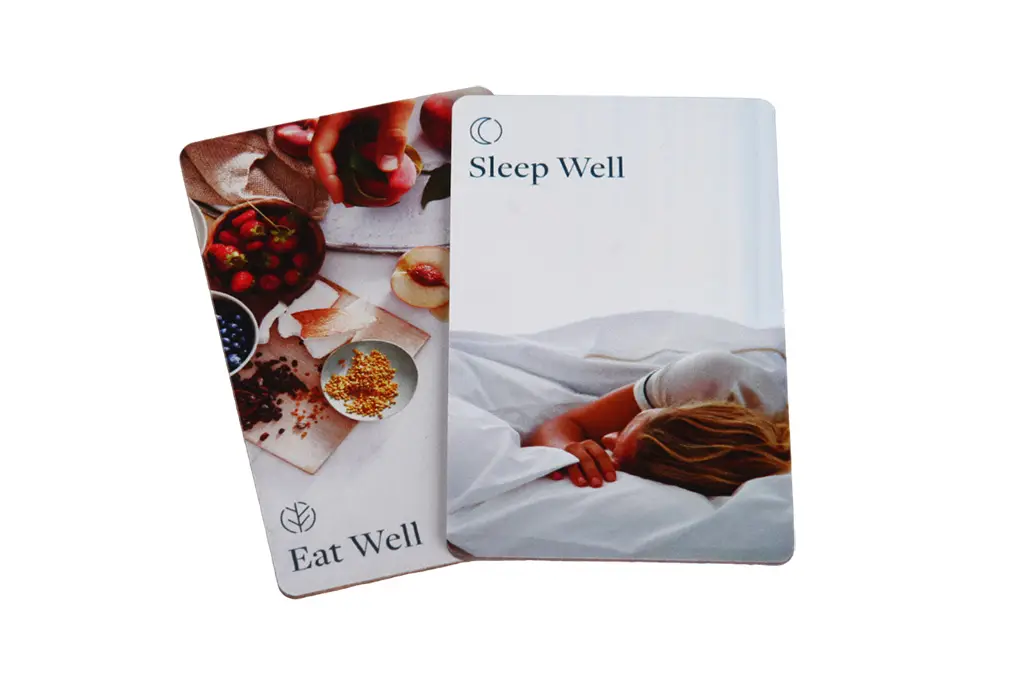
The card body has no effect on how the lock reads the card, as long as the antenna is tuned for the material. Standard cards are ISO/IEC 7810 ID-1 format (85.6 × 54 mm, 0.76 mm thick) in laminated PVC with full-colour print. Wooden and bamboo cards use a veneer over the inlay and can be printed or laser-engraved. For single-stay and event cards, a paper body replaces PVC. A PLA body is made from corn starch, while recycled-PVC cards, on the same page, keep a PVC body. In every body the chip and antenna are separate components, not paper, wood or PLA. A stripe-and-chip card carries one RFID chip and a magnetic stripe where a property still bridges two reader types; the hotel key card page covers the stripe options.
Whatever the body, a print run needs the same inputs: artwork in CMYK with bleed, any spot or metallic colours, whether a signature panel or numbering is required, and the encoder’s card-orientation requirement. For artwork options, see printed RFID cards.
Cards can be supplied blank or pre-encoded. Encoding to the property configuration is defined by the lock-system provider, and in most estates it happens on your own front-desk encoder with your own keys. Proud Tek supplies blank or pre-encoded cards to the integrator’s specification; confirm who is authorised to encode and exactly what data is required before the batch. Cards Proud Tek pre-encodes are read back one by one and delivered with a data report, and printed card numbers come with a list pairing each number with the card’s UID, supplied as Excel, CSV or XML (how encoding orders work).
How to order from Proud Tek
Proud Tek has manufactured RFID and NFC products in its Shenzhen factory since 2008 and makes the cards, not lock hardware or installation. To specify a hotel order:
- Send the lock model, a working sample card, your artwork and the quantity, and note any magnetic-stripe requirement.
- Proud Tek verifies the chip against your sample before quoting and confirms the card body, print and any pre-encoding.
- Request samples. Standard product samples are free; customised samples carry a setup fee. Pilot the samples on your own locks before approving the batch.
- Approve the batch. Standard products generally take 2–3 weeks; schedules for printed or large orders are confirmed individually. Pricing is by quotation against the confirmed specification.
Start a card enquiry through the inquiry form, or by email or WhatsApp, and keep the approved specification for reorders so repeat runs match the first. For the full chip-selection and migration detail, see the hotel key card solution guide.