SGTIN-96, SSCC-96, UHF labels and dock-door reads in brief
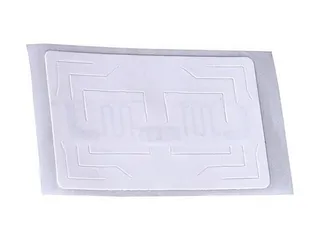
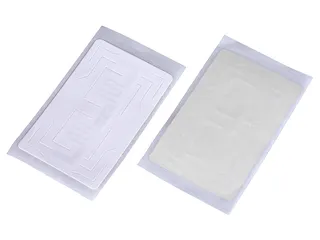
Give each consumer item an SGTIN-96, its GTIN plus a serial number, and each shipping carton or pallet an SSCC-96, both under your own GS1 company prefix. Carry the numbers on passive UHF (RAIN) tags: printed UHF RFID labels on cartons and pallets, blank label rolls for your own printer-encoders, or dry and wet UHF inlays for your converter. Read them at dock-door portals and pack-out conveyor tunnels, where each load is matched against its advance ship notice (ASN). Before equipping every door, pilot one lane with your hardest loads and prove complete carton counts, correct direction and ASN matches against figures agreed in advance.
Two free tools help: the GS1 EPC encoder builds and decodes SGTIN-96 values, so you can check a supplier's encoding before the first shipment, and the RFID inventory ROI calculator values the stock-counting side of the business case with your own figures.
What changes at each hand-over between sites
Between companies, goods move on paperwork: a purchase order, then an ASN that, under the GS1 Logistic Label Guideline (release 1.3), should list each logistic unit's Serial Shipping Container Code (SSCC) and the trade items inside it, sent when the goods are staged or loaded. The receiver scans the SSCC and either accepts the unit as the ASN describes it or opens it to check.
RFID adds a read at each hand-over between sites. Stock counts inside one site are a different job, covered in RFID inventory and asset tracking.
- Source: the tag is applied and encoded where the goods are made or packed, so each item or case has its serial before it ships.
- Pack-out: a conveyor tunnel reads the items in each carton and links them to the carton's SSCC; cartons are then linked to their pallet.
- Shipping dock: a portal confirms that the load leaving is the one on the order and the ASN.
- Carrier hand-over: reads at loading and unloading record when custody changed.
- Receiving dock: a portal checks the delivery against the ASN before put-away, so a short or wrong delivery is claimed before it disappears into stock.
- Returns and returnable assets: returned goods are identified on arrival, and totes, crates, kegs and pooled pallets are logged out and back by their GRAI, which GS1 describes as especially suitable for managing reusable transport items.
GS1 keys and filter values by packing level
Use GS1 keys so that one read means the same thing to your WMS, your carrier and your customer. GS1's EPC Tag Data Standard (TDS 2.3, October 2025) defines how each key is written to the tag's EPC memory, plus a 3-bit filter value that lets a reader select one kind of tag, such as the pallet tag among the item tags on the same load.
Encoding needs your own GS1 company prefix and a serial allocation plan, so that two factories or two label runs never issue the same number. The -96 schemes fit any chip with a 96-bit EPC; SGTIN-198 and GRAI-170 need a chip with more EPC memory, compared on UHF RFID inlays. We encode from your allocation, read back every encoded piece and ship each encoded order with a data report; for labels that also carry a printed number, a file in Excel, CSV or XML pairs each EPC with it (encoding service).
| Level | GS1 key | EPC scheme | Filter value (TDS section 10) |
|---|---|---|---|
| Consumer item | SGTIN: GTIN plus serial | SGTIN-96 (numeric serial without leading zeros, up to 274,877,906,943); SGTIN-198 (up to 20 alphanumeric characters) | 1, point-of-sale trade item |
| Standard case reordered under its own GTIN | SGTIN | SGTIN-96 | 2, full case for transport |
| Carton shipped as a logistic unit, mixed cartons included | SSCC | SSCC-96 | 2, full case for transport |
| Pallet or other unit load | SSCC; an SGTIN for a standard load with its own GTIN | SSCC-96 or SGTIN-96 | 6, unit load |
| Tote, crate, keg or pooled pallet | GRAI with its serial | GRAI-96 (numeric serial); GRAI-170 (up to 16 alphanumeric characters) | 0, all others (no other value is defined) |
| Dock door or other read location | Global Location Number (GLN) with extension: SGLN | SGLN-96 | 0, all others |
Tags for cartons, pallets and returnable containers
No single tag covers a whole chain. Carton and pallet labels must print and encode cheaply at volume; tags on returnable containers must survive washing, forklifts and years of reuse.
What sits inside the carton matters as much as the label. GS1 US's EPC placement guideline warns that metal, including foil and metallic inks, detunes a tag it touches, and that metal or liquid between tag and reader should be avoided; for such contents it says an accredited lab may be needed to confirm performance.
| Packing | Typical tag | What to check | From Proud Tek |
|---|---|---|---|
| Carton of dry goods | Printed UHF shipping label, with the SSCC also in the barcode | Same position on every carton, checked at the portal | UHF RFID labels |
| Carton of bottles, cans or foil packs | Label position or an offset tag, chosen by test on filled cartons | Contents between the tag and the portal antennas | UHF labels or custom tags |
| Pallet or unit load | UHF label at the pallet label position, or on the stretch wrap | Height and side facing the portal; wrap can tear | UHF RFID labels |
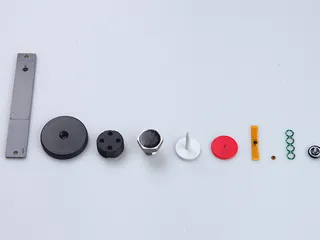
| Tote, crate, keg, drum or pooled pallet | Hard tag riveted, recessed or embedded; on-metal tag for kegs and drums | Wash temperature and chemicals, impact, forklift contact | Custom RFID tags |
| Truck, tractor or yard vehicle | Windshield label | Metallised or heated glass; the lane at the gate | Windshield tags |
| Metal trailer or container body | On-metal tag | Metal type, curvature and fixing | Custom RFID tags |
Reading at dock doors and conveyor tunnels
We manufacture the tags; readers and antennas come from reader manufacturers through your systems integrator, and we send sample tags for testing on the readers your integrator installs. The 2012 apparel study below describes pallets of cartons being read at receiving docks, shrink-wrappers and exit dock doors, and the items in each carton on conveyors once the pallet is broken down.
Direction matters as much as the read. GS1's EPCIS standard separates the read point (the doorway) from the business location (the room behind it), and notes that placing goods in the right location takes both a read at the doorway and the correct direction of movement (EPCIS 2.0, section 7.3.5).
| Read point | What it confirms | What to test in the pilot |
|---|---|---|
| Conveyor tunnel at pack-out | The items in each carton against the pick list, before shipping | Carton density and tag spacing at line speed |
| Pallet station or shrink-wrapper | The cartons on a pallet, linked to its SSCC | Cartons in the middle of the pallet |
| Shipping portal | The load against the order and the ASN | Direction; pallets that pass and come back |
| Receiving portal | The delivery against the ASN before put-away | Mixed pallets; stray reads from the next door |
| Yard or gate reader | Trailers and returnable assets entering and leaving | Vehicle speed and lane |
What published studies measured
The published results below come from apparel. A 2012 University of Arkansas working paper, now hosted by Auburn University's RFID Lab (summary, full paper), studied 17 supplier distribution centres (DCs) in the US, some of which audited a blanket 5 or 10 percent of inbound items by hand. At one supplier, two conveyor read points, each a single reader with three antennas around the belt, audited the item count of more than 99.99 percent of cartons, with up to 72 tagged items in a carton and the belt at up to about 400 feet per minute. On the same lines, RFID found up to an additional 4.8 percent pick-and-pack inaccuracy that manual audits had missed.
Project Zipper, a 2017–2018 study by the Auburn RFID Lab and GS1 US, measured order accuracy on shipments between brand and retailer DCs with and without RFID; its results are summarised in RFID vs barcode. Its test of the return suits any lane pilot: the cost of tags and read equipment against the cost of claims on that DC's shipments (GS1 US executive summary).
EPCIS 2.0: turning reads into events partners can use
A reader reports EPCs and timestamps; a trading partner needs to know what happened. GS1's EPCIS standard (release 2.0, 2022) turns reads into business events that record what (the EPCs), when, where (read point and business location), why (business step and disposition, such as shipping or receiving) and, new in 2.0, how: the condition of the goods, from sensor data. Release 2.0 also added a JSON and JSON-LD syntax alongside XML and REST bindings alongside SOAP, and it works with the Core Business Vocabulary, which names the steps. It defines five event types:
- ObjectEvent: objects were observed, or commissioned when their EPCs were first issued.
- AggregationEvent: cases were loaded onto a pallet or items packed into a case, or taken off or out again.
- TransactionEvent: EPCs were tied to a business transaction such as a purchase order or invoice.
- TransformationEvent: inputs were consumed and outputs produced, as when ingredients become a finished food product.
- AssociationEvent (new in 2.0): an object was associated with a parent object or a physical location, for links that outlast packing and unpacking.
Where regulations fit
Traceability rules shape many programmes; none of those below, as their sources summarise them, requires RFID. GS1 US summarises the US Drug Supply Chain Security Act as requiring a product identifier (a GTIN with the embedded National Drug Code, serial, lot and expiry) in a 2D barcode such as a GS1 DataMatrix, and interoperable electronic exchange of tracing data, for which it says the FDA recommends EPCIS (GS1 US on DSCSA). In the EU, the European Commission lists a unique identifier and an anti-tampering device on the outer packaging of medicines under Delegated Regulation (EU) 2016/161, applying from 9 February 2019 (European Commission).
The US FSMA Section 204 food traceability rule requires additional records for foods on the FDA's Food Traceability List: key data elements tied to critical tracking events, such as where the food is shipped, delivered or transformed. GS1 US adds that a location identifier such as a GLN is needed to tie the events to the data, that GS1 standards are one of the options the FDA outlines, and that the FDA announced its intention to extend the original deadline of 20 January 2026 into 2028 (GS1 US on FSMA 204). For products sold in the EU, the Digital Product Passport guide covers which data carriers the regulation allows.
An RFID tag that carries the same identifier as the printed code adds automatic capture to these programmes, and reads recorded as EPCIS events can feed the tracing records they ask for. Their dates have moved before, so confirm them with the regulator.
What a pilot must prove
Name the driver and the partners, fix the identifier scheme and the event vocabulary, then pilot one lane end to end: one source, one DC and one destination, with production-grade labels on your hardest products, before buying readers for every door. Agree the acceptance figures in writing first; the studies above show what can be measured, not what your loads will reach.
To value the result, weigh tag and reader costs against what shipment errors cost you in claims.
- Baseline: today's ASN discrepancies, the share of inbound cartons you audit, and what claims and chargebacks cost.
- Complete cartons: the share of cartons whose full item count is read at the tunnel, checked against a manual count of the same cartons.
- Right door, right direction: pallets read at their own door, moving the right way, with no stray reads of goods staged nearby.
- ASN match and events: each shipment reconciled against its ASN, and every expected event present, from commissioning and packing to shipping and receiving.
- Exceptions: how long a discrepancy takes to resolve, and who owns it.
- Freeze: the approved tag, chip, encoding, filter values and placement go into the purchase specification for every source.
What Proud Tek manufactures for supply-chain programmes
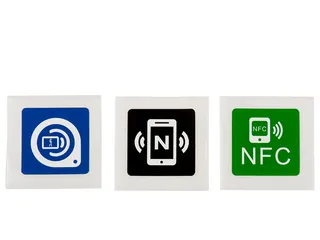
Proud Tek has manufactured RFID tags, labels and cards in its Shenzhen factory since 2008. For supply-chain programmes we produce UHF labels on paper or synthetic face stock, blank or printed with barcodes and text; dry and wet UHF inlays; rigid and on-metal custom tags for returnable containers, kegs, drums and trailer bodies; windshield labels for trucks and yard vehicles; and NFC labels where a phone check is part of the design. We do not supply UHF readers or portals.
Standard samples are free; printed, encoded or custom samples carry a setup fee, and we send them for testing at your own doors before production. Standard products generally have a 2–3 week lead time, while custom and large orders are scheduled in the quotation, sent within one business day of a workable enquiry.
Published 2026-09-09 · Updated 2026-09-28