RFID & NFC Labels
UHF RFID Inlays: Dry and Wet
Every UHF RFID label starts as an inlay: a RAIN RFID chip (NXP UCODE 9/9xe, Impinj M700/M800 series or Alien Higgs-9) bonded to an antenna on PET film, operating to ISO/IEC 18000-63 (EPC Gen2v2) in the 860–960 MHz band.
Dry and wet UHF RFID inlays for retail item-level and logistics labels, converters, card and tag makers, and system integrators, produced in Proud Tek's Shenzhen factory, where it has made RFID products since 2008. A dry inlay is the chip and antenna on a thin film with no adhesive, for lamination or your own conversion; a wet inlay is the same inlay on adhesive and a release liner, ready to convert or apply.
Specify the chip (NXP UCODE 9 or 9xe, Impinj M700 or M800 series, Alien Higgs-9), the antenna for your item and read region, and the roll format your line runs. Inlay size, roll format and defect handling are confirmed per order and checked on samples before a bulk run.
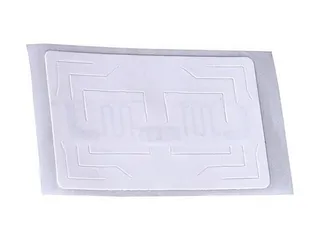
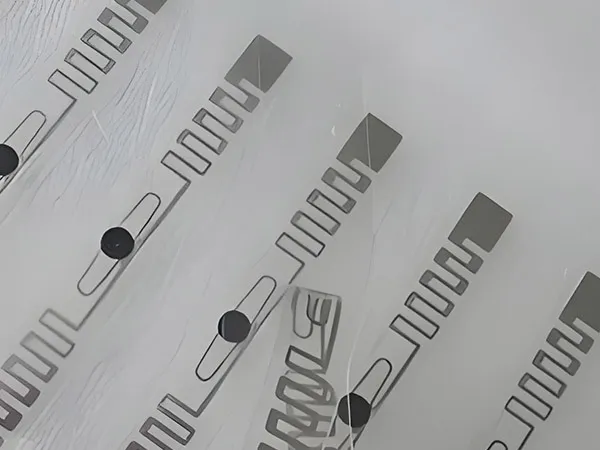
Photo: clear UHF labels, each showing its inlay antenna with the chip area at its centre. It does not show the inlay design for your order.
Free standard samples · Quotation within one business day
Product details
Dry or wet: which inlay format to order
Order a dry inlay when your own process laminates or embeds it: paper tickets, hangtags, PVC or PET cards, wristbands, or labels with your own adhesive. Order a wet inlay to convert into self-adhesive labels or to apply directly as a sticker. For printed labels, see UHF RFID labels.
| Format | What you receive | Typical next step | Specify |
| Dry inlay | Chip bonded to an antenna on a thin carrier film, no adhesive, on a roll | Lamination into cards, tickets or hangtags; embedding in tags or wristbands | Carrier, inlay outline, lamination process, pitch, rows across, core |
| Wet inlay | The same inlay on pressure-sensitive adhesive and a release liner, on a roll | Conversion into labels, or direct application to cartons or items | Adhesive, application surface and temperature, liner, pitch, core |
| Finished label | A wet inlay under a printable face stock, die-cut to size | Printing and encoding on your RFID printer, or delivered pre-printed and encoded | See UHF RFID labels |
A common construction is an etched aluminium antenna on PET film with the chip bonded at its feed point. The quotation states the carrier, antenna and outline of the inlay we offer.
Chip options and datasheet figures
Choose the chip by memory and features first, then compare sensitivity. Every chip below follows the GS1 EPC Gen2 air interface standard, harmonised with ISO/IEC 18000-63, so any Gen2 reader operating in the tag's band can inventory it. The chip changes memory, sensitivity and security features, not the reader.
| Chip | EPC memory | User memory | Read sensitivity (maker's data) | Worth knowing |
| NXP UCODE 9 | 96 bits | None | −24 dBm | NXP states UCODE 9 can re-use UCODE 8 inlay antenna designs (NXP) |
| NXP UCODE 9xe | 128 bits | None | −24 dBm | NXP's drop-in replacement for UCODE 9 with a larger EPC; access password hardwired to zero (NXP data sheet) |
| NXP UCODE Nxm | Up to 496 bits | Up to 752 bits | −24 dBm | 880 bits shared between EPC and user memory in three memory maps; NXP says it builds on UCODE 9xm (NXP) |
| Impinj M730 | 128 bits | None | −24 dBm | AutoTune V2; rated for 10,000 write cycles and 10-year retention |
| Impinj M750 | 96 bits | 32 bits | −24 dBm | As M730 but with a 96-bit EPC plus 32 bits of user memory |
| Impinj M775 | 128 bits | 32 bits | −24 dBm | Impinj Authenticity (Gen2X), which also needs a supporting reader and the Impinj Authentication Service |
| Impinj M780 | 496 bits | 128 bits | −23.5 dBm | Long EPCs such as SGTIN-198, plus user memory |
| Impinj M781 | 128 bits | 512 bits | −23.5 dBm | The largest user memory in the M700 series |
| Impinj M830 | 128 bits | None | −25.5 dBm | Impinj states it is drop-in compatible with M700 antenna designs |
| Impinj M850 | 96 bits | 32 bits | −25.5 dBm | As M830 but with a 96-bit EPC plus 32 bits of user memory |
| Alien Higgs-9 | 96 bits nominal, expandable to 496 | Up to 688 bits | Up to −20 dBm | 48-bit unique TID; 200,000 write cycles. EPC and user memory are configurable; confirm the split for your encoding |
Sources: NXP data sheets for UCODE 9 and UCODE 9xe, NXP's UCODE Nxm page, Impinj's M700 and M800 spec tables and Alien's Higgs-9 page. The UCODE 9 and 9xe data sheets and Alien quote sensitivity on a 2.15 dBi antenna; Impinj uses its own modelling and test data. A 1 dB gap on paper does not predict read range on your items.
Chips not to design in: NXP lists UCODE 8/8m as no longer manufactured and UCODE 9xm as end of life. If an existing specification names one, the quotation proposes a current chip with the memory you use (UCODE 9xe in place of UCODE 8; Impinj M750 or M850 in place of UCODE 8m; UCODE Nxm, Impinj M780 or M781 in place of UCODE 9xm), and samples are tested on your items before the switch.
NXP UCODE 9 in brief: a 96-bit EPC delivered pre-serialised, no user memory, a factory-locked 96-bit TID including a 48-bit unique serial number, read sensitivity −24 dBm and write sensitivity −22 dBm on a 2.15 dBi antenna, a 32-bit kill password and an access password hardwired to zero (NXP data sheet). The pre-serialised EPC copies the TID, so it is not a GS1 identifier.
Three memory details catch buyers who change chips. UCODE 9 and UCODE 9xe have no usable access password. Impinj lists the access and kill password as shared on every M700 and M800 chip; its M730/M750 datasheet explains that one 32-bit value serves both, so check how your encoding software sets them. And the TID, which records the chip maker and model, changes with the chip, so software that filters on TID values must be updated first. SGTIN-198 needs more than 128 bits of EPC memory (GS1 TDS), which points to M780, UCODE Nxm or Higgs-9.
Antenna design follows the application
The antenna matters as much as the chip. Each design is tuned for the material it sits on or near, so an inlay that reads well on a carton can read poorly on a bottle of water. We propose the antenna for your application and confirm its dimensions per order.
| Application | What the antenna has to cope with | Tell us |
| Item-level retail: hangtags, care labels, packaged goods | A small footprint, many tags close together, random orientation | Maximum inlay size, item material, how items are stacked or hung, retailer specification |
| Cartons and cases | Reading at distance on conveyors and dock doors, with contents affecting the signal | Carton contents, label position, how cartons pass the reader |
| On plastic | The plastic's type and thickness shift the tuning | Plastic type, wall thickness, placement area |
| Near liquids or moist goods | Water absorbs UHF energy and detunes the antenna | Liquid, container, fill level, placement; test on filled containers |
| Race bibs | Paper or Tyvek bibs worn on the body, which detunes a tag pressed against it; folding or piercing can break the tag | Bib material and how the bib printer adds the inlay; see RFID race timing |
| Directly on metal | A standard inlay does not read reliably on metal | Use a spacer construction or an on-metal tag; see custom RFID tags |
Chip features such as Impinj's AutoTune or NXP's Self-Adjust help at the margins but do not replace an antenna chosen for the item; test samples on the real item with the real reader.
Region tuning: ETSI, FCC or broadband
A UHF inlay antenna is tuned to the band where its tags will be read: 865–868 MHz in Europe under ETSI EN 302 208 and 902–928 MHz in the United States under 47 CFR 15.247. A broadband design covers both, with samples tested at each band. To find the band for another country, use our UHF RFID frequency lookup, which lists the bands and reader power limits GS1 gives for each country in its overview.
| Where tags are read | Band | Antenna choice |
| Europe | 865–868 MHz (ETSI EN 302 208) | EU-tuned or broadband design |
| United States | 902–928 MHz (FCC Part 15) | US-tuned or broadband design |
| Goods read in both regions | Both bands | Broadband design; test samples on each band |
| Other countries | National allocation | Name the country; we confirm the tuning before sampling |
NXP describes UCODE 9 and UCODE 9xe as broadband chips for global labels; performance in each band still depends on the inlay antenna.
Roll format, confirmed per order
Roll format must match your press, laminator or printer, so it is confirmed per order. Send your line's requirements or a sample roll of your current inlay.
| Parameter | What to specify |
| Pitch | Distance from one inlay to the next along the web |
| Rows across | Number of inlays across the web, and the web width |
| Core and roll size | Core inner diameter, and maximum outer diameter or inlays per roll |
| Winding | Inlay position and orientation on the web, and wind direction |
| Adhesive and liner (wet inlays) | Permanent or removable adhesive, application surface and temperature, liner type |
| Encoding | As delivered (some chips arrive with a factory pre-serialised EPC, which is not your GS1 identifier), or encoded to your EPC scheme |
| Packing | Roll labelling, packing and any traceability data per roll |
For encoded inlays we write the EPC from your list through the RFID encoding service, following the GS1 EPC Tag Data Standard, for example SGTIN-96; locking and passwords depend on the chip. Our GS1 EPC encoder and decoder builds SGTIN-96 values from a GTIN and serial range, or decodes an EPC you already have, before you send the list.
Inlay testing and defect handling
Inlays are tested before dispatch by the method agreed for your order, and inlays that fail are marked or removed as agreed. Encoded inlays are also verified one by one by reading them back after encoding, and a data report in Excel, CSV or XML goes out with every encoded order. Settle the details before the first run:
- Test: a read or read-and-write check, and whether blank inlays are tested one by one or by sample.
- Defects: how a failed inlay is marked, or whether it is removed and replaced, and whether splices are acceptable.
- Tolerance: the defective inlays per roll your line can accept; the quotation states what we commit to.
- Records: the fields the data report carries for encoded inlays, such as each inlay's TID and EPC.
Switching inlay suppliers
Qualify a new inlay in your application before it replaces the current one: match the chip and memory map first, then compare reads on your items with your readers.
- Describe the current inlay: chip, antenna footprint, pitch, roll format and any retailer specification it was approved against.
- Check your software: EPC length, user memory, passwords, locking and any rule that filters on TID values.
- Keep serials unique: if both suppliers deliver encoded inlays, give the new one a non-overlapping serial range under the same EPC scheme.
- Run qualification samples side by side with the current inlay on the same items, reader, antennas, power settings and tag positions, recording reads and misses.
- Run a converting trial on your line: pitch registration, die-cutting, lamination and encoding yield.
- Check retailer approval. Auburn University's RFID Lab publishes ARC approved inlay lists by the specification your retailer names. Approval belongs to a specific inlay model on the list for that spec; a similar test result does not count. Name the spec in your RFQ: before sampling we tell you whether the inlay we offer is on the approved list for that spec, and the quotation names the inlay model so you can check the current list. Where the spec calls for an approved inlay that is not ours, we can convert that ARC-approved inlay into your labels or hang tags.
- Approve a reference: keep the approved sample and specification sheet; reorders are produced against them.
Ordering checklist: what to send for a quote
Send what you know; anything missing is resolved before sampling. We reply with a quotation within one business day of a workable enquiry.
- Format: dry inlay, wet inlay or finished labels.
- Chip: a named chip, or the memory and features you need.
- Application: the item, its material and contents, where the inlay goes and the maximum inlay size.
- Region: the countries where tags are read, and your reader make and model if known.
- Roll format: pitch, rows across, core, roll size and winding, or a sample of your current roll.
- Your process (dry inlays): lamination or embedding method (hot or cold, temperature and pressure if known), finished product, die-cut tolerance and any registration or sensor mark your line needs.
- Adhesive (wet inlays): surface, application temperature, permanent or removable.
- Encoding: as delivered, or encoded to your EPC scheme. Never send password values in an enquiry.
- Quantities and delivery: sample, first order and annual volume, destination and target date.
What we confirm per order
The quotation or the approved sample fixes these points for each order; nothing is assumed from a catalogue.
| Item | Confirmed in the quotation or at sample approval |
| Chip | Maker and model for the batch |
| Antenna and inlay | Antenna design, inlay dimensions and carrier material |
| Adhesive and liner | Adhesive type and liner for wet inlays |
| Storage | Adhesive shelf life and storage conditions for wet inlays |
| Roll format | Pitch, rows across, core, roll size and winding |
| Testing | Test method, how failed inlays are marked or removed, tolerance per roll |
| Encoding and data | EPC content, locking and the data-report fields |
| Samples and lead time | Standard samples are free; a new antenna or inlay design is a custom sample with a setup fee. Standard products generally have a 2–3 week lead time; custom designs and large orders are scheduled individually. |
What Proud Tek makes, and what it does not supply
Proud Tek produces dry and wet UHF inlays, UHF RFID labels and custom RFID tags in its Shenzhen factory, and encodes them to order. We do not supply UHF fixed or handheld readers, reader antennas, RFID printers or encoders, race-timing systems, BLE beacons, or software and WMS integration; our reader range contains no UHF readers. For the wider programme, see RFID inventory tracking, RFID for retail and apparel and RFID supply chain management.
Plan the application
Frequently asked questions
Do you manufacture UHF inlays yourselves?
Yes. Proud Tek produces dry and wet UHF inlays in its own Shenzhen factory, where it has made RFID products since 2008, and converts them into UHF RFID labels and custom RFID tags. The chips come from their makers (NXP, Impinj, Alien); the chip, antenna, inlay size and roll format for your order are confirmed in the quotation and checked on samples.
What is the difference between a dry and a wet UHF inlay?
A dry inlay is the chip and antenna on a carrier film with no adhesive; the next process laminates or embeds it, for example into a card, ticket, hangtag or wristband. A wet inlay is the same inlay on a pressure-sensitive adhesive and release liner, so it can be converted into labels or applied directly. Neither has a printable face; for printed labels see UHF RFID labels.
Which chip should I choose for retail item-level tagging?
If your retailer or brand programme names a specification, start there. Otherwise, item-level retail usually needs only an EPC, which chips without user memory such as NXP UCODE 9 and Impinj M730 or M830 provide. Choose a chip with user memory, such as Impinj M750 or M850, only if your system writes data beyond the EPC. Decide on tests of the finished inlay on your items, not on sensitivity figures alone.
Are your inlays ARC-approved?
ARC approval belongs to a specific inlay model under a specific spec, and Proud Tek makes no ARC-listing claim for its own inlays. If your retailer requires an ARC-approved inlay, name the spec in your RFQ; we can also convert an ARC-approved inlay for that spec into your labels or hang tags. Before sampling we tell you whether the inlay we offer is on the ARC approved inlay list for that spec, and the quotation names the inlay model so you can check the current list before you sample or order.
Can one inlay work in both Europe and the United States?
Yes, if its antenna is designed for broadband use. Europe's main RFID band is 865–868 MHz and the United States uses 902–928 MHz; a broadband antenna covers both, while a region-tuned antenna is optimised for one. Tell us every country where the tags will be read, and test samples at each band your readers use.
Will a UHF inlay work on metal or on bottles of liquid?
Not with a standard design. An inlay placed directly on metal does not read reliably, and water absorbs UHF energy, so an inlay on a filled container needs an antenna designed for it and a position tested on the filled item. For metal, use a spacer construction or an on-metal tag from our custom RFID tags range.
Can you encode the inlays before delivery?
Yes. We write the EPC from your list, for example in a GS1 scheme such as SGTIN-96, and lock memory or set passwords where the chip supports them; UCODE 9, for example, has no usable access password. Every encoded inlay is read back, and the order's data report can list each TID and EPC. See the RFID encoding service, and never send password values in an enquiry.
What read range will the inlay achieve?
We do not publish a read range, because it depends on the reader, reader antenna and power, the regional band, the item material, the tag position and the inlay antenna together. Chip makers measure sensitivity under their own conditions. The reliable answer comes from testing samples on your items with your readers before a bulk order; UHF readers themselves come from your integrator or reader vendor, not from us.
Buyer guides
- RFID Data Encoding and Memory Structures RFID memory and data encoding explained: UID versus user memory, chip capacities from EM4305 to DESFire and UHF EPC banks, NDEF, and encoding control.
- How to Read an RFID Tag Quotation, Line by Line What decides RFID card and tag prices, and how to compare quotations line by line: unit-price basis, tooling, encoding, samples, freight and Incoterms.
- RFID RFP Template: Questions to Ask Every Supplier An RFID RFP template for distributors: the supplier questions that produce comparable quotes, and how to read the replies against one specification.
Ready to specify your order?
Send the product, quantity and application so we can confirm the options and pricing for your project.