RFID & NFC Labels
UHF RFID Labels
A UHF RFID label is a converted inlay — RAIN RFID chip and antenna — laminated under a printable paper or synthetic face and supplied on rolls for print-and-encode workflows.
UHF RFID labels made in Proud Tek's Shenzhen factory: print-and-encode rolls with a UHF inlay under a paper or synthetic face, for retail item tagging, apparel tickets and hang tags, cartons, pallets and fixed assets. We produce the inlays and convert them into finished labels ourselves.
Choose the chip (NXP UCODE, Impinj M700/M800 or Alien Higgs-9), the face stock, adhesive and roll format for your printer, and whether we encode the EPC to your data plan. The inlay, label size and any ratings are confirmed per order and tested on samples before the bulk run.
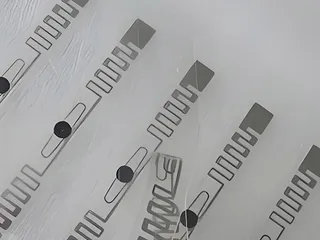
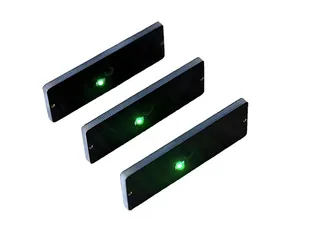
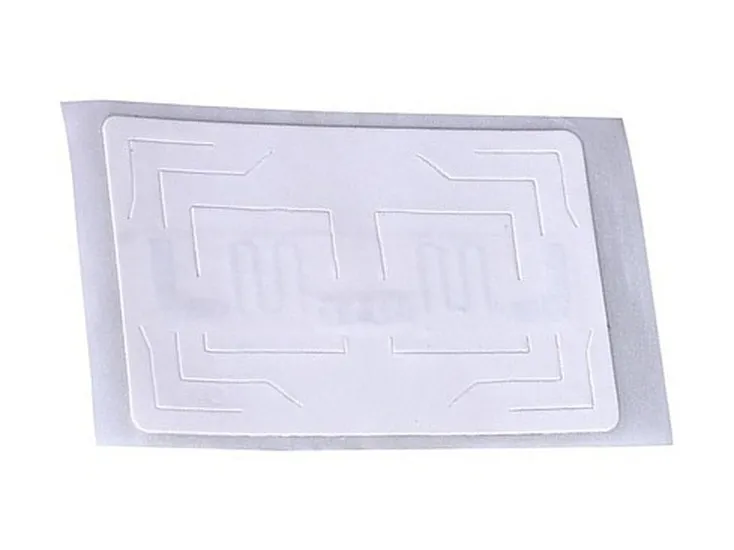
Photos: a UHF label with the inlay antenna visible through the face, and a slim UHF label with an LED. They show label types, not the design quoted for your order.
Free standard samples · Quotation within one business day
Product details
What a UHF RFID label is
A UHF RFID label, also called a RAIN RFID label, is a self-adhesive label with a passive UHF inlay (a chip bonded to a thin antenna, typically etched aluminium) under a printable face. A UHF reader identifies it without line of sight and reads many labels in one pass, which is why retailers and logistics operators tag items, cartons and pallets with UHF; NFC labels are made for short-range taps by a phone.
The chips follow the GS1 EPC Gen2 air interface, also known as ISO/IEC 18000-63 (GS1 TDS section 9.2); RAIN is the RAIN Alliance's name for passive UHF RFID on that standard (RAIN Alliance FAQ). Any Gen2 reader reads a Gen2 label whatever the chip brand; the chip changes memory, sensitivity and security features.
Proud Tek produces both the inlays and the finished labels in its Shenzhen factory, where it has made RFID products since 2008. A dry inlay is the chip and antenna on a thin carrier film, usually PET, with no adhesive; a wet inlay adds adhesive and a release liner; a label adds a printable face and is die-cut on a roll. Inlays alone are on the UHF RFID inlay page, and rigid constructions are under custom RFID tags.
Label formats we produce
We produce blank rolls, retail price labels, hang tags, shipping, carton and pallet labels, asset labels and race bib labels; on-metal and specialty variants are made per request. The quotation states whether your label is standard (free samples, standard 2–3 week lead time) or customised (sample setup fee, lead time stated in the quotation).
Blank UHF labels for RFID printers
Blank UHF labels are wound for an RFID printer that prints and encodes each label on site. Choose a direct thermal or thermal transfer face (see below) and send the printer model, so the inlay sits where it encodes.
Retail price labels, tickets and apparel hang tags
An RFID retail price label is a ticket or sticker with an inlay under the printed face, for item-level inventory on packaged goods. An RFID hang tag is a card or synthetic ticket with the inlay laminated inside, printed to your artwork. Under GS1-based retail programmes both carry an SGTIN, a serialised GTIN. Tell us the artwork, stock, attachment and your retailer's Spec; see RFID for retail and apparel.
RFID shipping, carton and pallet labels
An RFID shipping label adds a UHF inlay to the shipping label, so a carton is read at the dock door and can still be scanned by barcode where there is no reader. The SSCC in a GS1-128 barcode is the one mandatory element of a GS1 logistic label (GS1 Logistic Label Guideline), and the inlay can carry the same SSCC as SSCC-96. Use SSCC-96 for a logistic unit such as a pallet, or SGTIN-96 when the carton is a trade item with its own GTIN, as your programme specifies.
UHF asset labels
A UHF asset label identifies IT equipment, furniture, tools or other fixed assets for audits and check-out. Choose a synthetic face such as PET for durability, tamper-evident construction if needed, and GIAI-96 encoding or your own numbering. For metal assets, see the on-metal note below and RFID tool tracking.
Race bib labels
A race bib label is a UHF label stuck to or built into a race bib, often on a foam spacer. Tell us the timing system's chip and encoding requirements and the bib material, and test samples on the timing provider's readers; the timing system comes from your provider (RFID race timing).
On-metal and specialty labels
A standard UHF label on metal or on a liquid-filled container reads poorly or not at all: metal detunes the antenna and reflects the field, and water-based contents absorb UHF energy. On-metal variants typically use a spacer construction and are made per request once we know the item. See also the RFID tag with LED light and RFID windshield tag.
Chip options by label use
Most retail and logistics labels need only an EPC and the factory TID, so an EPC-only chip is often enough. Full datasheet figures and sources for UCODE 9, UCODE 9xe, UCODE Nxm, the Impinj M700 and M800 chips and Higgs-9, and notes on discontinued chips, are on the UHF RFID inlay page.
| Label use | Chips to consider | Memory, from the makers' data |
| EPC-only item, carton and pallet labels | NXP UCODE 9 or UCODE 9xe; Impinj M730 or M830 | EPC 96 bits (UCODE 9) or 128 bits (UCODE 9xe, M730, M830); no user memory |
| A small user memory | Impinj M750 or M850 | EPC 96 bits; user 32 bits |
| Maintenance, batch or configuration data on the label | Impinj M781; NXP UCODE Nxm; Alien Higgs-9 | User 512 bits (M781); up to 752 bits (UCODE Nxm, by memory map); up to 688 bits (Higgs-9) |
| SGTIN-198 (198 bits) or SGTIN+ (up to 216 bits) | Impinj M780; NXP UCODE Nxm; Alien Higgs-9 | EPC 496 bits (M780); up to 496 bits (UCODE Nxm, by memory map); expandable to 496 bits (Higgs-9) |
Impinj M780 has a 496-bit EPC and 128-bit user memory, and M781 a 128-bit EPC and 512-bit user memory (Impinj); NXP UCODE Nxm shares 880 bits between EPC and user memory in three memory maps (NXP UCODE Nxm). NXP lists UCODE 8/8m as no longer manufactured and UCODE 9xm as end of life, so neither is recommended for a new label design; if your existing specification names one, the quotation proposes a current chip and samples are tested before the switch. For password-protected locking, Higgs-9 has a 32-bit access password, while UCODE 9 and UCODE 9xe have none that can be used; for Impinj chips the quotation confirms it from the datasheet. Read range depends on the inlay antenna, item, reader and band, so we publish none per chip.
Retailer RFID programmes and ARC inlay approval
A retailer's RFID playbook may specify acceptable inlays. Under the ARC program, run by the Auburn University RFID Lab since 2009, the end user works with the lab to define a performance Spec (named with a code such as Spec W5), and ARC lists the inlays approved for it (ARC program, approved inlay lists). Approval belongs to a specific inlay model, not to a label factory, and this page claims no ARC listing for any Proud Tek inlay. We can convert an ARC-approved inlay for your Spec into labels and hang tags. Send us your Spec: the quotation names the inlay, how it is sourced and whether it is listed; an unlisted inlay should not be used where the playbook requires an approved one. Auburn's separate ARC Quality Certification audits inlay manufacturers; check whether your playbook asks for it.
EPC, TID and user memory explained
A Gen2 chip has four memory banks (GS1 EPC Tag Data Standard, section 9.2). Your system mostly reads the EPC; the TID identifies the chip itself.
| Bank | Contents | Who writes it |
| Reserved (00) | Kill and access passwords, where the chip supports them | Set at encoding if used; never send password values in an enquiry |
| EPC (01) | The code your readers report during inventory | Us or your RFID printer, to your data plan |
| TID (10) | Chip maker and model; on UCODE 9, UCODE 9xe and Higgs-9, a factory-locked 48-bit serial number | Locked when the chip is made |
| User (11) | Optional extra data, on chips that have it | Your application, or us as agreed |
Encoding to your data plan
We deliver labels blank, or encoded to your data plan through our RFID encoding service, with scheme and lock state confirmed per order. Every label we encode is read back, and each encoded order ships with a data report. Retail and logistics programmes usually follow the GS1 EPC Tag Data Standard, currently release 2.3 of October 2025 (GS1 TDS), which keeps the schemes of TDS 1.13 and adds newer ones.
- SGTIN-96 encodes a GTIN and a serial number in 96 bits for item-level tagging. The serial must be numeric, without leading zeros, and no higher than 274,877,906,943; any other serial needs SGTIN-198 or a TDS 2.x scheme such as SGTIN+ (variable length, up to 216 bits) (GS1 TDS, table 12-2).
- SSCC-96 encodes the Serial Shipping Container Code (SSCC) that identifies a logistic unit such as a carton or pallet.
- GIAI-96 encodes a Global Individual Asset Identifier for one specific asset, such as a computer, a vehicle or a piece of transport equipment.
GS1 encodings (SGTIN, SSCC, GIAI) need your own GS1 Company Prefix and a serial allocation, so two runs never issue the same number; a closed-loop system can use its own numbering. To see what a GTIN and serial become in SGTIN-96, or to check a list before you send it, use our GS1 EPC encoder and decoder. For encoded labels that carry a printed barcode or serial, a file in Excel, CSV or XML delivered with the order maps each label's EPC, and its TID if your system uses it, to that barcode or serial.
Face stock, adhesive and roll format
Choose the face by how long the print must last. Direct thermal paper darkens under the printhead without a ribbon and is sensitive to heat and light, so it suits short-life labels such as shipping labels; thermal transfer melts a ribbon onto the face and, with a matched face and ribbon, gives a longer-lasting print that resists moisture and rubbing (Zebra). For asset and long-life labels, use thermal transfer, on PET or another synthetic face where moisture, abrasion or chemicals are expected. We publish no temperature or durability ratings; test samples in your conditions.
| Item | Options | What we need from you |
| Face stock | Coated, direct thermal or thermal transfer paper; PET or another synthetic face | How long the print must last, and its exposure |
| Blank, or pre-printed with logo, colours, barcode and human-readable serial | Artwork and the data that must match the EPC | |
| Adhesive | Permanent, removable or freezer-grade | The surface, and the temperatures at application and in use |
| Roll format | Liner, core, roll diameter, labels per roll, wind direction | Printer or applicator make and model |
| Inlay position | Set for the printer's encoding position | Printer model; confirmed on samples in your roll format |
Regions, surfaces and read performance
UHF bands differ by region. The 2021 edition of ISO/IEC 18000-63 is titled for 860–960 MHz, and ISO lists a newer edition under development; GS1's current Gen2 release (3.0.1, February 2026) specifies 860–930 MHz (GS1 Gen2 standard). Each region allows only a narrower band inside these ranges. Europe uses 865–868 MHz under ETSI EN 302 208, which also covers 915–921 MHz where implemented; the United States uses 902–928 MHz under 47 CFR 15.247. For other countries, our UHF RFID frequency lookup lists the bands and reader power limits GS1 gives for each country in its overview.
An inlay antenna is tuned for a band and for the material behind it. Tell us every region and surface; we match the inlay, and your integrator's test with your readers qualifies it for rollout.
What we confirm per order
| Item | Confirmed in the quotation or at sample approval |
| Chip | Maker and model, as named in the quotation |
| Inlay and label | Inlay, antenna size, label size and construction |
| Materials | Face stock, adhesive, liner, core and roll format for your printer |
| Encoding | EPC scheme, lock state and the data-report fields (EPC, TID, printed number) |
| Non-reading labels | How any non-reading label in a roll is marked or removed |
| Samples | Standard samples are free; customised samples carry a setup fee. The quotation states which applies to yours |
| Lead time | Standard products generally 2–3 weeks; customised and large orders confirmed individually |
Ordering checklist: what to send for a quote
- Application and item: what the label goes on (carton, garment, plastic packaging, metal asset, race bib) and where it is read.
- Equipment: RFID printer make and model if you encode in-house; reader make and model and the regions of use.
- Chip: a preferred chip, or the ARC Spec or other inlay requirement from your retailer's playbook.
- Label: size, face stock, adhesive, blank or pre-printed, artwork.
- Encoding: EPC scheme (for example SGTIN-96, SSCC-96 or GIAI-96), GS1 Company Prefix and serial range, locking requirements. Do not include password values.
- Roll format: core, roll diameter, labels per roll, wind direction.
- Order: sample needs, quantity, destination country and target date.
Unknown details are resolved before sampling; a workable enquiry receives a quotation within one business day. Use this page's quote or sample buttons, which pass the product to the form, or the contact page.
What Proud Tek does not supply
We produce UHF labels, inlays and tags. We do not supply UHF fixed or handheld readers, reader antennas, UHF RFID printers or printer-encoders, middleware, WMS or ERP integration, race-timing systems or BLE beacons. The only readers we sell are on the RFID readers page, and none of them reads UHF. We send samples for your integrator's tests.
For project planning, see RFID inventory tracking, RFID supply chain management and RFID vs barcode. Other UHF products include the UHF wristband and textile RFID laundry tags.
Plan the application
Frequently asked questions
Do you make UHF RFID labels yourselves?
Yes. Proud Tek produces UHF inlays, dry and wet, and converts them into printed and encoded labels in its Shenzhen factory, where it has made RFID products since 2008. The chip and inlay for your order are named in the quotation; the chip options on this page are from NXP, Impinj and Alien. Dry and wet inlays are also sold on their own: see UHF RFID inlays.
What decides the price and minimum order of a UHF label?
The chip, the inlay and label size, the face stock and adhesive, the print colours, any variable printing and encoding, the roll format and the quantity. We do not publish a price list or a fixed minimum order; both are stated in the quotation for your specification, which a workable enquiry receives within one business day. Sending the ordering checklist above gets the most accurate figure.
Can you match the UHF label we buy now?
Send the current specification sheet or a sample label: chip, size, face stock, adhesive, roll format and any retailer Spec it was approved against, and we quote a label built to that specification. Your software must still accept the chip's EPC length and any TID filters, because the TID changes with the chip maker and model. Test both labels side by side on your items and readers before switching.
Will your labels work in our RFID printer?
Send the printer make and model with your enquiry. Print-and-encode printers expect the inlay in a particular position within the label and a matching roll format, so we set the inlay position, core, roll diameter and wind direction for your printer and supply samples wound to that roll format for testing before the bulk order. The sample quantity is confirmed in the quotation, and a setup fee applies if the sample is customised.
Can you encode SGTIN-96 and print the matching barcode?
Yes, through our RFID encoding service, with the scheme confirmed per order. You provide the GS1 Company Prefix and serial range. Under the GS1 Tag Data Standard, an SGTIN-96 serial must be numeric without leading zeros and no higher than 274,877,906,943; alphanumeric or longer serials need SGTIN-198 or a TDS 2.x scheme such as SGTIN+, and a chip with enough EPC memory. Every label is read back after encoding, and the order ships with a data report. The barcode is printed on the label that carries the matching EPC, and a list supplied with the order pairs each label's EPC with its printed barcode number or serial.
What read range will the labels have?
We do not publish a fixed figure, because range depends on the inlay antenna, the item and surface, the reader and antenna, reader power and the regional band. Tell us the items and readers, and test the samples in your own setup. A chip data sheet's sensitivity figure compares chips; it is not a label read range.
Do UHF labels work on metal or on bottles of liquid?
A standard UHF label on metal, or on a container of liquid, reads poorly or not at all: metal detunes the antenna and reflects the field, and water-based contents absorb UHF energy. On-metal label variants are made per request after we know the item and surface, and must be tested on the actual item. Rigid alternatives are under custom RFID tags.
Do you supply UHF readers, printers or software?
No. We produce the labels, inlays and tags, and send samples for your integrator's tests. UHF readers and antennas, UHF RFID printers and printer-encoders, and WMS or inventory software come from their own vendors. The readers we do sell, on the RFID readers page, do not read UHF.
Buyer guides
- RFID Frequencies Explained: LF vs HF vs UHF RFID frequencies explained for buyers: LF vs HF vs UHF, their read range, coupling, standards and materials handling, and how to choose the right band.
- RFID OEM and White-Label: What to Ask For An RFID OEM and white-label guide for distributors: white-label vs OEM, artwork ownership, print-ready files, reorders and the clauses to ask for.
- How to Read an RFID Tag Quotation, Line by Line What decides RFID card and tag prices, and how to compare quotations line by line: unit-price basis, tooling, encoding, samples, freight and Incoterms.
Ready to specify your order?
Send the product, quantity and application so we can confirm the options and pricing for your project.