RFID is not one technology but a family that operates across three frequency bands, and the band you choose is the first and least reversible decision in a project. It sets the read range, how the tag and reader couple, how the signal copes with metal and water, and which standards and chips are available to you. There is no firmware update that moves a system from one band to another: LF, HF and UHF readers and tags are not interchangeable. This guide explains the three bands and how to pick between them before you buy a reader.
Table of Contents
Why frequency is the first decision
An RFID system is a tag (the transponder) and a reader (the interrogator) talking over radio waves. The frequency of those waves decides three things at once: how far the reader can reach, how the tag draws power and replies, and how the signal behaves near water, metal and human tissue.
The single rule underneath everything below: lower frequencies read close and slow but pass through water and tissue; higher frequencies read far and fast but are absorbed by water and reflected by metal. Three bands cover almost all commercial RFID — Low Frequency, High Frequency and Ultra-High Frequency — and each has its own physics, standards and natural applications.

A note on read ranges: the figures are typical for passive tags and depend heavily on antenna size, reader power and surroundings. Treat them as classes, not guarantees, and test in the real environment.
LF: 125–134 kHz
Low Frequency operates at 125 kHz, or 134.2 kHz for the animal-identification standards ISO 11784/11785. It uses inductive (near-field) coupling — the reader and tag exchange energy through a magnetic field, the way a transformer does — which is the source of both its strengths and its limits.
- Read range: typically a few centimetres. Enough to tap a proximity card or scan an ear tag; not enough for hands-free scanning.
- Materials: its great advantage is that it passes through water, animal tissue and soil with little trouble and is relatively untroubled by nearby metal. This is why implantable pet chips and livestock tags use LF.
- Data: a low data rate, sufficient for a short identifier rather than a large payload. Many legacy LF protocols have no anticollision, so they read one tag at a time.
- Common chips: EM Microelectronic’s EM4200 and EM4305 and the rewritable T5577 (Microchip’s ATA5577C); proprietary access-control credentials such as HID Prox also use this band.
LF suits tags that live on or inside something wet or metallic and are read one at a time, up close. See 125 kHz proximity cards and fobs for the access-control case.
HF: 13.56 MHz
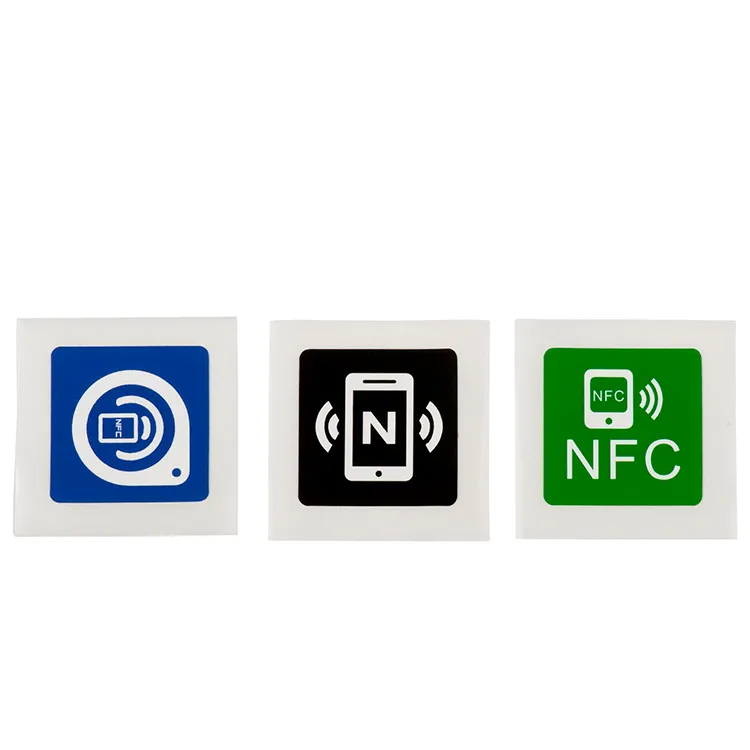
High Frequency operates at 13.56 MHz and, like LF, uses inductive near-field coupling — but the higher frequency allows a faster data rate and mature anticollision. This is the band in your phone, your hotel key and your transit card, because NFC is a subset of HF RFID.
- Read range: typically up to around 10 cm for passive tags; larger antennas in library or industrial readers can reach further under the vicinity standard.
- Standards: ISO/IEC 14443 for proximity cards (payment, transit, secure NFC) and ISO/IEC 15693 for vicinity tags (libraries, light asset tracking). The 14443 protocol supports notably higher data rates than LF chips manage.
- Smartphone support: nearly every modern phone reads ISO/IEC 14443 tags such as NTAG (MIFARE Classic’s proprietary sectors are not readable on iPhones), and some phones read 15693 as well.
- Anticollision: HF readers handle several tags in the field at once, resolving each in turn.
- Common chips: the NXP MIFARE families (Classic, Plus, DESFire) for access and transit, NXP NTAG for NFC cards and stickers, and ICODE for library and supply-chain use.
If a phone or a secure contactless reader has to interact with the item, HF is required. For the full NFC relationship, see NFC vs RFID.
UHF: 860–960 MHz
Ultra-High Frequency operates between 860 and 960 MHz and works completely differently: it uses backscatter (far-field) coupling, where the tag reflects and modulates the reader’s radiated signal rather than sharing a magnetic field. That is what buys the range — and also what makes UHF sensitive to its surroundings.
- Read range: typically up to several metres for passive tags with a fixed reader; battery-assisted tags reach further. Range collapses near water or bare metal.
- Standard: ISO/IEC 18000-63 (formerly 18000-6C), the air interface widely known as EPC Gen2, built for supply-chain identification under GS1’s EPC scheme.
- Bulk reading: strong anticollision lets a single reader inventory large numbers of tags quickly — the basis of pallet- and room-level scanning.
- Regional rules: UHF is the one band that is not globally harmonised. Europe (ETSI) uses roughly 865–868 MHz, plus 915–921 MHz where national rules allow it, North America (FCC) 902–928 MHz, and China around 920–925 MHz, with different power limits. Tags meant for worldwide use are designed to cover the full 860–960 MHz range, so confirm the destination band before ordering; our UHF RFID frequency lookup lists the band and power limit GS1 gives for each country in its overview.
- Materials: UHF is absorbed by water and reflected by metal, so tags on liquids or metal assets need specialised on-metal or far-field designs.
- Common chips: NXP UCODE, Impinj Monza/M-series and Alien Higgs, all conforming to the EPC Gen2 standard.
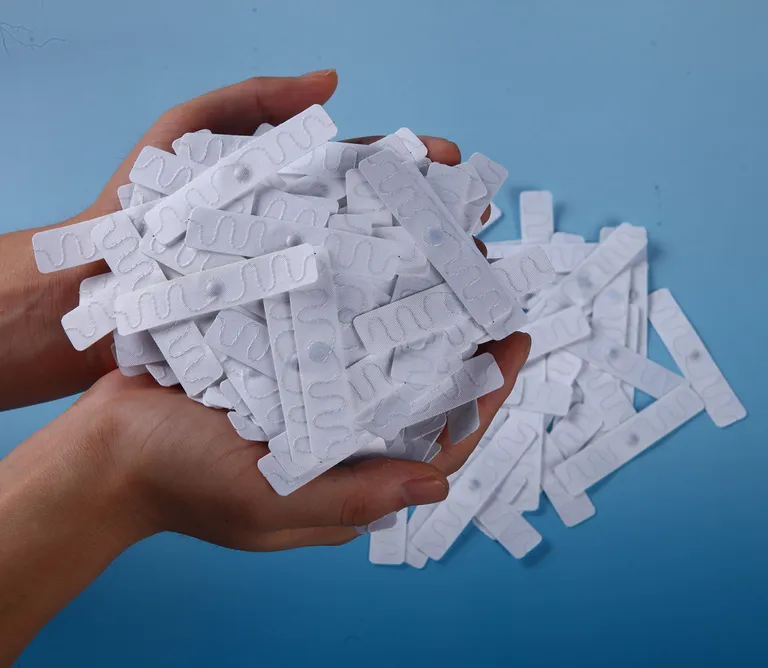
UHF is the only realistic option for long-range or bulk reading. Products such as RFID laundry tags, UHF wristbands and windshield tags use it, and it underpins supply-chain tracking and vehicle identification.
What is ISO/IEC 18000-6C?
ISO/IEC 18000-6C is the former name of the passive UHF air interface now published as ISO/IEC 18000-63 (“Type C”), the ISO counterpart of GS1’s EPC Gen2 protocol. A tag described as 18000-6C, 18000-63 or EPC Gen2 uses the same reader-talks-first, backscatter protocol and can be read by EPC Gen2 UHF readers operating in the band the tag is tuned for.
- Naming. Type C was added to ISO/IEC 18000-6 by a 2006 amendment. In the 2012–2013 revision, Part 6 became the general part and Types A, B, C and D moved to Parts 61 to 64.
- Harmonised with Gen2. GS1’s revision history records Gen2 being harmonised with the 18000-6 Type C amendment in 2005 and with 18000-63 in 2018; the current release is 3.0.1 (February 2026). Gen2 covers passive tags, including optional snapshot sensors, and refers to 18000-63 for battery-assisted tags and the sensor types that need a battery.
- What it defines. The signalling between reader and tag, the commands, and the collision arbitration that lets a reader inventory many tags. Optional security commands can use the ISO/IEC 29167 crypto suites. The tag memory has Reserved, EPC, TID and optional User banks, explained in RFID data encoding and memory.
- Frequency. Texts up to ISO/IEC 18000-63:2021 say 860–960 MHz; Gen2 release 3.0.1 and ISO/IEC 18000-6:2025 say 860–930 MHz, and ISO lists a revised 18000-63 with the same 860–930 MHz title. Every regional band listed above sits inside both ranges; local radio rules set the channels a reader uses.
Conformance does not tell you the read range, the regional band an inlay is tuned for, or how the tag behaves on metal or liquid. Those depend on the chip, inlay design and surface, so for our UHF RFID labels and UHF inlays they are confirmed per order and tested on samples. Proud Tek does not supply UHF readers.
Active vs passive RFID
The difference between active and passive RFID is the power source: a passive tag runs on the reader’s signal, an active tag on its own battery and transmitter. Passive tags have no battery and take all their operating energy from the reader, so they respond only while inside a reader’s field. Active tags’ battery and transmitter buy much longer range and room for sensors, at the cost of size, unit price and a battery that eventually runs out. Battery-assisted passive (BAP) tags, an optional mode of ISO/IEC 18000-63, use a battery to run the chip but still wait for the reader and reply by reflecting its signal.
| Property | Passive | Battery-assisted passive | Active |
|---|---|---|---|
| Power | Reader’s field only | Battery for the chip or sensor | Battery for chip and transmitter |
| Who starts | The reader (its field or a command) | The reader | Reader or tag, depending on the system |
| How it replies | Load modulation (LF/HF) or backscatter (UHF) | Backscatter | Its own transmitter |
| Service life | No battery to run down | Limited by the battery | Limited by the battery |
| Size and unit cost | Thin and lowest; fits cards and labels | Higher | Highest |
| Example standards | ISO/IEC 14443, 15693, 18000-63 | Optional mode in ISO/IEC 18000-63 | ISO/IEC 18000-7 (433 MHz) |
Which to choose: passive fits items presented to or passing a reader at a known point, such as a door, gate, counter or dock door, and suits thin cards, labels and wristbands that need no maintenance. Active tags suit cases where the tag must transmit by itself or needs its own transmitter’s range. BAP suits UHF tags that log conditions over time: Gen2 allows its Simple and Full Function sensors, which need a real-time clock, only on battery-assisted tags.
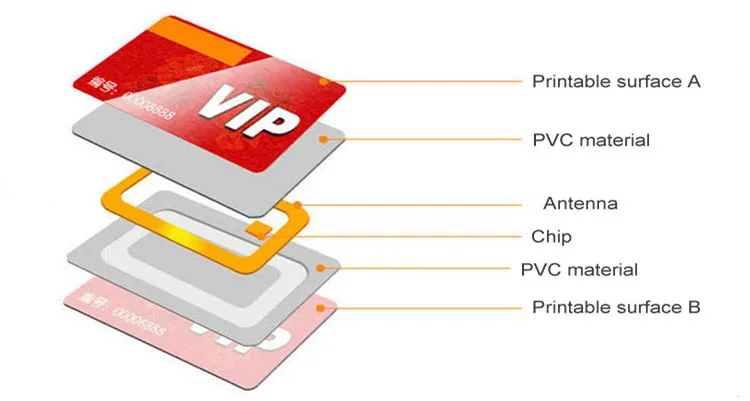
Every card, key fob, wristband, label, inlay and tag in our catalogue is passive, including the RFID tag with LED light, whose LED runs on the reader’s field. Our catalogue has no active or battery-assisted tags.
LF vs HF vs UHF at a glance
Anticollision cuts across all three bands: it is the protocol feature that lets a reader separate and address multiple tags at once. HF and UHF handle multi-tag reads well; many legacy LF protocols do not, which is why LF stays a one-at-a-time band.
| Property | LF (125–134 kHz) | HF (13.56 MHz) | UHF (860–960 MHz) |
|---|---|---|---|
| Coupling | Inductive (near-field) | Inductive (near-field) | Backscatter (far-field) |
| Typical passive range | A few centimetres | Up to around 10 cm | Up to several metres |
| Multi-tag reading | Limited | Good | Strong (bulk) |
| Water / metal tolerance | Best of the three | Good near water; metal needs special tags | Poor without special tags |
| Smartphone readable | No | Yes, NFC-type tags | No (needs a UHF reader) |
| Key standards | ISO 11784/11785 | ISO/IEC 14443, 15693 | ISO/IEC 18000-63 (EPC Gen2) |
| Typical uses | Access, animal ID | NFC, smart cards, libraries | Supply chain, retail, tolling |
How to choose the right frequency
Start with where the tag physically has to live, not with the spec sheet:
- Environment first. Metal and water lean towards LF; smartphone interaction requires HF/NFC; long-range or bulk reading requires UHF.
- Check regional rules. For UHF, confirm the frequency and power limits for the destination country, since they change your real-world range.
- Respect existing infrastructure. New tags usually have to coexist with legacy readers during any transition, and moving an installed system between bands is a major project.
- Sample in the real environment. Test on the actual surfaces, at the actual distances, before committing to production volumes.
What this means when you buy
The band is the decision everything else hangs on, and the one you cannot patch later. Answer three questions first: does a phone read it, does it need range or bulk reads, and does it sit on metal or water? Those point to HF, UHF or LF, and only then do chip, memory and body material matter.
Tell us the environment, the read distance and any reader you already run through the inquiry form, and we will confirm the band and chip against your case. Browse the full RFID tag range or the relevant RFID cards, read how RFID cards work for the mechanics, and request a sample pack so you can test the real read range on your own surfaces before you order in volume.
Common questions
Is EPC Gen2 the same as ISO/IEC 18000-6C?
For buying purposes, yes: they describe the same UHF air interface, and GS1 keeps Gen2 harmonised with ISO/IEC 18000-63, the current name for 18000-6C. The ISO text also gives the full description of battery-assisted tags and the battery-powered sensor options, which the GS1 text leaves to it.
Do passive UHF tags need a battery to read at several metres?
No. A passive UHF tag answers by backscatter using only the reader’s energy; its range depends on reader power, antennas, the inlay and the surface it sits on. A battery only enters with battery-assisted or active tags.