RFID Cards
NFC Cards
Custom, blank and printed NFC cards in bulk with NTAG213, NTAG215, NTAG216 or NTAG 424 DNA chips, in PVC, PET, paper, wood, PLA or metal. Tell us what the tap must do and which phones or readers must read it, and we quote the chip, body, printing and encoding together.
Free standard samples · Quotation within one business day
Product details
An NFC card is a card-sized carrier for a 13.56 MHz chip and antenna that a smartphone or an NFC reader reads by touch; the cards on this page use chips on the ISO/IEC 14443 Type A interface. We supply custom, blank and printed NFC cards in bulk to system integrators, distributors, agencies and resellers of digital business cards, review cards, loyalty and event programmes. The selection rule is simple: choose the chip for what the tap must do and which phones or readers must read it, then choose the card body for how the card will be handled and presented.
NFC card specifications at a glance
| Item | NFC card |
| Frequency and interface | 13.56 MHz, ISO/IEC 14443 Type A |
| NFC Forum tag type | Type 2 (NTAG213/215/216); Type 4 (NTAG 424 DNA, and DESFire EV2/EV3 when formatted for NDEF). MIFARE Ultralight EV1 and C are supplied for readers and ticketing systems, not as phone tags |
| Standard chip | NTAG213; NTAG215, NTAG216 and NTAG 424 DNA on request |
| Standard size | ID-1 (CR80), 85.6 × 54 mm; other sizes and die-cut shapes confirmed in the quotation |
| Thickness | ISO/IEC 7810 ID-1 nominal 0.76 mm; inlay cards are often slightly thicker, and the exact figure is confirmed in the quotation against your card printer |
| Card bodies | PVC, PET/PETG, paper, wood, PLA, stainless steel or anodised aluminium |
| Printing and finishing | Offset (CMYK) and Pantone printing, silkscreen, UV printing, laser engraving, gloss or matte finish, spot UV, foil, numbering, QR code and barcode |
| Delivery state | Blank, NDEF-formatted, encoded with one URL, or encoded per card from your data file; UID list for numbered cards |
| Phone read distance | A touch or near-touch; depends on the phone's antenna position and the card antenna |
Which chip should an NFC card use?
For a card that opens a web page on a phone, NTAG213 is the default: it holds a web address of up to 132 characters after https://www., reads natively on iPhone and Android, and is the lowest-risk choice for a large run. Move up only when the data or the security requirement demands it.
| Chip | NFC Forum type | User memory | Phone behaviour | Best use |
| NTAG213 | Type 2 | 144 bytes | Read natively on iPhone and Android | A URL or review link; the usual choice |
| NTAG215 | Type 2 | 504 bytes | Read natively on iPhone and Android | Longer links or several records |
| NTAG216 | Type 2 | 888 bytes | Read natively on iPhone and Android | The most data stored on the card, for offline use |
| MIFARE Ultralight EV1 | Not sold as a phone tag (ISO/IEC 14443 Type A chip) | 48 or 128 bytes | Made for readers and ticketing systems; phone reading depends on the phone and app, so confirm on a sample | Low-cost event tickets and passes checked at the gate readers |
| MIFARE Ultralight C | Not sold as a phone tag (ISO/IEC 14443 Type A chip) | 144 bytes | Made for readers and ticketing systems, which run its 3DES authentication; phone reading depends on the phone and app, so confirm on a sample | Tickets that need a simple authentication step |
| NTAG 424 DNA | Type 4 | 416 bytes (256-byte NDEF file) | The NDEF link opens on iPhone and Android | Authentication: AES-128 and a unique, verifiable URL on every tap |
| MIFARE Classic 1K / 4K | Not an NFC Forum type | 1 KB or 4 KB, sector-based | Not read by iPhone; only some Android phones | Access control and existing reader systems, not phone taps |
| MIFARE DESFire EV2 / EV3 | Type 4 when formatted | 2 to 32 KB by generation and part | Phones read an NDEF application if one is created | Multi-application access and campus systems that specify DESFire |
NTAG memory figures are from the NXP NTAG213/215/216 data sheet; the NDEF wrapper uses part of that space, so measure the complete encoded record, not the visible link; see NTAG213 vs NTAG215 vs NTAG216 for the byte count and URL length per chip. The NTAG chips differ almost only in memory: all three carry a 7-byte UID, an optional 32-bit password and a read counter. If the card must also work on an existing door or turnstile reader, start from the chip that system accepts — see our MIFARE Classic card page — and confirm it with your system provider; a MIFARE Classic card is the wrong choice for a phone tap. MIFARE Ultralight is chosen the same way, from the event or ticketing system's readers; a card that phones must read should carry NTAG21x. For multi-application access systems that specify DESFire, see MIFARE DESFire cards.
Which NFC card suits which job?
- A URL or landing page: an NTAG213 PVC card encoded with an https link on a domain you control, so the destination can change without re-encoding the card.
- Digital business cards: whether the card carries a profile link or a vCard, and how to change it after printing, is on the NFC business cards page; the NFC business card programmes guide covers a company roll-out.
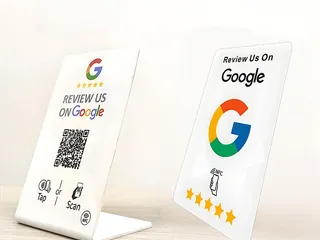
- Google review cards: one review link for each location, often in acrylic or as a table stand; see the Google review NFC card.
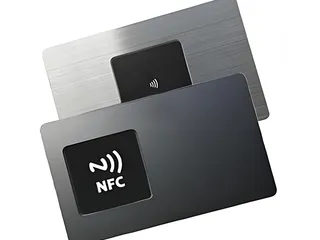
- Premium and executive cards: a stainless-steel or anodised-aluminium body built with a ferrite layer or an inlay window so it still taps; see the metal NFC card.
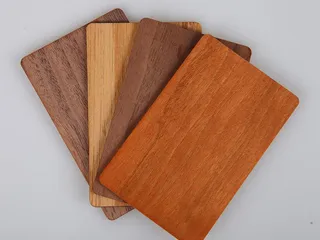
- Natural-material cards and hotel keys: wood species and engraving options are on the wooden RFID card page; a wooden card can be encoded for hotel locking systems whose locks accept the chip.
- Loyalty and membership: NTAG213 with a unique URL per card, or members matched by card UID in your CRM, so each tap identifies the member without storing personal data on the card.
- Event access: MIFARE Ultralight EV1 or NTAG213 cards, matched by UID in the ticketing system; confirm the chip the gate readers accept before artwork is approved.
- Authentication and anti-counterfeit: NTAG 424 DNA with a secure dynamic URL checked by a back-end; the same chip is available as an NTAG424 DNA label for products and packaging.
- A wearable instead of a card: a zirconia-ceramic NFC ring carries NTAG213, 215 or 216 for a phone tap, or MIFARE Classic for a 13.56 MHz door reader.
- A tag rather than a card: for packaging, posters and shelf edges, an NTAG213 NFC sticker carries the same link at label cost.
Will an NFC card work on iPhone and Android?
Yes, with an NTAG or NTAG 424 DNA chip and a correctly written NDEF record, but phones do not all behave the same way. The same applies to our NFC business cards and metal NFC cards.
- iPhone XS, XR and later read an NDEF tag in the background, with no app open, while the phone is in use; a locked iPhone asks to be unlocked first. The background reader acts only on a link record: a web address, or a mailto, tel or sms link. It ignores custom app schemes and other record types.
- iPhone 7, 8 and X have NFC but no background reading: the user taps NFC Tag Reader in Control Centre, available from iOS 14, or opens an app built on Core NFC.
- Earlier iPhones are not on Apple's list of models that read NFC tags, which starts at iPhone 7, so they need the QR code.
- Android phones look for tags while the screen is unlocked, unless NFC is switched off in Settings. The tag dispatch system opens a link record, or passes other records to an app registered for that type.
Where to hold the phone. Apple tells iPhone users to hold the top of the phone near a contactless reader, and a card is read the same way: tap it to the top edge, not the middle. Android antenna positions vary by model, so test the phones your users carry. A QR code to the same link on the back covers older iPhones and phones with NFC switched off.
- Use an https link. A web URL record opens most reliably on both platforms; text or custom records may need an app.
- A blank card does nothing. An unformatted or empty chip triggers no notification on iPhone, which is the most common "card not working" report.
- Reads on Android but not iPhone usually means a MIFARE Classic chip, which iPhone does not read, or a record type iPhone does not act on; order NTAG with a link record for phone taps.
Which card body: PVC, PET, paper, wood, PLA or metal?
The chip and antenna are the same in most bodies; the body decides durability, printing method, look and price. When the material matters to your customer, ask for the material specification of the construction offered. What we state about PLA (the material biodegrades under industrial composting conditions; the finished card is not described as compostable) and about the other bodies is on the eco RFID card page.
| Body | Character | Personalisation | Typical use |
| PVC | Laminated standard card, economical in volume | Full-colour offset on both sides, gloss or matte, spot UV, foil, numbering | Business, loyalty and membership cards in volume |
| PET / PETG | Polyester bodies without chlorine, laminated like PVC | As PVC | Buyers moving away from PVC |
| Paper | Coated paper around an antenna inlay; light | Full colour on both sides | Event passes, tickets and short campaigns |
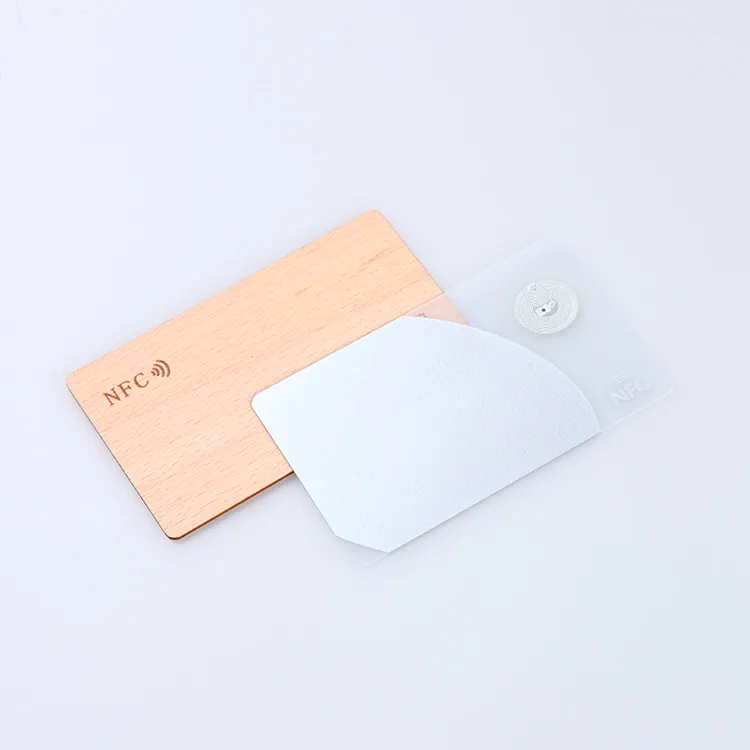
| Wood | Cherry, sapele, bamboo, beech, birch, black walnut, basswood or maple | Laser engraving, UV printing, hollow carving, die-cutting to shapes, epoxy covering for water resistance | Premium business cards, hotel keys, brands that want a natural material |
| PLA | PLA (polylactic acid) made from corn starch; PLA biodegrades under industrial composting conditions (European Bioplastics); the chip and antenna inlay are not PLA | Printing confirmed on a sample | Alternative-material card programmes |
| Metal | Stainless steel or anodised aluminium, heavy with a premium finish | Laser engraving, UV printing, plating and colour finishes | Executive and VIP cards; needs a ferrite layer or window |
Metal bodies detune a 13.56 MHz antenna unless built with a ferrite layer or window, and can read at a shorter distance than plastic. Wood and paper are more sensitive to moisture unless sealed, so confirm the read on a sample of the exact build.
Custom printed, blank or pre-encoded NFC cards?
- Blank NFC cards: white or coloured cards with no artwork, for printing on your own card printer and encoding with your own reader or app. Tell us the printer model and the card thickness it accepts so the surface and thickness suit it, and whether the chip should be NDEF-formatted and left writable.
- Printed NFC cards: your artwork on one or both sides, with Pantone matching, a finish, printed numbers, a QR code or a barcode. Keep metallic foil and heavy metallic ink clear of the antenna area, and place the tap icon where the antenna sits.
- Pre-encoded NFC cards: delivered ready to tap, with one URL on every card or a unique record on each card matched to its printed number, and locked or left writable as you specify.
How are NFC cards encoded and locked?
Encoding is agreed in writing before production and demonstrated on the approved sample. Each card is read back once it has been encoded, and every encoded order is delivered with a data report. The RFID and NFC encoding service page sets out what to agree before encoding. Common set-ups:
- One URL on every card: the simplest option; point it at a redirect you control so the destination can change later.
- A unique URL per card: written from your data file and matched to the printed serial number, for loyalty, membership and business-card programmes.
- UID list: numbered cards come with a file listing each chip's factory-programmed 7-byte UID beside the card's printed number, for systems that identify cards by UID; like the data report, it comes in Excel, CSV or XML. For unnumbered cards, whether a UID list is supplied is agreed in the quotation.
- UID and counter mirror: NTAG21x chips support a mirror that adds the UID and tap counter to the URL as the phone reads it, identifying each card without unique encoding; this is not cryptographic and can be copied. Configuration is available on request and confirmed in the quotation.
- Offline data on the chip: a text or contact record that works without a network; measure the encoded record against the chip memory before choosing NTAG213, 215 or 216.
- Locking: a permanent read-only lock, or the 32-bit password that blocks overwriting while allowing deliberate re-encoding. Approve the record before any permanent lock is set, because a lock cannot be undone.
A static NDEF record can be copied to another tag. If the tap must prove the card is genuine, specify NTAG 424 DNA with secure dynamic messaging and agree the verification service and key management with your integrator.
What to check on a sample before a bulk order
- Tap the encoded sample on the phones your users carry: a recent iPhone and at least two Android models, locked and unlocked.
- Confirm the link, record type and lock state are exactly what the batch will receive.
- Check colour, finish and printed data against the approved proof, and check that the tap mark sits over the antenna.
- If the card must also open doors or gates, test it on the actual reader or lock; for systems that accept a given chip, confirm the requirement with your system provider.
- Agree packing and labelling before production starts.
How to order custom NFC cards in bulk
NFC cards are quoted per project. Send the quantity, chip, card body, size and thickness, artwork, finish, encoding (blank, one URL or per-card data), lock requirement, destination country and required date. We reply within one business day and send a quotation within one business day of a workable inquiry. MOQ and freight are confirmed in the quotation for your specification and destination.
We have manufactured RFID and NFC products in Shenzhen since 2008. Strong chip supply channels, broad material purchasing and our own production and quality control let us quote competitively for the specification, quantity and quality you need; see how we manufacture and supply RFID cards and NFC tags. Standard samples are free, customised samples carry a setup fee, standard products generally have a lead time of 2–3 weeks, and large orders are scheduled individually. Request a free sample pack to test on your own phones, or send your specification through the contact form.
Plan the application
Frequently asked questions
Do NFC cards work on iPhone and Android without an app?
Yes, when the card carries an NTAG or NTAG 424 DNA chip with a well-formed https NDEF record. iPhone XS, XR and later read it in the background while the phone is in use; iPhone 7, 8 and X need NFC Tag Reader in Control Centre (iOS 14 or later) or an app; earlier iPhones need a printed QR code. Android phones read it while unlocked with NFC switched on. If a card reads on Android but not on iPhone, it usually carries a MIFARE Classic chip or a record type iPhone does not act on.
Can I buy blank NFC cards and program them myself?
Yes. Blank NTAG cards can be written with a phone app or a desktop NFC reader/writer. Tell us whether they should be NDEF-formatted and left writable, and which card printer you use and the thickness it accepts, so the surface, thickness and chip state suit your process.
What is the difference between NTAG213, NTAG215 and NTAG216 cards?
Mainly memory: 144, 504 and 888 bytes of user memory respectively, per the NXP data sheet. All three are NFC Forum Type 2 tags with a 7-byte UID, a 32-bit password option and a read counter. A short link fits NTAG213; longer records or several records need NTAG215 or NTAG216.
Can you print and encode each NFC card with a different URL?
Yes. Send the artwork and a data file, and each card is encoded with its own URL or record and matched to a printed number, QR code or barcode. Approve an encoded sample before the batch; the encoding service page lists what else to agree before the run.
Which card body should I choose for a bulk order?
Choose by how the card is handled. PVC is economical in volume; PET or PETG is laminated like PVC without chlorine; paper suits event passes and short campaigns; wood gives a natural, premium face; and metal needs a ferrite layer or window and can read at a shorter distance. The chip can be the same in each, so confirm the read on a sample of the exact build.
How long does an NFC card last?
NXP specifies NTAG213/215/216 for at least 10 years of data retention and 100,000 write cycles; those are chip figures, not the life of a card. How long a finished card lasts depends on its body, how it is handled and where it is kept, and we publish no lifespan figure for any card body, so judge it on a sample handled the way your cards will be.
Can an NFC card be copied?
A card that carries a static URL can be copied: the record can be written to another tag and will read identically. On a card meant for phone taps, the password only stops overwriting; it does not stop the public record being read and copied. When the tap must prove the card is genuine, use NTAG 424 DNA, which produces a unique AES-authenticated URL on each tap for a back-end to verify.
What are the sample terms, MOQ and lead time for custom NFC cards?
Standard NFC cards are supplied as free samples so you can test them on your own phones; customised samples with your printing or encoding carry a setup fee, confirmed before anything is made. MOQ depends on the chip, body and printing and is confirmed in the quotation. Standard products generally have a lead time of 2–3 weeks; large orders and customised builds are scheduled individually.
Buyer guides
- How to Program NFC Tags: NDEF, Apps and Readers How to program NFC stickers and cards on Android and iPhone: NDEF records, NFC Tools and NXP TagWriter, desktop readers, locking and pre-encoding.
- NFC vs RFID: The Difference Between NFC and RFID Explained NFC vs RFID explained for buyers: NFC is a 13.56 MHz subset of RFID. Compare range, modes, smartphone support and standards, and choose the right one.
- How to Read an RFID Tag Quotation, Line by Line What decides RFID card and tag prices, and how to compare quotations line by line: unit-price basis, tooling, encoding, samples, freight and Incoterms.
Ready to specify your order?
Send the product, quantity and application so we can confirm the options and pricing for your project.