Analytics cookies. Can we use Google Analytics and its cookies to see how visitors use this site? Change this any time under Cookie settings in the footer. Privacy policy
An NFC ring puts the credential on your finger — a passive chip sealed in zirconia ceramic — for door access or tap-to-share without carrying a card, fob or phone.
An NFC ring is a zirconia-ceramic ring with a passive RFID chip sealed inside, worn as a credential or a tap-to-share token. Choose NTAG for phones, MIFARE Classic for 13.56 MHz access readers or an ATA5577 for 125 kHz locks, then confirm the US ring size and test a sample on your own readers before ordering.
Contact and link sharing, Bluetooth or Wi-Fi connection, access control, identification
How an NFC ring works
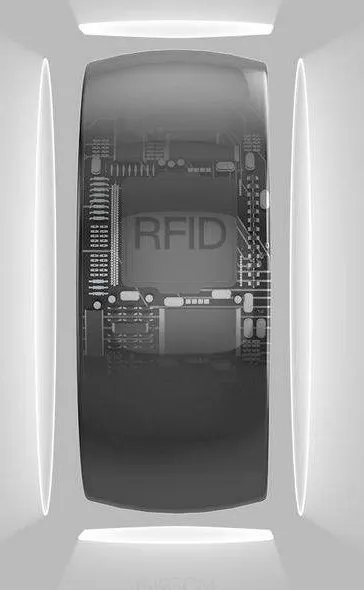
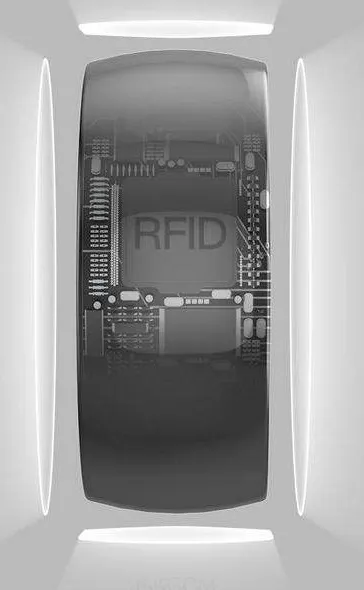
An NFC ring is a passive RFID transponder shaped as jewellery. A small coil antenna and a chip sit inside the ring body. They have no battery: the reader's field powers the chip for the fraction of a second the ring is held against it, and the ring answers with its identifier or with the data stored in its memory, exactly as a card or a key fob would. Everything that decides whether the ring "works" is therefore the same as for a card: the chip family, the frequency, and what the reader on the door, the turnstile or the phone is able to read.
The body is zirconia ceramic for a practical reason, not only for looks. Ceramic is an electrical insulator, so the reader's field passes through it to the coil. A solid metal band would shield the coil and absorb the field, which is why metal NFC rings on the market need a ceramic or resin window for the antenna. The all-ceramic body gives a full-circumference finish, resists scratching better than plated metal, contains no nickel, and is unaffected by water, sweat or hand sanitiser.
Choosing the ring body material
The chip decides what a ring can do; the body material decides how it wears and how well it reads. Because the reader's field has to pass through the body to reach the coil, the material is a radio choice as much as a cosmetic one. The standard ring on this page is zirconia ceramic, and other bodies can be specified per project when the look or the budget calls for it.
Body material
Feel and durability
Effect on reading
Zirconia ceramic
Hard, scratch-resistant and nickel-free; brittle, so a hard strike on stone can chip it
Radio-transparent full-circumference body; the standard choice
Titanium or stainless steel
Light and very tough; a premium metal finish
Metal shields the coil, so the antenna sits in a ceramic or resin window and the ring reads at the short end of the 1–5 cm range
Wood
Warm, light and distinctive; softer than ceramic and needs a sealed finish for daily wear
Radio-transparent, so the coil reads through the body
Resin
The lightest and lowest-cost body; cosmetic wear shows sooner than on ceramic
Radio-transparent, so the coil reads through the body
Carbon-fibre composite
Light and modern-looking, but stiffer and less forgiving than resin
The fibre is electrically conductive, so it detunes the coil much like a metal body: it needs a non-metal window and reads at the short end of the range
The practical lesson is that any solid metal band needs a non-metal window for the coil, and even then reads at a shorter distance, while ceramic, wood and resin let the field through the whole body. If a metal look is essential, plan for the window and test the read on your own reader; if read reliability matters most, a ceramic, wood or resin body is the safer specification. Whichever body you choose, the MIFARE Classic card and T5577 card pages explain how these chip types work.
Chip options: NTAG, MIFARE Classic or 125 kHz
The ring takes one chip. Choose it by what has to read the ring, because the three families below are not interchangeable: a reader built for one does not see the others.
Chip
Frequency and standard
Memory
Typical use
Read by phones?
NTAG213
13.56 MHz, ISO/IEC 14443A, NFC Forum Type 2
144 bytes user memory
Phone-readable NDEF: a contact card, a link, a Wi-Fi login or an app trigger
Yes, iPhone and Android
NTAG215
13.56 MHz, ISO/IEC 14443A, NFC Forum Type 2
504 bytes
Longer NDEF records with several fields
Yes
NTAG216
13.56 MHz, ISO/IEC 14443A, NFC Forum Type 2
888 bytes
The largest NDEF payload of the family
Yes
MIFARE Classic 1K (S50)
13.56 MHz, ISO/IEC 14443A
1 KB in 16 sectors
Access-control and membership readers that enrol MIFARE credentials
Android phones with an NXP NFC chip; not iPhone
MIFARE Classic 4K (S70)
13.56 MHz, ISO/IEC 14443A
4 KB in 40 sectors
Systems that already issue 4K cards
Same as 1K
ATA5577
125 kHz, no ISO air-interface standard
7 user blocks of 32 bits, programmable modulation
Proximity locks and 125 kHz readers; can be configured to common ID formats such as EM4100
No; phones have no 125 kHz radio
The NTAG family is the choice when the ring is a personal object: a tap shares a contact card or a link, opens a page or starts an automation on the wearer's phone. MIFARE Classic and ATA5577 are for buildings: they make the ring a credential on a system that already exists. The six chips in the table are the standard options.
Using an NFC ring on a door or a lock
The question we receive most often is whether a ring will open a particular door. The answer depends on the reader, not on the ring, and comes down to three checks.
Frequency. 125 kHz proximity readers and 13.56 MHz MIFARE readers are different radios. If your building issues 125 kHz fobs, the ring needs the ATA5577 chip; if it issues MIFARE cards, it needs MIFARE Classic. The key fob guide explains how to tell the two apart from the credentials you already carry.
How the system enrols credentials. Most access systems accept any new credential of the right chip type: the administrator presents the ring at the enrolment reader and the system stores its serial number (UID) against the user. This is how a ring joins a system that only knows cards. Systems that write their own keys and data to the credential, such as many hotel locks and some transit and campus systems, may reject a blank ring; check with the system vendor first.
Reader geometry. The coil in a ring is a fraction of the size of the antenna in a card, so a ring reads at a shorter distance than a card, 1–5 cm depending on the reader. Rings read reliably on flat wall readers and on door handles when the top of the ring faces the reader; recessed readers with a small antenna area may need the hand to be placed deliberately. Ask for samples and test on your own hardware before ordering a batch.
Because the ring carries the same chip type as a card, what the MIFARE Classic card and T5577 card pages say about UID enrolment, sector keys and 125 kHz formats applies to the ring as well. We encode rings to the identifiers or data you supply for a system you administer; we do not duplicate credentials for systems you do not control.
What an NFC ring cannot do
Contactless payment. Paying with a ring needs an EMV secure-element chip personalised and issued by a bank or its tokenisation partner, not a blank NTAG or MIFARE chip. Our rings are not payment rings and cannot be turned into one.
Long-range reading. 1–5 cm is the working distance. A ring cannot be read while the hand is in a pocket or from across a room.
Two frequencies in one ring. A ring carries one chip. If your site mixes 125 kHz and 13.56 MHz readers, decide which system the ring will serve or order two rings.
Holding secrets. A ring with NTAG213 can carry a link to a digital business card or a room-service menu, but it cannot host applets, bank keys or a transit purse.
A public side and a private side: two-chip rings
The standard ring carries one chip. Buyers sometimes ask for a single ring that both shares a link and opens a door: an outward, "public" NTAG chip tapped against the back of the hand, and an inward, "private" MIFARE Classic chip presented when the palm turns to the reader. Fitting two coils in one narrow band is a feasibility question to raise per project, not a stocked option. Two 13.56 MHz coils set that close together can couple and detune each other, so the construction has to be prototyped and each chip validated on its own reader before any quantity is committed. Tell us the two chips you have in mind and we will confirm whether it is workable for your case.
Two limits apply even where it is feasible. Both inlays would be 13.56 MHz, so a dual-inlay ring cannot bridge a 125 kHz reader — that remains a separate ATA5577 ring. And a payment credential is not one of the options: neither inlay can be a bank's secure element, so a dual-inlay ring is not a payment ring. Treat it as a specify-per-project request: tell us the two chips, which faces out and which faces in, and test a prototype on both the phone and the access reader before ordering a batch.
Sizes and how to measure
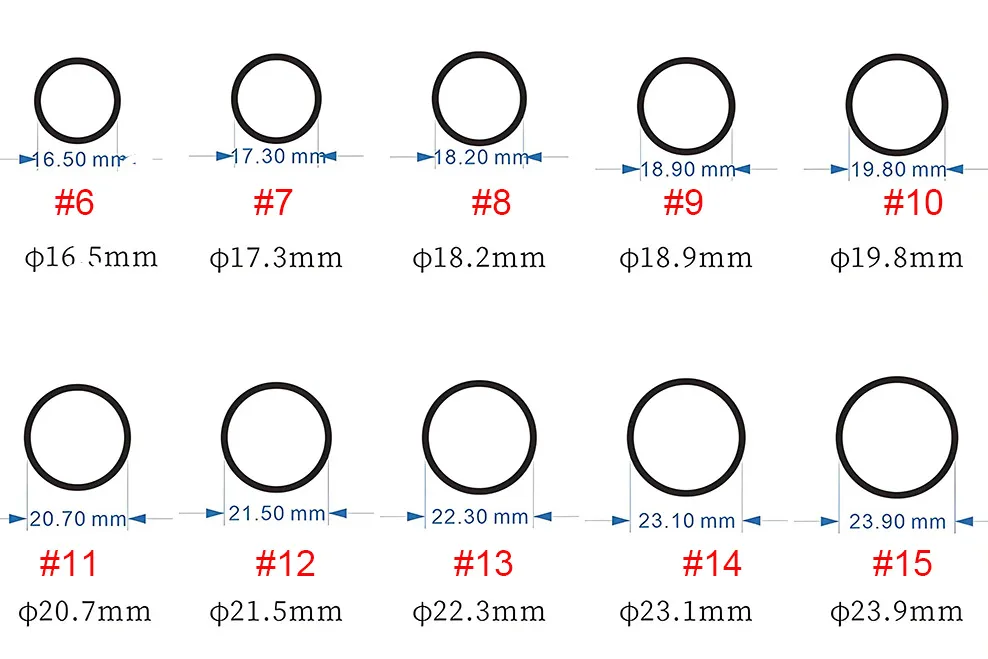
The ring is made in US sizes #6 to #15. The inside diameters below are the sizes the rings are produced in, as shown in the size chart; other sizes can be produced as a custom order.
US size
Inside diameter
Inside circumference (approx.)
#6
16.5 mm
51.8 mm
#7
17.3 mm
54.3 mm
#8
18.2 mm
57.2 mm
#9
18.9 mm
59.4 mm
#10
19.8 mm
62.2 mm
#11
20.7 mm
65.0 mm
#12
21.5 mm
67.5 mm
#13
22.3 mm
70.1 mm
#14
23.1 mm
72.6 mm
#15
23.9 mm
75.1 mm
Circumference is what European and ISO 8653 ring sizes state, so the third column is the one to compare with a jeweller's sizing. To measure at home, wrap a strip of paper around the finger at the knuckle the ring must pass over, mark the overlap and measure the length in millimetres. Ceramic cannot be resized after firing, so when a measurement falls between two sizes, choose the larger one.
Durability and care
Zirconia ceramic is harder than steel and keeps its polish for years; the trade-off is that it is brittle rather than ductile, so a fall onto a stone floor can chip it where a metal ring would dent. The chip and coil are sealed inside the ceramic body, so the ring can be worn while washing hands, swimming or showering. The sealed body tolerates everyday hot water, hand-washing and a shower; avoid extreme or sustained heat, and keep it away from a jeweller's torch. Sunlight, chlorine, salt water, sweat and hand sanitiser do not affect the ceramic or the chip.
Before you order
Chip: NTAG213, NTAG215 or NTAG216 for phones; MIFARE Classic 1K or 4K for 13.56 MHz access readers; ATA5577 for 125 kHz locks.
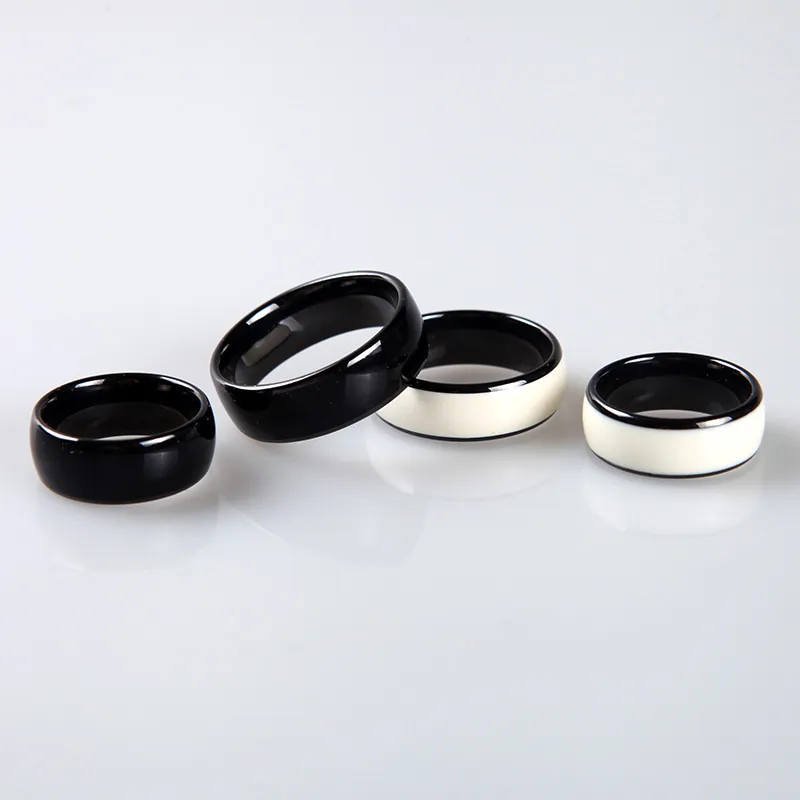
Sizes and quantity per size, in black or white. Colours and inlaid finishes other than plain black and white, such as those in the photos, are quoted per order.
Encoding: none, when your system enrols each ring by its UID; one NDEF record (URL, vCard or text) per ring; or data for a system you administer. Each ring we encode is read back afterwards, and a data report in Excel, CSV or XML goes out with the encoded order (encoding service). Whether a UID list comes with the rings is agreed in the quotation.
Samples: one ring per chip type to test on your readers before the batch. Ceramic rings are made to order, so allow additional lead time — confirmed in your quotation — and test a sample before committing to quantities.
Only if the door's reader accepts a new credential of the ring's chip type. For 125 kHz proximity readers choose the ATA5577 ring; for MIFARE readers choose MIFARE Classic. Most access systems enrol a ring by reading its UID once at the administrator's enrolment reader. Systems that write their own keys to the credential, such as many hotel locks, may not accept it, so test a sample first. The key fob guide explains how to identify your reader type.
Can I pay with this ring?
No. Contactless payment needs an EMV secure-element chip that a bank or its tokenisation partner personalises and issues. The NTAG, MIFARE Classic and ATA5577 chips in our rings cannot be used for payment, and a ring cannot be upgraded to a payment ring later.
Which chip should I choose for a ring that phones can read?
NTAG213 holds 144 bytes, enough for a web address, a short vCard or a Wi-Fi record; NTAG215 (504 bytes) and NTAG216 (888 bytes) suit a contact card with several fields. All three are NFC Forum Type 2 tags that current iPhones and Android phones read. An iPhone opens a web link from the ring without an app, but a vCard or Wi-Fi record stored on the chip needs an app on iPhone; how a phone reads an NFC card covers this and older iPhones. MIFARE Classic rings are not read by iPhones, and 125 kHz rings are not read by any phone.
What is the read range of an NFC ring?
1–5 cm, depending on the reader. The coil inside a ring is much smaller than the antenna in a card, so the ring must be brought close and turned so that its top faces the reader's antenna. Flat wall readers and door-handle readers work well; small recessed readers may need a deliberate hand position. Test a sample on your own readers before ordering quantities.
Is the ring waterproof and how much heat can it take?
The chip and coil are sealed inside the ceramic body, so the ring can be worn while washing hands, swimming or showering, and the ceramic is unaffected by chlorine, salt water, sweat or hand sanitiser. Avoid extreme or sustained heat, such as a jeweller's torch. Ceramic is hard and scratch-resistant but brittle: it shrugs off everyday knocks, but a hard strike against stone or metal can chip or crack it, so treat it like fine jewellery rather than a metal band.
How do I choose the ring size?
Use the size table on this page: sizes #6 to #15 correspond to inside diameters of 16.5 mm to 23.9 mm. Measure the inside diameter of a ring that fits the same finger, or wrap a paper strip around the finger at the knuckle and measure the length to get the circumference. Ceramic cannot be resized after firing, so between two sizes choose the larger. Other sizes can be made to order.
Can you copy my existing fob or card into a ring?
We encode rings for systems you administer, from the identifiers or data you supply. We do not duplicate credentials for a system you do not control, such as an employer's or a landlord's access system. The right route is to ask the system's administrator to enrol the new ring as an additional credential, which is how key fobs and cards are added as well.
Can one ring work on both 125 kHz and 13.56 MHz readers?
No. A ring carries one chip, and 125 kHz and 13.56 MHz are separate radios, so order one ring per system or choose the system the ring will serve. A ring with two 13.56 MHz chips, one to share a link and one to open a door, is a feasibility question per project rather than a stocked item, and it still cannot add a 125 kHz credential. The 125 kHz proximity fob page describes the LF family.
Buyer guides
How to Read an RFID Tag Quotation, Line by LineWhat decides RFID card and tag prices, and how to compare quotations line by line: unit-price basis, tooling, encoding, samples, freight and Incoterms.