Analytics cookies. Can we use Google Analytics and its cookies to see how visitors use this site? Change this any time under Cookie settings in the footer. Privacy policy
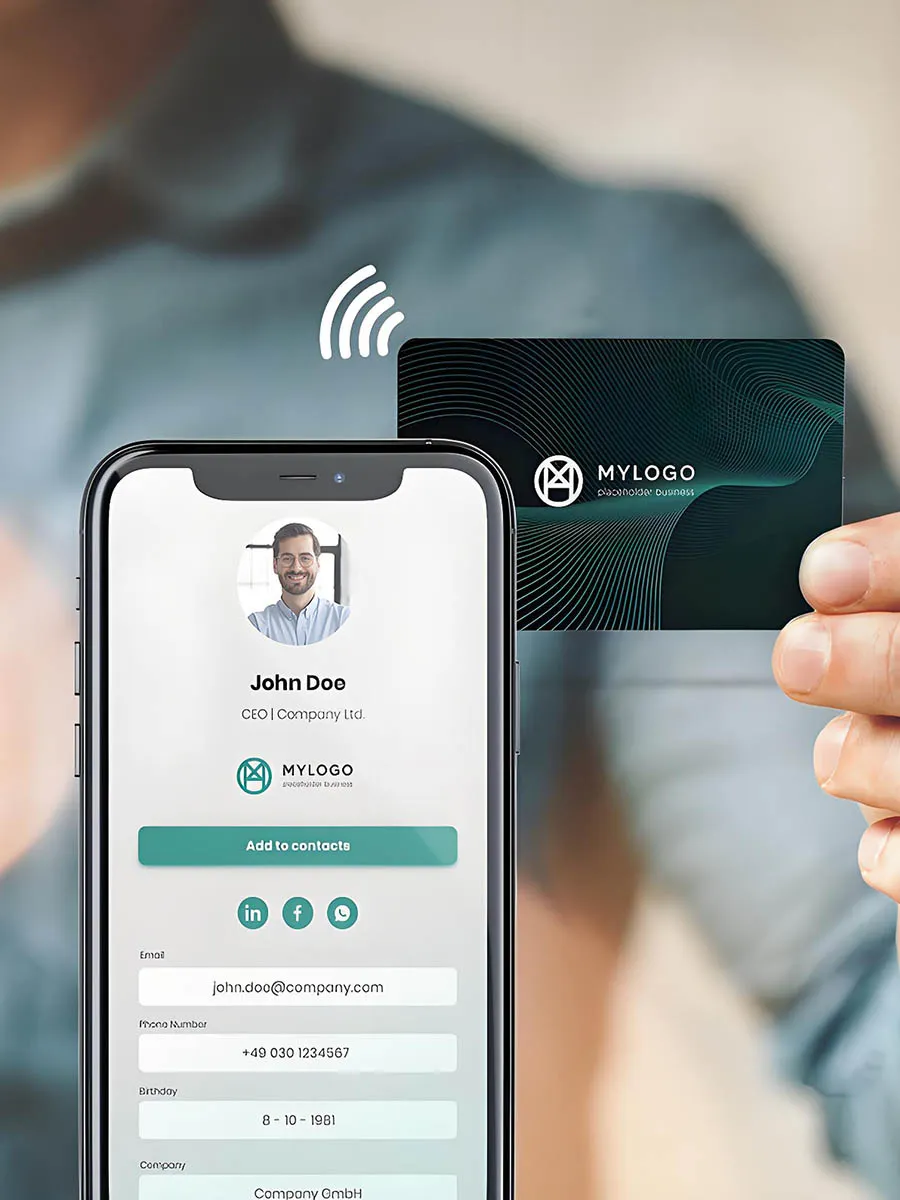
An NFC business card shares a profile when it is tapped to a phone. Its NTAG chip carries either a short link to a profile page you host, which you can change after the cards are printed, or a vCard stored on the chip itself. Decide that first, because it sets the chip; then choose the card body, printing and per-person encoding, and approve a sample before your order.
Free standard samples · Quotation within one business day
Product details
At a glance
Profile: a short link to a page you host, which you can change after the cards are printed, or a vCard stored on the chip that works offline.
Chip: NTAG213 for a link; NTAG215 or NTAG216 when the vCard lives on the card.
Card: PVC or PET from about 0.38 mm thick, printed on both sides, or a wood or bamboo face.
Per person: each card printed with its owner's name and encoded with that person's link or vCard from your list.
Specification
Item
NFC business card
Card body
PVC, PET, PETG, ABS, PC or wood; for a metal body see the metal NFC card
Chip
NTAG213, NTAG215 or NTAG216
Frequency and interface
13.56 MHz, ISO/IEC 14443 Type A; NFC Forum Type 2 tag
Size
CR80 (85.5 × 54 mm) or custom
Thickness
From about 0.38 mm to 0.8 mm
Colour
White, black, green, blue or custom
Chip data retention and write endurance
10 years and 100,000 write cycles (NXP NTAG21x data sheet)
Chip operating temperature
−25 °C to +70 °C (NXP NTAG21x data sheet); confirm the finished card per order
Printing
Offset, silkscreen, UV or digital printing
Marking
Printed or laser-engraved numbering, barcode, QR code
Encoding
One link on every card, or a link or vCard per person from your list
A profile link or a vCard on the chip?
The chip can carry the profile in two ways, and the choice decides the chip. A link record points at a profile page you host: it is short, fits the smallest chip, and the page can change after the cards are printed. A vCard record puts the contact fields on the chip itself, so it works without a network, but a contact with a name, company, several numbers, an email, an address and a photo link is large.
Chip
User memory
Comfortably holds
NTAG213
144 bytes
A short URL to a hosted profile, or a minimal name-and-phone vCard
NTAG215
504 bytes
A longer URL set, or a modest vCard with a few fields
NTAG216
888 bytes
A fuller vCard kept on the card, or several NDEF records
Memory figures are from the NXP NTAG datasheet. The choice also matters for iPhone users. An iPhone opens a link from the card without an app, but reads a vCard stored on the chip only through an app, because its background reader acts on links alone (Apple Core NFC documentation). A link to a profile page with a save-contact button therefore suits every recipient, which is why we recommend an NTAG213 with a link on a domain you control for most cards, and an NTAG215 or NTAG216 only when the contact must live on the card.
What a vCard on the chip can hold
A vCard on the chip is an NDEF MIME record of type text/vcard. In the current format, vCard 4.0 (RFC 6350), the text is always UTF-8, so it carries non-Latin scripts, and a name or title can be given in two languages as alternative versions of the same property, each tagged with its language; check on the encoded sample how your recipients' contacts apps show it. The cost is size: every field, and the NDEF framing around the record, uses chip memory. A contact with several fields rarely fits an NTAG213 and a long one can outgrow an NTAG215, so measure the complete encoded record before choosing the chip. If the contact should also save directly on an iPhone, add a vCard download button to the hosted profile page.
Changing the link after the cards are printed
A card that carries a short link on a domain you control never has to change: point the link at a new page and every card follows. For a whole team, the NFC business card programmes guide sets out that URL scheme, together with joiners, leavers and measuring taps. The chip itself can stay changeable as well: a card that is password-protected rather than permanently locked can be re-encoded on purpose, to a corrected link or a new owner, but not overwritten by accident. Decide the lock state before you order, and we encode each card to match; the lock options are explained under encoding on the NFC cards page.
Card body, printing and the tap mark
PVC and PET: the standard body, printed in full colour on both sides, matte or gloss, from about 0.38 mm to 0.8 mm thick.
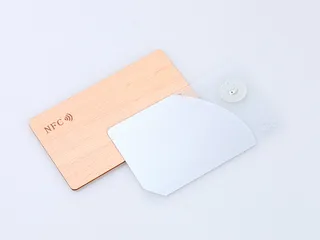
Wood and bamboo: a natural face, engraved or printed; species and finishes are on the wooden RFID card page.
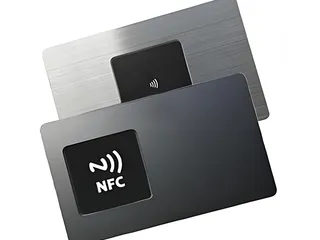
Metal: a steel or aluminium card is built differently so that it still reads; see the metal NFC card.
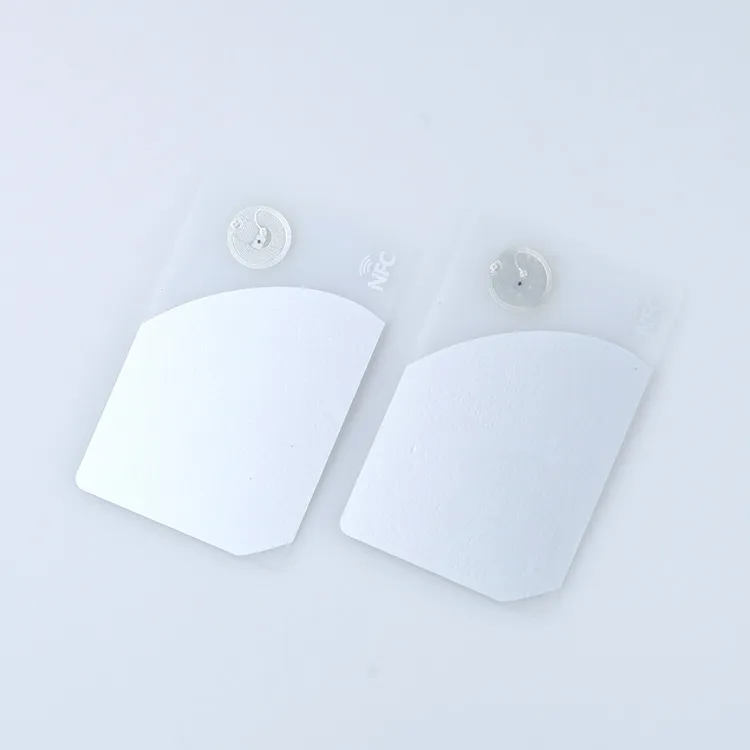
Clear chip window and spot effects: the inlay area can be left transparent, and metallic or spot-UV effects added away from it.
Keep metallic ink and foil off the antenna area, because metal close to the antenna weakens the read, and avoid heavy embossing over the inlay. Print a small tap symbol over that area, and a QR code to the same link on the back for phones that cannot read the tag; how a phone reads an NFC card explains which phones those are and where to hold the card.
Encoding each card to its owner
For a team order, send the artwork and one data list: each card is printed with a name or number and encoded with the link or vCard from the same row, so the printed card and the chip match. We read back each card after encoding it and send a data report with the order; where the cards carry a printed number, we also supply a file pairing every chip's UID with that number, and both come as Excel, CSV or XML (encoding service). Tap the encoded sample on the phones your contacts carry, check that it opens the right page or saves the right contact, and approve it before any lock is set. A free sample pack lets you handle the materials first.
Ordering
NFC business cards are quote-only. Tell us the chip, the card body and finish, the artwork, whether each card carries a link or a vCard, and whether each is encoded to a different person. We have manufactured RFID and NFC products in our Shenzhen factory since 2008; standard samples are free, customised samples carry a setup fee, and standard products generally have a lead time of 2 to 3 weeks. Printing, numbering and per-card encoding are available. Start on the contact form, by email or on WhatsApp. For a solid metal card see the metal NFC card; for blank cards and other tap-to-open uses see NFC cards.
Plan the application
Frequently asked questions
Should the card hold a vCard or a link?
A link to a profile page you host is usually the better choice: it fits an NTAG213, opens on any phone that reads the card, and the page can change after the cards are printed. A vCard written to the chip works without a network, but it needs an NTAG215 or NTAG216, and an iPhone reads it only through an app.
Which NTAG chip should I choose?
NTAG213 (144 bytes of user memory) is enough for a link to a hosted profile and is the common choice. NTAG215 (504 bytes) or NTAG216 (888 bytes) is needed when a vCard must live on the card; measure the complete encoded record, because a long vCard can outgrow an NTAG215. Memory figures are from the NXP NTAG datasheet.
Can I update my details after the cards are printed?
Yes, if the chip carries a link to a page you host: change the page, or where the link redirects, and every card follows. A vCard on the chip changes only if the chip was left writable or password-protected and is re-encoded. Decide which before you order, and we encode the cards to match.
Can a card be reassigned to a new person later?
The chip can, unless it was permanently locked, but the printing cannot: a card printed with one person's name stays theirs. Cards meant to be handed on, for example to new starters, are better printed with the company design and a card number, and encoded with a short link on your domain that you point at the next holder; a password-protected chip can also be re-encoded on purpose. The NFC business card programmes guide covers joiners and leavers.
Can you print our logo and encode each card to a different person?
Yes. We print both sides to your artwork, add per-card names or numbering, and encode each card to a different profile link or vCard from your data list. Send the artwork and the fields that change between cards, and approve an encoded sample before the run.
Do I need an app to use an NFC business card?
Not to open a link: current iPhones and Android phones with NFC switched on open it without an app, and the printed QR code covers older phones. A vCard stored on the chip is different: an iPhone opens it only through an app. How a phone reads an NFC card lists which iPhones need Control Centre.
Which card material should I pick?
PVC or PET is the standard and prints in full colour on both sides; wood or bamboo gives a natural face. A steel or aluminium card is built differently so that it still reads, and has its own metal NFC card page. The NTAG chip is the same in each.
Buyer guides
How NFC Tags Work with SmartphonesHow NFC tags work with smartphones: the 13.56 MHz link, NDEF records, iPhone background reading, Android behaviour, metal and antenna position.
How to Program NFC Tags: NDEF, Apps and ReadersHow to program NFC stickers and cards on Android and iPhone: NDEF records, NFC Tools and NXP TagWriter, desktop readers, locking and pre-encoding.
How to Read an RFID Tag Quotation, Line by LineWhat decides RFID card and tag prices, and how to compare quotations line by line: unit-price basis, tooling, encoding, samples, freight and Incoterms.
Ready to specify your order?
Send the product, quantity and application so we can confirm the options and pricing for your project.
Prefer to message us? WhatsApp or email about this product.