Laundry Solution
RFID Laundry Tags (2026)
PPS / Silicone / Textile Decision Matrix — ISO 15797, TRSA Hygienically Clean, UCODE 9 / ICODE SLIX2, ANSI/AAMI ST79 Procurement Guide
Quick answer
Procurement-grade RFID laundry tag guide for industrial laundries, hotel linen rotations, hospital scrubs / surgical-textile programmes, and uniform rental operators. Maps the material decision (PPS / Syensqo Ryton, silicone / Wacker ELASTOSIL HTV, sewn-in textile) to the wash profile (ISO 15797 industrial 75–95 °C with pH 11–12 alkaline formula vs ISO 6330 domestic), the chip selection (NXP UCODE 8/9 for UHF, ICODE SLIX2 for HF healthcare, Impinj Monza, Alien Higgs) and the reader infrastructure (tunnel reader vs handheld vs underbelt portal). Covers TRSA Hygienically Clean certification audit specifics (RODAC plates, USP <62>), ANSI/AAMI ST65 reusable surgical-textile reprocessing, ST79 steam sterilization, MRI-safe positioning (Datamars-style <3.5 mm artefact), and a concrete ROI worksheet (15–25% linen-loss reduction, $50K–$150K annual savings at typical commercial-laundry scale, 12–18 month payback).
- Wash profile + attachment method decide tag family before chip family. ISO 15797 industrial (75–95 °C, pH 11–12, 60-bar press, 180 °C ironer) is a fundamentally different durability target than ISO 6330 domestic.
- PPS (Syensqo Ryton), silicone (Wacker ELASTOSIL HTV) and sewn-in textile solve different failure modes. PPS rates 200–500 cycles; silicone bends and flexes; textile sews invisibly into the hem.
- Chip family follows the use case: NXP UCODE 9 / UCODE 8 / 8m for UHF tunnel-reader scale; ICODE SLIX2 for HF healthcare close-read; Impinj Monza 4QT and Alien Higgs-9 as UHF alternatives.
- TRSA Hygienically Clean Healthcare adds RODAC-plate and USP <62> microbiological testing on top of standard wash-cycle durability. ANSI/AAMI ST65 governs reusable surgical-textile reprocessing; ST79 governs steam sterilization for tags that re-enter sterile processing.
- Typical commercial-laundry ROI: 15–25% linen-loss reduction; $50K–$150K annual savings on a property running ~$1M/year linen replacement; 12–18 month payback at $0.50–$3.00 per tag cost-per-use of $0.01–$0.02.
Featured Laundry Tags Products
SKUs we typically deploy for laundry tags. Tap a card for specs and samples.
At a glance
Use these short answers to decide whether this page matches the project before moving into the detail.
Procurement context
Commercial laundries running tunnel washers + flatwork ironers + finishing lines at scale (Cintas / Aramark / Vestis / UniFirst / ImageFIRST / Alsco / regional operators...
Pre-sample decision sequence
Wash profile: ISO 15797 industrial (75–95 °C tunnel washer, pH 11–12 alkaline formula, 60-bar press, 180 °C ironer) vs ISO 6330 domestic (40–60 °C, neutral pH). Cycle ta...
Next step
Ready to move forward? Start your inquiry to get specific answers for this project.
Request laundry tag samples- Closest catalogue SKUs
Why most RFID laundry tag programmes fail in the first 90 days
A laundry RFID programme almost never dies in the spreadsheet — it dies in the wash. The tags clear every check on the bench, the pilot looks clean, the rollout order goes in, and then, well into live operation, the read rate quietly starts sliding because a batch of tags has been boiled, pressed and ironed into early retirement. The failure modes here are boringly predictable, though: a small set of them accounts for most first-year programme regret, and each has a procurement-side fix that costs far less than a re-tagging cycle.
The single most common failure is mismatch between the tag material and the actual wash profile. A property piloting on ISO 6330 domestic test cycles (40–60 °C, neutral pH detergent) and then deploying into an ISO 15797 industrial tunnel washer (75–95 °C, pH 11–12 alkaline formula, 60-bar press, 180 °C ironer) sees tags failing at 30 cycles when the spec sheet claimed 200. The fix is to validate samples against the actual tunnel washer chemistry, not a benchtop wash.
The second common failure is wrong attachment method for the textile substrate. A heat-sealed RFID tag on a polyester-cotton blend can delaminate after 50 cycles because the polyester component re-melts at ironer temperatures. A sewn-in textile carrier on a heavy-cotton chef coat survives 300+ cycles. A button-snap tag on a synthetic surgical scrub catches on linen-folder machinery.
The third common failure is the reader infrastructure not being designed alongside the tag. UHF tunnel readers (Datamars UHF Open Tunnel, Positek 18"–45" conveyor, Times-7 A6020 underbelt portal) capture 500+ tags/second at walking speed but cost $15K–$80K per read point. HF handhelds capture one tag at a time but cost $1,500–$4,000 per unit. Choosing the wrong reader stack inflates the per-cycle cost-per-tag by 5–10×.
Material decision — PPS, silicone, sewn-in textile
The three dominant tag materials each map to a clear use case. The decision matrix below is the single most leveraged procurement choice on the page — the chip, the reader, the attachment all derive from it.
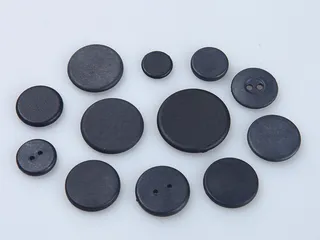
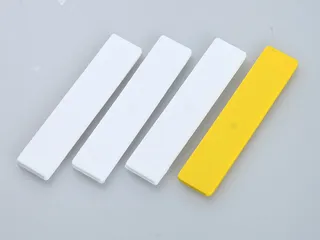
- PPS hard-shell (Syensqo Ryton R-4-200NA / R-7-120 polyphenylene sulfide) — rigid encapsulation. Survives 200–500+ wash cycles at 95 °C with 60-bar press. Continuous-use temperature 200 °C; autoclave-capable at 134 °C / 18 minutes per ANSI/AAMI ST79 with high-temp variants. Best for surgical textile reprocessing, heavy industrial workwear, and hospital scrubs. Costs $0.80–$3.00 per tag; relatively rigid so attachment is button-snap or sewn pouch.
- Silicone overmold (Wacker ELASTOSIL R 510/70 S, R 756/40 OH high-temperature grade) — flexible encapsulation rated −55 to +225 °C. R 756/40 OH survives 300 °C for 7 days. Best for items that flex during the wash cycle (terry towels, knit garments, sport jerseys). Heat-sealed or sewn-in. $0.30–$1.20 per tag at MOQ 1,000.
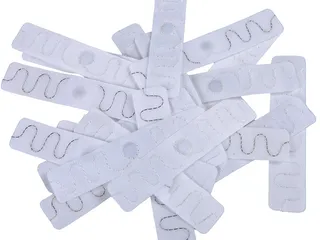
- Sewn-in textile carrier — chip + antenna laminated between woven layers, sewn invisibly into hem or label seam. Lowest disposable cost ($0.15–$0.45 per tag at MOQ 5,000). Best for chef coats, hotel linen rotation, uniform rental. Cycle life 100–200 cycles depending on carrier construction and sewing thread quality.
- MRI-safe variants — Datamars LaundryChip publishes "artefact size <3.5 mm" and non-ferromagnetic construction. Critical for any healthcare programme where tagged textiles can re-enter an MRI environment. Add ~10–15% to base tag cost.
- Antenna geometry — affects read distance and tunnel-washer survivability independent of polymer choice. Larger antenna footprints capture better at distance but are more prone to mechanical fatigue at fold creases.
Frequency + chip — UHF UCODE 9 / Monza / Higgs vs HF ICODE SLIX2
Frequency is a reader-infrastructure decision before it is a tag-chip decision. UHF (860–960 MHz) wins on throughput and read range; HF (13.56 MHz) wins on item-level close-read and healthcare compliance. Almost every commercial laundry today runs UHF; almost every hospital surgical-textile programme runs HF.
- NXP UCODE 9 (SL3S1206) — the current default for UHF laundry tag chips. EPC Gen2 V2; 96-bit EPC memory; supports anti-counterfeiting features. Standard pairing for new commercial-laundry rollouts.
- NXP UCODE 8 / 8m (SL3S1205_15) — predecessor to UCODE 9; widely deployed across legacy laundry tag stock. Compatible with installed UCODE 8 reader infrastructure.
- NXP ICODE SLIX2 (SL2S2602) — the standard HF (13.56 MHz) chip for healthcare surgical-textile and hospital-scrub programmes. ISO/IEC 15693 vicinity-coupling.
- Impinj Monza 4QT — UHF alternative with quad-port-tag (QT) feature for short-range / long-range mode switching. Common on premium commercial-laundry deployments.
- Impinj Monza R6 — higher-sensitivity UHF chip, used where read range matters more than memory size.
- Alien Higgs-3 / Higgs-4 / Higgs-9 — UHF chip family used across many Datamars and SML laundry tag SKUs. Higgs-9 is current generation.
- Frequency decision rule of thumb: > 500 tags/hour throughput → UHF tunnel reader; < 100 tags/hour with item-level close-read → HF handheld; mixed → dual-frequency tag with UHF + HF inlays (rare and expensive).
Reader infrastructure — tunnel, portal, handheld
Reader CapEx is often 5–10× the per-cycle tag cost on a commercial laundry, so the reader choice frames the rest of the programme. The table below maps reader categories to deployment scenarios and indicative cost.
- Read-point siting matters as much as reader choice — anti-collision algorithms degrade under tag density above 500/m². Design the tunnel reader geometry around your peak-throughput linen-folder configuration.
- Metal proximity issues — UHF tunnel readers above stainless conveyors require ferrite isolators and antenna tilt. Validate read rate on the production conveyor, not a benchtop mock-up.
| Reader category | Typical deployment | Throughput | Indicative cost | Common SKUs |
|---|---|---|---|---|
| UHF tunnel reader | Soil-sort conveyor, clean-side wrap conveyor, finished-goods packing line | 500+ tags/sec at walking speed | $30,000–$80,000 per read point | Datamars UHF Open Tunnel, Positek 18"–45" conveyor, Times-7 A6020 underbelt portal |
| UHF underbelt portal | Garment-on-hanger lines, single-item finishing | 200–400 tags/min | $15,000–$30,000 per read point | Times-7 A6020, Impinj Speedway xPortal |
| UHF fixed wall reader | Loading dock, soiled-linen weighing station | 100–300 tags/min | $5,000–$12,000 per read point | Impinj Speedway R420, Zebra FX9600 |
| UHF handheld | Spot inventory, item search, customer site audit | 1 tag/sec close-read | $1,500–$4,000 per unit | Zebra MC3300xR, Bluebird RFR900 |
| HF tabletop reader | Healthcare surgical-textile checkout / return desk | 1 tag/sec close-read | $300–$1,500 per unit | Various ICODE SLIX2-compatible readers |
| HF handheld | Sterile-processing department inventory | 1 tag/sec | $2,000–$5,000 per unit | Specialised healthcare RFID handhelds |
Healthcare deployment — TRSA Hygienically Clean Healthcare, ANSI/AAMI ST65 + ST79
Hospital and healthcare-textile programmes operate under stricter compliance constraints than commercial laundries. Surgical scrubs, isolation gowns, drapes and patient linens follow a different durability and microbiological-testing track than hospitality linens.
- TRSA Hygienically Clean Healthcare — adds RODAC-plate sampling and USP <62> microbiological testing on top of the standard Hygienically Clean wash-validation framework. Quarterly third-party microbiological audits.
- ANSI/AAMI ST65:2008 (R2018) "Processing of reusable surgical textiles for use in health care facilities" — the procedural standard for surgical-scrub and isolation-gown reprocessing.
- ANSI/AAMI ST79:2017 (R2022) "Comprehensive guide to steam sterilization and sterility assurance in health care facilities" — required for tags that re-enter sterile-processing departments. Steam sterilization at 134 °C / 18 minutes is the standard cycle.
- FDA UDI (Unique Device Identification) — if the tagged textile is a Class I/II medical device (some surgical-textile categories), the RFID tag may need to encode or link to the UDI for traceability.
- ISO 13485 — quality-management standard for medical-device manufacturers. Healthcare-textile reprocessors increasingly require their tag suppliers to operate under ISO 13485 quality systems.
- MRI compatibility — surgical textiles can re-enter MRI environments after sterilization. Tags need to be ferrite-free with artefact size <3.5 mm. Datamars LaundryChip family publishes this spec explicitly; competitors should match the standard.
- Documented deployments — Texas Children's Hospital + Zebra + Tecsys saved $14M on surgical-textile programmes per RFID Journal case study; ImageFIRST scrub programmes are the largest healthcare-textile RFID operator in the United States.
ROI worksheet — concrete numbers for a 2026 programme
The ROI conversation usually pivots on three numbers: current linen-loss rate, replacement-cost-per-item, and total annual linen replacement spend. The table below gives indicative ROI ranges for a typical commercial laundry running 200,000–500,000 items per cycle.
- Tag amortisation — cost-per-use is what matters, not unit cost. A $3.00 PPS tag at 500 cycles is $0.006/cycle; a $0.40 textile tag at 100 cycles is $0.004/cycle. The polymer choice trades unit cost against cycle life.
- Soft-cost savings — labour reduction (auto-counting eliminates physical inventory checks), shrinkage attribution (you know which property lost an item), and customer-billing accuracy (rental programmes can charge accurately).
- Insurance discounts — some commercial-laundry insurers now offer premium discounts for documented RFID-tracked linen inventories.
| Metric | Pre-RFID baseline | Post-RFID target | Source |
|---|---|---|---|
| Annual linen loss rate | 20–30% | 0.5–2% | AHLA hospitality benchmarks; RFID Journal case studies |
| Linen-replacement annual spend (per ~$1M baseline) | $1,000,000 | $200,000–$300,000 saved per year | Mid-size commercial laundry typical |
| Cost per RFID tag | — | $0.30–$3.00 depending on material | MOQ 5,000 published prices |
| Cost per cycle (amortised over tag life) | — | $0.01–$0.02 | 200–500 cycles × tag cost |
| Reader CapEx amortised year 1 | — | $30,000–$200,000 | Tunnel readers + handhelds |
| Payback period | — | 12–18 months | Multiple commercial-laundry deployments |
| Healthcare deployment savings (case study) | — | $14M saved on surgical textiles over deployment lifecycle | Texas Children's + Zebra + Tecsys, RFID Journal |
Attachment methods — sewn-in, heat-seal, button-snap, pocket-insert, pin
Attachment is where 60% of field failures originate. Each method has a different equipment cost, labour cost per item, finish quality and durability profile.
- Sewn-in textile carrier — RFID inlay encapsulated in a woven textile carrier that is sewn invisibly into the garment hem or label seam. Cycle life 100–200 cycles. Labour-intensive at install (sewing machine + skilled operator) but no specialised equipment needed.
- Heat-seal — ultrasonic or thermal weld of an RFID patch onto the garment surface. Cycle life 150–300 cycles. Equipment cost $80–$300 for benchtop heat sealer; can be automated for larger throughput. Best for synthetic textiles that accept thermal bonding.
- Button-snap (separable button-style tag) — PPS or silicone tag with a snap closure that attaches through a sewn buttonhole on the garment. Cycle life follows tag-polymer rating (200–500 cycles for PPS). Removable for repair / chip-rotation. Common on chef coats, surgical scrubs.
- Ultrasonic weld — high-frequency vibration bonds two thermoplastic layers around the RFID inlay. Faster than heat-seal at scale; requires specialised welding equipment ($1,500–$5,000).
- Pocket insert — RFID tag slips into a sewn-in pocket; removable for repair. Common on rental-uniform programmes where the tag can be re-used across multiple garment replacements.
- Pin / clip-on — for short-lifecycle or non-laundry use cases (one-time event, single-shift staff badges). Rare for production laundry programmes.
Pilot validation checklist — what to test before scaling
A good pilot is deliberately pessimistic. It exercises the tag, the attachment, the actual tunnel-washer chemistry, the reader infrastructure, the back-end software and the operational workflow — and treats each one as guilty until proven otherwise. The failure modes that politely sit out the bench test tend to surface only once the line is running at full speed, which is a far more expensive place to find them.
- Run the actual tunnel washer chemistry on samples — not a benchtop ISO 6330 test cycle. Document peak temperature, pH, chemical formula, and press / spin parameters.
- Test cycle target × 1.5 buffer — if the programme target is 200 cycles, validate samples to 300 cycles in the pilot. Field failure is usually 30–50% below benchtop claim.
- Read rate at production conveyor speed — anti-collision algorithms degrade above 500 tags/m². Validate at peak throughput, not benchtop dwell.
- Reader siting — confirm metal-proximity tuning and antenna geometry on the actual production line. Stainless conveyors below UHF tunnel readers introduce read-rate fade.
- For healthcare programmes — exercise the full surgical-textile reprocessing cycle including ST79 steam sterilization at 134 °C / 18 minutes; validate microbiological testing pass for TRSA Hygienically Clean Healthcare quarterly audit.
- Plan a 5,000-tag first production batch before scaling to a 50,000+ deployment. Most field failure modes show up in the first three months of live operation, and replacement at scale costs 5–10× the pilot rate.
Useful next pages
Use these linked product, guide and comparison pages to keep the next click specific and practical.
Laundry tag products
Starting points for the wash-profile-specific tag order. Match polymer to ISO 15797 vs ISO 6330 wash chemistry; match chip to reader frequency.
Side-by-side comparisons
Decision-tool pages for polymer family, frequency, and chip choices.
Related editorial
Background reading on industrial RFID laundry programmes.
FAQ
How many wash cycles can RFID laundry tags survive?
Depends on polymer and wash profile. PPS (Syensqo Ryton) hard-shell tags rate 200–500 cycles under ISO 15797 industrial wash chemistry (75–95 °C, pH 11–12, 60-bar press, 180 °C ironer). Silicone overmold tags (Wacker ELASTOSIL HTV) rate 150–300 cycles; high-temperature R 756/40 OH variants survive 300 °C / 7 days. Sewn-in textile carriers rate 100–200 cycles. Spec-sheet numbers should be validated against the actual tunnel washer chemistry in the pilot, not benchtop ISO 6330 tests — field failure is typically 30–50% below benchtop claim.
Should we choose UHF or HF for a commercial laundry?
UHF (860–960 MHz) for any programme over ~500 tags/hour with tunnel-reader or conveyor-portal infrastructure — the standard choice for hotel linen, commercial-laundry uniform programmes, and rental operations. HF (13.56 MHz, ICODE SLIX2) for healthcare surgical-textile programmes that need item-level close-read and TRSA Hygienically Clean Healthcare microbiological audit compliance. Mixed deployments occasionally use dual-frequency tags but the cost premium is rarely justified outside niche pharmacy / sterile-processing flows.
What attachment method works best for hotel linen?
For hotel terry towels and pool linen — silicone overmold heat-sealed at the corner or seam. The silicone tolerates the flexing of folded towels and the heat-seal survives commercial wash chemistry. For hotel pillowcases and sheets — sewn-in textile carrier in the hem corner; lower cost, invisible to guests, 100–200 cycle life suits the normal hotel-linen rotation. For chef coats and BOH uniforms — button-snap PPS tag through a sewn buttonhole; longest cycle life and easy to remove for garment repair.
How does an RFID laundry tag programme integrate with ANSI/AAMI ST79 sterile-processing?
For surgical-textile programmes that re-enter sterile processing, the tag must survive steam sterilization at 134 °C / 18 minutes (ANSI/AAMI ST79 standard cycle). High-temp PPS variants (Syensqo Ryton R-4-200NA) and high-temp silicone (Wacker R 756/40 OH) both qualify; standard silicone and textile carriers do not. The chip itself (typically NXP ICODE SLIX2 for HF healthcare) is stable through ST79 cycles. Document the autoclave-compatibility certification in the supplier RFP — most healthcare laundries require this as a pre-qualification gate.
What is TRSA Hygienically Clean Healthcare and why does it matter?
TRSA Hygienically Clean is the certification framework for commercial laundries demonstrating microbiological cleanliness; the Healthcare variant adds RODAC-plate sampling and USP <62> microbiological testing on quarterly audits. For RFID programmes the relevance is that the certification audits the entire textile-handling workflow — including RFID-tag handling, attachment durability and post-sterilization inspection. Suppliers responding to a healthcare-laundry RFP should be prepared to explain how their tag programme passes the Hygienically Clean Healthcare audit framework.
What is the typical ROI on an RFID laundry tag programme?
12–18 month payback at typical commercial-laundry scale. The headline number is linen-loss reduction: AHLA hospitality benchmarks cite 20–30% annual linen loss before RFID; deployed RFID programmes target 0.5–2% loss. On a $1M annual linen replacement spend that is $200,000–$300,000 / year saved. Reader CapEx (tunnel + handhelds) is typically $30,000–$200,000 for a mid-size operation; per-tag cost amortises at $0.01–$0.02 per cycle. Soft-cost savings (labour reduction, shrinkage attribution, customer-billing accuracy) often equal the hard-cost savings. Healthcare programmes can exceed these numbers — Texas Children's Hospital with Zebra + Tecsys documented $14M savings on surgical textiles per RFID Journal.
Are RFID laundry tags MRI-safe?
MRI-safe variants exist and matter for any healthcare-textile programme where the tagged garment can re-enter an MRI environment. Datamars LaundryChip family publishes "artefact size <3.5 mm" and non-ferromagnetic construction. Standard commercial-laundry tags (PPS, silicone, textile) are not MRI-safe unless explicitly certified — verify the spec sheet before specifying tags for hospital scrubs or surgical drapes that may end up in MRI suites.
Can one tag cover all the item categories in our laundry?
Usually not. A single chip family (UHF UCODE 9 for commercial, HF ICODE SLIX2 for healthcare close-read) can cover most items, but the polymer / attachment combination needs to match the item type. Heavy chef coats → PPS button-snap. Hotel terry → silicone heat-seal. Surgical scrubs reprocessed at 134 °C → high-temp PPS or high-temp silicone. Hotel pillowcases → sewn-in textile. Map item categories to tag SKUs before sampling; most commercial laundries end up with 2–4 distinct tag SKUs covering their full programme.
How does Fudan MIFARE Classic backdoor disclosure (Aug 2024) affect RFID laundry tags?
Not directly — the August 2024 Quarkslab disclosure of a hardware backdoor in Fudan FM11RF08 / FM11RF08S MIFARE Classic clones affects 13.56 MHz hotel key cards and access cards, not the UHF chips (UCODE 8/9, Monza, Higgs) used in commercial laundry. HF healthcare tags running ICODE SLIX2 are also unaffected because SLIX2 is a different NXP chip family (ISO/IEC 15693) than MIFARE Classic. Procurement teams running parallel hotel-key-card programmes should still verify their key-card supplier ships NXP-fab silicon — see /solutions/hotel-key-cards/ for that decision.
Sources & references
Primary standards, OEM datasheets and regulatory documents cited by this article. All URLs were verified on the access date shown below.
- ISO 15797:2017 — Industrial laundering test procedures (workwear)
Industrial wash standard — 75–95 °C, pH 11–12 alkaline formula, 60-bar press, 180 °C ironer. The actual benchmark for commercial-laundry tag durability, not the domestic-wash ISO 6330.
- ISO 6330:2021 — Domestic washing and drying procedures for textile testing
Domestic wash standard (40–60 °C, neutral pH); useful for understanding the gap vs ISO 15797 industrial.
- TRSA Hygienically Clean certification
Cleanliness validation framework for commercial laundries.
- TRSA Hygienically Clean Healthcare
Healthcare variant — adds RODAC plates + USP <62> microbiological testing on quarterly audits.
- ANSI/AAMI ST79:2017 (R2022) — Comprehensive guide to steam sterilization
Steam sterilization at 134 °C / 18 minutes — required cycle for tags re-entering sterile processing.
- ANSI/AAMI ST65 — Processing of reusable surgical textiles
Procedural standard for surgical-scrub, isolation-gown and drape reprocessing.
- NXP UCODE 9 datasheet (SL3S1206)
Current-generation UHF chip for commercial-laundry tag stock. EPC Gen2 V2; 96-bit EPC memory.
- NXP UCODE 8 / 8m datasheet (SL3S1205_15)
Predecessor UHF chip; still widely deployed in installed UCODE 8 reader infrastructures.
- NXP ICODE SLIX2 datasheet (SL2S2602)
Standard HF (ISO/IEC 15693) chip for healthcare surgical-textile programmes.
- Impinj Monza 4 datasheet
UHF alternative chip with quad-port-tag feature for short / long range mode switching.
- Datamars Textile-ID — product portfolio
Major OEM in commercial-laundry RFID tags; MRI-safe LaundryChip family with <3.5 mm artefact size.
- Datamars MRI compatibility note
Source for the "artefact size <3.5 mm" MRI-safe specification.
- Avery Dennison Smartrac Laundry Tag
Competitor product portfolio — HF UID-only for lowest-cost-of-ownership commercial laundry.
- HID Global Textile RFID Tags
LinTRAK / textile RFID tag portfolio including MRI-compatible C15S-MRI-M730 SKU.
- Wacker ELASTOSIL HTV product family
High-consistency silicone rubber portfolio used in silicone-overmold RFID laundry tags.
- Wacker ELASTOSIL R 510/70 S datasheet
Standard silicone grade for laundry-tag overmold: −55 to +225 °C operating range.
- Syensqo (Solvay) Ryton PPS portfolio
Source polymer for PPS hard-shell RFID laundry tags — continuous-use temperature 200 °C, autoclave-capable.
- Solvay Ryton PPS grade comparison
R-4-200NA vs R-7-120 grade comparison for PPS RFID tag specification.
- ARTA — American Reusable Textile Association
Industry-association reference for reusable textile programmes including healthcare scrubs.
- RFID Journal — Texas Children's $14M case study
Documented healthcare deployment — Texas Children's Hospital + Zebra + Tecsys saved $14M on surgical-textile programmes.
- RFID Journal — UHF tunnel reader systems for laundry
Industry-press reference for tunnel reader infrastructure capabilities.
- NIH PMC — RFID in healthcare scoping review
Peer-reviewed scoping review of RFID applications in healthcare including surgical-textile tracking.
- AHLA hospitality benchmarks (linen loss baseline)
Hospitality-industry baseline for 20–30% annual linen-loss rate against which RFID programmes are evaluated.
Proud Tek is a Shenzhen-based RFID & NFC manufacturer supplying hotel chains, transit operators, event venues and retail brands worldwide. Every order includes free samples, RF testing and dedicated project support.
Get a Quick Quote
Tell us about your project and we'll respond within one business day. Fields marked (asterisk) are required.