
Long-Range UHF Windshield
Long-Range UHF RFID Windshield Sticker
Toll & Yard

Quick answer
Long-range UHF RFID windshield stickers extend the standard 3-10 m windshield-RFID read range to 5-12 m through automotive glass, enabling drive-through identification at highway-toll speeds and yard-management gate reads where the standard windshield-label SKU is insufficient. Designed for fleet yards (Manhattan Active YMS / Blue Yonder / SAP Yard Logistics), 6C-compatible private-tolling, gated-community high-throughput gates and TMS / telematics-fed RFID-vs-ALPR hybrid deployments. Tamper-evident destructible adhesive + EPC Gen2v2 + Impinj Monza R6-P / NXP UCODE 9 long-range antenna design.
- 5-12 m read range through automotive windshield glass — drive-through identification at highway toll speeds and automatic gate opening without vehicles stopping. Extends the standard windshield-label SKU's 3-10 m reach.
- Tamper-evident destructible adhesive — permanently bonds to the windshield interior and self-destructs if removal is attempted, preventing unauthorised transfer between vehicles.
- EPC Gen2v2 UHF chips (Impinj Monza R6-P, M730, NXP UCODE 8/9) — 96-bit or 128-bit EPC memory for serialised vehicle identification + integration with toll, parking, yard-management and telematics platforms.
Used in these industries
Deployments where this product is referenced on our industry landing pages.

At a glance
Use these short answers to decide whether this page matches the project before moving into the detail.
Frequency + chip silicon
UHF 860-960 MHz RAIN per ISO/IEC 18000-63:2015 (EPC Gen2v2) Impinj Monza R6-P (auto-tune for windshield mounting) — recommended
Long-range antenna design
Copper-etched or aluminium-etched long-dipole antenna Optimised for through-glass RF transmission (6-12 dB athermic compensation)
Next step
Ready to move forward? Start your inquiry to get specific answers for this project.
Request a quote for windshield RFID stickersCommercial terms
- MOQ
- Varies by SKU — stock items from 100 pcs; custom production typically 200-1,000 pcs
- Lead time
- Production 2-3 weeks after artwork and encoding sign-off; reorders on a 3-4 week cycle
- Samples
- Free samples and RF test report with every order; courier at customer cost
- Payment
- 50% T/T deposit, 50% before shipment; Net 30/60 for established accounts; LC for large orders
- Shipping
- FOB Shenzhen / Yantian; DHL, FedEx or EMS air freight; sea LCL / FCL for volume
- Response
- Itemized quote within one business day, Mon-Fri (UTC+8)
How UHF RFID windshield stickers enable automated vehicle identification
- A UHF RFID reader mounted at a toll plaza, gate, or parking entrance interrogates the windshield sticker from several metres away as the vehicle approaches, reading the unique EPC number in milliseconds.
- The read EPC is matched to a vehicle record in the backend database, triggering automatic toll deduction, gate opening, or parking access authorisation without driver interaction.
- At highway speeds of 100+ km/h, the tag must be readable within the brief window when the vehicle is in the reader's field. Our long-range stickers use high-sensitivity chips and optimised antenna designs to ensure first-pass read success rates above 99.5%.
- Windshield mounting places the tag behind glass, protecting it from weather, car washes, and physical damage while maintaining clear line-of-sight to overhead or side-mounted reader antennas.
- Long-range stickers extend the standard 3-10 m windshield-label range to 5-12 m via larger antenna + Monza R6-P auto-tune — enabling deployments where vehicles cannot slow to gate speed.
Read the truck before it reaches the barrier
5-8 m at 0-30 km/h (parking + yard gate) 8-12 m at 30-100 km/h (toll + highway) First-pass read success >99.5% with 30 dBm circular-polarised reader Tag-chip sensitivity −20 dBm (Monza R6-P) Anti-collision: hundreds of vehicles per second per reader
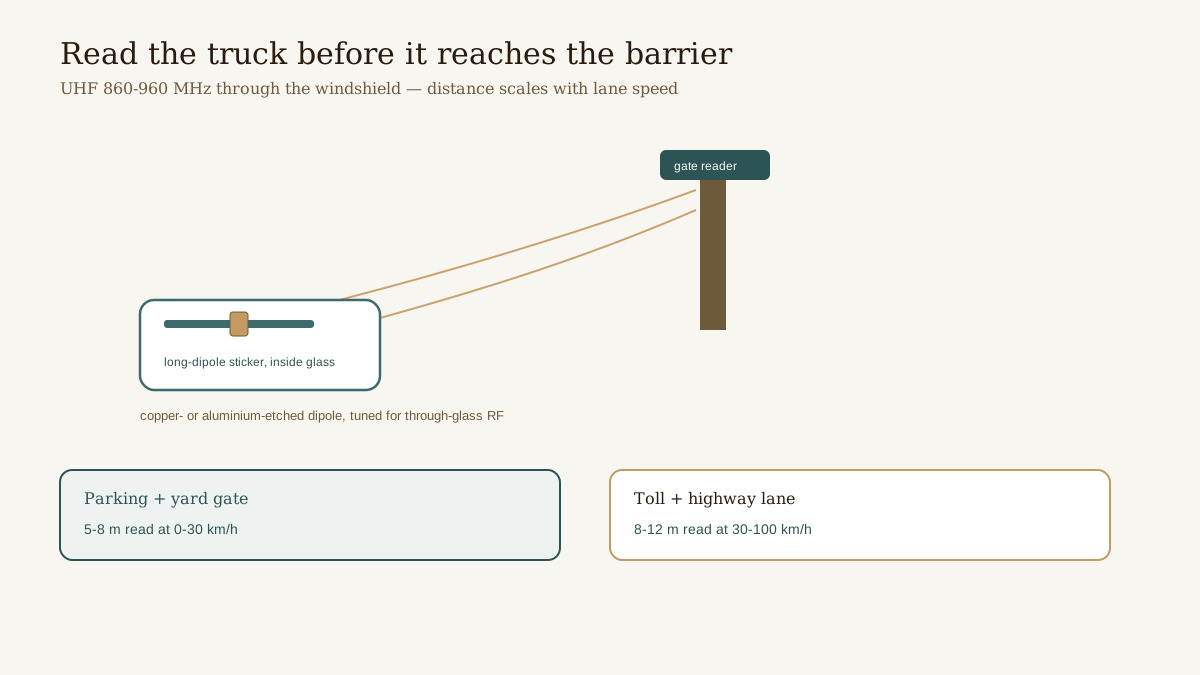
- Copper-etched or aluminium-etched long-dipole antenna Optimised for through-glass RF transmission (6-12 dB athermic compensation) Auto-tune chip variant compensates for vehicle-by-vehicle glass variation Form factor 100 × 40 mm (standard) or 120 × 50 mm (long-range) <0.5 mm total profile — fits behind rearview mirror without ADAS interference
- Impinj Speedway R420 / R700 fixed reader (5-10 m rated) Zebra FX9600 fixed reader (4-portal antennas) Alien ALR-9900+ enterprise reader Mid-range RAIN reader 1-2 per gate lane + 2-4 antennas/reader 30 dBm EIRP (FCC) / 33 dBm ERP (ETSI) reader power
Stays on its windshield — or stops existing
Destructible PET face stock + brittle face material Antenna fractures if peel attempted → tag electronically dead One-to-one sticker-to-vehicle binding (no reuse on different vehicle) Visual evidence of removal attempt for security audit Single-use teardown via destructible adhesive
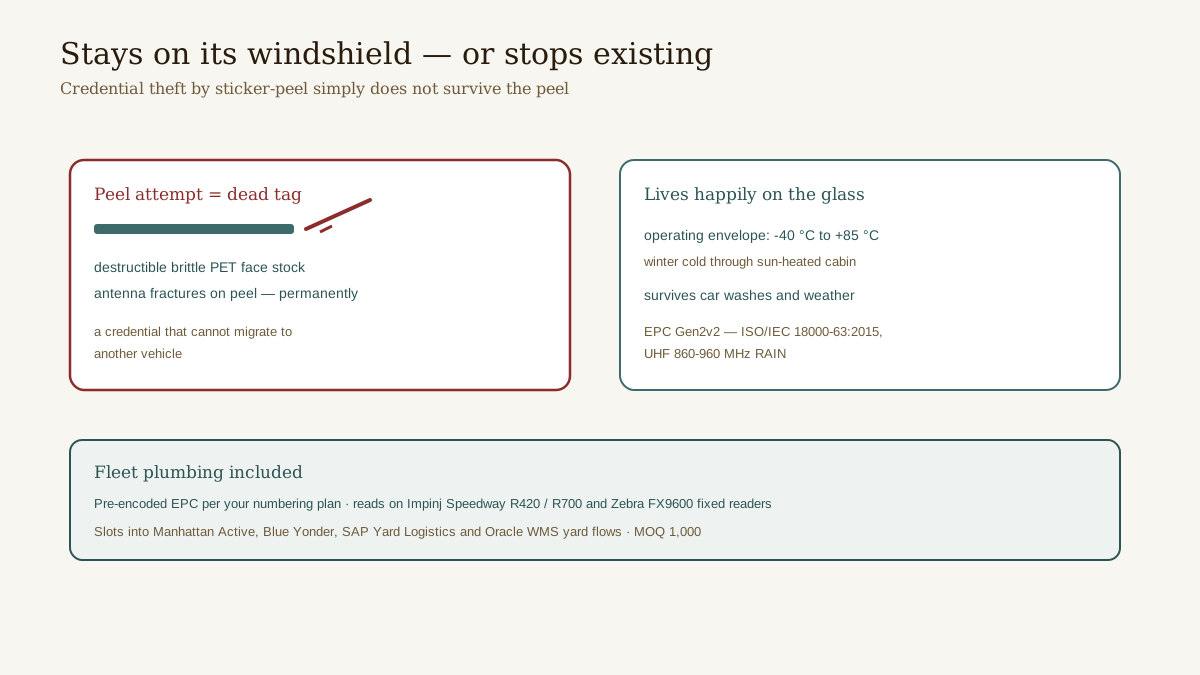
- Operating temperature −40 °C to +85 °C (winter cold + sun-heated cabin) Survives car-wash + windshield wiper + winter ice + UV 5+ year outdoor lifespan validated Inside-windshield placement = weather-protected RF survives car-cleaning chemicals + plate-spec adhesive removers
- Standard windshield-label: 3-10 m read range, USD 0.20-0.50/unit, parking + corporate campus Long-range windshield-sticker: 5-12 m, USD 0.40-2.00/unit, highway-speed + yard + 6C tolling Long-range = larger antenna + Monza R6-P auto-tune + premium SKU Standard = entry-tier for static or slow-speed gate access Same destructible adhesive + same chip family — choose by read-range requirement
Standard windshield-label vs long-range sticker — choosing the right SKU
Standard UHF RFID windshield label (3-10 m)
- 3-10 m read range — adequate for parking gate stop-and-read
- USD 0.20-0.50/unit — entry-tier price
- Standard antenna size 80×30 to 100×40 mm
- Best for: corporate campus, gated community at gate-speed
- Compatible: Impinj M730, NXP UCODE 8 entry-tier
Long-range UHF windshield sticker (5-12 m, this page)
- 5-12 m read range — tractor-trailer yard + toll-speed reads
- USD 0.40-2.00/unit — premium SKU
- Long-dipole antenna 100×40 to 120×50 mm + Monza R6-P auto-tune
- Best for: logistics yard, 6C tolling, highway-speed identification
- Compatible: Impinj Monza R6-P, M770, NXP UCODE 9 premium
- Chip options — Impinj Monza R6-P (auto-tune for windshield mounting), Impinj M730/M750/M770, NXP UCODE 8/9 — all supporting EPC Gen2v2 and ISO/IEC 18000-63 for global UHF compatibility.
- Antenna design — copper-etched or aluminium-etched long-dipole antenna optimised for through-glass RF transmission, compensating for the 6-12 dB signal attenuation caused by automotive windshield coatings.
- Tamper-evident adhesive — brittle face material and high-bond adhesive destroy the tag if peeling is attempted. The antenna fractures and the tag becomes non-functional, preventing transfer to another vehicle.
- Form factor — typical dimensions of 100 × 40 mm (standard long-range) or 120 × 50 mm (extended-range), slim enough to mount discreetly behind the rearview mirror area on the windshield interior.
- Operating temperature — −40 °C to +85 °C — covering extreme cold (winter windshield surfaces) through intense sun-heated windshield interior temperatures in summer.
Per-tap data published from a Proud Tek long-range UHF windshield sticker
- Auto-tune chip: Monza R6-P retunes per windshield to compensate dielectric variation.
- Long-dipole antenna: 100×40 / 120×50 mm for 6-12 dB athermic compensation.
- Reader power: 30 dBm EIRP (FCC) / 33 dBm ERP (ETSI) circular-polarised.
- First-pass success: 99.5%+ at 100 km/h with site-survey-tuned reader placement.
- YMS integration: Manhattan + Blue Yonder + SAP + Oracle + Körber + PINC + C3.
Technical specifications and design features
- Chip options — Impinj Monza R6-P (auto-tune for windshield mounting), Impinj M730, NXP UCODE 8, NXP UCODE 9 — all supporting EPC Gen2v2 and ISO/IEC 18000-63 for global UHF compatibility.
- Antenna design — copper-etched or aluminium-etched long-dipole antenna optimised for through-glass RF transmission, compensating for the signal attenuation caused by automotive windshield coatings.
- Tamper-evident adhesive — brittle face material and high-bond adhesive destroy the tag if peeling is attempted. The antenna fractures and the tag becomes non-functional, preventing transfer to another vehicle.
- Form factor — typical dimensions of 100 × 40 mm or 120 × 50 mm, slim enough to mount discreetly behind the rearview mirror area on the windshield interior.
- Operating temperature — −40 °C to +85 °C — covering extreme cold (winter windshield surfaces) through intense sun-heated windshield interior temperatures in summer.
Deployment and system integration
- Compatible with all major toll collection and vehicle access control platforms that use EPC Gen2 UHF protocols, including national electronic toll collection (ETC) programmes (per agency agreement).
- Proud Tek provides pre-encoded stickers with sequential EPC numbers and a corresponding database file (CSV / Excel) for bulk import into your vehicle management or toll collection system.
- Custom printing on the sticker surface with your organisation's logo, vehicle category indicator, or barcode backup for manual identification at staffed checkpoints.
- Site-survey support for read-range optimisation per gate layout — Proud Tek field-validates 50-sticker sample roll on a representative vehicle fleet before volume order.
- Integration playbook for YMS / TMS / fleet-telematics platforms — Manhattan Active YMS, Blue Yonder Luminate, SAP Yard Logistics, Geotab MyGeotab, Samsara Fleet, Verizon Connect Reveal, Trimble TMW, Omnitracs.
Fleet / yard management, TMS / WMS integration and the RFID vs ALPR trade-off
- Yard management system (YMS) integration is the primary long-range UHF windshield-sticker application for logistics operators — Manhattan Active Yard Management, Blue Yonder YMS, SAP Yard Logistics, Oracle WMS Cloud Yard Management, Körber K.Motion Yard Management, PINC Advanced Yard Management and C3 Solutions Yard Smart all ingest UHF RFID reads at gate + dock + trailer-parking zones. The windshield sticker serves as the tractor identity anchor; a UHF RFID tag on the trailer (uhf-rfid-pallet-label or equivalent) serves as the trailer identity; the YMS correlates both to track dwell time, empty / loaded state, dock assignment and carrier.
- For fleet telematics overlays, the windshield UHF sticker integrates with Geotab MyGeotab, Samsara Fleet, Verizon Connect Reveal, Trimble TMW / PeopleNet, Omnitracs, Motive (KeepTruckin), Lytx — via the RFID gateway / API layer rather than the telematics device directly. Typical architecture: RFID gate reader → RFID middleware (Impinj ItemSense, Zebra MotionWorks, Alien Gateway) → REST API webhook → telematics platform event stream.
- RFID-vs-ALPR (Automatic License Plate Recognition) is the standard trade-off at toll plazas and high-throughput gates. ALPR uses cameras + OCR + cloud matching and works without any in-vehicle hardware, but has 5-15% misread rates (dirty plates, snow, trailer hitches, non-standard plate formats) and higher per-installation cost. UHF RFID is 99.5%+ first-pass accurate, lower per-transaction cost, requires each vehicle to carry a sticker. Many deployments combine the two — RFID as primary, ALPR as secondary / fallback for vehicles without stickers (visitors, occasional guests). Sensys Gatso, Kapsch TrafficCom, Axis Communications and Genetec all ship combined RFID+ALPR solutions.
- For corporate campus / gated community / HOA / hospital / university shuttle / rental-car-lot applications, typical deployment: 1-2 readers per gate lane + 2-4 antennas per reader + mid-range RAIN RFID reader (Impinj Speedway R420 / R700 or Zebra FX9600), 5-10 metre rated read zone; installation 4-8 weeks; sticker issue at vehicle registration; replacement at windshield-change / ownership transfer via destructible adhesive teardown.
Long-range UHF windshield sticker timeline — from active proprietary to passive 6C interoperability
- 1989-2004 — TransCore SeGo + active 915 MHz baseline
TransCore SeGo (Super eGo) active battery-powered 915 MHz transponder establishes ETC market. Proprietary protocol predates ISO/IEC standardisation; battery life 10+ years.
- 2004 — ISO/IEC 18000-6C ratified
EPC Gen2 / ISO/IEC 18000-6C ratified — passive UHF 860-960 MHz becomes vendor-neutral global air-interface. Foundation for passive 6C public + private vehicle-ID applications.
- 2014-2018 — Impinj Monza R6-P + auto-tune maturity
Impinj Monza R6-P with auto-tune feature reaches windshield-deployment-ready cost + sensitivity. Per-windshield dielectric-variation compensation enables consistent 5-12 m read range across vehicle fleet.
- 2015 — IBTTA 6C national-interoperability working group
IBTTA initiates 6C national-interoperability working group. SunPass Pro, FasTrak, TxTag, ExpressToll, I-PASS, Ohio EZPass 6C transition begins. Late-2020s near-national interop target.
- 2018-2020 — YMS + TMS RFID integration scale
Manhattan Active YMS + Blue Yonder Luminate + SAP Yard Logistics + Oracle WMS Cloud + Körber K.Motion + PINC + C3 Solutions ratify RFID gateway integration patterns. Logistics-yard tractor-trailer ID becomes default RFID windshield-sticker use case.
- 2020 — FCC FCC 20-164 + RFID-vs-ALPR hybrid maturity
FCC reallocates 5.9 GHz upper 30 MHz to C-V2X (vacating DSRC) — RFID + ALPR remain primary vehicle-ID for static / gate / yard applications. Sensys Gatso + Kapsch + Axis + Genetec combined RFID+ALPR pedestals scale.
- 2022-2024 — Geotab + Samsara + Verizon Connect Reveal + Motive RFID overlays
Major fleet telematics platforms (Geotab, Samsara, Verizon Connect, Motive, Omnitracs, Trimble) ratify RFID middleware bridge architecture (Impinj ItemSense + Zebra MotionWorks + Alien Gateway). REST-API-fed RFID overlays standardise.
- 2026 — Today: long-range UHF windshield sticker standard practice
Field-reference patterns drawn from logistics-yard-tractor-id, 6c-private-toll, gated-community-high-throughput, fleet-depot-allocation, customer-loyalty-drive-through and rental-car-lot programmes converge on Impinj Monza R6-P + long-dipole antenna + destructible adhesive + YMS-integration middleware as the default architecture.
The reference facts, at a glance
Yard management integration
Manhattan Active Yard Management Blue Yonder YMS (Luminate) SAP Yard Logistics Oracle WMS Cloud Yard Management Körber K.Motion Yard Management PINC Advanced Yard Management + C3 Solutions Yard Smart
Fleet telematics platforms
Geotab MyGeotab — REST API + RFID gateway Samsara Fleet — RFID middleware bridge Verizon Connect Reveal — fleet RFID overlay Trimble TMW / PeopleNet — TMS integration Omnitracs + Motive (KeepTruckin) + Lytx Michelin Effitires / Bridgestone Webfleet for tire-coupled deployments
RFID vs ALPR
ALPR cameras + OCR + cloud matching — no in-vehicle hardware required ALPR misread rate 5-15% (dirty plates / snow / hitches / non-standard plates) RFID 99.5%+ first-pass + lower per-transaction cost Hybrid deployment: RFID primary + ALPR fallback for visitors Sensys Gatso, Kapsch TrafficCom, Axis, Genetec ship combined RFID+ALPR
Application verticals
Logistics yard — tractor identification at DC gates + dock-door + parking-zone 6C-compatible private toll (corporate, port, airport peripheral) Gated community high-throughput gates with through-traffic Hospital + university shuttle + rental-car-lot Customer loyalty parking (premium retailer drive-through) Fleet depot + operations centre + driver-yard-allocation tracking
Procurement
MOQ 1,000 stickers (long-range variant) Lead time 12-15 business days Pre-encoded EPC + per-vehicle CSV + corporate-logo print Sample roll (50 stickers) for site-survey read-range validation Per-YMS / per-TMS integration documentation on request Standard windshield-label SKU available at lower price for static-gate use
Useful next pages
Use these linked product, guide and comparison pages to keep the next click specific and practical.
Vehicle RFID identification products
Explore tags and labels for vehicle tracking and identification.
Chip-level technical reference
Deep-dive specifications and chip-family comparisons relevant to this SKU.
FAQ
Does windshield glass reduce the RFID read range?
Yes. Automotive windshield glass attenuates UHF RFID signals by 3-6 dB depending on glass type, coatings (such as solar-reflective metallised layers), and windshield angle. Our long-range windshield stickers use antenna designs and high-sensitivity chips specifically tuned to compensate for this glass attenuation, maintaining usable read ranges of 5-12 metres through standard automotive glass (3-6 dB) and 5-8 m through athermic / metallised glass (8-15 dB).
Can the windshield sticker be transferred to another vehicle?
No. The tamper-evident design uses a destructible face material that fractures the RFID antenna if removal is attempted. Once the sticker is peeled from the windshield, the antenna breaks and the tag becomes permanently non-functional. This prevents unauthorised transfer between vehicles and ensures one-to-one sticker-to-vehicle binding.
What read range can I expect in a parking garage environment?
In a parking garage with a fixed overhead reader antenna, typical read range is 5-8 metres at vehicle approach speeds of 10-20 km/h. For highway toll applications with high-gain reader antennas, range extends to 8-12 metres. We recommend a site survey with sample tags to validate performance in your specific installation before full deployment.
Can this sticker work with athermic / metallic-coated / heated windshields, and what are the options for signal-challenging glass?
Standard long-range windshield UHF stickers perform well on most automotive glass. Vehicles with metallic-coated (athermic, often found on EVs and premium European brands — BMW, Mercedes-Benz, Audi, Tesla, Porsche, Jaguar Land Rover) or heated windshields with embedded resistance wires (common in Ford, Volvo, Land Rover winter-climate trims) can attenuate UHF signals by an additional 8-15 dB. Three solutions: (1) athermic-glass version with tuned antenna compensating for the metallic coating (5-8 m typical range on metalised glass); (2) relocation to a non-coated 'RFID window' — most athermic windshields have a clear / uncoated area near the rearview mirror for GPS / radar sensors, and the sticker mounts there; (3) a headlamp-mounted UHF tag as an alternative form factor for vehicles where windshield mounting is infeasible (uhf-rfid-tire-label is a complementary option for heavy-fleet tire-ID applications). We provide an athermic-glass-compatible SKU on request; the quote includes a sample for on-vehicle read-range validation before committing to volume.
How do long-range UHF windshield stickers compare to EZPass / 6C toll transponders for public toll road applications?
Public electronic toll collection (ETC) and private long-range UHF windshield stickers use related but distinct technology layers. Public toll operators (EZPass Group, SunPass, FasTrak California, TxTag Texas, ExpressToll Colorado, I-PASS Illinois) issue proprietary transponders under their own agency agreement + back-office billing system. The 6C passive-UHF transition (ISO/IEC 18000-63 / EPC Gen2v2) allows the same physical chip technology across private + public domains, but interoperability with a specific toll agency requires the agency-issued transponder ID and a back-office agreement — we do not sell stickers for direct use on public toll roads without an agency agreement, as that would require the toll agency's permission and enrollment. For private applications (gated community, corporate campus, hospital, university, port, logistics yard, rental-car lot, HOA, employee parking, customer loyalty lot), our long-range windshield stickers are purpose-built and deliver the 5-12 m read range + tamper-evidence + serialised EPC that these deployments require. Fleet operators contracted with a public tolling agency (commercial trucking, ride-share) typically carry both — an agency-issued public-toll transponder + our private windshield sticker for yard / depot access.
Sources & references
Primary standards, OEM datasheets and regulatory documents cited by this article. All URLs were verified on the access date shown below.
- ISO/IEC 18000-63:2015 — RAIN RFID air interface (EPC Gen2v2)
UHF RAIN RFID 860-960 MHz air-interface — basis for Impinj Monza R6-P + NXP UCODE 9 chip families used in long-range windshield stickers.
- International Bridge, Tunnel and Turnpike Association (IBTTA) — National Interoperability working group
IBTTA 6C national-interoperability working group — late-2020s near-national US toll-agency interop target. Foundation for 6C-compatible private windshield deployments.
- FCC Part 15.247 — Operation in the 902-928 MHz band
FCC Part 15.247 — North American 902-928 MHz, 4 W EIRP regulatory framework for UHF RAIN windshield-sticker deployment.
- ETSI EN 302 208 — RFID devices operating in the band 865-868 MHz
ETSI EN 302 208 — European 865-868 MHz, 2 W ERP regulatory framework for EU windshield-sticker yard / corporate-campus deployment.
- Impinj M700 series / Monza R6-P tag chips
Impinj Monza R6-P auto-tune chip — recommended high-sensitivity chip for windshield-mounted long-range deployment. Auto-tune compensates per-vehicle dielectric variation.
- NXP UCODE 8 / UCODE 9 UHF RFID IC product page
NXP UCODE 8 / 9 — alternative high-sensitivity RAIN chip family for windshield-sticker premium SKUs.
- GS1 EPC Tag Data Standard (TDS 2.0) — SGTIN-96 and vehicle identification encoding
GS1 EPC TDS 2.0 — SGTIN-96 / GIAI-96 binary encoding for vehicle-identifier on long-range UHF windshield stickers.
- Manhattan Active Yard Management
Manhattan Active YMS — leading yard-management platform with native RFID-gate-reader integration. Tractor windshield sticker + trailer pallet-label correlated for dwell-time + dock-door + carrier tracking.
- Geotab MyGeotab fleet telematics platform — RFID gateway integration
Geotab MyGeotab — major fleet telematics platform. RFID middleware bridge (Impinj ItemSense / Zebra MotionWorks / Alien Gateway) feeds REST-API webhook events into Geotab event stream for tractor-yard-allocation tracking.
- Sensys Gatso combined RFID+ALPR pedestal product page
Sensys Gatso combined RFID + ALPR pedestal — common hybrid deployment. RFID primary (99.5%+ first-pass) + ALPR fallback for visitors without sticker. Kapsch + Axis + Genetec ship equivalent solutions.
Proud Tek is a Shenzhen-based RFID & NFC manufacturer supplying hotel chains, transit operators, event venues and retail brands worldwide. Every order includes free samples, RF testing and dedicated project support.
Get a Quick Quote
Tell us about your project and we'll respond within one business day. Fields marked (asterisk) are required.