
On-Metal RFID
RFID Anti-Metal Tags
UHF Tracking on Steel Assets

Quick answer
Standard UHF RFID tags fail on metal surfaces because the metal reflects and detunes the antenna. Anti-metal RFID tags solve this with a specialized construction that isolates the antenna from — or deliberately uses. The metal substrate, enabling reliable 1-10 m UHF reads on machinery, vehicles, containers, tools and metal assets from 10 mm micro tags to 200 mm long-range industrial tags.
- For long-life deployments, engineered for metal — ferrite-backed or ceramic construction isolates (or exploits) the metal substrate — some designs perform better on metal than in free air.
- Read range 1-10 m even when mounted directly on steel, aluminum, copper or iron; copper/brass delivers roughly 80-90% of steel read-range.
- Size range from 10×10 mm micro ceramic tags to 200×30 mm industrial tags covers IT servers, hand tools, containers, vehicles and factory equipment.
Used in these industries
Deployments where this product is referenced on our industry landing pages.


At a glance
Use these short answers to decide whether this page matches the project before moving into the detail.
Frequency
860-960 MHz (global UHF)
Protocol
EPC Gen2v2 (ISO/IEC 18000-63)
Next step
Ready to move forward? Start your inquiry to get specific answers for this project.
Request anti-metal tag quote- Construction
-
- Ceramic substrate (exploits metal as ground plane)
- PCB (FR4) substrate (ferrite-isolated)
- ABS housing with ferrite absorber
- Flexible foam-backed label
- Read range (on metal)
-
1-5 m (handheld), 3-10 m (fixed reader, depending on size)
- Sizes
-
10×10 mm (micro) to 200×30 mm (industrial long-range)
- Substrate tolerance
-
Carbon steel, stainless steel, aluminum, copper (≈80-90% of steel), brass
- Operating temp
-
-40 to +85 °C (standard), up to +250 °C (ceramic)
- IP rating
-
IP67 or IP68 depending on housing
- Mounting
-
3M VHB, screw/rivet, epoxy, weld-mount stud, magnetic base
- EPC scheme
-
GS1 GIAI-96 for serialized metal assets; SGTIN-96 for serialized goods
- MOQ / Lead time
-
500 pieces / 12-18 business days
Commercial terms
- MOQ
- Varies by SKU — stock items from 100 pcs; custom production typically 500-1,000 pcs
- Lead time
- Production 2-3 weeks after artwork and encoding sign-off; reorders on a 3-4 week cycle
- Samples
- Free samples and RF test report with every order; courier at customer cost
- Payment
- 50% T/T deposit, 50% before shipment; Net 30/60 for established accounts; LC for large orders
- Shipping
- FOB Shenzhen / Yantian; DHL, FedEx or EMS air freight; sea LCL / FCL for volume
- Response
- Itemized quote within one business day, Mon-Fri (UTC+8)
Problems procurement teams face when tagging metal assets with standard RFID
Metal defeats off-the-shelf UHF tags.
- IT and facilities managers deploying standard UHF RFID tags on server racks, metal shelving and equipment find read rates materially degraded by antenna detuning on metal surfaces — in practice often too low to sustain automated asset tracking, forcing a continued manual-barcode fallback.
- Industrial operations teams applying adhesive RFID labels to metal machinery and containers see tags fail prematurely as the adhesive releases from painted or powder-coated metal in high-temperature or high-vibration environments. Realised service life depends heavily on substrate, environment and adhesive specification.
- Military and defense procurement officers require tags that survive -40 °C storage, desert heat (+85 °C), chemical exposure and physical impact — specifications that standard plastic-housed tags cannot meet.
- Logistics operators tracking steel shipping containers at port and rail facilities need read ranges of 3–8 m for automated gate reads, but standard tags mounted on metal containers read at under 0.5 m or not at all.
- Organizations managing tool cribs, calibration instruments, and molds need tags small enough to mount on 10–30 mm surfaces without interfering with mechanical function — standard 50+ mm tags are impractical.
How Proud Tek anti-metal tags solve on-metal RFID deployment
Isolate — or exploit — the metal.
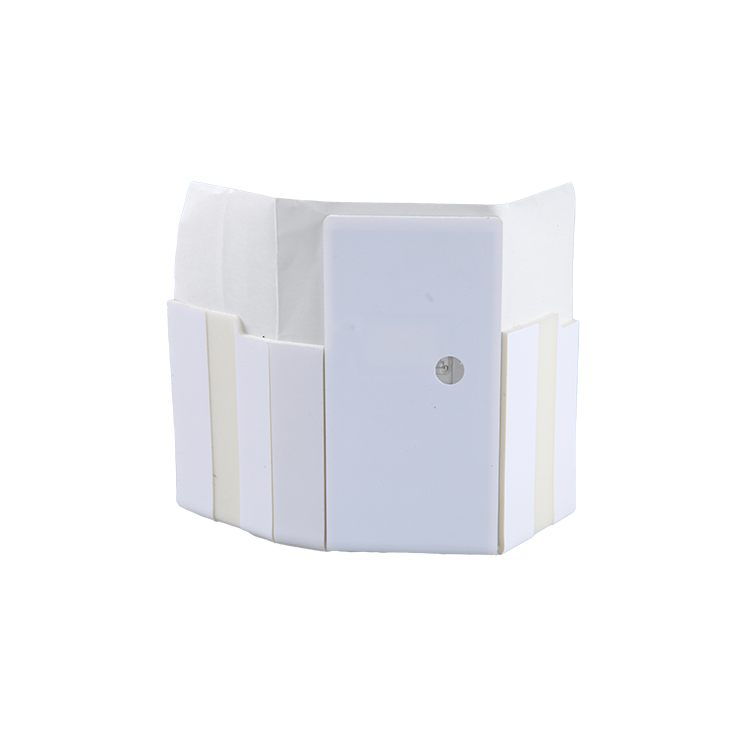
- Ferrite absorber, foam-core, ceramic and PCB substrate designs that isolate — or deliberately use — the metal surface as a ground plane, achieving 1–10 m read range on steel, aluminum, copper and iron depending on tag size and construction.
- Industrial adhesive (3M VHB), screw/rivet, epoxy and weld-mount stud options ensure tags remain permanently attached through vibration, thermal cycling and chemical wash-down without adhesive failure.
- Ceramic tags rated to +250 °C and IP67/IP68 enclosures for military, aerospace and high-temperature industrial applications where no alternative technology survives.
- Micro ceramic tags (10×10 mm) for tool tracking and jewelry, scaling to 200×30 mm industrial long-range tags for container and vehicle applications — matched to the exact read range your automation infrastructure requires.
- Per-lot performance verification on representative metal test plates before shipment, with application-specific antenna tuning available for your precise substrate material and surface geometry.
Ground-plane effect: why a ceramic tag can outperform free air
Metal becomes the antenna, not the enemy.
Typical outcomes from anti-metal RFID tag deployments
Deployment patterns, not case-study claims.
Figures below are directional benchmarks drawn from the published on-metal RFID literature and common integrator deployment patterns. Individual results depend on tag construction, reader infrastructure, asset mix and integration with the asset-management system — quantify against your own baseline before sizing the programme.
- IT asset management teams deploying PCB anti-metal tags on server and networking hardware compress inventory cycle time by roughly an order of magnitude versus manual barcode — multi-day audits collapse into a handheld scan that completes in hours. Read-rate reliability on metal at this tag-class is consistently reported above 95% in the on-metal RFID literature.
- Tool-crib managers using ceramic micro tags on drill bits and calibration instruments materially reduce the annual tool-replacement line driven by untracked losses. Absolute dollar recovery scales with your tool-crib spend; quantify against your current tool-loss rate before sizing the programme.
- Port logistics operators using ABS anti-metal tags on steel containers achieve automated gate reads at multi-metre range through fixed portal readers — enabling vehicle-through reads without stopping and supporting throughput rates that manual-scan workflows cannot match.
- Manufacturing plants tagging metal WIP components and fixtures materially reduce mis-picks and wrong-routing incidents after deployment. Resulting rework-cost savings are meaningful; quantify against your current scrap and rework cost centres before sizing the programme value.
Why standard tags fail on metal
Detuning, not mystery.
UHF RFID tags work by coupling electromagnetic energy between the reader antenna and the tag antenna. When a standard tag is placed on a metal surface, the metal acts as a ground plane that dramatically changes the antenna's impedance and radiation pattern — the tag's antenna is no longer impedance-matched to the chip, the antenna efficiency collapses, and the tag can no longer harvest enough energy to power on and respond. The result is severely reduced or zero read range.
Anti-metal tags solve this by either inserting a spacer layer (ferrite absorber, foam or air gap) between the antenna and the metal surface, or by deliberately designing the antenna as a patch antenna that uses the metal as its ground plane. The first strategy isolates the antenna; the second exploits the metal. Both restore — and can exceed — free-air performance on conductive substrates.
Standard barcode asset tag vs anti-metal RFID tag
Side-by-side on the same server rack.
Construction types
Pick by temperature + size + substrate.
| Type | Size range | Read range (on metal) | Temp range | Best for |
|---|---|---|---|---|
| Ceramic | 10×10 to 30×10 mm | 0.5-3 m | -40 to +250 °C | High-temp industrial, autoclave, tool-crib |
| PCB (FR4) | 12×12 to 100×25 mm | 1-8 m | -40 to +85 °C | IT assets, tools, server racks |
| ABS housing | 30×15 to 80×30 mm | 2-5 m | -30 to +80 °C | Containers, vehicles, outdoor |
| Flexible foam | 40×20 to 100×30 mm | 1-4 m | -20 to +70 °C | Curved metal surfaces, pipes |
| Industrial long-range | 120×30 to 200×30 mm | 5-10 m | -40 to +85 °C | Dock-door portals, vehicle gate reads, shipping containers |
Deployment phases integrators follow
Pilot, tune, roll, sustain.
- Substrate test plate
Ship sample tags on the customer's actual substrate sample (painted steel plate, aluminum chassis cutout, container panel). Validate read range with the customer's reader inventory before committing form factor. Duration: 1-2 weeks.
- Pilot fleet
Tag 200-500 representative assets with pre-encoded GIAI-96 EPCs. Instrument handheld + fixed portal read positions. Measure read-rate and write-verify. Duration: 2-4 weeks.
- Full rollout
Tag the rest of the fleet during normal decommission/commission work orders — avoid all-at-once disruption. Wire EPC feed into CMMS/CMDB per EPCIS 2.0 ObjectEvent schema. Duration: 2-6 months depending on fleet size.
- Sustaining audits
Quarterly or monthly bulk handheld audits replace manual barcode cycles. Missing-tag alerts trigger CMMS work orders. Tag-retire events close the asset lifecycle loop.
Applications
Every conductive surface is a candidate.
- IT asset tracking: laptops, servers, networking equipment and data center hardware.
- Tool and equipment management — track hand tools, power tools and calibration instruments.
- Vehicle and fleet identification — mount on chassis, bumpers or door frames for automated fleet management.
- Shipping container tracking: weatherproof tags on steel containers for port and logistics operations.
- Manufacturing WIP: track metal components, molds and fixtures through production lines.
- Utility and infrastructure: tag transformers, meters, manholes and metal utility infrastructure.
- Military and defense: ruggedized tags for weapons, vehicles and equipment inventory with MIL-STD-130N IUID compliance.
Mounting options
Six attachment methods, one tag family.
- 3M VHB adhesive: industrial double-sided tape rated for metal surfaces, outdoor weather and temperature cycling.
- Screw/rivet mount: through-holes in the tag housing for permanent mechanical attachment.
- Epoxy bonding: two-part industrial epoxy for vibration-prone environments.
- Magnetic mount: optional magnetic base for temporary, repositionable attachment.
- Cable tie slot: pass a cable tie through the tag housing for pipe and cable tray mounting.
- Weld-mount stud: spot-weld a threaded stud to the metal surface, then bolt the tag in place.
Useful next pages
Use these linked product, guide and comparison pages to keep the next click specific and practical.
Related on-metal and industrial RFID SKUs
Adjacent form-factors for on-metal and rugged industrial asset tagging.
Industry landings where on-metal RFID deploys
Sector pages that elaborate on-metal RFID programme design per vertical.
Related solutions and chip-family reference
The horizontal inventory-tracking solution this SKU anchors, and the UHF chip-family decision that feeds it.
FAQ
What read range can I expect on a steel surface?
Read range depends on tag size, chip sensitivity and reader power. As a guideline: micro ceramic tags (10×10 mm) achieve 0.5-1.5 m; mid-size PCB tags (50×15 mm) achieve 2-5 m; large-format tags (100×25 mm) reach 5-10 m on flat steel with a fixed reader; and long-range industrial tags (200×30 mm) can reach 8-10 m for dock-door and gate-read applications. Curved surfaces and paint coatings may slightly reduce range.
Does the tag work on aluminum, copper and brass as well as steel?
Yes — our anti-metal tags are designed to work on all common metals including carbon steel, stainless steel, aluminum, copper and brass. Performance is optimized for steel and aluminum (the most common industrial metals). On copper and brass, read range is typically 80-90% of steel performance due to higher RF losses in those alloys. Specify the substrate when requesting samples so we can ship the correct tuning.
Can these tags survive outdoor exposure?
Yes. Our ABS and ceramic anti-metal tags are rated IP67/IP68 and operate from -40 to +85 °C (or +250 °C for ceramic). They withstand rain, snow, UV exposure, salt spray and industrial chemicals. For extreme environments, we recommend ceramic tags, which are virtually indestructible.
Do you have tags that work on both metal and non-metal surfaces?
Most anti-metal tags are tuned specifically for metal surfaces and may have reduced performance in free space (off metal). If you need a tag that works well on both metal and non-metal surfaces, we offer dual-purpose designs with wider impedance matching. Specify your application and we will recommend the best option.
How do I choose the right tag size for my application?
Choose based on required read range and available mounting space. For IT servers in data centers where space is limited, use 12-25 mm micro tags (1-2 m range). For tools, equipment and containers scanned with handheld readers at 2-3 m, use 50-80 mm medium tags. For dock-door portals, vehicle identification and long-range applications, use 100-200 mm industrial tags (5-10 m range). We provide sample kits with multiple sizes for side-by-side testing on your actual substrate.
Is this tag suitable for MIL-STD-130N IUID or FAA AC 20-162A part-marking?
Yes — our PCB and ceramic anti-metal tag families are commonly specified into MIL-STD-130N Item Unique Identification (IUID) programs for DoD asset accountability and FAA AC 20-162A airworthiness programs for aviation part marking. We encode the UII data construct (DFAR 252.211-7003) or ATA Spec 2000 Ch. 9-5 identifiers at the factory from your XML or CSV feed. Request the MIL-STD-130N UII pre-encoding option and the FAA AC 20-162A worksheet when contacting us.
Sources & references
Primary standards, OEM datasheets and regulatory documents cited by this article. All URLs were verified on the access date shown below.
- ISO/IEC 18000-63:2021 Information technology — Radio frequency identification for item management — UHF air interface
UHF Gen2v2 air-interface protocol governing anti-metal UHF tag variants.
- GS1 Tag Data Standard 2.0
§7.1 GIAI-96 encoding for serialized reusable metal assets; §7.3 SGTIN-96 for serialized trade items.
- MIL-STD-130N (Change 1) — Identification Marking of U.S. Military Property
Item Unique Identification (IUID) data-construct requirements satisfied by pre-encoded anti-metal UHF tags.
- FAA Advisory Circular 20-162A — Airworthiness Approval of Automatic Identification (AI) Devices
Airworthiness approval framework for permanent RFID marking of aircraft parts.
- NXP UCODE 8 product datasheet (SL3S4011/12)
Chip sensitivity and self-adjust features used across the anti-metal PCB and ceramic variants.
- Impinj Monza R6-P tag chip datasheet
Autotune/Integra features specifically marketed for on-metal tag designs.
- FCC Part 15, Subpart C — Intentional Radiators (902-928 MHz)
US 4 W ERP limit for UHF reader power, which bounds practical on-metal read-range claims.
Proud Tek is a Shenzhen-based RFID & NFC manufacturer supplying hotel chains, transit operators, event venues and retail brands worldwide. Every order includes free samples, RF testing and dedicated project support.
Get a Quick Quote
Tell us about your project and we'll respond within one business day. Fields marked (asterisk) are required.