
RFID Supplier Dubai & UAE
RFID Supplier for Dubai & the UAE
Factory-Direct China

Quick answer
Proud Tek ships RFID to the UAE factory-direct from Shenzhen with Emirates-market spec sheets. The one fact that decides a UHF order: the UAE follows the European allocation, not the US or Australian one — UHF RFID runs at 865-868 MHz (2 W e.r.p.) with an optional 915-921 MHz upper band (4 W e.r.p.) under the TDRA per ETSI EN 302 208, so EU-standard 865-868 MHz inlays are band-correct here and US 902-928 MHz stock is not the default. Access and hotel cards run at 13.56 MHz (HF), which is global. Express air reaches Dubai, Abu Dhabi and Sharjah in 3-5 business days; RFID smart cards (HS 8523.52) clear at the 5% GCC customs duty plus 5% VAT, and DDP is available.
- Band-correct for the UAE — UHF inlays tuned for the TDRA 865-868 MHz band (2 W e.r.p., ETSI EN 302 208), with the 915-921 MHz upper band (4 W e.r.p.) available; EU-standard 865-868 MHz stock is correct here, unlike US 902-928 MHz tuning. HF hotel and access cards run at 13.56 MHz.
- Hospitality and access ready — MIFARE Classic and MIFARE DESFire cards compatible with Assa Abloy, Dormakaba, SALTO and Onity locks and with HID, Gallagher and Suprema readers across UAE properties, backed by Arabic- and English-speaking Gulf-region account managers.
- Landed, not just priced — express air to Dubai in 3-5 business days, the 5% GCC customs duty and 5% VAT settled, HS 8523.52 on the invoice, and DDP quoted up front.
At a glance
Use these short answers to decide whether this page matches the project before moving into the detail.
UAE band and radio rules
UHF RFID in the UAE operates on the European allocation under the TDRA per ETSI EN 302 208: a primary 865-868 MHz band at 2 W e.r.p. (four interrogator channels centred...
Type approval and conformity
The RFID reader/interrogator is the regulated radio and needs TDRA type approval, operating under the Short Range Device class authorization; passive tags are exempt fie...
Next step
Ready to move forward? Start your inquiry to get specific answers for this project.
Request a quote for UAE RFID supply- Landed cost
-
RFID smart cards, inlays and tags classify under HS 8523.52. The UAE applies the GCC Common Customs Tariff — a 5% duty on the CIF value for most goods — with no China-UAE free-trade preference, plus 5% UAE VAT on the customs value (generally recoverable for a registered importer). Goods in a Dubai free zone (Jebel Ali, Dubai South) are duty-suspended until they enter the mainland. Incoterms EXW, FOB or DDP; DDP includes freight, duty, VAT and clearance.
- Logistics
-
Express air via DHL/FedEx from Shenzhen to Dubai, Abu Dhabi and Sharjah in 3-5 business days; with 5-7 days production most first orders land in about 10-12 days. Sea freight serves bulk programmes into Jebel Ali. Free sample kits ship to UAE addresses for lock- and reader-compatibility testing before a bulk order.
RFID products for the UAE market
Everything below ships from one Shenzhen line with UAE-market spec sheets: 865-868 MHz-tuned UHF inlays for logistics and retail, and 13.56 MHz cards that drop into the hotel-lock and access-control estates across the Emirates. Dubai's role as a re-export hub makes band and reader fit the first question, not the last — a generic inlay tuned for the wrong band is the classic sourcing mistake.
- Hotel key cards: MIFARE Classic and MIFARE DESFire cards compatible with Assa Abloy, Dormakaba, SALTO and Onity lock systems deployed across UAE hotels — see our hotel key card solutions.
- Access-control cards: MIFARE Classic and DESFire credentials for corporate, government and residential sites reading on HID, Gallagher and Suprema readers in Dubai, Abu Dhabi and Sharjah.
- UHF RFID tags and labels tuned for the UAE 865-868 MHz band for warehouse, supply-chain and retail inventory across Jebel Ali and the Emirates' logistics zones.
- Event and tourism wristbands: silicone, fabric and Tyvek wristbands for UAE conferences, concerts, theme parks and water parks, built for the Gulf climate, with cashless-payment and access functions.
- NFC smart cards and tags at 13.56 MHz for smart-city, digital-identity and contactless-marketing programmes across the Emirates.
Get the band right: 865-868 MHz (and the 915-921 MHz upper band) under the TDRA
The single most expensive mistake in cross-border RFID sourcing is band mismatch — and the UAE has a pleasant twist. Unlike Australia or the US (902-928 MHz), the UAE follows the European allocation under the TDRA per ETSI EN 302 208: a primary 865-868 MHz band at 2 W e.r.p., plus an optional 915-921 MHz upper band at 4 W e.r.p. That means an EU-standard 865-868 MHz inlay is already band-correct for the UAE; a US 902-928 MHz-tuned inlay is not the default. New to frequency planning? Start with our LF vs HF vs UHF guide. (Access cards at 13.56 MHz are global and unaffected.)
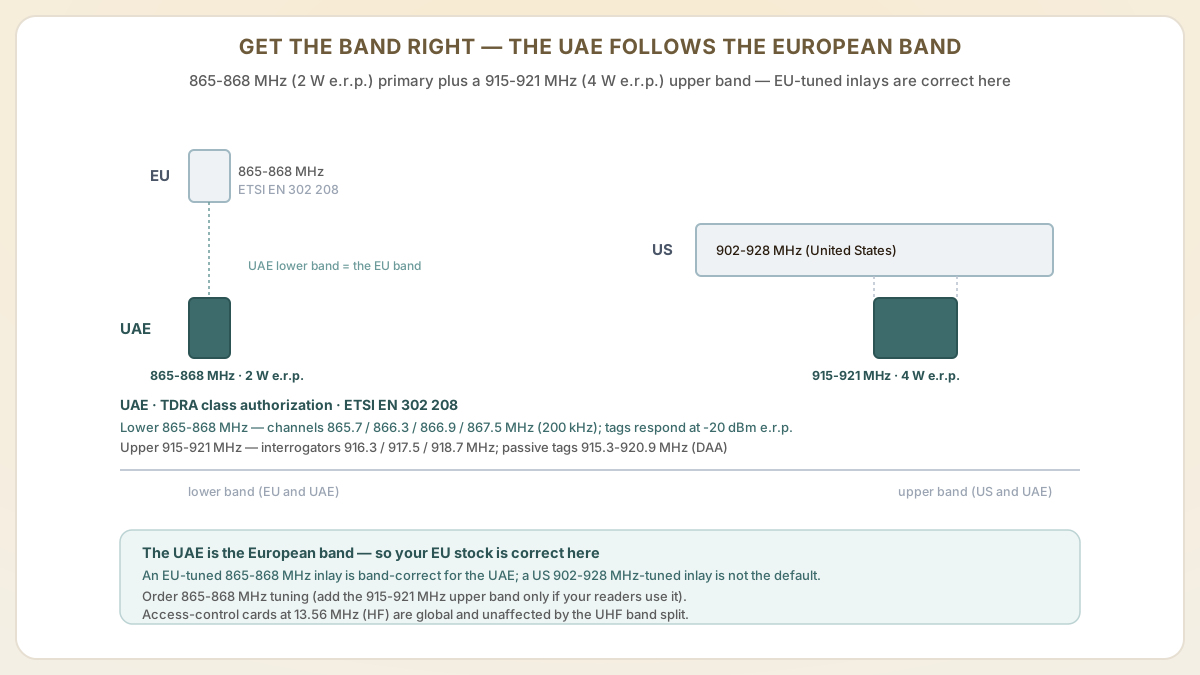
| Parameter | United Arab Emirates (TDRA · EN 302 208) | European Union (ETSI EN 302 208) | Why it matters to your order |
|---|---|---|---|
| UHF RFID band | 865-868 MHz (primary) + 915-921 MHz (upper) | 865-868 MHz, plus 915-921 MHz upper band | The UAE uses the European allocation — order 865-868 MHz-tuned inlays, not US 902-928 MHz stock |
| Reader power ceiling | 2 W e.r.p. (865-868 MHz); 4 W e.r.p. (915-921 MHz) | 2 W e.r.p. (865-868 MHz); 4 W e.r.p. (915-921 MHz) | Identical to the EU — an EU-tuned deployment transfers cleanly to the UAE |
| Lower-band channels | Four channels: 865.7, 866.3, 866.9, 867.5 MHz (200 kHz each) | Same four channels | Interrogators hop these four; tags respond at -20 dBm e.r.p. around them |
| Upper-band channels | 916.3, 917.5, 918.7 MHz at 4 W e.r.p.; passive tags 915.3-920.9 MHz, DAA required | Same upper-band plan | The 915-921 MHz option adds power but needs Detect-And-Avoid; most sites use 865-868 MHz |
| Who holds the approval | The reader — TDRA type approval + SRD class authorization | The interrogator is the regulated device | Passive tags are field devices, tuned not certified — ask for the reader's TDRA approval |
| Access-control (HF) | 13.56 MHz — global | 13.56 MHz — global | MIFARE / DESFire cards are unaffected by the UHF band |
UAE compliance: TDRA type approval, ECAS/MOIAT and the PDPL
Two frameworks decide whether a shipment is clean into the UAE — radio/product conformity and data. Below is the honest map for China-sourced RFID; the access-control page covers the credential stack in full.
| Rule | What it actually covers | Straight answer for China-sourced RFID |
|---|---|---|
| TDRA type approval | Approval/registration of radio and telecom equipment supplied in the UAE | The RFID reader/interrogator is the radio station and needs TDRA type approval; passive tags are exempt field devices tuned to 865-868 MHz |
| SRD class authorization | Authorises short-range devices, including RFID, in the 865-868 and 915-921 MHz bands | Compliant readers operate under the class authorization — no per-site spectrum licence to hold |
| ECAS (MOIAT) | The Emirates Conformity Assessment Scheme for regulated products, run by the Ministry of Industry and Advanced Technology (which replaced ESMA in 2020) | Reader hardware in regulated categories needs an ECAS Certificate of Conformity from a MOIAT-appointed body; passive cards and tags carry RoHS and quality documentation |
| UAE PDPL | Federal Decree-Law No. 45 of 2021 on Personal Data Protection — handling of personal data | A credential-data concern for your access-control system, not the card blank — encode the minimum and manage identities on your side |
| ISO/IEC 14443 & 18000-63 | The card (HF) and UHF air-interface standards the products implement | Our MIFARE / DESFire cards are ISO/IEC 14443; UHF inlays are ISO/IEC 18000-63 (Gen2) |
Landed cost: HS 8523.52, the 5% GCC tariff and 5% VAT
The unit price is the headline; the landed cost is the story. For the UAE there are three characters — the HS line, the GCC common tariff, and VAT. Our air vs sea freight guide shows the freight-mode math; the short version is below.
- Factory-direct from Shenzhen strips out the 20-40% markup that regional trading companies and distributors add — China-factory pricing with international-quality documentation.
- Ask for the HS 8523.52 classification on the commercial invoice so your broker enters the goods correctly the first time.
- UAE VAT is generally recoverable for a registered importer — it is a cash-flow line, not a sunk cost.
- A Jebel Ali or Dubai South free-zone address defers the 5% duty until the goods move to the mainland — useful for re-export programmes.
| Incoterm | Freight | UAE duty + VAT | Customs clearance | Choose it when |
|---|---|---|---|---|
| EXW Shenzhen | You arrange from our dock | You pay duty + VAT at entry | Your broker | You run your own freight programme |
| FOB Shenzhen / Yantian | We deliver to the port; you book the vessel | You pay duty + VAT at entry | Your broker | Sea-volume buyers with a Gulf forwarder |
| DDP to your UAE address | We handle door to door | Included in the quoted price | We arrange | You want one all-in landed number and no border admin |
Logistics: Shenzhen to Dubai in 3-5 days
Shenzhen's workday overlaps the Gulf morning, which is quietly useful — an RFQ sent at your close of business is usually quoted by the next day, and production runs while your office sleeps. Freight and clearance are the boring part done right.
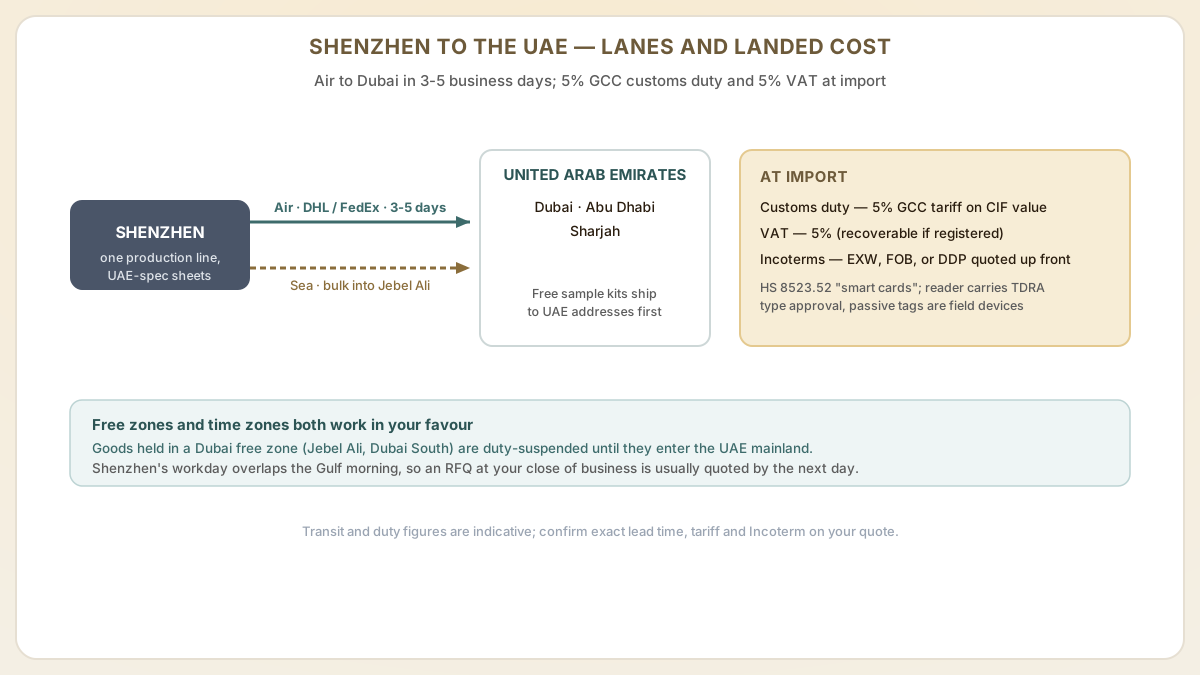
- Express air via DHL/FedEx from Shenzhen to Dubai, Abu Dhabi and Sharjah in 3-5 business days; with 5-7 days production, most first orders land in about 10-12 days. Sea freight to Jebel Ali serves bulk programmes.
- Free sample kits ship to UAE addresses so you can test read performance and lock/reader compatibility before a bulk order.
- Arabic- and English-speaking Gulf-region account managers run the order from RFQ to delivery, on hours that overlap the UAE business day.
How a UAE order runs, step by step
No time-zone roulette — this is the cadence a first UAE order follows from RFQ to receiving dock.
- Day 0 · RFQ
Send the lock or reader make/model (Assa Abloy, Dormakaba, SALTO, Onity, HID, Gallagher, Suprema), any UHF use-case, quantity and artwork. You get a quote with 865-868 MHz tuning specified and an Incoterm (EXW / FOB / DDP).
- Day 1-5 · Samples
Free sample cards or inlays ship by DHL express to your UAE address to test on your live readers before committing. UHF samples are 865-868 MHz-tuned so the test reflects UAE field conditions.
- Day 5-12 · Production + QC
Cards printed and encoded, or UHF inlays converted and tuned for 865-868 MHz; every card read-tested before packing.
- Day 10-12 · DDP delivery
Express air to Dubai with the 5% duty, 5% VAT and clearance settled on a DDP order; the compliance pack travels with the shipment, not on request.
Proof a UAE buyer can verify without a plant visit
Proud Tek supplies hotels, access-control integrators, government agencies, event organisers and retail chains across the UAE — but don't take a market page's word for it. Here is what you can check before you commit.
- Request free samples and read them on your own hotel-lock or access readers before any bulk order.
- Ask your reader vendor for the reader's TDRA type approval and ECAS Certificate of Conformity, and ask us for the ISO/IEC 14443 / 18000-63 conformance for the cards and inlays.
- Confirm 865-868 MHz tuning in writing on the PO for UHF orders — and keep the approved sample as the reference.
- Get the HS 8523.52 line on the proforma and confirm the 5% GCC duty and 5% VAT treatment with your customs broker.
- Verify our ISO 9001 and ISO 14001 certificates with the issuing registrar using the ISO certification verification guide, then work the China factory audit checklist remotely.
Useful next pages
Use these linked product, guide and comparison pages to keep the next click specific and practical.
Popular products for UAE customers
Browse the RFID products most commonly ordered by our Dubai and UAE clients.
UAE compliance and cost reading
The guides UAE procurement teams pair with this page.
FAQ
Which UHF band do your tags use for the UAE?
The UAE follows the European allocation under the TDRA per ETSI EN 302 208: a primary 865-868 MHz band at 2 W e.r.p. and an optional 915-921 MHz upper band at 4 W e.r.p. We tune passive inlays for 865-868 MHz, so EU-standard 865-868 MHz stock is band-correct here — a US 902-928 MHz-tuned inlay is not the default. HF hotel and access cards at 13.56 MHz are globally harmonised and unaffected; specify 865-868 MHz only for UHF inlay and label orders.
Do passive RFID tags need their own TDRA type approval?
No. The regulated radio is the reader/interrogator, which needs TDRA type approval and operates under the Short Range Device class authorization. Passive UHF tags are not transmitters — they backscatter the reader's signal — so what matters is that the tag antenna is tuned for the UAE 865-868 MHz band. When evaluating suppliers, ask for the reader's TDRA approval and the tag's tuning and read data rather than an approval for the tag itself.
How do UAE customs duty and VAT work on an order?
RFID smart cards classify under HS 8523.52. The UAE applies the GCC Common Customs Tariff — a 5% duty on the CIF value for most goods, with no China-UAE free-trade preference — plus 5% UAE VAT on the customs value, which is generally recoverable for a VAT-registered importer. Goods held in a Dubai free zone (Jebel Ali, Dubai South) are duty-suspended until they enter the mainland. On a DDP quote, freight, duty, VAT and clearance are included up front — confirm the exact classification and any exemption with your customs broker.
How long does shipping from Proud Tek to Dubai take?
Express air freight from Shenzhen to Dubai takes 3-5 business days. Combined with our standard production lead time of 5-7 days, most orders arrive in the UAE within about 10-12 business days of order confirmation. Sea freight into Jebel Ali is available for large-volume orders at lower cost and longer transit.
Are your cards compatible with the hotel locks and access readers used in the UAE?
Yes. We supply MIFARE Classic and MIFARE DESFire cards compatible with Assa Abloy, Dormakaba, SALTO and Onity hotel-lock systems and with HID, Gallagher and Suprema access readers deployed across the UAE. Because configurations vary, we ship free sample cards to your UAE address so you can confirm compatibility on your live readers before any bulk order.
Can I get product samples before placing a large order?
Yes. Free sample kits including RFID cards, tags, labels and wristbands ship via DHL express to any UAE address at no charge, typically arriving in 3-5 business days. For UHF orders the samples are 865-868 MHz-tuned so the test reflects UAE field conditions. Custom-printed samples with your artwork are also available with a short lead time.
Sources & references
Primary standards, OEM datasheets and regulatory documents cited by this article. All URLs were verified on the access date shown below.
- TDRA — Regulations for Ultra-Wide Band and Short Range Devices, Version 5.0 (Article 4, RFID)
Primary source for the UAE UHF RFID bands: 865-868 MHz at 2 W e.r.p. (channels 865.7/866.3/866.9/867.5 MHz, 200 kHz; tags at -20 dBm e.r.p.) and 915-921 MHz at 4 W e.r.p. (passive tags 915.3-920.9 MHz, DAA; interrogators 916.3/917.5/918.7 MHz), both referencing EN 302 208, plus 13.56 MHz RFID/NFC.
- GS1 — Overview of UHF frequency allocations for RAIN RFID
Global RAIN UHF allocation reference; corroborates the UAE's European (865-868 MHz + 915-921 MHz) model.
- ETSI EN 302 208 — RFID equipment in the 865-868 MHz and 915-921 MHz bands
The RFID air-interface/equipment standard the TDRA references for both UAE UHF bands and their power limits (2 W and 4 W e.r.p.).
- TDRA — Class Authorization for Short Range Devices
Basis for operating RFID readers under class authorization and for equipment type approval; passive tags are field devices.
- US Commercial Service — United Arab Emirates: Standards for Trade (ECAS / MOIAT)
Describes the Emirates Conformity Assessment Scheme (ECAS) administered by MOIAT, which replaced ESMA in 2020, and MOIAT-appointed Notified Bodies.
- UAE Federal Tax Authority — Value Added Tax (standard rate 5%)
UAE VAT standard rate of 5% (Federal Decree-Law No. 8 of 2017), applied to imports on the customs value including duty.
- US Commercial Service — United Arab Emirates: Import Tariffs (5% GCC common tariff)
GCC Common Customs Tariff of 5% on the CIF value for most goods entering the UAE; free-zone duty suspension.
Proud Tek is a Shenzhen-based RFID & NFC manufacturer supplying hotel chains, transit operators, event venues and retail brands worldwide. Every order includes free samples, RF testing and dedicated project support.
Get a Quick Quote
Tell us about your project and we'll respond within one business day. Fields marked (asterisk) are required.