
RFID Manufacturer for the German Market
RFID & NFC Manufacturer for Germany
Factory-Direct

Quick answer
Proud Tek ships EU-band (865-868 MHz) UHF tags, 13.56 MHz NFC products, and access credentials from Shenzhen to Germany in 4-6 days via DHL Express, with DDP shipping that settles EU customs clearance, duties, and 19% German import VAT inside the quoted price. German manufacturers, automotive suppliers, industrial companies, and technology integrators buy factory-direct at 30-40% below European-sourced alternatives on the same NXP silicon — with CE conformity documentation under RED 2014/53/EU, REACH and RoHS declarations, ISO 9001:2015 quality records, and Digital Product Passport-ready NTAG 424 DNA tags ahead of the EU's 2027 passport deadlines.
- Band-correct by default: UHF inlays antenna-tuned for Europe's 865-868 MHz allocation under ETSI EN 302 208, plus 13.56 MHz NFC and ISO/IEC 14443 access credentials — so the tags you receive perform on the readers you already run.
- Factory-direct pricing 30-40% below European-sourced alternatives on the same NXP chips, with 100% electrical testing, ISO 9001:2015 and ISO 14001:2015 certified production, and the quality documentation German auditors actually ask for.
- Express delivery to Germany in 4-6 days via DHL Express, with DDP shipping that includes all EU import duties, VAT, and customs clearance handled on behalf of the buyer — EORI entry and 19% Einfuhrumsatzsteuer settled before your dock.
At a glance
Use these short answers to decide whether this page matches the project before moving into the detail.
EU band and radio rules
UHF RFID in the EU operates at 865-868 MHz at up to 2 W ERP with four high-power channels under ETSI EN 302 208 (V3.4.1, December 2023). A 915-921 MHz upper band at up t...
CE marking and RED
CE marking for RFID runs on the Radio Equipment Directive 2014/53/EU: readers and battery-assisted tags need a manufacturer's Declaration of Conformity and CE mark; pass...
Next step
Ready to move forward? Start your inquiry to get specific answers for this project.
Request a quote for German RFID supply- Customs, EORI, and import VAT
-
B2B imports clear EU customs against an EORI number (mandatory for import, export, and transit operations). IOSS does not apply to business freight — it is the B2C channel for consignments up to EUR 150. Standard imports into Germany pay 19% import VAT, recoverable as input tax for VAT-registered businesses; import VAT, not duty, is usually the bigger line for RFID products, and DDP quotes settle the whole stack before delivery.
- Lead times to Germany
-
Production runs 5-7 business days after artwork approval; DHL Express delivery to any German address takes 4-6 days; sea freight to European ports runs 18-22 days for pallet volumes. Free sample kits ship before any production commitment.
- Verification and quality documentation
-
ISO 9001:2015 and ISO 14001:2015 certified manufacturing, with certificates shared with qualified buyers on request; 100% electrical testing; quality records retained for 7 years; per-shipment compliance pack (Declaration of Conformity, RoHS/REACH declarations, Certificate of Origin, HS-coded commercial invoice); free samples with RF test data.
RFID and NFC products for the German market
Germany builds the machines that build everything else — and lately every one of them ships with a tag. From one Shenzhen production line, Proud Tek supplies factory-direct NFC manufacturing and EU-band UHF for automotive traceability, Industry 4.0 asset tracking, and credentials that drop into existing access control systems — each with a spec sheet a German engineering department can actually file.
| Product family | Chips / standards | Where German buyers deploy it |
|---|---|---|
| UHF RFID tags and labels | EPC Gen2, antenna-tuned for 865-868 MHz | Retail and logistics inventory, warehouse portals, industrial asset tracking, Industry 4.0 tool and WIP identification |
| NFC stickers and tags | NTAG 213/215/216, 13.56 MHz, NFC Forum Type 2 | Product information links, marketing engagement, tap-to-register warranty activation |
| Authentication and DPP tags | NTAG 424 DNA with dynamic URL and cryptographic verification | EU Digital Product Passport programs, brand protection, anti-counterfeit smart packaging |
| Access credentials and hotel key cards | MIFARE Classic and MIFARE DESFire (ISO/IEC 14443) | Corporate offices, hotels, and facilities — compatible with installed European lock and access systems |
| Inlays for converters | HF and UHF wet and dry inlays | German label converters and packaging companies integrating RFID into their own formats |
| NFC business cards | PVC, metal, and wooden formats | Germany's professional networking market — tap-to-share profiles |
Get the band right: 865-868 MHz under ETSI EN 302 208
The most expensive mistake in cross-border RFID sourcing is band mismatch. Europe's UHF workhorse is 865-868 MHz; the United States runs 902-928 MHz — and an inlay tuned for a Texas warehouse will pass every visual inspection and still sulk in a Stuttgart dock door, because antennas hold grudges measured in megahertz. New to frequency planning? Start with our LF vs HF vs UHF guide.
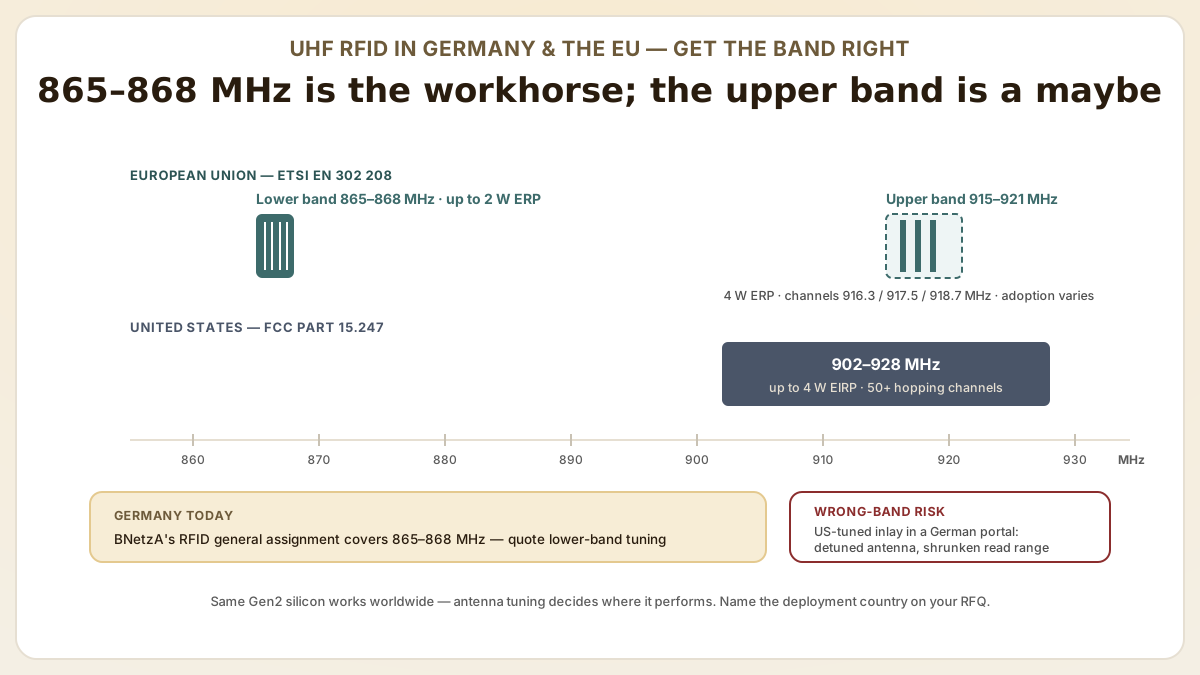
| Parameter | European Union (ETSI EN 302 208) | United States (FCC Part 15.247) | What it means for your PO |
|---|---|---|---|
| UHF RFID band | 865-868 MHz lower band; 915-921 MHz upper band where the member state has opened it | 902-928 MHz | Inlay antennas are tuned per band — specify EU tuning for German sites |
| Reader power ceiling | 2 W ERP lower band; 4 W ERP upper band | Up to 4 W EIRP | EU site plans don't transfer 1:1 from US deployments — portal counts and antenna layouts differ |
| Channel plan | Four high-power channels in the lower band | Frequency hopping across at least 50 channels | Dense multi-reader sites need more channel coordination in the EU lower band |
| Upper band status | Channels 916.3, 917.5, and 918.7 MHz at up to 4 W ERP under Decision (EU) 2018/1538 — adoption varies by member state | Not applicable — one national band | Germany has not opened the upper band for general RFID use; plan German sites on 865-868 MHz |
| Who holds the certificate | The reader (interrogator) carries the conformity assessment under RED | The reader carries the FCC ID | Passive tags are tuned, not certified — ask for tag tuning data, not a tag certificate |
CE, RED, and the paperwork German procurement actually files
German procurement has a reputation: if the documentation is wrong, the meeting is over. Fair enough — the rules below decide who legally owes which paper, and a supplier who cannot produce them on request is a risk you would be importing along with the goods. For the full conformity walk-through, see our RFID CE marking compliance guide.
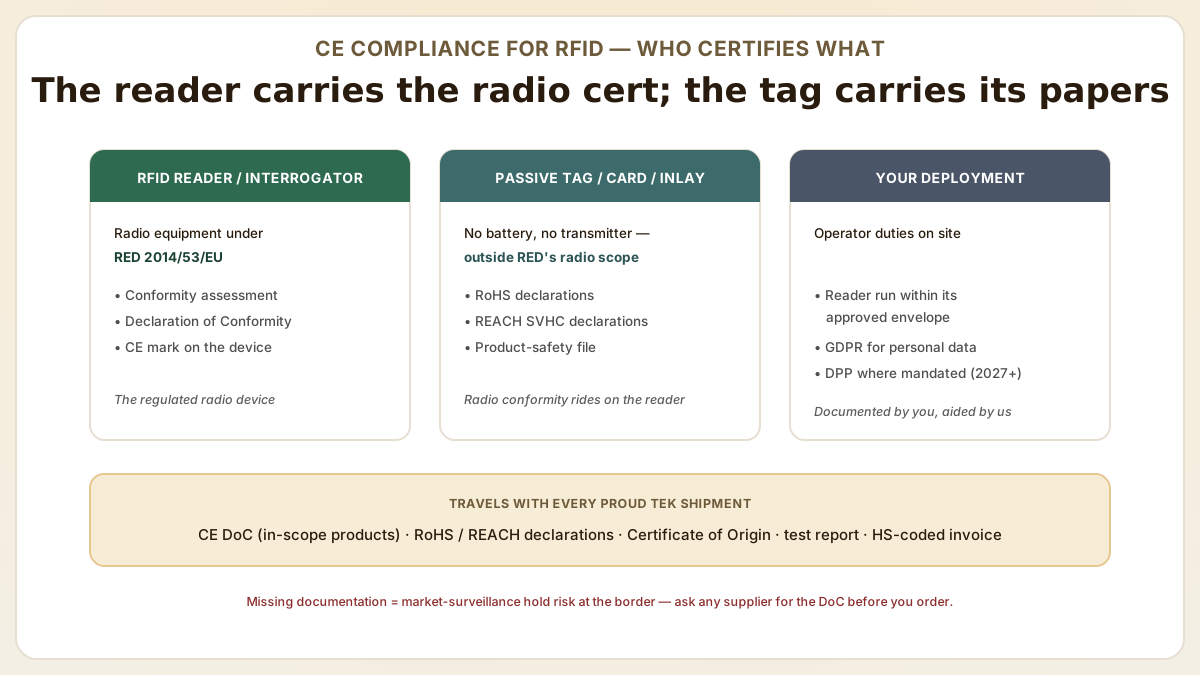
| Rule | What it actually covers | Straight answer for China-sourced RFID |
|---|---|---|
| CE marking / RED 2014/53/EU | Radio equipment placed on the EU market — readers, and battery-assisted or active tags | Radio conformity rides on the reader. We supply Declarations of Conformity and CE documentation for in-scope products, with copies for your importer file |
| Passive tags under RED | Passive backscatter tags have no battery and no transmitter — generally outside RED's radio scope; the reader's certification covers the radio operation | Tags still ship with the non-radio compliance evidence buyers need: RoHS, REACH, and product-safety documentation |
| RoHS 2011/65/EU | Hazardous-substance limits for electrical and electronic equipment, including tag and card electronics | RoHS declarations travel with every shipment |
| REACH (EC) 1907/2006 | Chemical registration and SVHC disclosure duties for articles placed on the EU market | SVHC declarations ship in the documentation pack — the substance data German quality departments cross-file |
| GDPR (EU) 2016/679 | Personal data written to credentials or collected in read logs — an obligation on your deployment, not on blank tags | Encode the minimum and keep the UID-to-person mapping in your access-controlled backend; blank cards and tags carry no personal data |
Digital Product Passport: Germany's head start
The EU spent a decade writing sustainability rules; German industry gets to manufacture them. The Digital Product Passport under ESPR — in force since July 2024 — will attach machine-readable product data to batteries, textiles, electronics, and more, and Germany's automotive and battery supply chains are first in line. Tag-side, this is exactly what NTAG 424 DNA was built for: our EU battery passport guide and ESPR apparel timeline map the deadlines by sector.
- EU Digital Product Passport: German manufacturers across automotive, electronics, textiles, and batteries are preparing for EU DPP requirements. NFC tags embedded in products will carry sustainability, composition, and recyclability data accessible via smartphone tap.
- NTAG 424 DNA tags ship pre-encoded with DPP-compatible data structures and dynamic URLs pointing at your product passport platform, with cryptographic verification for anti-counterfeit use.
- Automotive parts authentication: German OEMs and tier-1 suppliers use NFC for parts authentication, maintenance-record access, and tap-for-manual experiences — the same tag infrastructure the DPP will ride on.
- Industry 4.0: NFC embedded in machine components, tools, and work-in-progress items for automated identification, maintenance logging, and digital-twin data access on the factory floor.
Landed cost: EORI, 19% import VAT, and honest Incoterms
The unit price is the headline; the landed cost is what your controller reconciles in December. For a German B2B importer the stack is short — a customs entry against an EORI number, import VAT, and whoever you have nominated to do the paperwork. Our RFID RFP template shows the quote-comparison math in full; the Germany-specific version is below.
- EORI: an Economic Operators Registration and Identification number is mandatory for EU customs operations (import, export, transit). On EXW or FOB terms your company is the importer of record and files against its own EORI; on DDP terms, clearance is handled for you.
- IOSS is not your channel: the Import One Stop Shop covers B2C distance sales in consignments up to EUR 150. B2B freight clears as a standard import — EORI, entry declaration, import VAT — which is exactly the stack a DDP quote absorbs.
- Every commercial invoice lists the HS classification per line item, so your broker (or ours) enters the goods correctly the first time — import VAT, not duty, is usually the bigger line for RFID products.
| Incoterm | Freight | EU clearance + import VAT | Choose it when |
|---|---|---|---|
| EXW Shenzhen | You arrange from our dock | Your broker files against your EORI; you pay import VAT at entry | You run your own freight program and want maximum control |
| FOB Shenzhen / Yantian | We deliver to the port; you book the vessel | Your broker files against your EORI; you pay import VAT at entry | Sea-volume buyers with an established forwarder |
| DDP to your door | We book air or sea end to end | Included — clearance, duty, and import VAT settled in the quote | You want one landed number and no counter at customs — the default for German orders |
Logistics: Shenzhen to Germany, minus the time-zone drama
Shenzhen's afternoon is Munich's morning: an RFQ sent with your first coffee is usually quoted before the next one, and production runs while your office sleeps. The freight-mode math lives in our air vs sea freight guide; the Germany lanes are below.
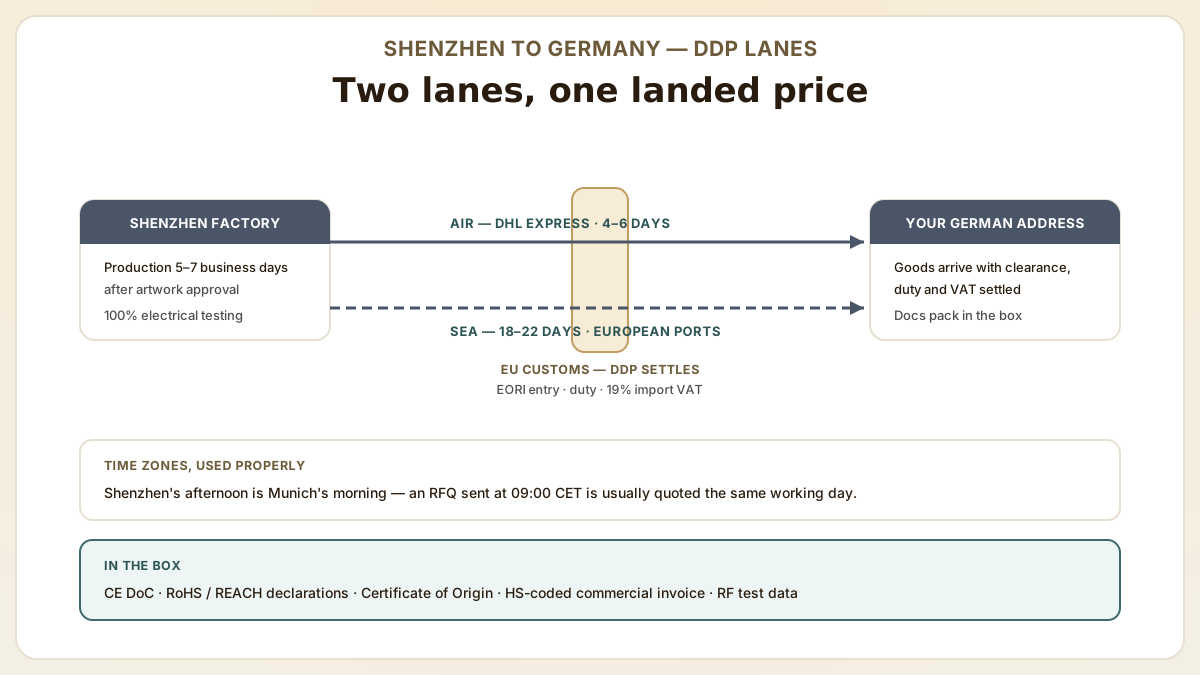
- Day 0 — RFQ
Send specs, artwork, or a competitor datasheet. Quotations come back within one business day, itemized by chip, material, and print process.
- First week — free samples
Sample kits ship by DHL Express to any German address at no charge, with RF test data so you can validate on your own readers. Custom-printed samples take 7-10 days.
- Artwork approval — the gate
Production starts only after you sign off artwork and encoding spec. Changes cost nothing before this gate.
- Production + QC — 5-7 business days
Standard production runs 5-7 business days with 100% electrical testing; every encoded card gets a functional read test before packing.
- Delivery — 4-6 days via DHL Express
DDP orders land at your door with clearance, duty, and 19% import VAT settled; the documentation pack travels with the shipment, not on request.
Proof a German buyer can verify without leaving the office
Mittelstand procurement is famously relationship-first — suppliers are auditioned, not swiped — and audits are where a factory with real paperwork does its best work. Verify us the way you would verify any China supplier: check the certificate numbers with the issuing registrar using our ISO certification verification guide, then run the China RFID factory audit checklist remotely or in person. Long-term supply relationships are the point here, not the sales pitch.
- ISO 9001:2015 and ISO 14001:2015 certified quality and environmental management — certificates shared with qualified buyers on request; verify the certificate number with the issuing registrar, not just the PDF
- 100% electrical testing on every card and tag (chip response, antenna resonance, read range), with a functional test report included in the shipment
- Direct NXP chip sourcing with chip certificates and traceability — the provenance evidence German quality auditors require
- Per-shipment compliance pack: Declaration of Conformity for in-scope products, RoHS/REACH declarations, Certificate of Origin, and an HS-coded commercial invoice
- Quality records retained for 7 years; third-party and buyer audits accommodated, including pre-shipment inspection by your QC agent in-house at no charge
- NDA and exclusivity agreements for custom designs — IP protection that survives translation
Useful next pages
Use these linked product, guide and comparison pages to keep the next click specific and practical.
NFC products for German customers
Explore NFC tags, stickers, and inlays for the German market.
Germany compliance and cost reading
The guides German procurement teams pair with this page.
FAQ
Do your NFC and RFID products meet EU CE marking requirements?
Yes. Products in scope of the Radio Equipment Directive (RED) 2014/53/EU — readers and battery-assisted tags — ship with a Declaration of Conformity and CE marking. Passive 13.56 MHz NFC tags and UHF labels have no transmitter, so the radio conformity rides on the CE-certified reader; the tags themselves ship with RoHS Directive 2011/65/EU and REACH compliance documentation. We provide Declarations of Conformity and CE documentation for EU market requirements.
Are your UHF tags tuned for the European 865-868 MHz band?
Yes. UHF tags and labels for German orders are antenna-tuned for the EU lower band, 865-868 MHz, per ETSI EN 302 208. The 915-921 MHz upper band is harmonised at EU level but has not been opened for general RFID use in Germany, so German deployments should be planned on 865-868 MHz. Samples ship with RF test data so you can verify read performance on your own readers before production.
Do I need an EORI number to import RFID products from China to Germany?
If your company is the importer of record (EXW or FOB terms), yes — an EORI number is mandatory for customs clearance in the EU, and German businesses obtain one from the customs administration. If you order DDP, Proud Tek's forwarder handles clearance and you receive goods with duties and import VAT already settled, so no customs interaction is required on your side.
Does IOSS apply to B2B RFID orders from China?
No. The Import One Stop Shop (IOSS) is a VAT simplification for B2C distance sales of consignments not exceeding EUR 150. Business freight clears as a standard import: an entry declaration against an EORI number plus German import VAT at 19%, which VAT-registered businesses recover as input tax. DDP quotes fold the whole stack into one landed price.
How does ordering from China compare to European NFC suppliers?
Proud Tek offers 30-40% lower pricing than European-sourced NFC products because we manufacture in our own facility rather than reselling. Quality is equivalent: we use the same NXP chips, the same ISO standards, and the same testing procedures. Delivery to Germany takes 4-6 days via DHL Express, which is competitive with European supplier lead times for custom orders.
Can you supply NFC tags pre-configured for the EU Digital Product Passport?
Yes. We supply NTAG 424 DNA tags that can be pre-encoded with DPP-compatible data structures and dynamic URLs pointing to your product passport platform. Our team works with your DPP solution provider to ensure the tag encoding matches the required specifications.
Do RFID cards and tags create GDPR obligations?
Blank credentials carry no personal data, so GDPR (EU) 2016/679 obligations attach to your deployment rather than to the hardware: they begin when your system writes personal data to a credential or links its UID to a person. The standard architecture keeps the tag as a pointer — encode the minimum, hold the UID-to-person mapping in your access-controlled backend — and credential-based systems remain straightforward to document under GDPR.
What is the minimum order quantity for German and EU orders?
MOQs for German orders match our standard factory minimums: custom-printed PVC cards start at 500 pieces (digital printing accepts runs as low as 100), NFC inlays and labels at 1,000 pieces (one roll), and silicone wristbands at 500 pieces. Free sample kits ship to any German address before any production commitment.
Sources & references
Primary standards, OEM datasheets and regulatory documents cited by this article. All URLs were verified on the access date shown below.
- Directive 2014/53/EU — Radio Equipment Directive (RED)
Directive of 16 April 2014 on the making available on the market of radio equipment. Basis for the CE/RED rows: radio equipment placed on the EU market carries the manufacturer's conformity assessment and CE marking; readers, not passive tags, are the regulated radio devices.
- ETSI EN 302 208 V3.4.1 — RFID equipment in 865-868 MHz (up to 2 W) and 915-921 MHz (up to 4 W)
ETSI publication directory verified: V3.4.1 published December 2023 (03.04.01_60), superseding V3.3.1. Source for the EU lower band 865-868 MHz at up to 2 W ERP with four high-power channels, and the 915-921 MHz upper band power class.
- Commission Implementing Decision (EU) 2018/1538 — spectrum harmonisation for short-range devices in 874-876 and 915-921 MHz
Decision of 11 October 2018. RFID interrogator transmissions in the upper band are permitted at the 916.3, 917.5, and 918.7 MHz channel centres at up to 4 W ERP; member states designate national availability, which is why upper-band adoption varies across the EU.
- Regulation (EU) 2016/679 — General Data Protection Regulation (GDPR)
Regulation of 27 April 2016 on the protection of natural persons with regard to the processing of personal data. Cited for the credential-data guidance: obligations attach to the deployment processing personal data, not to blank tags.
- Directive 2011/65/EU — Restriction of Hazardous Substances (RoHS)
Directive of 8 June 2011 on the restriction of the use of certain hazardous substances in electrical and electronic equipment — the declaration basis for tag and card electronics.
- Regulation (EC) No 1907/2006 — REACH
Registration, Evaluation, Authorisation and Restriction of Chemicals — SVHC disclosure duties for articles placed on the EU market; basis for the substance-declaration row.
- Regulation (EU) 2023/1542 — Batteries Regulation (battery passport)
Regulation of 12 July 2023 concerning batteries and waste batteries — the battery passport obligation from 18 February 2027 for EV, industrial, and LMT batteries; the page's first-DPP-deadline figure.
- Economic Operators Registration and Identification number (EORI)
EORI is mandatory for the clearance of all customs operations in the EU customs territory (import, export, transit); issued by the national customs authority; format is a two-letter country code plus up to 15 alphanumeric characters.
- VAT e-Commerce — One Stop Shop (IOSS scope)
The Import One Stop Shop simplifies VAT for B2C distance sales of imported goods in consignments not exceeding EUR 150 — confirming IOSS does not cover B2B freight, which clears under standard import rules.
- EU VAT rules and rates — standard rate table (Germany 19%)
Official EU table of member-state VAT rates: Germany standard rate 19% (reduced 7%). Basis for the import VAT figure on this page.
- 47 CFR § 15.247 — Operation within the bands 902-928 MHz, 2400-2483.5 MHz, and 5725-5850 MHz
US comparison rows: the 902-928 MHz band with 1 W conducted output for systems using at least 50 hopping channels and up to 6 dBi antenna gain — the 4 W EIRP operating point cited in the band table.
- ISO/IEC 14443-1:2018 — Contactless proximity objects, Part 1: Physical characteristics
The proximity-card standard series behind MIFARE-family access credentials named in the products table (Edition 4, published 2018).
Proud Tek is a Shenzhen-based RFID & NFC manufacturer supplying hotel chains, transit operators, event venues and retail brands worldwide. Every order includes free samples, RF testing and dedicated project support.
Get a Quick Quote
Tell us about your project and we'll respond within one business day. Fields marked (asterisk) are required.