
NFC Components
NFC Wet Inlays
PSA Roll Stock for Label Converters
Quick answer
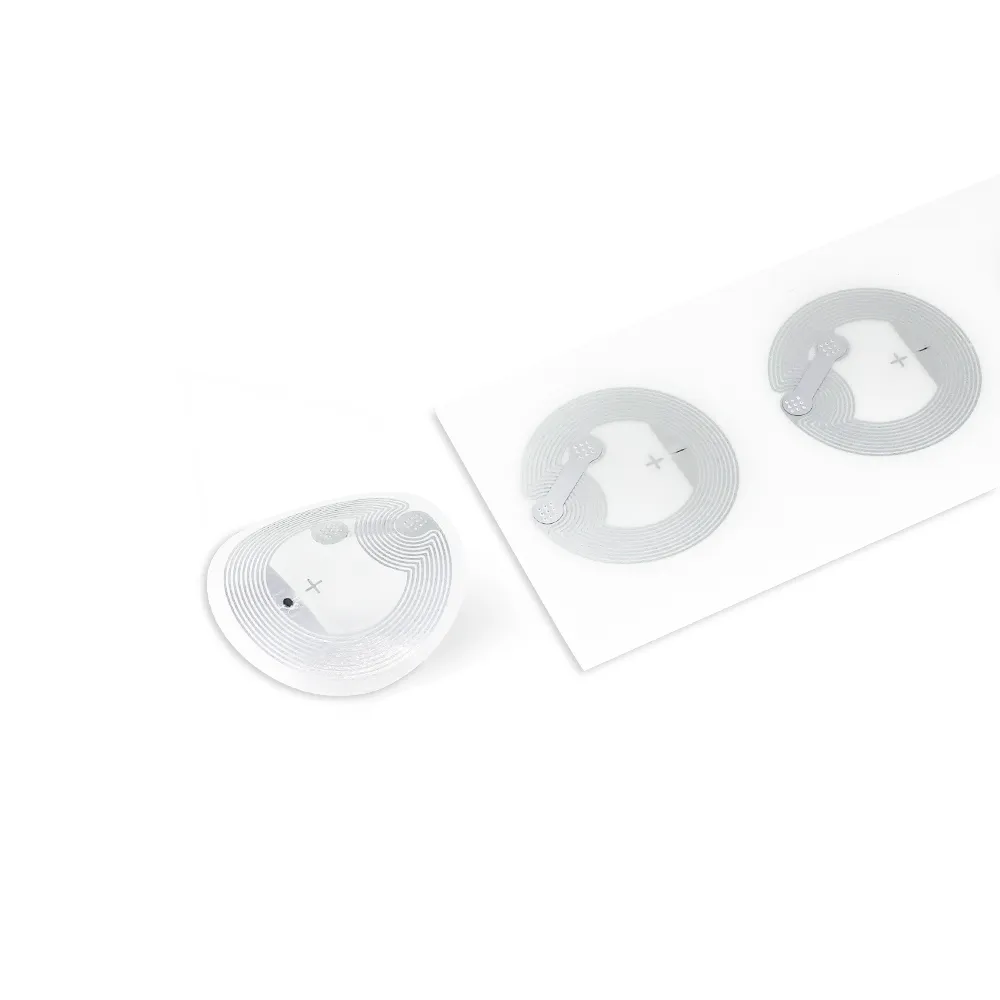
NFC wet inlays are the raw building block for NFC labels — a 13.56 MHz chip and antenna on 50-75 µm PET film with pressure-sensitive adhesive. 'Wet' means the adhesive layer plus release liner; 'dry' inlays omit it. Converter-ready rolls carry 1,000-10,000 inlays on a 3-inch core with ±0.5 mm pitch, ±0.3 mm chip placement and 100% HF read-test. Chip options span NTAG213/215/216, NTAG 424 DNA and ICODE SLIX2 (ISO/IEC 15693).
- Thin PET substrate (50-75 µm) with PSA adhesive backing + release liner — ready to laminate into your own label stock or product housing.
- Available with NTAG213, NTAG215, NTAG216, NTAG 424 DNA (AES-128 SUN) and ICODE SLIX2 (ISO/IEC 15693 vicinity HF) chips.
- Roll format (1,000-10,000 per roll on 3-inch core) for automated pick-and-place or inline label converting — ±0.5 mm pitch tolerance + single-chip-batch guarantee.
Used in these industries
Deployments where this product is referenced on our industry landing pages.

At a glance
Use these short answers to decide whether this page matches the project before moving into the detail.
Construction
Aluminium or copper-etched antenna on PET film Pressure-sensitive adhesive (PSA) coating + release liner
Chip silicon options
NXP NTAG213 (NT2H1311G0DU) — 144 byte entry-tier NXP NTAG215 (NT2H1511G0DU) — 504 byte mid-tier (Amiibo-spec)
Next step
Ready to move forward? Start your inquiry to get specific answers for this project.
Request wet inlay quote- Typical pricing
-
USD 0.15–0.25 @ 1k · 0.05–0.10 @ 100k+ (typical FOB Shenzhen range) — firm quote in one business day.
Commercial terms
- MOQ
- Varies by SKU — stock items from 100 pcs; custom production typically 200-1,000 pcs
- Lead time
- Production 2-3 weeks after artwork and encoding sign-off; reorders on a 3-4 week cycle
- Samples
- Free samples and RF test report with every order; courier at customer cost
- Payment
- 50% T/T deposit, 50% before shipment; Net 30/60 for established accounts; LC for large orders
- Shipping
- FOB Shenzhen / Yantian; DHL, FedEx or EMS air freight; sea LCL / FCL for volume
- Response
- Itemized quote within one business day, Mon-Fri (UTC+8)
What an NFC wet inlay actually is
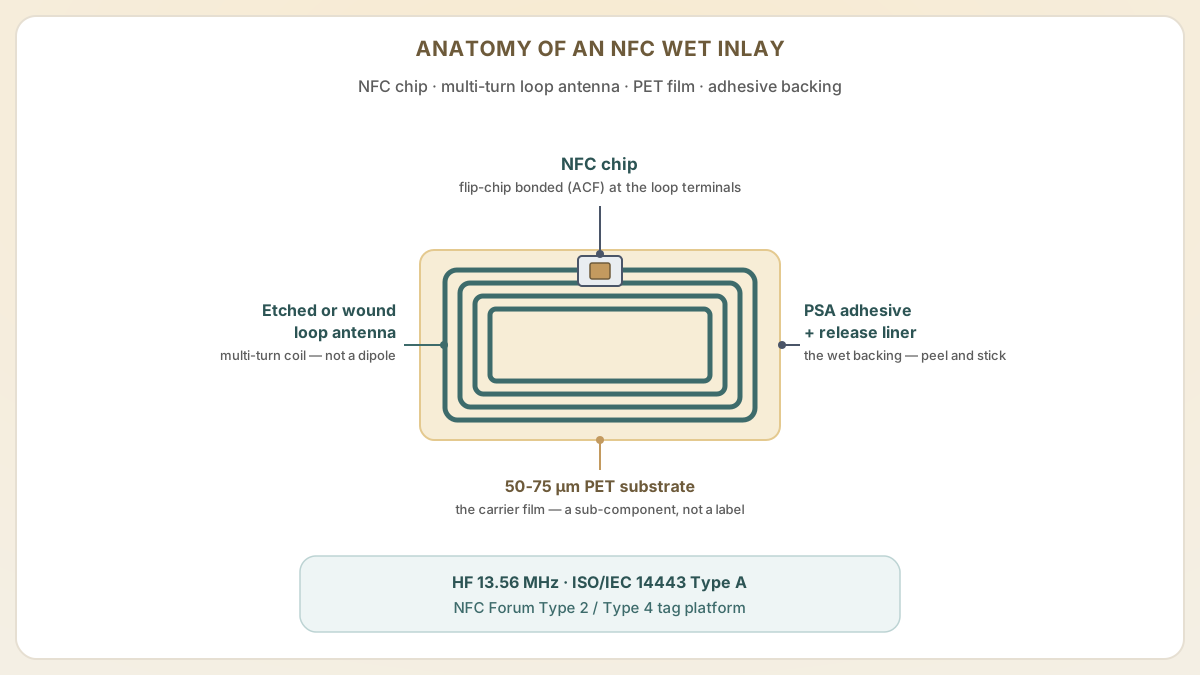
Peel back the printed face and what actually answers the phone is small: an NFC chip flip-chip bonded to an etched or wound loop antenna — a multi-turn coil, not a UHF dipole — on a 50-75 µm PET film. That coil resonates at 13.56 MHz and speaks ISO/IEC 14443 Type A and the NFC Forum tag platforms; the loop's diameter is what sets how far a phone reads it. The chip and the coil barely change between jobs — the antenna footprint is the part you actually pick, and it ships in six standard sizes.
- Ø18 mm round (1-2 cm read range, compact pharma vial)
- Ø22 mm round (2-3 cm, wine capsule + general)
- Ø26 mm round (3-4 cm, retail label)
- Ø30 mm round (3-5 cm, maximum phone read range)
- 12×19 mm rectangular (compact cosmetics + narrow-space)
- 45×76 mm rectangular (large label / poster / signage)
Dry, wet, converted: the adhesive is the whole point
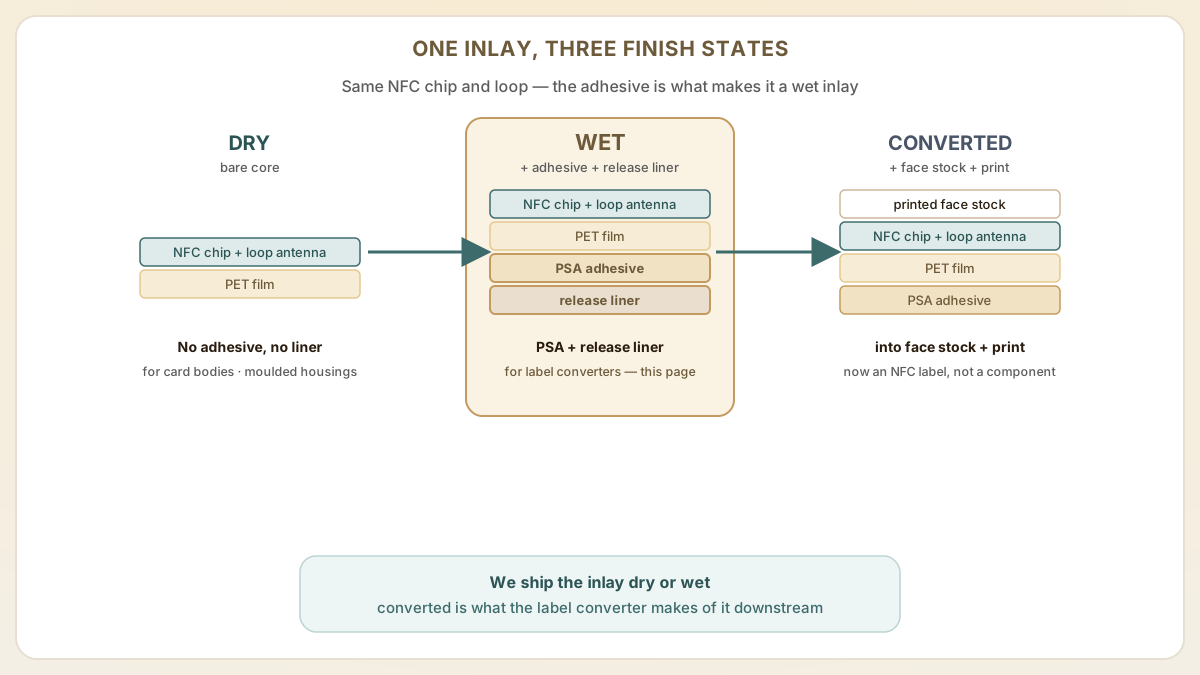
The same chip and loop leave the line in one of three finish states, and the adhesive is what earns this one the word 'wet'. A dry inlay is the bare core — chip, loop and PET, no glue — for card-body lamination and moulded housings. A wet inlay adds the layer that names it: a pressure-sensitive adhesive coating plus a release liner, so a converter can peel the liner and laminate the inlay straight into label stock. Convert it into printed face stock and it stops being a component and becomes a finished NFC label.
- 50-75 µm PET substrate
- Acrylic permanent PSA — general-purpose smooth surfaces
- Enhanced rubber-based PSA — textured + curved + low-energy plastics
- Removable PSA — temporary placement / event use
- FDA 21 CFR 175.105 indirect-food-contact PSA option
- Release liner: 50 µm white or kraft paper
Common problems label converters face when sourcing NFC wet inlays
- Roll pitch mismatch with converting line. A label converter ordering 30 mm pitch inlays discovers their flatbed laminator requires 32 mm pitch; even a 2 mm variance jams the feed mechanism, making the entire roll unusable.
- Adhesive bleed during lamination. Inlays with low-viscosity adhesive bleed onto the antenna coil during the heat lamination step, detuning the antenna and creating silent read failures in the finished label.
- Inconsistent chip placement within tolerance. A converter building pharmaceutical vial labels to a ±0.5 mm placement spec receives inlays with ±1.5 mm chip placement, causing the antenna to misalign with their label's window die-cut.
- No UID inventory list. Converters using UIDs as item identifiers need a pre-shipment UID log to seed their database; suppliers who cannot provide this force buyers to scan every inlay individually after delivery.
- Mixed chip lots in a single roll. A buyer ordering NTAG216 inlays receives a roll that contains a run of NTAG215 chips where the supplier switched mid-production, causing capacity errors in finished labels.
How Proud Tek solves NFC wet inlay sourcing problems
Generic wet-inlay supplier — no pitch control / no UID log / mid-roll splices
- Pitch ±2 mm variance jams flatbed laminator — entire roll unusable
- Low-viscosity adhesive bleeds onto antenna coil — detune + silent read failures
- Chip placement ±1.5 mm — pharmaceutical-vial label antenna die-cut misaligns
- No UID log — 3-day manual scan to seed database, 500K-label scale-blocker
- Mid-roll splice between NTAG215 ↔ NTAG216 — capacity error in finished labels
Proud Tek wet inlay with custom pitch + UID-CSV + single-chip-batch (this page)
- Custom pitch to ±0.5 mm tolerance — buyer-spec compatible (18/22/26/30 mm + custom)
- Heat-laminate-qualified PSA — zero bleed at 80 °C / 60 sec converter-line cycle
- ±0.3 mm chip placement — pharmaceutical-vial die-cut compatible
- UID-CSV inventory list standard — database seeding 3 days → 2 hours
- Single-chip-batch rolls + roll labelled with chip batch code — zero substitution
- Custom pitch to ±0.5 mm tolerance: buyers specify their converting line's pitch requirement and we manufacture to that spec; standard pitches (18, 22, 26, 30 mm) are in stock, non-standard pitches available at MOQ 5,000.
- Adhesive formulation qualified for heat lamination: our wet inlay adhesive is tested at 80 °C for 60 seconds — the lamination window for most pressure-sensitive label converters — with zero bleed beyond the die-cut edge.
- Chip placement tolerance ±0.3 mm: our automated chip bonding equipment operates within this spec and is verified with a coordinate measurement check on every 500th inlay during production.
- UID inventory list standard on all orders: a CSV file listing every UID in roll sequence ships with every order, enabling buyers to seed their database without scanning.
- Single-chip-type rolls guaranteed: each roll is produced from a single chip batch; Proud Tek does not splice rolls between chip lots, and every roll is labelled with the chip batch code for traceability.
Per-tap data published from a Proud Tek NFC wet inlay (post-conversion)
- Read range post-conversion: 1-2 cm (Ø18 mm), 2-3 cm (Ø22 mm), 3-5 cm (Ø30 mm).
- NDEF capacity: 144 B (NTAG213), 504 B (NTAG215), 888 B (NTAG216), 416 B (NTAG 424 DNA).
- Counter-anomaly defense (NTAG 424 DNA SUN): per-tap CMAC + monotonic counter.
- Single-chip-batch UID range — sequential UID inventory CSV per roll.
- Variable encoding ready — converter can replace pre-encoded URL with downstream data.
What is an NFC wet inlay
A wet inlay consists of three layers: an NFC chip bonded to an etched or wound antenna on a thin PET substrate, covered by a pressure-sensitive adhesive and a release liner.
The term 'wet' refers to the adhesive layer — the inlay arrives ready to stick onto a surface or laminate into a multilayer label structure. In contrast, a 'dry inlay' has no adhesive and is designed for embedding into rigid housings, card bodies or injection-moulded products.
Wet inlays are the most versatile NFC component because they serve as the starting point for finished products: stick one onto paper stock and you have an NFC sticker; laminate one into a folding carton and you have smart packaging; embed one into a wristband and you have an NFC wearable.
Chip selection guide
| Chip | Memory | Security | Standard | Best for |
|---|---|---|---|---|
| NTAG213 | 144 bytes | 32-bit password | NFC Type 2 | URLs, marketing, Google reviews |
| NTAG215 | 504 bytes | 32-bit password | NFC Type 2 | Amiibo, medium data, Wi-Fi sharing |
| NTAG216 | 888 bytes | 32-bit password | NFC Type 2 | vCards, large payloads |
| NTAG 424 DNA | 416 bytes | AES-128 + SDM SUN | NFC Type 4 | Authentication, anti-counterfeit |
| ICODE SLIX2 | 256 bytes | Password | ISO/IEC 15693 | Library tags, long-range HF |
Available antenna sizes
| Shape | Dimensions | Read range (phone) | Use case |
|---|---|---|---|
| Round | Ø18 mm | 1-2 cm | Compact labels, pharmaceutical vials |
| Round | Ø22 mm | 2-3 cm | General-purpose stickers, wine capsules |
| Round | Ø26 mm | 3-4 cm | Standard NFC tags, retail labels |
| Round | Ø30 mm | 3-5 cm | Maximum read range for phone tap |
| Rectangular | 12×19 mm | 1-2 cm | Ultra-compact, narrow-space applications |
| Rectangular | 45×76 mm | 4-6 cm | Large labels, posters, signage |
Applications
- Label converters — laminate wet inlays into your own printed label stock on a converting line.
- Smart packaging — embed into folding cartons, blister packs or corrugated boxes for tap-to-interact consumer experiences.
- Wearable integration — insert into wristbands, key fobs, rings or badge holders during assembly.
- Card manufacturing — laminate between PVC sheets for custom NFC card production.
- Product authentication — integrate NTAG 424 DNA inlays into product seals and packaging for brand protection.
- Retail and marketing — apply to shelf talkers, point-of-sale displays and promotional materials.
Ordering and delivery
- Roll format — standard 1,000 / 2,000 / 5,000 / 10,000 inlays per roll on 3-inch core.
- Pitch (spacing) options — 18 / 22 / 26 / 30 mm or custom pitch to match your converting line.
- Orientation — antenna face up or face down per your lamination process.
- NDEF pre-encoding available — we write your URL or data onto each inlay before shipping.
- 100% HF testing — every inlay is read-verified on the production line.
NFC wet inlay timeline — from raw chip to converter-feed flagship
- 2001 — NFC Forum founded + ISO/IEC 14443 ratified
NXP, Sony and Nokia found the NFC Forum to standardise short-range (13.56 MHz) tag-based interaction; ISO/IEC 14443 Type A becomes the dominant transmission protocol. Inlay-stage manufacturing emerges as a distinct supply-chain layer between chip-fab and finished-label converter.
- 2007-2013 — NTAG21x family + ICODE SLIX evolution
NXP introduces NTAG203 → NTAG213/215/216 (NFC Forum Type 2 Tag) + ICODE SLIX2 (ISO/IEC 15693 vicinity HF) — wet inlay format becomes the default chip-to-converter delivery vehicle for NFC consumer applications.
- 2014 — Apple Pay + iPhone 6 NFC normalisation
Apple ships iPhone 6 with NFC; widespread Android NFC support already established. Demand for NFC stickers + smart-packaging + label-converter NFC integration explodes.
- 2017-2018 — iOS Core NFC + iOS 12 background NDEF
Apple iOS 11 introduces Core NFC for app-based tag reading; iOS 12 (2018) enables background NDEF reading on iPhone XS / XR — wet inlays in smart-packaging + Google review NFC stickers see explosive growth.
- 2018 — NTAG 424 DNA + AES-128 SUN authentication
NXP launches NTAG 424 DNA — first commodity NFC chip with cryptographic AES-128 SUN per-tap unique URL. Wet inlay format adapts to support pre-provisioned master keys + pre-computed SUN URL templates for converter integration into brand-protection programmes.
- 2020-2024 — Smart packaging + NFC business card explosion
NTAG216 wet inlays dominate NFC business card market (Linq / Popl / Mobilo / dot.); NTAG213 wet inlays dominate Google review + marketing; NTAG 424 DNA wet inlays dominate cosmetics / spirits / pharma anti-counterfeit. Single-chip-batch rolls + UID-CSV become standard procurement requirements.
- 2024-2025 — DPP forward-compat + GS1 Digital Link 1.3
GS1 Digital Link 1.3 + EU ESPR 2024/1781 DPP framework adoption — wet inlays pre-encoded with GS1 Digital Link URI become DPP-ready for textile / electronics / battery / pharma category rollout 2027-2029.
- 2026 — Today: NFC wet inlay inlay-stage flagship for converter feed
From buyer conversations across cosmetics-smart-label, pharmaceutical-vial-label, wine-capsule-label, ntag424-dna-brand-protection and nfc-business-card-printing programmes converge on NTAG21x / NTAG 424 DNA wet inlays in roll format with custom pitch + UID-CSV + single-chip-batch + 100% HF read-test as the default converter-feed architecture.
The reference facts, at a glance
Everything a label converter or procurement reviewer cross-checks against the datasheet — roll format, frequency and protocol, QC and chip integrity, pre-encoding, UID traceability, application verticals, standards and procurement — gathered into one scannable block.
Roll specifications
Roll quantities: 1,000 / 2,000 / 5,000 / 10,000 inlays per roll · Core: 3-inch standard for converter line feed · Pitch (spacing) options: 18 / 22 / 26 / 30 mm or custom · Pitch tolerance: ±0.5 mm · Chip placement tolerance: ±0.3 mm · Antenna face up or face down per buyer's lamination process
Frequency & protocol
13.56 MHz HF carrier · ISO/IEC 14443 Type A — NTAG21x + NTAG 424 DNA · ISO/IEC 7816-4 APDU framing — NTAG 424 DNA Type 4 Tag · ISO/IEC 15693 — ICODE SLIX2 vicinity · NFC Forum Type 2 Tag (NTAG21x) + Type 4 Tag (NTAG 424 DNA)
QC & chip integrity
Single-chip-batch rolls — no mid-roll splice between chip lots · Roll labelled with chip batch code for traceability · Capability container byte verification per chip type · 100% HF read-test on every inlay before shipment · Coordinate measurement check on every 500th inlay
Pre-encoding services
NDEF URL pre-encoding — write your URL or data to each inlay · Variable per-tag NDEF — unique URL/data per inlay (UID-mapped) · NTAG 424 DNA SUN URL templating — AES-128 mirror pre-computed · MIFARE-family AES key provisioning (DESFire family on dry-inlay variant) · 100% read-back verification before shipment
UID inventory & traceability
UID inventory CSV — every UID in roll sequence · Database seeding: 3 days manual scan → 2 hours CSV import · Roll-batch + chip-batch + lot-code traceability · Anti-substitution: zero NTAG215-for-NTAG216 mid-roll incidents · FDA 21 CFR Part 11 compatible audit trail option
Application verticals
Label converter — flatbed laminator integration into printed label stock · Smart packaging — folding cartons + blister packs + corrugated boxes · Wearable integration — silicone wristband + key fob + ring + badge · Card manufacturing — laminated PVC card body builds · NTAG 424 DNA brand-protection — cosmetics + spirits + pharma + luxury · Retail + marketing — shelf talkers + POS displays + promotional materials
Standards & compliance
ISO/IEC 14443-3:2018 — Type A initialization + anticollision · ISO/IEC 7816-4 — APDU framing for NTAG 424 DNA Type 4 · ISO/IEC 15693 — vicinity HF (ICODE SLIX2) · NFC Forum Type 2 + Type 4 Tag Operation Specifications · NFC Forum NDEF + URI RTD + Smart Poster RTD · Apple Core NFC framework + Android NFC API · RoHS / REACH compliant materials
Procurement
MOQ 5,000 inlays (standard sizes, common chip types) · Custom antenna / non-standard chip MOQ 10,000+ · Lead time 10-15 business days standard, 20-25 for custom + NDEF pre-encoding · Sample sets 50-100 inlays for converting-line evaluation · Encrypted UID-to-data CSV delivered separately for variable-encoding orders
Useful next pages
Use these linked product, guide and comparison pages to keep the next click specific and practical.
Finished NFC products
If you need ready-to-use NFC products rather than raw inlays.
Adhesive-free variant
For card-bureau lamination + injection-mould embedding (no adhesive).
FAQ
What is the difference between a wet inlay and a finished NFC sticker?
A wet inlay is the raw NFC component — chip, antenna and adhesive on bare PET film with no printing or protective coating. A finished NFC sticker adds a printed face stock, optional protective lamination or epoxy dome, and is ready for end-user application. Wet inlays are for manufacturers and converters who integrate NFC into their own products.
Can wet inlays be used directly as stickers?
Technically yes — peel the release liner and stick the inlay onto any clean surface. However, the bare PET film offers no printing surface, minimal durability and no UV protection. For consumer-facing applications, we recommend our finished NFC stickers or having the inlays laminated into your own label stock.
What adhesive types are available?
Standard wet inlays use a general-purpose permanent acrylic adhesive suitable for most smooth surfaces (paper, plastic, glass). For challenging surfaces (textured, curved, low-energy plastics), we offer enhanced rubber-based formulations. Removable adhesive options are also available for temporary applications. FDA 21 CFR 175.105 indirect-food-contact PSA option for food + beverage label applications.
Which NFC Forum standards define NDEF and the Type 2 / Type 4 tag platforms that our wet inlays follow?
The NFC Forum NDEF (NFC Data Exchange Format) Technical Specification defines the record structure written to every consumer-facing NFC tag, including the URI RTD and Smart Poster RTD that Apple Core NFC (iOS 14+) and Android CTS require for tap-to-open URL behaviour. NTAG213 / 215 / 216 implement the NFC Forum Type 2 Tag platform (ISO/IEC 14443 Type A, 106 kbps, read-only UID anti-collision); NTAG 424 DNA implements Type 4 (ISO/IEC 7816-4 APDU framing, AES-128 authentication, SUN dynamic message) for brand-protection use cases. Our wet inlays ship pre-formatted per the relevant Type 2 or Type 4 specification and we can NDEF-encode the URL of your choice before shipment.
How does NTAG 424 DNA SUN (Secure Unique NFC) authentication work for brand-protection and anti-counterfeit label programmes?
NTAG 424 DNA's SUN mirror feature appends a cryptographically computed CMAC (AES-128) plus a monotonically incrementing tap counter to the outbound URL every tap. A verification backend such as SmartCosmos, Authena, Identiv uTrust, or a custom service built on NXP AN12196 verifies the CMAC using the diversified chip key and checks the counter has advanced — proving both that the tag is genuine (private-key material never leaves the chip) and that the URL payload is fresh (clone tags with replayed URLs fail the counter check). We supply NTAG 424 DNA wet inlays with pre-provisioned master keys delivered under NDA and NDEF-templated SUN URL mirrors for converters integrating into cosmetic, spirits, pharma and luxury authentication programmes.
Sources & references
Primary standards, OEM datasheets and regulatory documents cited by this article. All URLs were verified on the access date shown below.
- NFC Forum NDEF (NFC Data Exchange Format) Technical Specification
NDEF data-exchange format specification + URI RTD + Smart Poster RTD — basis for NDEF encoding on wet inlay rolls.
- NFC Forum Type 2 Tag Technical Specification
Type 2 Tag Operation Specification — command set, memory model, NDEF mapping for NTAG21x wet inlay family.
- ISO/IEC 14443-3:2018 — Identification cards, proximity, anti-collision and transmission
Type A air-interface initialization + anticollision — basis for NTAG21x + NTAG 424 DNA wet-inlay RF behaviour.
- NXP NTAG213/215/216 product datasheet
NTAG21x family datasheet — 144 / 504 / 888 byte memory tier for entry / mid / high-tier wet inlay applications.
- NXP NTAG 424 DNA product datasheet
AES-128 SUN cryptographic chip — wet inlay support for brand-protection / anti-counterfeit converter integration.
- NXP AN12196 — NTAG 424 DNA Secure Unique NFC Message (SUN) authentication
Reference application note for SUN URL templating + CMAC computation + monotonic counter verification.
- NXP ICODE SLIX2 ISO/IEC 15693 vicinity tag datasheet
ICODE SLIX2 2,528-bit (≈316 byte) user memory ISO/IEC 15693 vicinity HF chip — library / long-range HF wet inlay applications.
- Apple Core NFC documentation — URI and NDEF reader sessions on iOS
iOS 11 Core NFC framework + iOS 12 background NDEF reading on iPhone XS / XR — basis for app-free consumer NFC tap on wet-inlay-derived labels.
- ISO/IEC 15693 — vicinity HF (ICODE SLIX2)
Vicinity HF air-interface specification — ICODE SLIX2 chip family for library / inventory / asset-tracking wet inlay applications.
- GS1 Digital Link URI Standard 1.3
Web-resolvable identifier syntax — wet inlays pre-encoded with GS1 Digital Link URI for DPP forward-compatibility.
Proud Tek is a Shenzhen-based RFID & NFC manufacturer supplying hotel chains, transit operators, event venues and retail brands worldwide. Every order includes free samples, RF testing and dedicated project support.
Get a Quick Quote
Tell us about your project and we'll respond within one business day. Fields marked (asterisk) are required.