Patient and visitor wristbands
A printed wristband identifies a patient by being read by a person. An NFC wristband adds a chip that a bedside reader or a phone taps to fetch the record, which removes the step where a printed band is misread or a barcode is scanned off the wrong band. The chip holds an identifier; the electronic record, the medication schedule and the allergies are looked up from it.
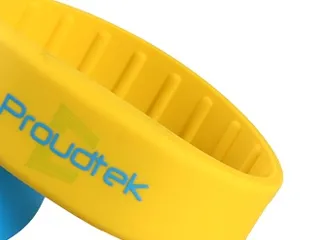
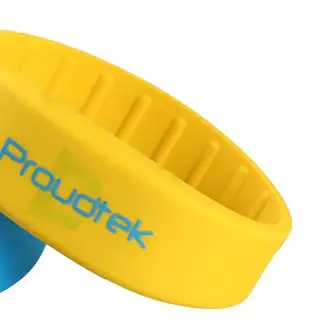
For a stay of days, a disposable band with a sealed inlay and a one-way closure is the usual choice. For longer stays, for paediatric and dementia care, and for visitor and parent access to secure wards, a silicone wristband with a locking clasp is more comfortable and survives washing. Bands must be latex-free and hypoallergenic, and the inlay must not be positioned where it will be cut off for a cannula.
Bedside patient identification devices: band, scanner and record
Bedside identification uses three parts: the patient's wristband, a bedside scanner (handheld or on the medication cart) and the record software. The clinician scans the band; the software resolves it to the patient's record, checks it against the order and flags a mismatch before treatment. An NFC (13.56 MHz) chip turns the scan into a tap; the print and barcode stay on the band.
The Joint Commission requires accredited hospitals to use at least two patient identifiers. Its standards FAQ on two patient identifiers says the armband only carries identifiers and is not one itself, and that barcode or RFID coding with two or more person-specific identifiers is acceptable. Which identifiers the barcode and chip carry is the hospital's decision. An opaque serial on the chip is a lookup key, checked against the printed band and the patient; person-specific identifiers on the chip put PHI on it and call for key-protected access such as MIFARE DESFire, not an open NTAG.
| Part | What it does | Who supplies it |
|---|---|---|
| Wristband: print, barcode, optional NFC/RFID chip | Carries the identifiers the hospital names; the chip holds an identifier (NTAG: write-locked after encoding) | Proud Tek: band and chip, blank or encoded, with test samples; the hospital adds patient details (printer fit confirmed on samples) |
| Bedside scanner, handheld or on the cart | Reads the barcode and, where fitted, the chip | The hospital's device vendor or integrator |
| EHR, eMAR or medication-administration software | Resolves the identifier, checks patient, drug, dose and time, logs the scan | The hospital's EHR vendor and IT team |
Patient wristbands, PHI and HIPAA requirements
Patient wristbands contain protected health information (PHI), printed visibly and embedded in the barcode. HIPAA prescribes no wristband format; it sets principles the hospital applies. Bands commonly show name and date of birth with a barcode (AHRQ PSNet), and HHS lists hospital identification bracelets among PHI that in general must not go into publicly accessible trash unless first rendered unreadable (HHS FAQ on disposal), so used bands, chip included, follow the hospital's PHI disposal route. This summarises HHS guidance and is not legal advice.
- Reasonable safeguards, not zero risk. The Privacy Rule permits incidental disclosures where reasonable safeguards and minimum-necessary policies apply; it does not require eliminating all risk (HHS guidance on incidental uses and disclosures). Those policies decide what a band prints.
- Keep personal data off the chip. An NFC phone can read an unprotected NTAG chip, so unless the hospital's system requires more and secures it, encode a serial that reveals nothing to a phone, not a name, diagnosis or record number; inside the hospital it still links to the record, so the band stays PHI. Write-lock it after encoding (NXP NTAG213/215/216 data sheet); where a band must not be copied, use MIFARE DESFire (availability in the chosen band confirmed per batch) with keys the hospital holds.
- Security of the record. The Security Rule's access, audit, integrity and transmission safeguards apply to systems holding electronic PHI (HHS Security Rule summary): the EHR and scan logs the hospital runs with its EHR vendor and integrator, not the band.
Staff credentials and ward access
Hospitals run large access-control estates with mixed histories: proximity fobs on old wings, MIFARE Classic cards from a refit, and DESFire on the newest building. The staff card usually doubles as a photo ID and as a login token for workstations, printers and drug cabinets, so the chip choice affects several systems at once.
The current baseline for anything sensitive is MIFARE DESFire EV2/EV3 with keys held by the access-control administrator. Where readers cannot be replaced at once, a dual-frequency combi card carries a proximity chip and a DESFire chip and works on both generations while doors are upgraded in order of risk. The key fob and hotel key card pages cover the migration mechanics; they apply unchanged to a hospital.
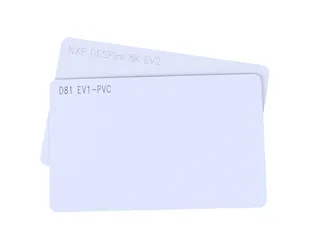
Photo ID cards are printed on inkjet-printable PVC or pre-printed with the trust's design, with the same chip inside.
Textiles through the laundry
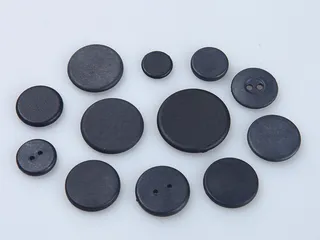
Scrubs, gowns, drapes and patient linen are counted, sorted and charged by an in-house or contracted laundry. A tag sewn into or heat-sealed onto each item counts it at soil-sort and clean-issue, records its cycles, and shows which ward is losing stock. The mechanics are the same as for hotels, described on the laundry tags page, with two differences.
First, the wash is harsher: healthcare laundering runs thermal disinfection cycles and stronger chemistry, so the tag and its attachment must be validated on the real line. Second, some items go through steam sterilisation. None of our laundry tags carries a sterilisation rating, so a PPS or silicone tag has to be trialled through the full cycle, repeated as often as the item will see it, and the attachment must survive the same cycle. Items that may enter an MRI suite need tags with no ferromagnetic parts, which is a question to put to the supplier in writing.
UHF is the usual frequency for bulk counting; HF is chosen where an item must be confirmed one at a time at close range.
Equipment and asset tracking
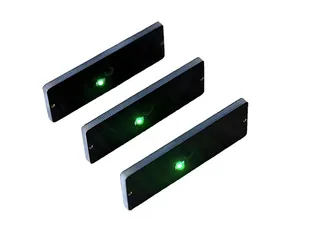
Infusion pumps, monitors and wheelchairs migrate between wards and disappear into cupboards. A UHF label on each item lets a handheld reader sweep a room and list what is there, and fixed readers at corridor points log movements. On metal housings the label must be an on-metal design; on plastic a standard label works. A tag with an LED can be triggered from the reader to light up, which turns a search of a storeroom into a glance.
Real-time location systems with active beacons are a separate, larger investment; passive RFID covers periodic audits and cupboard-level location at label cost. Many hospitals start with passive and add active tracking only for the highest-value mobile equipment.
Blood-bag and blood-bank labels
A blood-bank RFID label carries the same kind of opaque identifier as everything else on this page: it indexes the unit's record in the laboratory information system or blood-bank software. It does not replace the printed label. The mandated identifier for blood, tissue and cellular products is ISBT 128, maintained by ICCBBA and printed as linear Code 128 barcodes, with a 2D Data Matrix where compound data is carried; RFID is added alongside the barcode, never instead of it. Where a programme does add RFID, ICCBBA publishes guidance on carrying ISBT 128 data on RFID tags (using the ISO/IEC 18000-3 13.56 MHz air interface accepted for blood products), so the tag encodes the same Donation Identification Number and product code as the barcode and the two carriers always agree.
The barcode stays primary the whole way through collection, testing, labelling, storage, crossmatch and the bedside check. RFID is added only at the high-touch points where a single tap is faster and less error-prone than lining up a scanner: the two-person pre-transfusion check, where one unit is confirmed against one patient wristband, and read-in at a fridge door. HF or NFC suits the bedside, at close range, one unit at a time. UHF can count a populated fridge in bulk, but the blood inside every bag attenuates UHF far more than HF, so the read rate must be proven on a full, closed fridge rather than on a bench before anyone relies on it.
Label face and adhesive are the parts that fail first in this workflow, and their requirements are confirmed per product, not assumed. State the storage temperatures, whether the unit is frozen, and the centrifuge programme used for component separation when you request samples: the construction must hold through refrigerated storage (red-cell units are held at 1-6 degrees Celsius), through freezing where plasma is frozen, through condensation and moisture, and through the centrifugal force of separation without lifting at a corner. We supply label constructions rated for the cold chain and you validate them on the real process before committing; we do not invent temperature or cycle figures for a bag we have not seen.
One point to state plainly to procurement: 21 CFR Part 11 and comparable electronic-records rules apply to the system that stores and signs the scan data, not to the tag. The tag is a data carrier. It is the laboratory information system or blood-bank software that has to be validated, audit-trailed, access-controlled and retained. Buying a compliant label is not the same as having a compliant electronic-records system, and the label supplier does not provide that system.
Surgical-instrument tags
A reusable surgical instrument is reprocessed before every use: a washer-disinfector with chemical detergents, heat and often ultrasonics, then steam sterilisation in an autoclave, repeated several times a week across a service life measured in decades. Autoclave cycles are commonly run at 134 degrees Celsius for a few minutes, or as a longer cycle near 121 degrees Celsius, under saturated steam. A general-purpose label delaminates and detunes on the first cycle, so an instrument tag has to be engineered for this from the outset. It is not a rugged sticker.
Autoclave-rated tags seal the chip and antenna inside a hermetic or high-temperature package: a ceramic disc, a glass capsule, a high-temperature PEEK polymer body, or an epoxy-encapsulated on-metal inlay, chosen for the instrument's size and how it is handled. HF at 13.56 MHz (ISO/IEC 14443 or 15693) is usually preferred over UHF for instrument-level tagging because HF magnetic coupling stays reliable against the metal of a packed tray, where UHF antennas detune and near-field reads become unpredictable, and HF's short range gives controlled, one-item selectivity. On-metal designs are not optional; the instrument body detunes an ordinary antenna. The tag memory holds only a cross-reference to the sterile-processing record.
Attachment has to survive the same cycles as the encapsulation. A stainless-steel rivet or a laser-weld into the handle, an OEM-embedded pocket, or a high-temperature epoxy will hold; a surface-mount adhesive inlay will not, and most real-world 'chip failures' turn out to be adhesive failures diagnosed as something else. For baskets, containers and whole sets rather than individual instruments, a cable-tie or bracket-mounted tag rides the tray instead. Cycle life is confirmed per product against your own sterile-processing cycle, its temperature, dwell, pressure, chemistry and repeated count, and is never inferred from a material name: obtain the model's validation documentation and run samples through your line.
Decide the granularity first. Tray-level tagging counts and tracks whole sets and is the common starting point; instrument-level tagging tags every item and supports lifecycle records, tray right-sizing and individual sterilisation history, at higher tagging cost and effort. Direct part marking of reusable instruments (a permanent plain-text and/or AIDC mark on the instrument body, commonly a laser-etched 2D Data Matrix, though 21 CFR 801.45 permits plain-text or any AIDC technology) is a separate requirement the instrument OEM meets; an attached RFID tag is not itself the direct mark, and typically holds a cross-reference to where that Unique Device Identifier record lives in the sterile-processing system rather than duplicating the regulated identifier. RFID surgical sponge and gauze counting is a separate matter: those are regulated medical devices supplied as complete cleared systems by their manufacturers, and they are outside Proud Tek's scope.
Compliance points to confirm
Regulation applies to how identifiers are used, not to the chip. The questions a buyer should have answers to:
- Data on the chip. Only an opaque identifier, unless the hospital's system requires more and secures it; personal and clinical data stay in the system under its access controls and audit logs.
- Skin contact. Wristband materials latex-free and hypoallergenic, with documentation from the supplier.
- Infection control. Wipeable, non-porous credential bodies; disposable wristbands for isolation wards.
- Textile processes. Tags and attachments validated on the disinfection and, where relevant, sterilisation cycles actually used.
- MRI. Tags on items or people that may enter an MRI suite declared free of ferromagnetic parts.
- Blood products. ISBT 128, maintained by ICCBBA, stays the mandated identifier on every bag; RFID is added under ICCBBA's guidance for carrying ISBT 128 on RFID tags and encodes the same Donation Identification Number, never replacing the barcode.
- Electronic records. 21 CFR Part 11 and equivalent rules govern the validated system that stores and signs scan data, not the tag; the tag is only a data carrier, and the records system comes from your integrator.
- Instrument identity. Where instruments carry an FDA Unique Device Identifier, confirm the RFID payload cross-references the device record; the OEM's direct part mark on the instrument body remains the regulated carrier, and the RFID tag does not replace it.
- Medication packaging. Where serialised traceability is regulated, the printed 2D code remains mandatory and RFID is an addition; see the supply chain page.
What Proud Tek manufactures for healthcare
We manufacture silicone and disposable wristbands with NTAG and MIFARE chips, staff cards in DESFire and dual-frequency versions with photo-ID print, laundry tags in PPS and silicone, and labels for equipment. Blood-bag and blood-bank labels and autoclave-rated surgical-instrument tags are specified per project rather than from a fixed catalogue page: send us the cold-chain, wash or sterilisation cycle and we quote the construction rated for it and supply samples to validate before you commit. Where a unit or item needs tamper-evident authentication, an NTAG 424 DNA label adds a rolling cryptographic check that a plain identifier cannot. We do not supply bedside or handheld clinical scanners, UHF readers, the electronic health record or laboratory-system integration, real-time location software, or RFID surgical sponge-counting systems; those come from your integrator or from the device's own manufacturer, and we test our tags and credentials against the readers and processes they specify.
Published 2026-09-09 · Updated 2026-09-28