
Child Safety Wristbands
RFID Child Safety Wristbands
Parent-Child Pairing
Quick answer
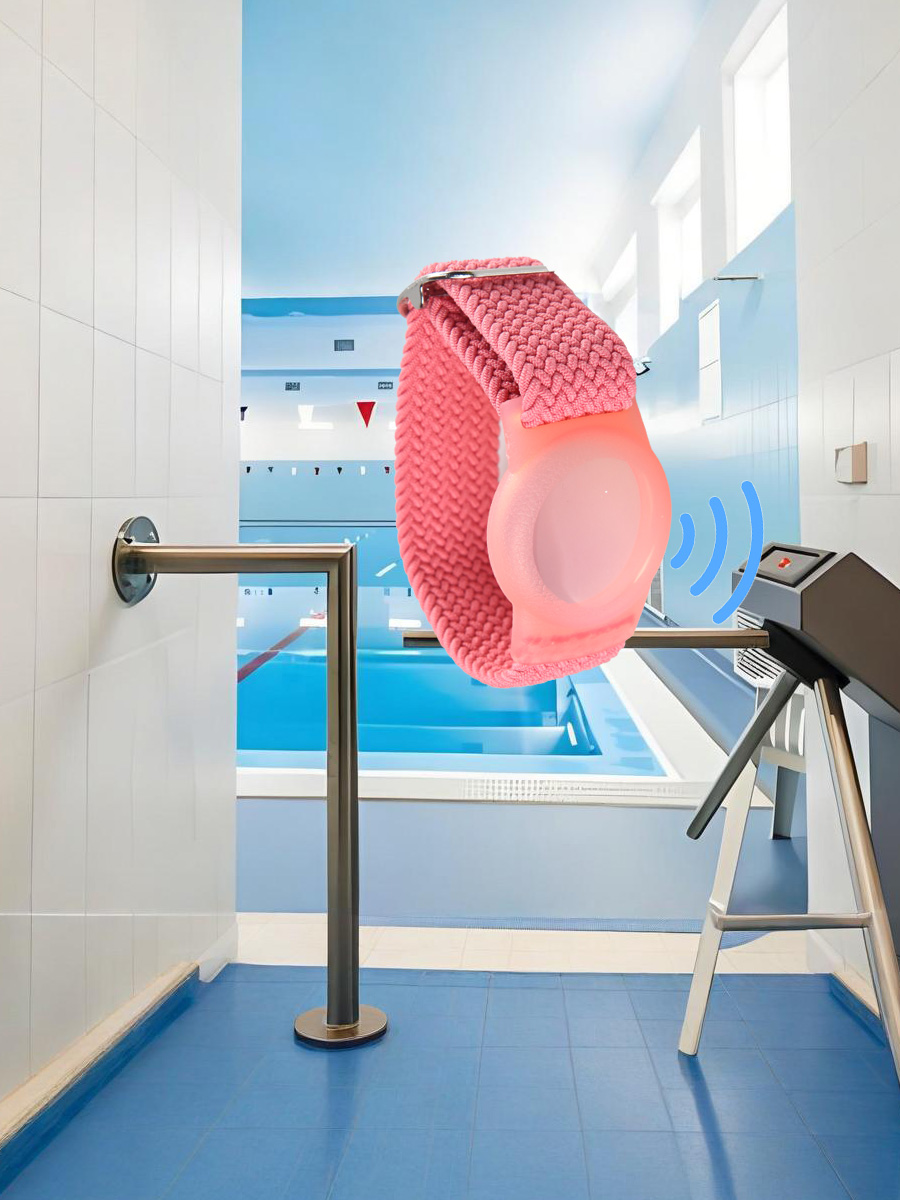
RFID child safety wristbands embed an NFC chip (NTAG213 / 215 / 216, MIFARE Ultralight EV1) or UHF EPC Gen2 chip (Impinj Monza R6) inside a child-sized band. Band options are hypoallergenic medical-grade silicone, woven fabric, or Tyvek, with a tamper-resistant closure that a young child cannot remove unaided. The wristband UID is paired to the accompanying adult's credential at check-in so staff can verify the match before allowing the child to leave with an adult. This is the structural mechanism behind rapid lost-child reunification, unauthorised-departure prevention, and emergency-evacuation accountability at family water parks, theme parks, daycare programmes, school field trips, summer camps, swim classes, and family-zone festivals.
- Tamper-resistant closure spectrum (tamper-evident adhesive single-use, security snap lock reusable, recessed-button clasp child-proof) — child cannot remove the band unaided up to ~8-10 years old; the structural mechanism behind unauthorised-departure prevention at family parks, daycare programmes, and school field trips.
- Parent-child UID-pairing at check-in creates a linked record in the venue / school / camp platform — at pick-up or reunification, scanning the child's wristband immediately surfaces the linked adult; reunification time drops from minutes-of-PA-announcements to seconds at the help desk.
- Child-sized silicone / fabric / Tyvek substrate options (toddler 130-150 mm / child 150-170 mm / tween 170-190 mm), all clear U.S. CPSIA + ASTM F963 + EU Toy Safety Directive 2009/48/EC + EN 71 children's-product safety regimes; child-friendly Pantone / cartoon-character branding + QR-code no-NFC-phone fallback for lost-child outside-the-venue recovery.
Used in these industries
Deployments where this product is referenced on our industry landing pages.

At a glance
Use these short answers to decide whether this page matches the project before moving into the detail.
Substrate options for child wear
Platinum-cured medical-grade silicone — hypoallergenic, latex-free, BPA-free, phthalate-free; FDA 21 CFR 177.2600 + ISO 10993-5 / 10993-10 biocompatibility evaluation fr...
Air interface and chip pairing
HF 13.56 MHz, ISO/IEC 14443-A — NTAG213 (144 B) for tap-to-URL parent profile, NTAG216 (888 B) for emergency contact + medical / allergy info, MIFARE Ultralight EV1 / Cl...
Next step
Ready to move forward? Start your inquiry to get specific answers for this project.
Request quote and samples- Sizing for child-specific fit
-
- Toddler (130-150 mm circumference, 14-18 mm width); child (150-170 mm, 16-20 mm width); tween (170-190 mm, 18-22 mm width).
- Size colour-coding option for visual staff segmentation at venue entry and group-tour transitions — operationally meaningful at family parks running mixed adult / child sessions.
- Antenna geometry tuned per size so on-wrist read range stays consistent across all variants without dead-zones at smaller sizes.
- Tamper-resistant closures
-
- Tamper-evident adhesive (single-use) — band tears visibly on attempted removal; the disposable / single-day default that catches casual transfer attempts at the gate.
- Security snap lock (reusable) — requires adult hand strength to open; child-proofed for under-10 wear; the multi-month family-pass / season-pass default.
- Recessed-button clasp (child-proof) — opens with a pointed tool (pen tip, paperclip); the most-secure variant for higher-coercion environments (medical paediatrics, behavioural-health adolescent units, foster-care programmes).
- No closure is 100% tamper-proof against a determined older child; closures effectively prevent accidental loss and casual removal by young children up to ~8-10 years old.
- Parent-child UID-pairing workflow
-
- At check-in: staff scan the child's wristband + the accompanying adult's credential (wristband, ticket, or member card). The venue platform creates a linked pair record.
- At check-out / pick-up: staff scan the child's band → platform displays the linked adult's name, photo (if on file), and contact info. Adult must present matching credential to complete pick-up.
- If child is found separated: staff scan the child's band → platform routes to the linked adult's location (if also wearing an RFID credential) or contacts them via the registered phone number. The reunification time drops from minutes-of-PA-announcements to seconds.
- Lost-child / emergency-evacuation accountability
-
- UHF dual-frequency variant enables passive headcount at zone-boundary readers — group-tour transitions, school-bus boarding, ride-line zone entries — without requiring children to actively tap.
- Emergency evacuation: real-time headcount visible to ops staff via the platform dashboard; missing-child alerts route to the linked adult and venue staff simultaneously.
- Lost-child standard procedure (Code Adam in U.S. retail / NCMEC reference) operationalised on the wristband layer: the digital pair-link replaces verbal description as the reunification mechanism.
- Daycare / kids' club / resort children's programme
-
- Sign-in / sign-out workflow replaces paper sign-out sheets that are easily falsified; only authorised adults whose credentials are paired in the system can collect the child.
- Multi-adult authorisation — child paired to multiple linked adults (mother, father, grandparents, designated carers) at registration; venue staff verify any one of the authorised pairs.
- Resort children's programme integration with the parent's room-key wristband (PVC / vinyl / silicone) keeps the family in one credential system end-to-end.
- School / camp / field-trip use
-
- Field trips: chaperone-child UID pairing for headcount at every transition point (museum entry, lunch venue, bus return).
- Summer camps: cabin-counsellor pairing, activity-zone access, swim-lake check-in / check-out, swim-buddy pairing for aquatic-safety protocols.
- Sports day / school carnival / education-fair: temporary parent-child linking for events held on school premises with public attendance.
- Privacy-by-design: chip carries an opaque non-PII serial; lookup to the school SIS / camp roster happens server-side.
- Aquatic-venue child safety
-
- Waterparks: age-appropriate zone enforcement at slide entry and pool-zone gates; UHF zone-boundary readers detect when a child enters a restricted area and alert staff.
- Swim-class programmes: instructor-pupil pairing, parent-pickup verification at the pool exit, swim-class progress tracking on NTAG216 user memory.
- IP68 silicone-substrate child variant survives chlorinated-pool / sunscreen / multi-day exposure in family-park / resort programmes.
- Branding and parental engagement
-
- Child-friendly cartoon-character designs, bright Pantone colours, venue logo + sponsor characters; UV-reactive ink and glow-in-the-dark options for night-time aquatic programmes.
- QR-code printed on the band (paired with the NFC chip) routes to an emergency contact / lost-child / parent-portal page if the child is found by a member of the public outside the venue — the no-NFC-phone fallback.
- Parent-app NFC tap reads the child's band to view live location (where supported), reunification status, photo album, and ride-photo / activity-log.
- Procurement and operations
-
- MOQ 200 silicone (multi-month / season-pass / member tier); MOQ 200 fabric or Tyvek (event / programme / camp single-day); lead time 12-15 business days for silicone, 10-14 for Tyvek, 15-20 for sublimation fabric.
- Per-band cost USD 0.20-0.40 Tyvek / 0.55-1.40 silicone / 0.80-1.50 fabric depending on chip family and finish complexity.
- Regulatory and safety compliance
-
- U.S. CPSIA (Consumer Product Safety Improvement Act) Section 101 lead and phthalate restrictions for children's products.
- ASTM F963 — Standard Consumer Safety Specification for Toy Safety (small parts, choking hazard, sharp edges, mechanical integrity).
- EU Toy Safety Directive 2009/48/EC + EN 71 series (mechanical, flammability, chemical) for child-product compliance in EU markets.
- FDA 21 CFR 177.2600 (food-contact baseline) + ISO 10993-5 / 10993-10 biocompatibility evaluation framework for silicone variants.
Commercial terms
- MOQ
- Varies by SKU — stock items from 100 pcs; custom production typically 200-1,000 pcs
- Lead time
- Production 2-3 weeks after artwork and encoding sign-off; reorders on a 3-4 week cycle
- Samples
- Free samples and RF test report with every order; courier at customer cost
- Payment
- 50% T/T deposit, 50% before shipment; Net 30/60 for established accounts; LC for large orders
- Shipping
- FOB Shenzhen / Yantian; DHL, FedEx or EMS air freight; sea LCL / FCL for volume
- Response
- Itemized quote within one business day, Mon-Fri (UTC+8)
Why a child-specific wristband — the safety arithmetic
- Lost-child events at large family venues are routine — parks spanning dozens of acres handle multiple parent-child separations every operating day. Without an RFID-paired identification system, staff rely on verbal description, a slow process that extends distress time.
- Daycare and kids' club paper sign-out sheets are falsifiable and slow; photo-ID checks queue at busy pick-up windows. The RFID-paired credential turns the verification step into a tap that staff can run in seconds.
- School field trips and camps: passive UHF headcount at zone transitions catches a missing child within minutes of separation rather than at the next manual roll-call.
Closure spectrum — matching coercion-resistance to environment
Single-day disposable / multi-month family pass
- Tamper-evident adhesive: single-use, tears on removal; family-festival / day-pass default
- Security snap lock: reusable, adult-strength to open; multi-month season-pass / family-park default
- Both close in seconds at the check-in counter without specialised tools
- Effective up to ~8-10 years old for casual-removal prevention
- Closure cost: low (adhesive) / moderate (snap)
Higher-coercion environments — paediatric medical, behavioural-health, foster-care
- Recessed-button clasp: requires pointed tool (pen tip, paperclip) to release
- Use cases: paediatric inpatient, behavioural-health adolescent unit, foster-care
- Adolescents and older children require closure determined enough to defeat casual removal
- Higher closure cost; production-grade per-band manifest and chip-deactivation hooks for tamper events
- Pair workflow extends to medical-staff / clinical-care-team credential as well as family
What the parent-child pair-link actually moves
- Tap-to-find at the help desk: chip UID resolves to linked adult Patient / Guardian record server-side.
- PA announcement only as fallback when the linked adult is unreachable by phone; not the primary mechanism.
- UHF dual-frequency variant: passive zone-boundary detection alerts staff before the child reaches a help desk.
- Privacy-by-design: chip carries opaque non-PII serial; identity lookup happens server-side per HIPAA / CPSIA / venue-policy minimisation.
From paper sign-out to RFID-paired family-credential
- 1980s-90s
Family parks, daycare programmes, and resort children's clubs use paper sign-out sheets and photo-ID checks; lost-child PA announcements are the standard reunification mechanism.
- 1994
U.S. National Center for Missing & Exploited Children (NCMEC) publishes Code Adam protocol for retail and family-venue lost-child response — the procedural framework that RFID later operationalises on the credential layer.
- 2008
U.S. CPSIA (Consumer Product Safety Improvement Act) codifies lead and phthalate restrictions for children's products; PVC and silicone child wristband formulations become the default, ahead of EU Toy Safety Directive 2009/48/EC.
- 2010-2014
NXP NTAG / MIFARE silicon commoditises HF NFC; child-sized wristbands gain embedded RFID for parent-pair workflow at family parks (Disney FastPass+, Universal CityWalk, regional water parks).
- 2015-2018
Disney MagicBand at scale demonstrates body-worn RFID + parent-child link on a family-park credential; the design pattern crosses over to daycare, school field trip, and summer camp programmes.
- 2020-2024
Mindbody / Procare / Brightwheel / HiMama daycare platforms add NFC-wristband integration for sign-in / sign-out workflow; UHF dual-frequency child wristbands enter the school-bus boarding and field-trip-headcount space.
- 2026 Today
How experienced teams run family-water-park, school-field-trip, summer-camp, theme-park-multi-day, and swimming-class programmes converge on hypoallergenic medical-grade silicone (or sublimation fabric for multi-day events / Tyvek for single-day issue) + NTAG216 / Ultralight EV1 + tamper-resistant closure matched to coercion-resistance + parent-pair UID-link workflow + UHF dual-frequency for passive-headcount transitions as the operator-side template.
Closure options
- Tamper-evident adhesive (single-use, tears on removal): family-festival / day-pass / single-issue events.
- Security snap lock (reusable, requires adult dexterity): multi-month family-pass / season-pass / daycare programme.
- Recessed-button clasp (child-proof, opens with a pointed tool): paediatric medical / behavioural-health adolescent / foster-care.
Useful next pages
Use these linked product, guide and comparison pages to keep the next click specific and practical.
Related family-venue RFID wristbands
Other wristband formats in the family-venue safety footprint.
Industry landings
Vertical pages anchoring the family-venue and education use-cases.
Related solutions, compares, and pillar
Solution guides and the wristband pillar.
FAQ
Can a child remove the tamper-resistant wristband?
Tamper-resistant closures are designed so that a child under ~8-10 years old cannot remove the band unaided. The adhesive variant tears visibly on attempted removal, alerting staff. The security snap lock requires adult hand strength. The recessed-button clasp requires a pointed tool (pen tip, paperclip) to release. No closure is 100% tamper-proof against a determined older child; the closure choice should match the realistic coercion-resistance envelope of the deployment (lower for day-pass families, higher for paediatric medical / behavioural-health adolescent units).
How does parent-child linking work?
At check-in, staff scan the child's wristband + the accompanying adult's credential (wristband, ticket, or member card); the venue platform creates a linked-pair record. At check-out or if the child is found separated, staff scan the child's band → platform displays the linked adult's name, photo, and contact info. The parent must present their matching credential to complete pick-up. Linking adds only a few seconds to each family's check-in. Multi-adult authorisation (mother + father + grandparents + designated carers) is supported at registration.
Is the chip storing the child's name and personal information?
No — by design. The chip carries an opaque non-PII serial / token; the venue / school / camp platform resolves the serial to the child's record server-side. This is the privacy-minimisation pattern that aligns with HIPAA Privacy Rule 45 CFR 164.502 / 164.514, U.S. COPPA (Children's Online Privacy Protection Act) for under-13 PII handling, FERPA for school records, and EU GDPR Art. 8 children's-data minimisation. Names and DOBs may appear on the printed face but are not written to the chip.
Are these wristbands safe for children with sensitive skin?
Yes — silicone variants are platinum-cured medical-grade hypoallergenic material; latex-free, BPA-free, phthalate-free; clear FDA 21 CFR 177.2600, EU REACH SVHC, RoHS Directive 2011/65/EU, and U.S. CPSIA / ASTM F963 / EU Toy Safety Directive 2009/48/EC + EN 71 series for children's products. Tyvek and fabric variants similarly pass children's-product safety regimes. Specify substrate at order stage; certificates of compliance ship with bulk dispatch.
What is the MOQ and lead time?
Silicone child wristbands with tamper-resistant closure: MOQ 200, lead time 12-15 business days. Tyvek disposable child bands: MOQ 200, lead time 10-14 business days. Sublimation fabric for multi-day camping / school field trip: MOQ 200, lead time 15-20 business days. Custom child-friendly designs with venue branding included within standard lead time. Volume pricing at larger quantities for seasonal operations — 8-10 weeks ahead of season opening for guaranteed delivery on bulk orders.
Can the wristband integrate with our daycare-management platform?
Yes — Procare, Brightwheel, HiMama, Kindo, Famly, Tadpoles all consume the wristband UID via SDK or middleware for sign-in / sign-out, parent-pair-link, and emergency-contact lookup. Mindbody (kids' club programmes inside fitness clubs) and venue-management platforms (Glownet / Tappit / Semnox / accesso family-park modules) similarly accept the standard chip-encoding spec. Switching wristband supplier is invisible to the platform layer.
Sources & references
Primary standards, OEM datasheets and regulatory documents cited by this article. All URLs were verified on the access date shown below.
- ISO/IEC 14443-1..4 — Identification cards — Proximity cards
13.56 MHz HF air-interface standard underlying NFC child wristband chip operation.
- ISO/IEC 18000-63 — RFID for item management — Air interface 860-960 MHz Type C (EPC Gen2)
UHF air-interface standard for passive headcount on dual-frequency child wristband programmes.
- NXP NTAG213 / NTAG215 / NTAG216 product data sheet
NFC silicon options for child wristband programmes.
- U.S. Consumer Product Safety Improvement Act (CPSIA) Section 101 — lead and phthalate restrictions
U.S. children's-product safety baseline applied to PVC, silicone, and adhesive components in child wristband production.
- ASTM F963 — Standard Consumer Safety Specification for Toy Safety
Toy-safety specification covering small parts, choking hazard, sharp edges, mechanical integrity for child wristband variants.
- EU Toy Safety Directive 2009/48/EC
EU children's-product safety regime that child-sized wristband variants must clear in EU markets.
- FDA 21 CFR 177.2600 — Rubber articles intended for repeated use
Food-contact baseline applied as the prolonged-skin-contact safety reference for medical-grade silicone child wristbands.
- ISO 10993-5 — Biological evaluation of medical devices — Tests for in vitro cytotoxicity
Reference biocompatibility evaluation framework for prolonged-skin-contact silicone child wristband qualification.
- U.S. COPPA — Children's Online Privacy Protection Act
Under-13 PII handling regime applicable to platform-side child-record management linked to wristband UIDs.
- National Center for Missing & Exploited Children — Code Adam protocol
Procedural framework for retail / family-venue lost-child response that RFID parent-pair workflow operationalises on the credential layer.
Proud Tek is a Shenzhen-based RFID & NFC manufacturer supplying hotel chains, transit operators, event venues and retail brands worldwide. Every order includes free samples, RF testing and dedicated project support.
Get a Quick Quote
Tell us about your project and we'll respond within one business day. Fields marked (asterisk) are required.