
RFID Library Solutions
RFID Library Management
ISO 28560 Tags

Quick answer
RFID library management cuts patron checkout time 75% and completes full-collection inventories 8–10× faster — hours instead of weeks. HF 13.56 MHz tags on ICODE SLIX2 silicon, encoded per the ISO 28560 data model, automate self-checkout, returns, sorting, security gates and shelf inventory. Kiosk hardware from Bibliotheca, FE Technologies and EnvisionWare connects via SIP2 / NCIP to Ex Libris Alma, Koha and SirsiDynix platforms.
- Self-service checkout and return. Patrons check out and return items at RFID kiosks without staff assistance, handling multiple items simultaneously in seconds.
- Automated sorting: returned items pass through RFID-read sort conveyors that route each item to the correct bin for shelving, holds or interlibrary loan.
- Rapid shelf inventory: handheld RFID readers scan entire shelves at walking speed, counting items, detecting misshelved books and identifying missing titles in a fraction of the time needed for barcode scanning.
Featured Library Management Products
SKUs we typically deploy for library management. Tap a card for specs and samples.

At a glance
Use these short answers to decide whether this page matches the project before moving into the detail.
Library segment served
Public libraries — central + branch + bookmobile networks running SIP2 / NCIP self-service. Academic / university libraries — research collections + reserves + electroni...
ISO 28560 data model + chip choice
ISO 28560-1:2014 — overall data model + 27 mandatory + optional data elements. ISO 28560-2:2014 — encoding on ISO/IEC 15693 vicinity (most common for libraries).
Next step
Ready to move forward? Start your inquiry to get specific answers for this project.
Request library RFID tag pricing- Kiosk + reader hardware ecosystem
-
- Bibliotheca — global library RFID leader; SmartServe self-checkout, smartFlow sorter, smartShelf, smartGate.
- FE Technologies (Australian) — popular APAC + UK kiosk vendor with checkPoint EAS gates + assistU staff stations.
- P.V. Supa (Finnish) — Nordic + European kiosk + sortation; SUPA Solutions stack.
- EnvisionWare — US public-library focused; OneStop self-checkout, Express Checkout, Intelligent Reservation Station.
- 3M / Tattle-Tape (legacy) — pre-2018 estates; replaced gradually by Bibliotheca after acquisition.
- Checkpoint Systems — EAS + RFID gate vendor; Apparel + library-tag integrated systems.
- D-Tech — UK + Ireland kiosk vendor with V-Series self-service.
- Lyngsoe Systems — Danish sortation specialist; LibraryMate sorter at large public + university estates.
- Self-checkout reader hardware: HID OMNIKEY 5127, FEIG Electronic LRM2500, Bibliotheca SmartServe RFID reader.
- ILS / LSP integration matrix
-
- Ex Libris Alma (Clarivate) — dominant academic / consortia library-services platform.
- Koha — open-source ILS used by smaller public + academic libraries globally.
- SirsiDynix Symphony + BLUEcloud + Horizon — major US public + academic library ILS.
- Innovative Sierra + Millennium + Polaris (acquired by ProQuest, now Clarivate) — public library focus.
- OCLC WorldShare Management Services — academic + special library cloud LSP.
- Follett Destiny — K-12 dominant ILS.
- Auto-Graphics VERSO — small public + special library ILS.
- Library.Solution (TLC) + Surpass — niche US ILS vendors.
- Integration via SIP2 (Standard Interchange Protocol) + NCIP (NISO Circulation Interchange Protocol).
- Self-service + staff workflow
-
- Patron self-checkout: place items on reader pad → scan library card → confirm → receipt.
- Self-return + book-drop: chute integration with sortation conveyor + automated check-in.
- Sortation: 4–24 bin sorter routing returned items by branch / shelf / hold / ILL / damage / weeding.
- Staff station: faster batch check-in / reserve / weeding / collection-management workflows.
- Security gate: AFI-bit detection at exit triggers alarm if AFI not flipped to checked-out state.
- Shelf reader: handheld walks shelves at 1–3 m/sec; identifies missing + misshelved + due-for-weeding items.
- Reservation pickup shelf: RFID-monitored reservation shelf; automated patron notification on retrieval.
- Privacy + ALA compliance framework
-
- American Library Association (ALA) Privacy Bill of Rights — patron privacy is fundamental library value.
- ALA Resolution on RFID — opposes RFID use that compromises patron privacy + circulation confidentiality.
- NISO RP-6-2012 RFID in U.S. Libraries — recommended practice for ISO 28560 + privacy + EAS.
- Patron card: encode minimal patron ID; never store name / address / circulation history on card.
- Item tag: encode item ID only; never store patron-association on item tag.
- Privacy by design: AFI security bit toggled on/off; UID privacy mode at check-out per ICODE SLIX2.
- Data retention: circulation history purged per local + state library privacy law (varies US state-by-state).
- FERPA — student-record privacy for K-12 + academic library circulation.
- Programme economics + TCO
-
- Per-tag BOM: $0.15–$0.30 ICODE SLIX2 book label at 100k+ qty; $0.40–$0.80 specialty tags.
- Self-checkout kiosk: $4,000–$12,000 per station depending on vendor + features.
- Sortation system: $50K–$300K per branch depending on bin count + throughput.
- Security gate: $5,000–$15,000 per pair.
- ISO 28560 conversion programme cost: $2–$5 per item all-in (tag + application labour).
- Staff-time saving: 50–75% reduction in circulation-staff hours; redirected to patron-service / programming.
- Inventory time: full collection inventory drops from weeks to hours (8–10× faster).
- Payback: typically 3–7 years for full programme; varies by collection size + staff cost baseline.
- Collection lifecycle + weeding workflow
-
- Per-item circulation history captured at every check-in / check-out.
- Weeding analytics: low-circulation items flagged for retire / withdrawal review.
- Damage tracking: condition-update events captured at staff handling.
- Re-cataloguing: ISO 28560 item-type + set-information enables material re-classification.
- Inter-branch transfer: RFID-validated inter-branch shipment.
- Reservation + hold: AFI-bit-flipped state distinguishes reserved-for-pickup items.
- Withdrawal: RFID-validated weeding event + tag-deactivation.
- Implementation programme stages
-
- Stage 1 — ILS / LSP audit + ISO 28560 data-model adoption decision.
- Stage 2 — Vendor selection: Bibliotheca / FE Tech / P.V. Supa / EnvisionWare / D-Tech / Lyngsoe.
- Stage 3 — Conversion programme: bulk-tag + ISO 28560 encoding for entire collection.
- Stage 4 — Self-checkout + sortation + security gate hardware deployment.
- Stage 5 — Staff training + patron onboarding + signage.
- Stage 6 — Go-live + first quarter operational tuning.
- Stage 7 — Inventory cycle: first full-collection RFID inventory + reconciliation.
- Stage 8 — Ongoing operations + annual tag-grade refresh + ILS upgrade alignment.
- What this solution is NOT — adjacent scope
-
- NOT a single library-tag SKU page — see /products/rfid-tags/rfid-library-book-tag/ + /products/rfid-labels/rfid-book-spine-label/.
- NOT a generic RFID asset-tracking programme — see /solutions/rfid-asset-tracking-labels/ for non-library asset tracking.
- NOT a corporate access-control programme — see /solutions/rfid-access-control/ + /solutions/rfid-attendance-system/.
- NOT a museum / artifact specialty programme — covered separately under museum + archive vertical.
- NOT a library-card SKU only — see /products/rfid-cards/icode-slix-card/ for the patron-card SKU.
- NOT a libraries industry landing — see /industries/libraries/ for sector-level view.
How RFID transforms library operations
Before RFID, taking inventory was a rite of passage: a barcode wand, a clipboard, and the slow business of confirming that each book sat exactly where the catalogue said it did. The checkout desk ran on the same patient logic — one patron, one beep, one item at a time, while the queue studied the carpet. RFID rewrites the underlying physics. Tags read in bulk and without line-of-sight, so a full stack checks out in a single motion, and a shelf inventory that used to run for weeks now takes an afternoon.
Barcode-based library
- Staff required at every checkout station
- One item scanned at a time — line-of-sight needed
- Manual shelf reading takes weeks for full inventory
- No automated sorting of returned items
RFID-enabled library
- Self-service checkout and return kiosks — no staff needed
- Multiple items read simultaneously on reader pad
- Handheld scanner counts entire shelves at walking speed
- Automated RFID sort conveyors route items to correct bins
- Self-checkout kiosks: patrons place one or more books on the reader pad, the RFID system reads all tags simultaneously, links them to the patron's library card, and completes the checkout transaction in 3-5 seconds per stack.
- Self-return stations: patrons feed items into a return slot, RFID reads the tag, checks the item in automatically, and routes it to an internal sorting conveyor or bin for staff to reshelve.
- Security gates: RFID-enabled security gates at library exits detect tagged items that have not been checked out, triggering an alarm to prevent unauthorized removal.
- Collection inventory: staff walk through the stacks with a handheld RFID reader, scanning hundreds of items per minute along shelf rows. The system flags missing items, misshelved items and items due for weeding.
- Interlibrary loan tracking: RFID tags enable automated check-in and check-out of interlibrary loan items, with system integration to ILL management software.
RFID tags for library materials
- Stage 1 — ILS audit + ISO 28560 adoption
Audit existing ILS / LSP (Alma / Koha / Symphony / Sierra / Polaris / WorldShare / Destiny) + barcode population + collection size. Decide ISO 28560 data-model encoding (Part 2 most common). Confirm SIP2 / NCIP integration capability for kiosk + sortation.
- Stage 2 — Vendor + hardware selection
Choose kiosk + sortation + security-gate vendor: Bibliotheca, FE Technologies, P.V. Supa, EnvisionWare, D-Tech, Lyngsoe Systems. Specify per-branch: self-checkout kiosk count, sortation bin count, security-gate count, staff-station count.
- Stage 3 — Tag selection + collection conversion
ICODE SLIX2 baseline; specialty tags for AV cases + CD/DVD hub. Conversion programme: bulk-tag + ISO 28560 encoding for entire collection. In-house staff or outsourced conversion service.
- Stage 4 — Hardware install + ILS integration
Self-checkout kiosk + sortation + security-gate + staff-station hardware install. ILS SIP2 / NCIP integration test. Network + firewall + power + cabling per branch.
- Stage 5 — Staff training + patron onboarding
Staff training on new self-service workflow + collection-management tools. Patron-facing signage + onboarding kiosks. Marketing campaign for self-service adoption.
- Stage 6 — Go-live + first-quarter operational tuning
Soft launch one branch first, expand to estate. Tune kiosk firmware + AFI security-bit logic + sortation rules. Monitor patron adoption rate + staff-time redirection metrics.
- Stage 7 — First full-collection inventory cycle
Handheld shelf-reader walks every shelf in collection. Reconcile against ILS catalogue. Identify missing + misshelved items. Establish quarterly inventory cadence.
- Stage 8 — Ongoing operations + annual refresh
How experienced teams run libraries, education, fitness, hospitality and laundry-services programmes — annual ALA + NISO privacy-policy review; ICODE SLIX2 PrivacyMode firmware update; ILS / LSP version-upgrade alignment; consortia-wide data-model harmonisation; tag-replacement reserve for damaged items at 1–3% per year baseline.
- Book spine labels: thin HF RFID labels (ICODE SLIX or NTAG) applied inside the book cover or on the spine, with or without a printed barcode overlay.
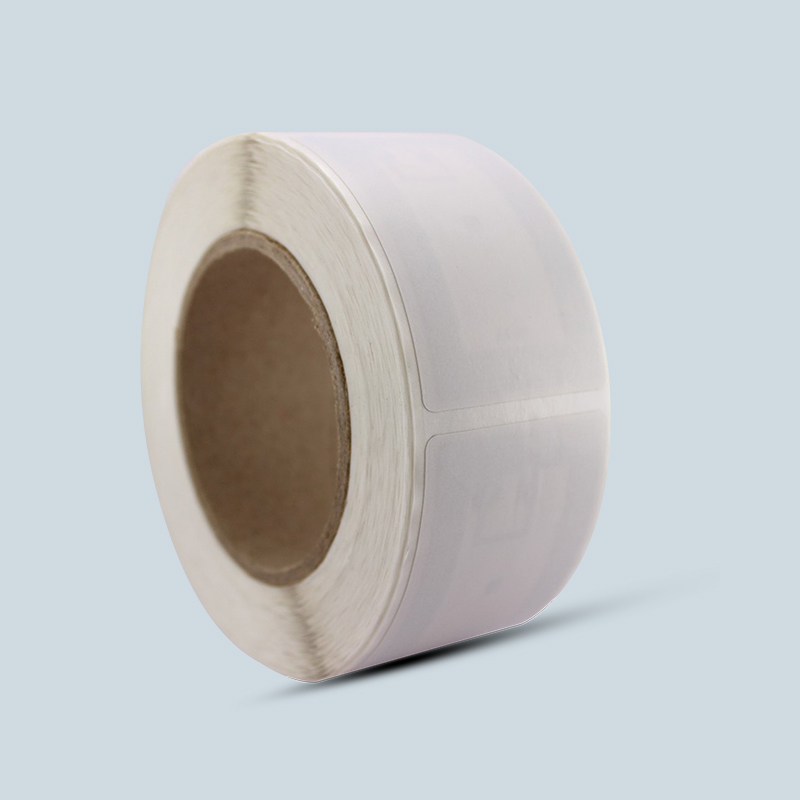
- Square book tags — 50 × 50 mm HF RFID labels for standard placement inside book covers, with adhesive backing and optional security bit for EAS (Electronic Article Surveillance).
- CD/DVD hub labels. Circular HF RFID labels designed to apply to the center hub of optical media without affecting disc playback.
- AV case tags: larger HF RFID labels for audiovisual cases, boxed sets and multimedia packaging.
- Patron library cards: RFID-enabled cards (MIFARE or ICODE chip) that serve as patron identification for self-checkout kiosks and door access.
ISO 28560 data model — Part 1/2/3 + chip silicon binding deep-dive
- ISO 28560-1:2014 — defines the data model for RFID in libraries; specifies the data elements (primary item identifier, owner library, etc.) + encoding rules. ANSI/NISO Z39.27-2011 superseded; libraries worldwide standardise on ISO 28560.
- ISO 28560-2:2014 — defines the encoding rules for Block 0 + AFI (Application Family Identifier) + DSFID (Data Storage Format Identifier) on the ICODE SLIX chip; the EU + UK + APAC dominant implementation.
- ISO 28560-3:2014 — defines an alternative encoding using fixed-length data elements; the North American dominant implementation (used by Bibliotheca, EnvisionWare, FE Tech 3M).
- ISO 28560-4:2024 — newer multi-frequency profile allowing HF + UHF dual-frequency for special collection.
- Data elements typically encoded — Primary Item Identifier (24 char barcode-equivalent), Owner Library (4-5 char), Title Identification, Set ID, Type of Usage, Shelf Location, ONIX media format, Library of Congress / Dewey classification mark, supplier identifier, language, country of publication.
- AFI (Application Family Identifier) — 1-byte value indicating item is a library item; security-bit dual-state (sold/borrowed vs. on-shelf-not-sold); EAS gates check AFI before alarm. Standard library values 0x07, 0x08, 0x09, 0xC2.
- DSFID (Data Storage Format Identifier) — 1-byte indicating ISO 28560 Part 2 or Part 3 encoding; allows multi-vendor interoperability.
- Chip silicon — NXP ICODE SLIX (1024-bit user memory) + SLIX2 (2528-bit user memory + Privacy Mode + Originality Signature + tamper-detect) dominate; SLIX2 is the 2026 baseline for new deployments.
- Privacy Mode (SLIX2) — when activated, chip stops responding to all but authorised reader using a Privacy Password; defends against patron-skimming attack outside the library; activated automatically at checkout, deactivated at return.
- Originality Signature (SLIX2) — cryptographic ECC signature in chip ROM at manufacture; reader verifies signature to ensure chip is genuine NXP, not cloned cheap counterfeit.
- Alternative chips — NXP NTAG 213/215/216 (NFC Type 2) used for media item + special collection where patron NFC-tap interaction is desired; lower capacity but smartphone-readable.
- UHF library RFID — emerging trend at large academic + national libraries (British Library, Library of Congress) for fast inventory walking + shelf-density; uses Impinj M730 / NXP UCODE 9 or specialty paper-face inlays. Slower adoption than HF due to AFI ecosystem entrenchment.
- Tag form factor — book spine label (most common, 50×50mm or 76×50mm), CD/DVD hub label (donut-shaped 35mm overlay), audiobook-pouch sticker (60×40mm), magazine inlay (50×80mm), special-collection card-mounted (rare books, manuscripts).
- Encoding workflow — supplier delivers blank tags; library acquires Online Computer Library Center (OCLC) records + ILS catalogue; encoding station prints barcode + writes ISO 28560 data to AFI + DSFID + user memory; QC at 100% inline read verification.
ILS / LSP integration — Sierra / Polaris / Symphony / Alma / Koha / WMS / Aleph
- Sierra (Innovative Interfaces) — US dominant ILS in public + academic libraries; predecessor Millennium remains in some installations. RFID integration via SIP2 (Standard Interchange Protocol 2) + NCIP (NISO Circulation Interchange Protocol). Most kiosk + sortation vendors certify Sierra integration.
- Polaris (Innovative Interfaces, formerly III) — North American public library focus; SIP2 + NCIP standard; common in mid-large public library systems.
- Symphony (SirsiDynix) — global public + academic; Symphony eResource Central + Mobile Circulation; SIP2 + NCIP.
- BLUEcloud Suite (SirsiDynix) — modern web-based supplement layered atop Symphony; SIP3 + REST API for newer integrations.
- Aleph (Ex Libris, part of Clarivate) — academic + research library; widespread in EU + APAC. SIP2 + NCIP + Aleph X-Server REST API. Common at British Library + multiple national libraries.
- Alma (Ex Libris) — modern cloud-based Library Services Platform (LSP) replacing Aleph at many institutions; native REST API + RFID integration via NCIP + Alma Self-Service API. Common at US + EU + APAC academic.
- Koha — open-source ILS, deployed worldwide; SIP2 + REST API; community-supported but also commercially supported by ByWater Solutions (US), PTFS Europe (UK), Catalyst IT (NZ), BibLibre (France).
- Evergreen — open-source ILS, originated at Georgia PINES; SIP2 + REST API; community-supported.
- WMS (OCLC WorldShare Management Services) — cloud-based LSP from OCLC; SIP2 + NCIP + REST API.
- Folio (FOLIO project, Open Library Foundation) — open-source modern LSP; modular Microservices architecture; growing adoption in academic.
- Library.Solution (TLC) — North American mid-market public library ILS; SIP2 + NCIP.
- CARL.X (TLC) — North American mid-large public library.
- Apollo (Biblionix) — small + rural public library; SIP2; cloud-based.
- Auto-Graphics VERSO + Mandarin Library Automation M5 — additional ILS options for SMB + special libraries.
- Integration pattern — RFID kiosk + sortation + handheld shelf-reader connects to ILS via SIP2 (TCP/IP socket) or NCIP (XML/HTTP); kiosk checks patron + item status, updates loan record, marks item returned, deactivates EAS gate AFI bit. SIP3 + REST API + EDS (Ex Libris) emerging as modern alternatives.
- Discovery + patron-facing — Primo (Ex Libris), EBSCO Discovery Service, ProQuest Summon, OCLC WorldCat Discovery, BiblioCommons surface RFID-enabled self-service + place-hold workflows.
Self-service kiosk + AMH (automated material handling) hardware
Automated material handling is the part of the library most patrons never see. Behind the return slot, a returned book rides a short conveyor past a reader, gets identified, and is nudged into the right bin — reshelve here, hold-shelf there, interlibrary loan down the line. It is, more or less, airport baggage handling for hardcovers, minus the part where your bag ends up in a different country.
- Bibliotheca (Switzerland + global, owned by GreenLight Capital Partners) — largest global library RFID vendor; kiosk: SelfCheck 1000 + SmartServe 1000 + selfCheck 2200; AMH: smartReturn + smartSort; flowSort gantry; integrates with all major ILS.
- EnvisionWare (US) — major US library RFID + kiosk vendor; PC reservation, print management, OneStop kiosk, FlexCheck, integrates with Sierra/Polaris/Symphony.
- Tech Logic (US) — public library focus; circulation management + self-check + sorter; common in mid-large US public.
- FE Tech / 3M Library — historical brand merged into Bibliotheca; legacy 3M Tattle-Tape EM detection vs RFID parallel installed base.
- D-Tech (UK) — UK + EU public + academic library RFID; smartCheck kiosk + smartSort AMH.
- P.V. Supa (Finland) — Nordic + Baltic + EU library vendor; OneStop kiosks; AMH common in Helsinki + Stockholm + Copenhagen public libraries.
- Tagsys (France + global) — major library + retail RFID vendor; library AMH + reader portfolio.
- Checkpoint Systems Library — RFID + EAS overlap for media security; legacy EM Tattle-Tape replacement.
- Lyngsoe Systems (Denmark + global) — AMH + sortation specialist for medium-large libraries.
- Vanderlande + Beumer Group — large-conveyor AMH for very large central libraries (e.g., NYC Public Library Stephen A. Schwarzman Building).
- Kiosk hardware patterns — touchscreen interface 12-22 inch, barcode + RFID reader, payment module (cash + chip-card + Apple Pay / Google Pay), receipt printer, optional patron card reader (MIFARE Classic / DESFire student card OR proximity 125kHz library card), audio/video, accessibility features (ADA-compliant reach + height).
- AMH workflow — patron returns book at outside return slot; book conveys to first RFID portal that identifies it; sortation gantry routes to correct bin (re-shelve / hold-shelf / inter-library loan / weed / repair); status updates ILS automatically.
- Bin design — 4-15 bin sortation typical for medium library; 30+ bin for very large branch with multi-genre depth; ergonomic height + lighting + RFID-blocking dividers between bins.
- Acoustic + lighting — modern AMH design avoids loud belts + bin slams; LED zone lighting on active bin; reduced patron noise complaints in public-facing areas.
- Maintenance + reliability — typical kiosk MTBF 8,000-15,000 transactions between service calls; AMH MTBF 100K-500K items between service calls; quarterly preventive maintenance contract typical.
- Procurement leverage — multi-branch standardised hardware spec yields 10-20% vs branch-by-branch procurement; multi-year maintenance contract another 10-15%; consortium-wide procurement (e.g., shared multi-county consortia) drives 20-30% volume discount.
Privacy + ALA + RFID skim defence + ICODE SLIX2 Privacy Mode
- ALA (American Library Association) Library Bill of Rights + RFID in Libraries: Privacy and Confidentiality Guidelines (revised 2017) — ALA position is that patron privacy must be protected; library RFID systems must NOT broadcast patron identity, reading history or item metadata outside the library.
- Key ALA principles — no patron data on the tag (item ID only, encoded against library catalogue); secure between tag-reader-ILS (kiosk reads tag, queries ILS server-side); privacy notice + retention policy; opt-out path for sensitive item categories.
- NISO RP-6-2012 — Recommended Practice for RFID in U.S. Libraries; covers data model + privacy + EAS gate + interoperability.
- ICODE SLIX2 Privacy Mode — Patron checks out book → kiosk activates Privacy Mode using random Privacy Password → chip stops responding to read commands → patron carries book home with chip unreadable by outside parties → at return, kiosk deactivates Privacy Mode → chip becomes readable again. Defends against patron-skimming attack outside the library.
- Originality Signature — chip-attestation that prevents counterfeit tag substitution; relevant for high-value rare books + special collection.
- AFI security bit — separate from Privacy Mode; toggles between 'sold' (no alarm) and 'on-shelf' (gate alarm); fast verification at EAS gate without reading user memory.
- Reader sensitivity range tuning — kiosk + gate readers tuned to library RF environment to minimise unintended pickup; gates set to ~30-50cm range so a book inside a backpack at 1m doesn't accidentally alarm.
- Data minimisation — item-level data on tag is minimised to barcode + owner library + AFI + DSFID + minimal classification; full bibliographic + circulation history kept server-side in ILS.
- GDPR + CCPA — patron data subject access + erasure rights apply; ILS retention policy must support both. EU library systems (Alma, Aleph, Koha-EU) include native GDPR-mode patron-data export + erasure.
- FERPA (US, education) — academic libraries with student-linked reading history must satisfy FERPA records-protection; library-school information-sharing tightly controlled.
- Children's library + COPPA — under-13 patron RFID systems must satisfy COPPA verifiable parental consent for any data collection beyond the minimum-necessary for circulation.
- Patron threat model — librarian shoulder-surfing (trivial without RFID), patron-to-patron book-content disclosure (skim attack), state-actor surveillance of library reading (rare but documented, e.g., USA PATRIOT Act Section 215 historical concerns); ALA + EFF + ACLU positions stress strong privacy posture.
- Practical 2026 — most US + EU public libraries operate ALA + NISO compliant RFID with SLIX2 Privacy Mode; academic libraries occasionally deploy weaker defaults given researcher access pattern; rare-book + manuscript collections add cryptographic NTAG 424 DNA SUN per-tap verification for forensic provenance.
Programme economics + TCO — per-branch + consortium-scale
The economics of library RFID come down to a trade every director recognises: spend capital once on tags, kiosks and a sorter, and buy back the staff hours that were quietly vanishing into the check-in desk. The numbers below scale from a mid-size public system to a national library — the shape of the argument stays the same, only the count of zeros changes.
- Tag cost — library book spine label $0.10-$0.30 at 50K+ qty (ICODE SLIX2); CD/DVD donut overlay $0.15-$0.40; thicker hub label $0.30-$0.60; rare-book card-mount $0.50-$2.00.
- Tagging labour — bulk-tagging existing collection $0.25-$0.80 per book depending on tagging-station efficiency + ILS integration; outsourced tagging service $0.50-$1.50 per book at scale.
- Self-check kiosk — $8K-$25K per unit installed (touchscreen + RFID reader + barcode + receipt printer + payment + cabinetry); 1 kiosk serves 200-400 patrons/day capacity.
- AMH / sortation — $50K-$300K per unit installed depending on bin count + throughput; common for medium-large public library main branch; payback on staff-time savings 24-48 months.
- EAS gate — $4K-$12K per gate pair (RFID-AFI based); shoplifting / book-theft loss reduction 60-80% post-deployment.
- Handheld shelf-reader — $1,500-$3,500 per unit; enables annual inventory walk in 2-4 weeks vs 6-12 months manual baseline.
- Software + integration — ILS RFID middleware $20K-$80K one-time + $5K-$20K/year maintenance; SIP2 + NCIP gateway $10K-$30K; reader management $15K-$40K.
- Mid-size public library (50K collection, 3 branches, 100K annual circulation) — Y1 capex: 50K tags × $0.20 = $10K; tagging labour 50K × $0.50 = $25K; 3 self-check kiosks × $15K = $45K; 3 EAS gates × $8K = $24K; AMH at 1 branch $120K; handheld × 2 = $5K; integration + software $50K. Y1 total ~$280K. Y2+ recurring: tag-replacement (1-3% damaged) 1K × $0.20 = $200; maintenance $15K; software $10K.
- Large public library (500K collection, 15 branches, 1.5M annual circulation) — Y1 capex: 500K tags × $0.15 = $75K; tagging labour 500K × $0.40 = $200K; 30 kiosks × $15K = $450K; 15 EAS × $8K = $120K; AMH at 5 branches × $200K = $1M; handheld × 10 = $25K; integration + software $200K. Y1 total ~$2.07M. Y2+ recurring ~$80K.
- Academic university library (1-3M collection, 1-3 branches) — Y1 capex $1.5M-$5M depending on coverage; large special-collection adds $200K-$500K rare-book NTAG 424 DNA tier.
- National library (10M+ collection) — Y1 capex $10M-$50M for full RFID + AMH + EAS; multi-year phased rollout typical (British Library, Library of Congress, BNF France).
- Quantified savings — circulation staff reallocation 30-50% from check-in/out to patron service / programming; inventory accuracy from ~85% to >99% reduces unfindable items + collection-replacement spend; theft reduction 60-80% cuts collection-replacement budget by similar; patron satisfaction lift drives 15-30% circulation volume increase (more circulation = more usage-funding from per-circulation state aid in some jurisdictions).
- Funding sources — IMLS (Institute of Museum and Library Services) grants, LSTA (Library Services and Technology Act), state library agency grants, county / city capital budget, library foundation private giving, friends-of-library campaigns, vendor financing.
- Consortium leverage — multi-library consortia (CALIFA, SCELC, OhioNet, Amigos Library Services, Lyrasis) drive 20-40% volume discounts; shared infrastructure (consortium-wide ILS, shared discovery layer) further reduces per-library cost.
- Replacement cycle — kiosk 7-10 year refresh; EAS gate 10-15 year; AMH 10-15 year; handheld 4-6 year; tag-replacement 1-3% per year ongoing.
Useful next pages
Use these linked product, guide and comparison pages to keep the next click specific and practical.
Library RFID tag products
Tags and labels designed for library collections.
Case studies & deep dives
Deployment evidence from live library RFID migrations.
FAQ
Which RFID chip is standard for library tags?
ICODE SLIX (ISO 15693) at 13.56 MHz is the most widely used chip for library RFID worldwide. It provides sufficient memory for item identification, supports the AFI (Application Family Identifier) security bit for EAS gates, and is compatible with all major library RFID system vendors (Bibliotheca, EnvisionWare, 3M/Tattle-Tape, Checkpoint). NTAG chips (ISO 14443) are also used by some systems.
How long do RFID tags last inside library books?
HF RFID labels inside books have an expected lifespan of 15-20+ years. Longer than most library materials remain in circulation. The tags have no battery and no moving parts. The main durability factor is the adhesive bond, which remains stable in the controlled temperature and humidity environment of a library for decades.
Can RFID replace the barcode on library items?
RFID supplements barcodes rather than fully replacing them. Most libraries retain a visible barcode as a backup identification method and for compatibility with older equipment. The RFID tag adds automated self-service, security, and rapid inventory capabilities that barcodes alone cannot provide. The barcode number is typically encoded into the RFID tag memory for cross-referencing.
ISO 28560 Part 2 vs Part 3 — which encoding should we use?
Depends on geographic + vendor ecosystem. ISO 28560-2:2014 (variable-length DDM encoding) dominates in EU + UK + APAC libraries; ISO 28560-3:2014 (fixed-length encoding) dominates in North America via Bibliotheca + EnvisionWare + FE Tech (formerly 3M Library). Both use the same ICODE SLIX2 chip; the difference is how data elements are laid out in chip memory. The kiosk + gate + handheld reader must be configured for the correct encoding to interoperate with the ILS. For new deployments, follow your kiosk vendor's recommended ISO 28560 part — most vendors support both with a configuration flag. Consortia operating across regions sometimes adopt both encodings with vendor-supplied bilingual readers. AFI + DSFID bytes encode which Part is in use so multi-vendor readers can adapt dynamically.
How does RFID integrate with our existing ILS — Sierra / Symphony / Alma / Koha?
All major ILS / LSP platforms integrate via SIP2 (Standard Interchange Protocol 2, NISO Z39.83) or NCIP (NISO Circulation Interchange Protocol). Sierra + Polaris (Innovative Interfaces) + Symphony + BLUEcloud Suite (SirsiDynix) + Aleph + Alma (Ex Libris) + Koha (open-source, ByWater / PTFS Europe / Catalyst IT support) + Evergreen + WMS (OCLC) + Library.Solution + CARL.X (TLC) + Apollo (Biblionix) + Folio + Auto-Graphics VERSO all support SIP2 + most support NCIP. The RFID kiosk sends an SIP2 request to the ILS via TCP/IP socket; the ILS authenticates the patron + verifies item status + returns OK/deny + the kiosk updates the AFI security bit on the tag. Sophisticated integrations also use REST API (Alma + Folio + WMS) for richer status + holds + reservations + payment. Most kiosk vendors (Bibliotheca + EnvisionWare + Tech Logic + D-Tech + P.V. Supa) certify against the major ILS platforms; multi-vendor consortia may require additional integration testing.
What does the AMH (automated material handling) workflow look like?
AMH automates the book-return + sortation process. Patron returns book at an external return slot 24/7; the book conveys past an RFID portal that identifies it; a sortation gantry routes it to the correct bin (re-shelve / hold-shelf / inter-library loan / weed / repair); the ILS status updates automatically (item returned, available, hold-fill, transit, etc.). Bin design typically 4-15 bins for medium library, 30+ for large branches with multi-genre depth. Major AMH vendors: Bibliotheca smartReturn + smartSort + flowSort; Tech Logic; FE Tech; D-Tech; P.V. Supa OneStop; Lyngsoe Systems; Vanderlande + Beumer Group (for very large central libraries like NYC Public Library Stephen A. Schwarzman Building). MTBF typically 100K-500K items between service calls; preventive maintenance contract typical. AMH typically reduces check-in staff time 60-80% and enables 24/7 return acceptance — a significant patron service improvement.
How does SLIX2 Privacy Mode protect patrons?
Privacy Mode is an ICODE SLIX2-specific feature where the chip can be cryptographically suspended from responding to read commands. Workflow: at checkout, the kiosk activates Privacy Mode using a random Privacy Password; the chip stops responding to all readers until deactivated. The patron carries the book home; outside parties attempting to skim the chip get no response. At return, the kiosk deactivates Privacy Mode using the same password; the chip becomes readable again for circulation + EAS gate + inventory. This defends against the 'patron-skimming' threat where a hostile party with a covert reader attempts to identify what books a patron is reading. Combined with ALA Library Bill of Rights data-minimisation (no patron name on tag, only item ID against the catalogue) and NISO RP-6-2012 + originality signature verification, SLIX2 Privacy Mode is the strongest patron-privacy posture available in 2026 library RFID.
Sources & references
Primary standards, OEM datasheets and regulatory documents cited by this article. All URLs were verified on the access date shown below.
- ISO 28560-1:2014 — RFID in libraries (data model)
Library RFID data-model standard used by RFID library-management systems — defines 27 mandatory + optional data elements.
- ISO 28560-2:2014 — RFID in libraries — Encoding on ISO/IEC 15693
HF library-tag encoding standard used across public, academic and school libraries — most common encoding for ICODE SLIX2.
- ISO/IEC 15693:2009 — Vicinity cards (13.56 MHz)
HF vicinity air-interface used by library book, media and patron cards.
- NISO RP-6-2012 — RFID in U.S. Libraries
Recommended practice for RFID in US libraries covering data models, privacy, EAS migration.
- American Library Association — Privacy: An Interpretation of the Library Bill of Rights
Library privacy principles informing RFID patron-card and loan-record design.
- NXP ICODE SLIX2 — ISO 15693 library tag IC
Widely deployed HF library-tag silicon compatible with ISO 28560-based systems — 256-byte memory + AFI security bit + PrivacyMode.
- Bibliotheca — RFID library management solutions
Reference vendor for turnkey RFID library-management platforms — SmartServe self-checkout, smartFlow sorter, smartGate.
- ISO 15511:2019 — International Standard Identifier for Libraries (ISIL)
Library identifier standard used alongside ISO 28560 data models in RFID library-management systems.
- NISO Z39.83 — Standard Interchange Protocol (SIP2) + NCIP for circulation interchange
Library circulation-protocol standards used by RFID self-checkout kiosks + sortation systems integrating with ILS / LSP.
- Ex Libris Alma — Library Services Platform
Dominant academic library services platform consuming RFID circulation events via SIP2 / NCIP from kiosk + sortation hardware.
- Innovative Interfaces — Sierra + Polaris ILS
US dominant public + academic ILS; SIP2 + NCIP RFID integration with kiosk + sortation vendors.
- SirsiDynix — Symphony + BLUEcloud Suite ILS
Global public + academic ILS with native RFID integration via SIP2 + NCIP + SIP3 / REST API.
- Koha — Open Source Integrated Library System
Open-source ILS deployed worldwide with commercial support from ByWater Solutions (US), PTFS Europe (UK), Catalyst IT (NZ), BibLibre (France).
- ALA — RFID in Libraries: Privacy and Confidentiality Guidelines
ALA position on patron privacy in library RFID systems; foundational reference for ICODE SLIX2 Privacy Mode + data minimisation + NISO RP-6-2012 alignment.
- EnvisionWare — library self-service + kiosk + AMH
Major US library RFID + kiosk vendor; PC reservation, OneStop kiosk, FlexCheck self-check, integrates with major ILS.
- ISO 28560-3:2014 — RFID in libraries — Part 3: Fixed-length encoding
Fixed-length encoding rules dominant in North American library RFID via Bibliotheca + EnvisionWare + FE Tech (formerly 3M Library).
- ISO 28560-4:2024 — RFID in libraries — Part 4: Multi-frequency profile
Newer multi-frequency profile allowing HF + UHF dual-frequency for special collection + large academic + national library use cases.
- OCLC WorldShare Management Services (WMS)
Cloud-based Library Services Platform integrating with RFID circulation via SIP2 + NCIP + REST API.
- IMLS — Institute of Museum and Library Services grants
US federal funding source for library RFID + AMH + kiosk programmes; LSTA + State Library Agency grants flow through IMLS.
- Bibliotheca smartReturn + smartSort + flowSort AMH
Major library AMH portfolio with 4-30+ bin sortation; reference deployment at major US + EU public libraries.
Proud Tek is a Shenzhen-based RFID & NFC manufacturer supplying hotel chains, transit operators, event venues and retail brands worldwide. Every order includes free samples, RF testing and dedicated project support.
Get a Quick Quote
Tell us about your project and we'll respond within one business day. Fields marked (asterisk) are required.