
ISO/IEC 15693 Vicinity Cards
ICODE SLIX Cards
Library & Document Tracking

Quick answer
NXP ICODE SLIX and SLIX2 are 13.56 MHz vicinity chips that implement ISO/IEC 15693 and ISO/IEC 18000-3 Mode 1 — the long-read-range, anti-collision HF air-interface chosen by libraries, document-tracking programmes, gas-bottle fleets and industrial inventory operators that need to read a stack or shelf of cards in a single pass rather than one-at-a-time NFC taps.
- ISO/IEC 15693 anti-collision: staff workstations and security gates read 30+ cards in a single pass, against 1 card at a time for ISO/IEC 14443 NFC.
- Effective read range 30 cm – 1 m with a 1 W reader and 40 cm × 40 cm gate antenna, versus 5–10 cm typical of ISO/IEC 14443.
- Library-grade EAS bit + AFI + DSFID + 896-bit (SLIX) or 2,528-bit (SLIX2) user memory — the Danish Data Model / ISO 28560-2 data layout fits natively.
Used in these industries
Deployments where this product is referenced on our industry landing pages.
At a glance
Use these short answers to decide whether this page matches the project before moving into the detail.
Chip family
NXP ICODE SLIX (SL2S2002) and SLIX2 (SL2S2602) are the dominant ISO/IEC 15693 chips in library and document-tracking deployments worldwide. ICODE ILT-M and ICODE DNA are...
Air-interface standard
ISO/IEC 15693 parts 1–3 cover physical, anti-collision and transmission protocol for vicinity cards at 13.56 MHz. ISO/IEC 18000-3 Mode 1 is the ISO/IEC 18000-series mapp...
Next step
Ready to move forward? Start your inquiry to get specific answers for this project.
Request quote and samples- Typical pricing
-
USD 0.30–0.50 /pc @ 5k–50k (typical FOB Shenzhen range) — firm quote in one business day.
Commercial terms
- MOQ
- Varies by SKU — stock items from 100 pcs; custom production typically 200-1,000 pcs
- Lead time
- Production 2-3 weeks after artwork and encoding sign-off; reorders on a 3-4 week cycle
- Samples
- Free samples and RF test report with every order; courier at customer cost
- Payment
- 50% T/T deposit, 50% before shipment; Net 30/60 for established accounts; LC for large orders
- Shipping
- FOB Shenzhen / Yantian; DHL, FedEx or EMS air freight; sea LCL / FCL for volume
- Response
- Itemized quote within one business day, Mon-Fri (UTC+8)
Why ICODE SLIX is the HF card when the bill of work is 'scan the shelf, not the card'
ICODE SLIX is the library and document-tracking chip. Its 13.56 MHz ISO/IEC 15693 air-interface trades the cryptographic depth of DESFire EV3 for something a transit chip cannot offer — useful read range and anti-collision bulk inventory.
In ISO/IEC 14443 NFC the reader selects one card at a time at 5–10 cm. In ISO/IEC 15693 vicinity the reader inventories 30+ cards in a single slotted-ALOHA round at 30 cm – 1 m. That is a capability difference, not a performance difference — it makes shelf-sweep inventory, cart-scan returns and security-gate check-in feasible in ways NFC cannot support.
The cost of that capability is security: SLIX is password-based with no mutual authentication. It is the right chip for library books, file folders, gas-bottle cards and staff route tokens, and the wrong chip for cashless payments, enterprise access control or high-value credentials — those remain DESFire EV3 / MIFARE Plus SE / HID iCLASS SE territory.
Reads the stack, not the card
ISO/IEC 15693 parts 1–3 cover physical, anti-collision and transmission protocol for vicinity cards at 13.56 MHz. ISO/IEC 18000-3 Mode 1 is the ISO/IEC 18000-series mapping of the same interface for asset-ID applications. NFC Forum Type 5 Tag specification (2015) brings phone compatibility for ISO/IEC 15693 — Android with NXP controllers + iOS 14+ via Core NFC.
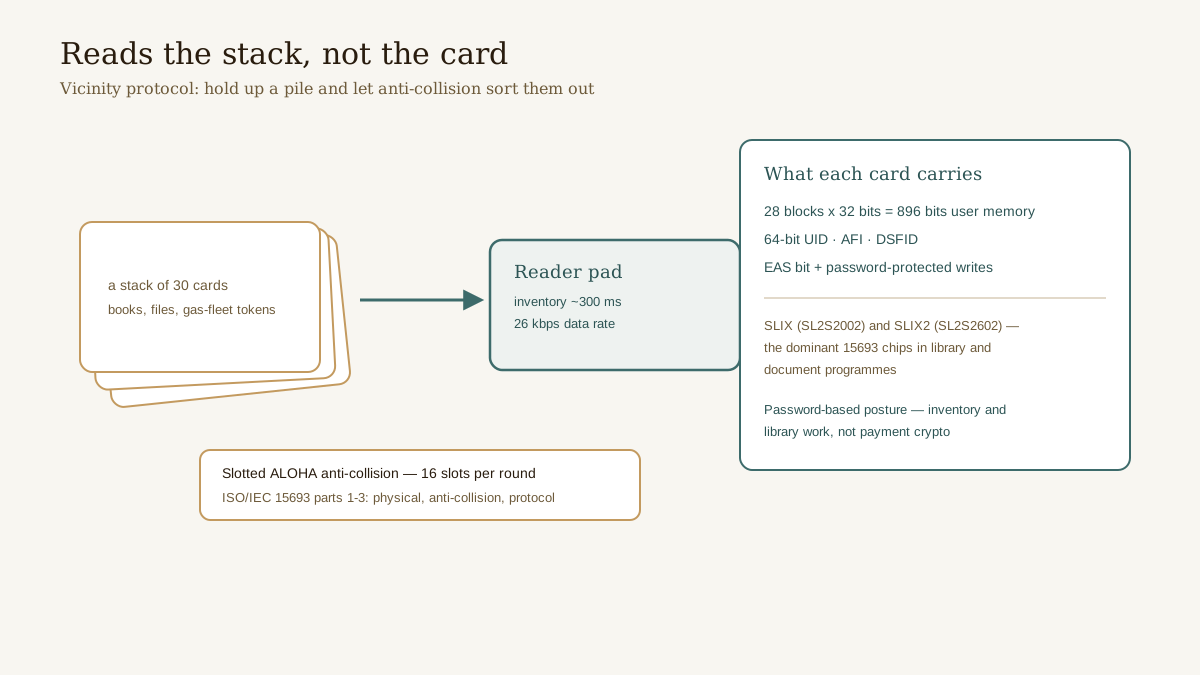
- Slotted ALOHA with 16 slots per round — typical inventory of 30 cards completes in ~300 ms on a 26 kbps data rate. Bulk-read throughput is the canonical differentiator vs ISO/IEC 14443 NFC, which enforces single-card selection.
- ICODE SLIX: 28 blocks × 32 bits = 896 bits user memory + 64-bit UID + AFI + DSFID + EAS bit + password-protected write block. ICODE SLIX2: 79 blocks × 32 bits = 2,528 bits user memory + privacy mode that disables card response until password authentication. SLIX2 adds originality signature and per-block password protection — useful for document tracking where chain-of-custody integrity matters.
One bit runs the exit gate
ISO 28560-2 defines the data element layout for RFID in libraries — primary item identifier, set information, type of usage, supplier identifier, ISIL code, etc. Maps onto SLIX memory blocks directly. Danish Data Model (DDM) 2.0 is the ISO 28560-2 profile used across Scandinavia, the Netherlands and most BIC-2 UK libraries. SIP2 (3M) and NCIP (NISO Z39.83) are the two ILS-to-self-service-kiosk protocols that read AFI/EAS state on check-in and check-out.
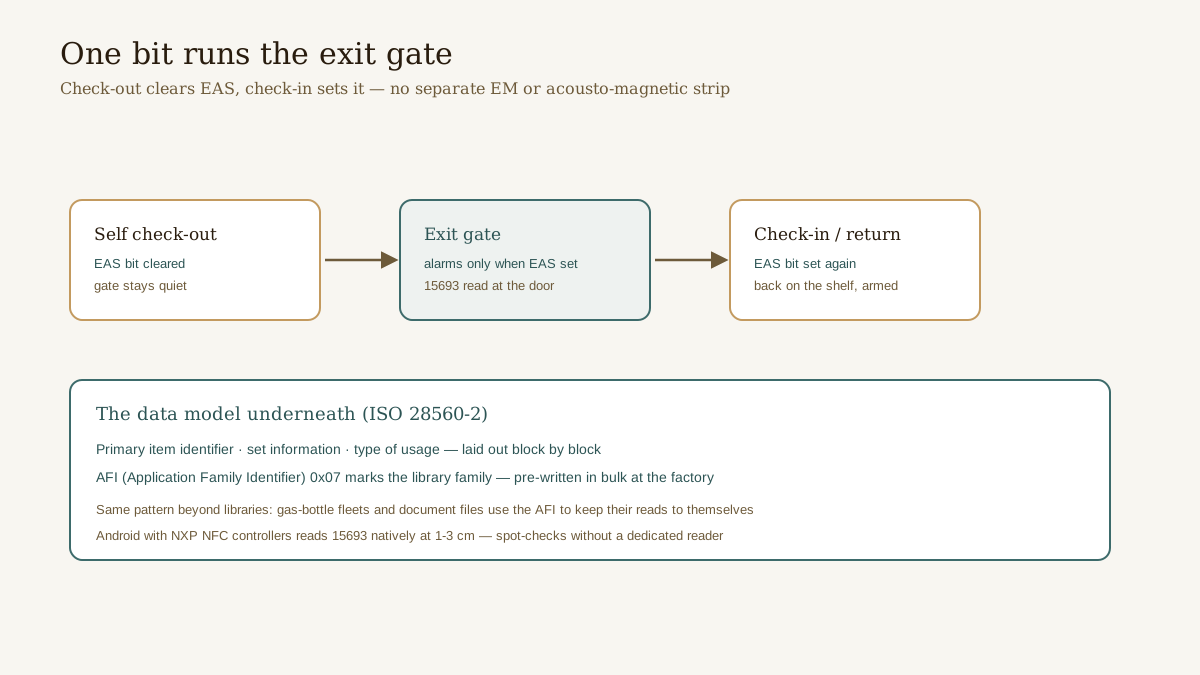
- The ICODE SLIX EAS bit is cleared at self-service check-out and set at check-in — no separate EM / acousto-magnetic strip is required. Bibliotheca, D-Tech, Nedap, P.V. Supa and 3M Tattle-Tape RFID gates all natively read the SLIX EAS bit per the Danish Data Model.
- AFI (Application Family Identifier — e.g. 0x07 for libraries per ISO 28560) can be pre-written in bulk at the factory. DSFID + user-data blocks pre-encoded per the ILS vendor's mapping (Bibliotheca, Axiell, Ex Libris Alma, Koha, Evergreen) → plug-and-play library deployment.
SLIX vs DESFire EV3 vs MIFARE Classic 1K — pick the HF chip for the job
HF chips compared — ICODE SLIX (ISO/IEC 15693)
- ISO/IEC 15693 vicinity: 30 cm – 1 m range, slotted-ALOHA anti-collision, bulk inventory of a shelf in ~300 ms.
- Password-based write protection; no mutual authentication; no AES / 3DES crypto.
- 896-bit (SLIX) or 2,528-bit (SLIX2) user memory, EAS bit, AFI, DSFID.
- Library ILS / kiosk ecosystem: Bibliotheca, Axiell, D-Tech, Nedap, P.V. Supa, 3M Tattle-Tape; library-specific protocols SIP2 + NCIP.
- Use when the bill of work is shelf-sweep inventory, cart-scan check-in, file-folder tracking or gas-bottle fleets — not authenticated access or cashless payments.
vs ISO/IEC 14443 peers
- ISO/IEC 14443-4 DESFire EV3: 5–10 cm range, single-card selection, AES-128 mutual authentication, EAL5+ — the transit, government-ID and enterprise-access chip.
- ISO/IEC 14443-3 MIFARE Classic 1K: 5–10 cm range, Crypto-1 (broken), 1 KB memory — residual use for gym badges, event tickets, loyalty cards.
- ISO/IEC 14443 peers cannot bulk-scan a shelf or a returned cart of books; that is the SLIX differentiator, not a performance tweak.
- Migration between 15693 and 14443 is never in-place — readers, antennas, firmware and ILS integrations all differ. Dual-frequency cards exist for phased programmes.
Cart-scan throughput — why libraries choose SLIX over individual NFC taps
Proud Tek ICODE SLIX card — specifications and pre-encoding
- NXP ICODE SLIX (SL2S2002) default — 896 bits user memory, 64-bit UID, AFI, DSFID, EAS bit, password-protected write block.
- ICODE SLIX2 (SL2S2602) upgrade — 2,528 bits user memory, privacy mode (card does not respond until password authentication), originality signature, per-block password protection.
- ISO/IEC 7810 ID-1 PVC laminate body (85.6 × 54 × 0.76–0.84 mm) with copper or aluminium circular coil antenna tuned for ISO/IEC 15693 resonance at 13.56 MHz.
- Offset or digital print up to CMYK + 1 spot colour + matte or gloss laminate; barcode (EAN-13 / Code 39 / Code 128) overprint for dual-technology libraries.
- Pre-encoded data: AFI (0x07 libraries per ISO 28560-2), DSFID, ISIL code, primary item identifier, type-of-usage and set information written in bulk at the factory.
- Tested on Bibliotheca SmartBlade, D-Tech WorkPad, Nedap Librix, P.V. Supa SelfCheck and FEIG MR102-I reference readers during production QA.
Industrial and document-tracking use-cases beyond libraries
- Law-firm and government-records file-folder tracking — shelf-sweep inventory at 30–50 cm with handheld ISO/IEC 15693 readers (FEIG ID ISC.PRHD200 / Turck Q300) impossible on ISO/IEC 14443 NFC.
- Gas-bottle fleet cards (AGA, Linde, Air Liquide regional programmes) — card-form SLIX issued to drivers and depot staff, cross-referenced with SLIX hard-tags on bottle collars.
- Industrial laundry route and staff cards — the hard-tags on uniform bundles are SLIX; the route / staff credential cards inherit the same reader infrastructure.
- Airline ground-handling backup — IATA RP 1740c baggage is UHF EPC Gen2, but staff-ID and zone-access cards at ground-handling facilities sometimes use SLIX for consistency with baggage-loader HF inventory.
- Events and conferences with bulk-scan zone entry — 15693 cards in lanyard form enable cohort-scanning at a zone gate, not individual tap; less common than NFC but growing for 500+ attendee zones.
Phone compatibility — ISO/IEC 15693 via NFC Forum Type 5 Tag
- Android with NXP NFC controllers (PN544 onward) reads ISO/IEC 15693 through android.nfc.tech.NfcV — range 1–3 cm with the phone's small ferrite antenna.
- iPhone 7 and later on iOS 14+ read ISO/IEC 15693 via Core NFC ISO15693ReaderSession — 1–2 cm range.
- NFC Forum Type 5 Tag (2015) standardises URI / NDEF over ISO/IEC 15693. NXP ICODE NTP and ICODE DNA are the Type-5-focused SKUs for phone-tap product authentication; SLIX is the library / inventory SKU.
- Dedicated ISO/IEC 15693 readers (FEIG ID ISC.LR2500, Turck Q300, Balluff BIS V) hit the 30 cm – 1 m range that the standard advertises — phones do not.
Roadmap — ICODE SLIX milestones from 2005 to 2026
- 2005 — ICODE SLI launch
NXP launches the first ICODE SLI chip implementing ISO/IEC 15693 — library RFID programmes in the Netherlands, Denmark and UK adopt rapidly.
- 2010 — SLIX (SL2S2002)
SLIX adds the EAS bit formalised for library gate integration per the emerging Danish Data Model — Bibliotheca / 3M / Nedap / D-Tech standardise on the chip.
- 2011 — ISO 28560-2 published
ISO 28560-2 Data model for use of RFID in libraries codifies the AFI / DSFID / primary identifier layout SLIX had been running de-facto.
- 2015 — NFC Forum Type 5 Tag
NFC Forum Type 5 Tag formalises ISO/IEC 15693 NDEF — Android + iOS phones can read SLIX at close range.
- 2017 — SLIX2 (SL2S2602)
SLIX2 adds 2,528-bit memory, privacy mode, originality signature and per-block password protection — library programmes in EU DPA-sensitive regions migrate to SLIX2.
- 2020 — BISG library RFID position
Book Industry Study Group publishes the library RFID position paper reaffirming ISO/IEC 15693 + ISO 28560-2 as the bulk-scan standard; NFC Forum Type 5 phones remain a secondary channel.
- 2026 — Today
ICODE SLIX / SLIX2 is the default chip for library RFID, document-tracking and industrial inventory programmes worldwide. Cross-buyer reference experience on library-self-service, file-folder-tracking, gas-bottle-fleet, industrial-laundry-staff and records-management SLIX-ISO-15693 programmes shows.
The reference facts, at a glance
Regional radio regulation
EU: ETSI EN 300 330 SRD rules cover 13.56 MHz operation up to 42 dBμA/m at 10 m. US: FCC Part 15 Subpart C §15.225 sets 13.56 MHz band limits — the same band SLIX reaches the 1 m range claim under. Japan: ARIB STD-T82 (13.56 MHz) governs equivalent HF reader EIRP.
Industrial inventory
Gas-bottle fleets (AGA, Linde, Air Liquide regional programmes) use SLIX as the chip on card-shaped fleet tokens that attach to bottle collars for inventory sweeps. Law-firm and records-management centres run shelf-sweep inventories at 30–50 cm with handheld ISO/IEC 15693 readers — impossible with ISO/IEC 14443 NFC. Industrial laundry operators use SLIX hard-tags on uniform bundles; card-form SLIX shows up mostly in staff credentials and route-identification cards.
Phone compatibility
Android with NXP NFC controllers (PN544 onward) reads ISO/IEC 15693 natively — 1–3 cm range with the phone's small antenna. iPhone 7 and later on iOS 14+ read ISO/IEC 15693 via Core NFC ISO15693ReaderSession — limited to 1–2 cm. NFC Forum Type 5 Tag (2015) formalised URI / NDEF over ISO/IEC 15693, used by NXP ICODE NTP / DNA product-authentication SKUs rather than SLIX.
Card form factor
Standard ISO/IEC 7810 ID-1 (85.6 × 54 × 0.76–0.84 mm) PVC laminate body with a copper or aluminium circular coil antenna tuned for ISO/IEC 15693 resonance at 13.56 MHz. Coil geometry differs from ISO/IEC 14443 inlays — SLIX antennas are typically larger-turn and narrower-trace to favour range over proximity coupling.
Security posture
SLIX / SLIX2 crypto is password-based; there is no AES / 3DES mutual authentication — SLIX is the inventory-and-library chip, not the access-control chip. For authenticated access or cashless payments, DESFire EV3 (ISO/IEC 14443-4) is the canonical NXP option — not SLIX. SLIX2 privacy mode stops arbitrary readers from enumerating UIDs — a library privacy requirement under some EU DPA guidance.
Useful next pages
Use these linked product, guide and comparison pages to keep the next click specific and practical.
Related HF products and compare pages
ISO/IEC 15693 and ISO/IEC 14443 peers for shortlist comparison.
FAQ
What is the difference between ICODE SLIX and NFC (ISO/IEC 14443)?
Both operate at 13.56 MHz but use different air-interfaces. ISO/IEC 14443 (NFC) is short-range (5–10 cm), single-card selection — the transit, building-access and payment interface. ISO/IEC 15693 (ICODE SLIX) is vicinity (30 cm – 1 m), slotted-ALOHA anti-collision — the library, inventory and shelf-sweep interface. Most Android phones with NXP controllers read both; iPhone 7+ on iOS 14+ reads both via Core NFC, but the phone antenna limits 15693 to 1–3 cm. Dedicated ISO/IEC 15693 readers achieve the full range.
Can ICODE SLIX cards be read by NFC phones?
Yes, on Android with NXP NFC controllers (PN544 onward) via android.nfc.tech.NfcV and on iPhone 7+ with iOS 14+ via Core NFC ISO15693ReaderSession — but only at 1–3 cm because the phone antenna is small. For library-gate (30 cm) and shelf-sweep (50 cm – 1 m) ranges you need a dedicated ISO/IEC 15693 reader such as FEIG ID ISC.LR2500 or Bibliotheca / D-Tech workstation kits.
How does SLIX compare to SLIX2, and when is the upgrade worth it?
SLIX2 adds 2,528 bits of user memory (vs 896), privacy mode that stops arbitrary readers enumerating the UID, an originality signature and per-block password protection. For ISO 28560-2 library deployments SLIX is usually sufficient. SLIX2 is worth the premium when the programme has a privacy obligation under GDPR / EU DPA guidance, stores extended item metadata that does not fit 896 bits, or needs chain-of-custody signatures on document-tracking cards.
What is the MOQ and lead time?
Blank white ICODE SLIX cards: MOQ 200, lead time 5–7 business days. SLIX2 cards at the same MOQs with a modest per-card premium. Custom-printed cards with pre-encoded AFI / DSFID / user-data blocks: MOQ 500, lead time 12–15 business days from artwork approval — the extra time is for the pre-encoding sample pass against the customer's ILS vendor reference reader.
Sources & references
Primary standards, OEM datasheets and regulatory documents cited by this article. All URLs were verified on the access date shown below.
- ISO/IEC 15693-3 — Vicinity cards — Anti-collision and transmission protocol
Defines the slotted-ALOHA anti-collision + transmission protocol that gives SLIX its bulk-scan behaviour.
- ISO/IEC 18000-3 Mode 1 — Air-interface for HF items
ISO/IEC 18000-series mapping of the ISO/IEC 15693 HF interface used in asset-ID programmes.
- NXP SL2S2002 (ICODE SLIX) product datasheet
Official ICODE SLIX datasheet — 896-bit user memory, 64-bit UID, AFI, DSFID, EAS bit.
- NXP SL2S2602 (ICODE SLIX2) product datasheet
ICODE SLIX2 datasheet — 2,528-bit user memory, privacy mode, originality signature, per-block password protection.
- ISO 28560-2 — Information and documentation — RFID in libraries
Codifies AFI / DSFID / primary item identifier / ISIL / type-of-usage data layout SLIX library programmes follow.
- Danish Data Model (DDM) 2.0 — Library RFID data profile
- NFC Forum Type 5 Tag specification
Formalises URI / NDEF over ISO/IEC 15693 — Android + iOS phone read path for SLIX-class chips.
- BISG RFID in Libraries Position Paper
Reaffirms ISO/IEC 15693 + ISO 28560-2 as the library RFID standard vs ISO/IEC 14443 NFC and UHF alternatives.
- ETSI EN 300 330 — Short Range Devices 9 kHz – 25 MHz
European SRD rules covering 13.56 MHz reader EIRP limits that set the 1 m SLIX range envelope.
- FCC Part 15 Subpart C §15.225 — 13.56 MHz band operation
US reader band limits for the 13.56 MHz HF band SLIX operates under.
Proud Tek is a Shenzhen-based RFID & NFC manufacturer supplying hotel chains, transit operators, event venues and retail brands worldwide. Every order includes free samples, RF testing and dedicated project support.
Get a Quick Quote
Tell us about your project and we'll respond within one business day. Fields marked (asterisk) are required.