
RFID Supplier for Brazil
RFID Manufacturer for Brazil
Factory-Direct China

Quick answer
Proud Tek ships RFID to Brazil factory-direct from Shenzhen with Brazil-market spec sheets. The one fact that decides a UHF order: Brazil runs two sub-bands — 902-907.5 MHz and 915-928 MHz, with a cellular guard gap at 907.5-915 MHz — under ANATEL restricted-radiation rules, so a reader set to the full 902-928 MHz band is non-compliant. Passive inlays are tuned for the Brazilian bands, and the reader — not the passive tag — carries ANATEL homologation. Access cards run at 13.56 MHz (HF), which is global. Express air reaches Guarulhos, Galeao and Viracopos in 7-10 business days; there is no China-Brazil free trade agreement, so import taxes (II, IPI, PIS/COFINS and state ICMS) are settled by the importer of record via SISCOMEX — we quote EXW/FOB/CIF, put the NCM on every invoice, and work with your Brazilian broker.
- Band-correct for Brazil — UHF inlays tuned for the two ANATEL sub-bands (902-907.5 MHz and 915-928 MHz), not the EU 865-868 MHz band; the reader carries ANATEL homologation, passive tags do not.
- Built for Brazil's applications: retail item-level UHF, livestock ear tags (UHF plus LF 134.2 kHz, ISO 11784/11785 for the world's largest cattle herd), toll/ETC windshield stickers, logistics, and MIFARE and NFC cards.
- Landed honestly — no China-Brazil FTA, so II/IPI/PIS-COFINS/ICMS are paid at clearance by the importer of record via SISCOMEX; we quote EXW/FOB/CIF, provide NCM guidance, and work with your customs broker (7-10 days air, 25-35 days sea).
At a glance
Use these short answers to decide whether this page matches the project before moving into the detail.
Brazilian band and radio rules
UHF RFID in Brazil is authorised only in two sub-bands — 902-907.5 MHz and 915-928 MHz — with a guard gap at 907.5-915 MHz that protects the cellular band, under ANATEL'...
Compliance and data
ANATEL homologation is mandatory before radio-communication equipment can be imported, sold or operated in Brazil, and it requires testing at ANATEL-accredited Brazilian...
Next step
Ready to move forward? Start your inquiry to get specific answers for this project.
Get RFID pricing for Brazil- Landed cost
-
RFID cards and tags classify under NCM 8523.52 (the Mercosur nomenclature aligned to HS 8523.52). Brazil has no free trade agreement with China, so there is no tariff preference; Import Duty (II) applies on the CIF value, then IPI, PIS/COFINS and the state ICMS are layered on cumulatively, so the effective uplift on CIF is significant and varies by NCM and destination state. Taxes are paid by the importer of record when the goods clear via SISCOMEX. Incoterms EXW, FOB or CIF; DDP-to-door is uncommon for RFID consumables.
- Logistics
-
Express air via DHL/FedEx from Shenzhen to Guarulhos (Sao Paulo), Galeao (Rio de Janeiro) and Viracopos (Campinas) in 7-10 business days; sea freight to Santos in 25-35 days for bulk, with Paranagua also served. Full export documentation — commercial invoice, packing list, certificate of origin and NCM classification guidance — travels with every shipment for Receita Federal clearance. Free sample kits ship to Brazilian addresses for reader-compatibility testing before a bulk order.
RFID products for the Brazilian market
Everything below ships from one Shenzhen line with Brazil-market spec sheets: UHF inlays tuned for the two ANATEL sub-bands for item-level inventory and supply-chain tracking, rugged ear tags for the world's largest cattle herd, and tamper-evident windshield tags for toll and vehicle ID. China builds most of the world's RFID; the skill is buying the portion tuned for Brazil's radio rules, not a generic full-band inlay.
- UHF RFID tags and labels. EPC Gen2 inlays tuned for Brazil's 902-907.5 MHz and 915-928 MHz bands for retail, logistics and toll applications — Impinj and NXP silicon, converted for the Brazilian sub-bands.
- RFID animal ear tags. Rugged UHF and LF tags (134.2 kHz, ISO 11784/11785) for cattle identification and livestock traceability across Brazilian agriculture, built for long-term outdoor use.
- RFID windshield stickers. Tamper-evident UHF tags for electronic toll collection (ETC) and vehicle identification on Brazilian highways.
- MIFARE and NFC cards. Access-control cards, transit cards and NFC business cards for Brazilian urban markets — HF at 13.56 MHz, unaffected by the UHF band split.
- RFID wristbands. Waterproof silicone and fabric wristbands for Brazil's large events and tourism — Carnival, music festivals and water parks — with cashless-payment and access options.
Get the band right: 902-907.5 MHz + 915-928 MHz under ANATEL
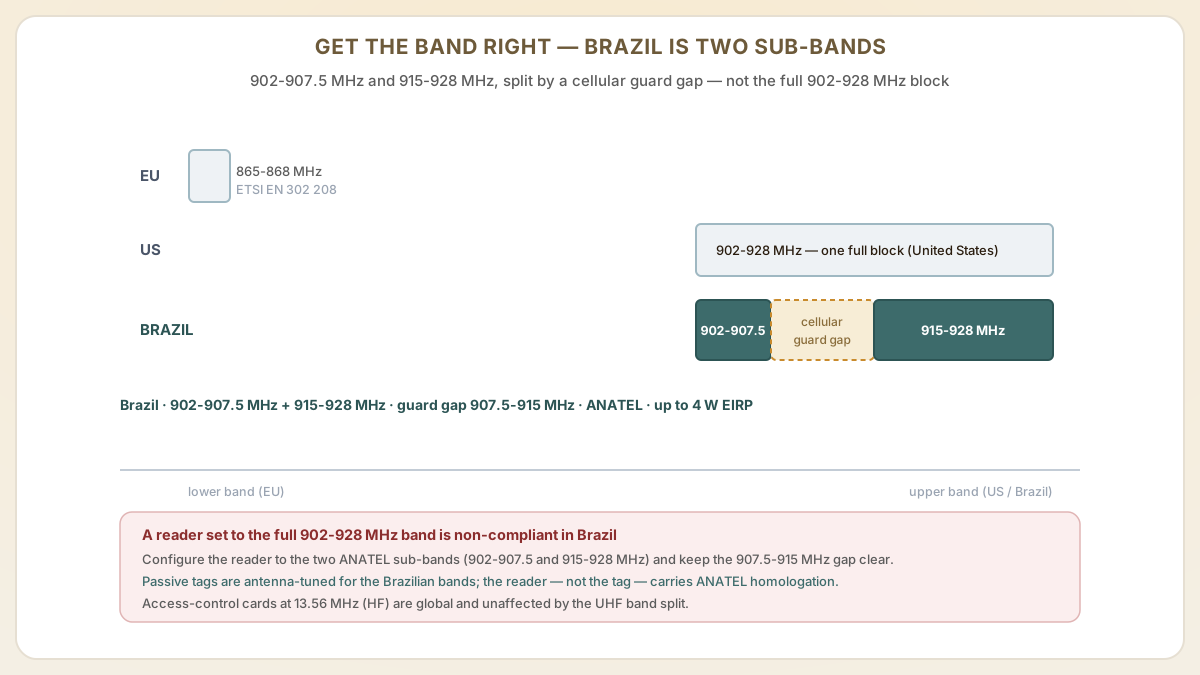
The single most expensive mistake in cross-border RFID sourcing is band mismatch — and Brazil is the trickiest UHF market to get right. It does not use one clean block like the US 902-928 MHz; it carves out two sub-bands, 902-907.5 MHz and 915-928 MHz, and leaves a guard gap at 907.5-915 MHz to protect the cellular band. A reader set to the full 902-928 MHz range is operating illegally in Brazil. New to frequency planning? Start with our LF vs HF vs UHF guide. Order the Brazilian sub-band tuning on the PO; access cards at 13.56 MHz are global and unaffected.
| Parameter | Brazil (ANATEL) | European Union (ETSI EN 302 208) | Why it matters to your order |
|---|---|---|---|
| UHF RFID band | 902-907.5 MHz and 915-928 MHz (guard gap at 907.5-915 MHz) | 865-868 MHz | Brazil is two sub-bands with a cellular gap — a reader on the full 902-928 MHz band is non-compliant; specify the Brazilian tuning on the PO |
| Max power | Up to 4 W EIRP; conducted output up to 1 W with at least 35 FHSS hopping channels (0.25 W with fewer) | 2 W ERP (865-868 MHz) | Brazilian portals run at US-class EIRP; EU site layouts and low-band inlays do not transfer |
| Who is homologated | The reader — the active radio-communication device — carries ANATEL homologation; passive tags are field devices and are exempt | The interrogator is the regulated device | Ask your reader vendor for the ANATEL homologation number; the tag is specified by band tuning, not a certificate |
| Silicon vs antenna | Global 860-960 MHz Gen2 silicon; the antenna sets the sweet spot for the Brazilian sub-bands | Same silicon, different antenna tuning | "Global-tuned" inlays are a compromise — fine for mixed fleets, wrong for maximum range on a Brazilian portal |
| Access-control (HF) | 13.56 MHz — global | 13.56 MHz — global | MIFARE and NFC cards are unaffected by the UHF band split |
Brazilian compliance: ANATEL homologation, the band plan and the LGPD
Two frameworks decide whether a shipment is clean into Brazil — radio homologation and data. Below is the honest map for China-sourced RFID, including the row buyers most often get wrong: homologation is a reader obligation, not a tag one.
| Rule | What it actually covers | Straight answer for China-sourced RFID |
|---|---|---|
| ANATEL homologation | Mandatory approval for radio-communication (restricted-radiation) equipment before import, sale or operation; testing at ANATEL-accredited Brazilian labs — FCC/CE reports do not substitute | The reader/interrogator is homologated because it is the active radio; passive tags and inlays are field devices and are exempt. Ask your reader vendor for the ANATEL homologation number |
| ANATEL frequency plan | UHF RFID authorised only in 902-907.5 MHz and 915-928 MHz, FHSS, up to 4 W EIRP | Specify the Brazilian sub-bands on the PO; a reader running the full 902-928 MHz band is non-compliant |
| LGPD (Law 13.709/2018, ANPD) | Handling of personal data, including cardholder credential data | A concern for your system and back end, not the card blank — encode the minimum and manage identities on your side |
| NCM / Receita Federal | 10-digit Mercosur (NCM) classification drives duty and the SISCOMEX import declaration | RFID cards and tags classify under NCM 8523.52; we put the NCM on the commercial invoice so your broker files the DI correctly |
| ISO/IEC air interfaces | The card (HF) and UHF air-interface standards the products implement | MIFARE and NFC cards are ISO/IEC 14443; UHF inlays are ISO/IEC 18000-63 (EPC Gen2) |
Landed cost: NCM 8523.52, no FTA, and Brazil's cumulative tax stack
The unit price is the headline; in Brazil the landed cost is a whole chapter. Brazil has no free trade agreement with China, so there is no tariff preference to claim — instead there is a cumulative stack of import taxes settled at customs. Our RFID RFP template shows the quote-comparison math; the Brazil-specific short version is below. RFID cards and tags classify under NCM 8523.52 (the Mercosur nomenclature aligned to HS 8523.52). Because there is no China-Brazil free trade agreement, there is no duty preference: the Import Duty (II) applies on the CIF value, then the IPI, PIS/COFINS and the state-level ICMS are layered on cumulatively, so the effective uplift on the CIF value is significant and varies by NCM and by the destination state's ICMS rate. Brazilian import taxes are paid by the importer of record when the goods clear through SISCOMEX, which is why we quote EXW, FOB or CIF and provide NCM guidance rather than a folded-in DDP number — your customs broker files the Import Declaration (DI) and settles the taxes. Confirm the exact rates for your NCM and state with your broker before you commit. (Sources: US Dept of Commerce — Brazil Country Commercial Guide (Import Tariffs); ANATEL.)
- Because Brazil taxes the importer of record at clearance, DDP-to-door is uncommon for RFID consumables; EXW/FOB/CIF with your broker is the norm, and we support all three.
- Ask for the NCM 8523.52 line on the commercial invoice so your broker classifies the goods and files the Import Declaration (DI) correctly the first time.
- Exact II/IPI/PIS-COFINS/ICMS rates depend on the final NCM code and your destination state's ICMS rate — your customs broker confirms the landed number before you order.
- No FTA
- II
- IPI
- PIS/COFINS
- ICMS
| Incoterm | Freight | Brazilian import taxes | Customs clearance / DI | Choose it when |
|---|---|---|---|---|
| EXW Shenzhen | You arrange from our dock | Importer of record pays at clearance | Your Brazilian broker files the DI | You run your own freight and broker programme |
| FOB Shenzhen / Yantian | We deliver to the port; you book the vessel | Importer of record pays at clearance | Your broker, via SISCOMEX | Sea-volume buyers with an established forwarder |
| CIF Brazilian port | We book freight and insurance to Santos or Paranagua | Importer of record pays on the CIF value at clearance | Your broker, via SISCOMEX | You want cost, insurance and freight quoted to the port and taxes cleared locally |
Logistics: Shenzhen to Brazil, air in 7-10 business days
Shenzhen and Brazil sit almost exactly half a day apart, which is quietly useful: an RFQ sent at the end of your Sao Paulo afternoon is usually quoted while Brazil sleeps and waiting when you open your inbox. Freight and clearance are the boring part done right — for the mode math, see air vs sea freight for RFID orders.
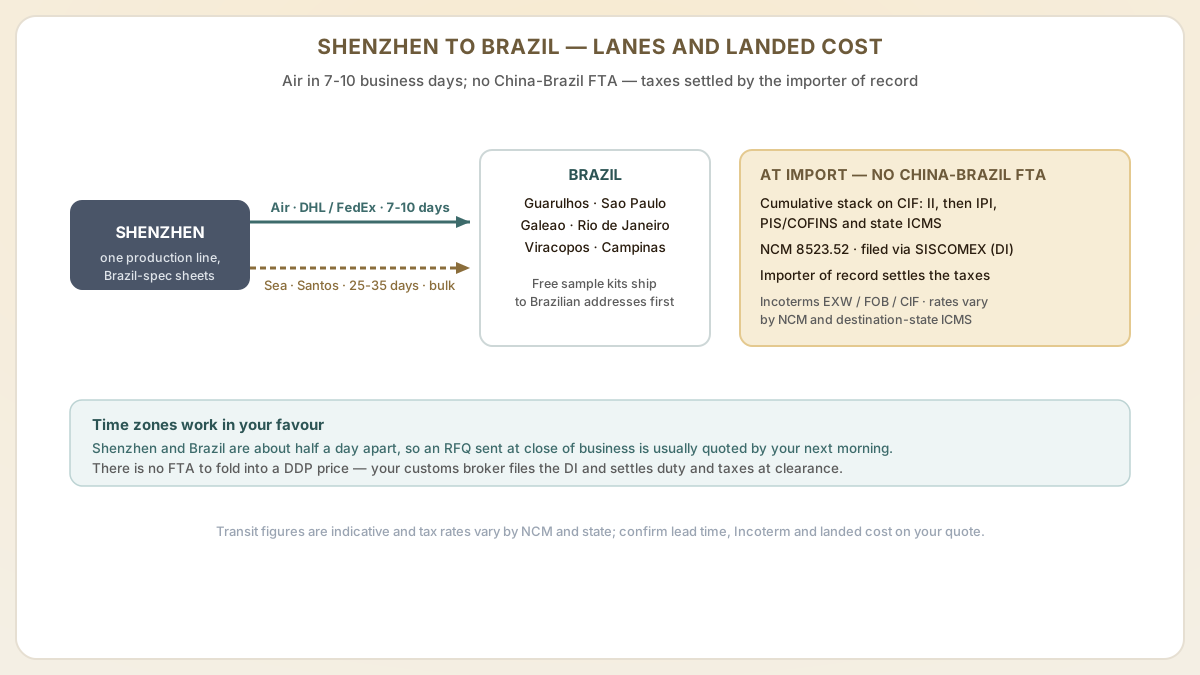
- Express air freight via DHL/FedEx delivers from Shenzhen to Guarulhos (Sao Paulo), Galeao (Rio de Janeiro) and Viracopos (Campinas) in 7-10 business days.
- Sea freight from Shenzhen to Santos in 25-35 days for bulk orders, with Paranagua also served, for maximum cost savings on price-sensitive, large-volume requirements.
- Full export documentation — commercial invoice, packing list, certificate of origin and NCM classification guidance — travels with every shipment for Receita Federal clearance.
- We work with experienced Brazilian customs brokers and can advise on SISCOMEX import procedures; free samples ship first so you can read them on your own readers before a bulk order.
How a Brazilian order runs, step by step
No mystery and no time-zone roulette — this is the cadence a first Brazilian order follows from RFQ to receiving dock.
- Day 0 - RFQ
Send specs, artwork or a competitor datasheet and your UHF use-case. Quotes come back with the Brazilian sub-band tuning (902-907.5 / 915-928 MHz) specified and an Incoterm (EXW / FOB / CIF).
- Samples first
Free sample inlays or cards ship to your Brazilian address so you can read them on your live readers before committing to a production run.
- Artwork approval - the gate
Production starts only after you sign off artwork and encoding spec. Changes cost nothing before this gate.
- Production + QC
UHF inlays are converted and tuned for the Brazilian bands, or cards are printed and encoded; every unit is read-tested before packing.
- Air + clearance - 7-10 business days
Express air lands the goods at Guarulhos, Galeao or Viracopos; your broker files the Import Declaration (DI) and settles II/IPI/PIS-COFINS/ICMS via SISCOMEX.
Proof a Brazilian buyer can verify without a plant visit
Proud Tek supplies retailers, system integrators, resellers and enterprises across Brazil — but don't take a market page's word for it. Verify us the way you would audit any China factory: check certificates with the issuing registrar using our ISO certification verification guide, then work through the China RFID factory audit checklist remotely or in person.
- Request free samples and read them on your own readers, tuned to the Brazilian sub-bands (902-907.5 / 915-928 MHz), before any bulk order.
- Ask your reader vendor for the ANATEL homologation number — homologation is a reader-side obligation; the passive tags are specified by band tuning and air-interface standard.
- Confirm the Brazilian UHF tuning in writing on the PO for UHF orders, and hold the sample as the reference.
- Get the NCM 8523.52 line and a certificate of origin on the proforma so your broker can file the DI and calculate II/IPI/PIS-COFINS/ICMS accurately.
- Verify our ISO 9001 quality certificate with the issuing registrar, and check ISO/IEC 14443 (cards) or ISO/IEC 18000-63 (UHF) conformance for the products.
Useful next pages
Use these linked product, guide and comparison pages to keep the next click specific and practical.
RFID products for Brazilian customers
Explore RFID tags and labels for the Brazilian market.
Brazil compliance and cost reading
The guides Brazilian procurement teams pair with this page.
FAQ
Which UHF band do your tags use for Brazil?
Brazil authorises UHF RFID only in two sub-bands — 902-907.5 MHz and 915-928 MHz — with a guard gap at 907.5-915 MHz that protects the cellular band, under ANATEL's restricted-radiation rules (up to 4 W EIRP with frequency hopping). We tune passive inlays for those Brazilian sub-bands. A reader set to the full 902-928 MHz band is non-compliant in Brazil, and EU 865-868 MHz inlays read short. HF access cards at 13.56 MHz are globally harmonised and unaffected — specify the Brazilian tuning only for UHF inlay and label orders.
Do your RFID products need ANATEL homologation?
ANATEL homologation is mandatory for radio-communication equipment before it is imported, sold or operated in Brazil, and it requires testing at ANATEL-accredited Brazilian laboratories — FCC or CE reports do not substitute. Only active, transmitting equipment is homologated, which is the reader/interrogator; passive RFID tags and inlays are field devices powered by the reader and are exempt. When evaluating a UHF system, ask your reader vendor for the ANATEL homologation number, and specify the passive tags by their band tuning (902-907.5 / 915-928 MHz) and air-interface standard.
Can you supply RFID ear tags for cattle identification?
Yes. We manufacture both UHF and LF (134.2 kHz, ISO 11784/11785) RFID ear tags suitable for livestock identification programs. Our cattle ear tags are designed for long-term outdoor use with UV-resistant and waterproof construction. Brazil has the world's largest commercial cattle herd (over 200 million head), so contact our team with your specific requirements for Brazilian livestock traceability applications.
How do import taxes and customs work when importing RFID to Brazil?
RFID cards and tags classify under NCM 8523.52 (the Mercosur nomenclature aligned to HS 8523.52). Brazil has no free trade agreement with China, so there is no tariff preference: Import Duty (II) applies on the CIF value, and IPI, PIS/COFINS and the state-level ICMS are layered on cumulatively, with the ICMS rate varying by destination state. The taxes are paid by the importer of record when the goods clear through SISCOMEX. We provide FOB and CIF pricing plus NCM guidance so your customs broker can calculate the landed cost accurately; the exact rates depend on the final NCM and your state, so confirm them with your broker. For large-volume orders, the total landed cost from Proud Tek is typically 30-50% lower than sourcing from domestic Brazilian distributors.
What Incoterms can Brazilian buyers choose?
Brazilian buyers can order EXW Shenzhen, FOB Shenzhen/Yantian, or CIF to a Brazilian port such as Santos or Paranagua. Because Brazilian import taxes are paid by the importer of record when the goods clear via SISCOMEX, DDP-to-door is uncommon for RFID consumables — EXW/FOB/CIF with your own customs broker is the norm, and we support all three, with the NCM 8523.52 line and a certificate of origin on every invoice.
Can I get product samples before placing a large order?
Yes. We provide free sample kits including RFID cards, tags, labels and wristbands shipped via express courier to any Brazilian address at no charge. For UHF orders the samples are tuned for the Brazilian sub-bands (902-907.5 / 915-928 MHz) so the test reflects Brazilian field conditions. Custom-printed samples with your artwork are also available.
Sources & references
Primary standards, OEM datasheets and regulatory documents cited by this article. All URLs were verified on the access date shown below.
- GS1 — Regulatory status for using RFID in the UHF (860-960 MHz) band (Brazil: 902-907.5 MHz and 915-928 MHz, up to 4 W EIRP)
Canonical UHF RAIN allocation reference; lists Brazil's two sub-bands 902-907.5 MHz and 915-928 MHz at up to 4 W EIRP with FHSS.
- ANATEL — Certification and Homologation of telecommunications and restricted-radiation radio equipment
Brazilian regulator: homologation is mandatory for radio-communication equipment before import, sale or operation, with testing at ANATEL-accredited Brazilian laboratories.
- Tech in Brazil — RFID Equipment Homologation by ANATEL
Documents the ANATEL rule in detail: UHF RFID at 902-907.5 MHz and 915-928 MHz; conducted output up to 1 W (>=35 hopping channels) or 0.25 W (fewer); and that only active/transmitting equipment is homologated — passive tags are exempt.
- atlasRFIDstore — UHF RFID Frequency Regulations (GS1 summary)
Confirms Brazil's two uncommon sub-bands within 902-928 MHz and that a reader set to the full 902-928 MHz range violates Brazilian regulations; links the GS1 UHF regulations PDF.
- US Dept of Commerce — Brazil Country Commercial Guide: Import Tariffs (II, IPI, PIS/COFINS, ICMS, NCM)
Primary source for Brazil's cumulative import-tax structure — Import Duty (II) on CIF, IPI, PIS/COFINS and state ICMS layered cumulatively — and NCM (Mercosur Common Nomenclature) classification.
- LGPD — Lei Geral de Protecao de Dados (Law No. 13.709/2018)
Brazil's data-protection law governing personal data, including cardholder credential data; enforced by the ANPD.
- ETSI EN 302 208 — RFID equipment in the 865-868 MHz band
The EU band cited in the comparison — 865-868 MHz at 2 W ERP — showing why EU-tuned inlays differ from Brazilian tuning.
Proud Tek is a Shenzhen-based RFID & NFC manufacturer supplying hotel chains, transit operators, event venues and retail brands worldwide. Every order includes free samples, RF testing and dedicated project support.
Get a Quick Quote
Tell us about your project and we'll respond within one business day. Fields marked (asterisk) are required.