
RFID Technology
RFID Frequencies Explained
LF vs HF vs UHF
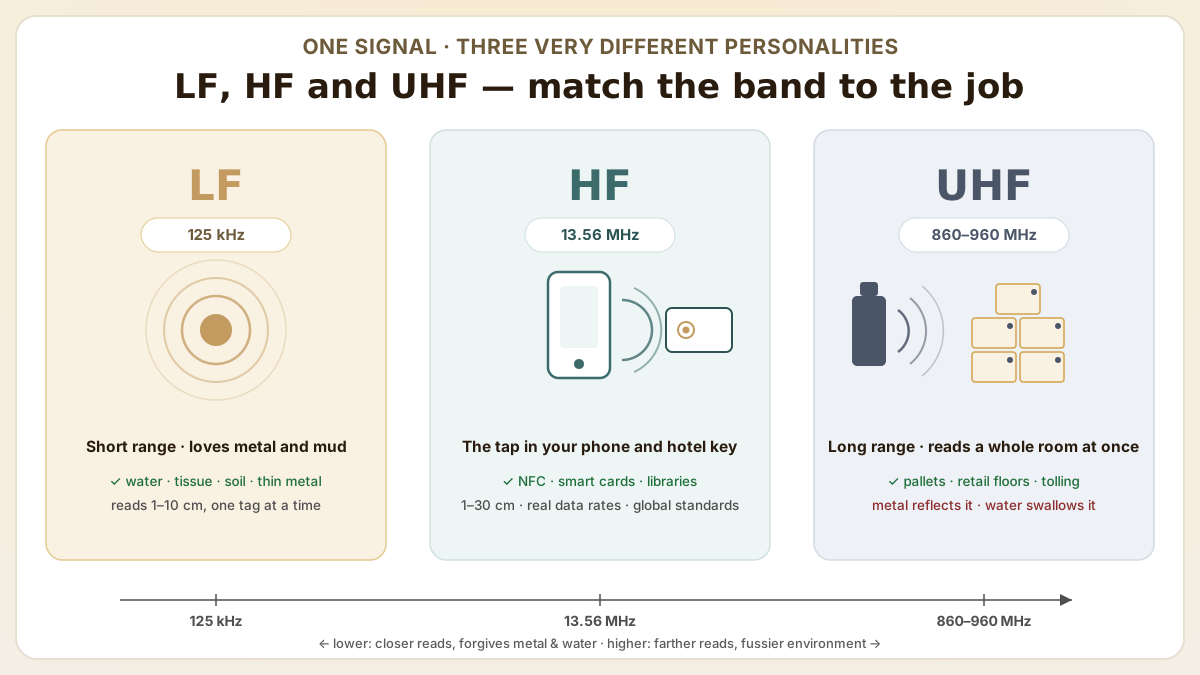
Quick answer
LF at 125 kHz, HF at 13.56 MHz or UHF at 860-960 MHz — the band decides read range (1 cm to 12 m), data rate and how the signal survives metal and water. Pick by environment first: there is no firmware patch for the wrong radio.
- Frequency is the first domino. It decides read range, data speed and how the signal copes with metal, water and human flesh — get it wrong and nothing downstream can save you.
- LF shrugs off metal and water, HF runs NFC and smart cards, UHF reads a pallet from across the room.
- There's no firmware patch for the wrong radio. Match the band to the job before you buy a single reader.
At a glance
Use these short answers to decide whether this page matches the project before moving into the detail.
Key takeaway
Frequency is the first domino. It decides read range, data speed and how the signal copes with metal, water and human flesh — get it wrong and nothing downstream can save you.
What are RFID frequencies and why they matter
Somewhere, right now, a pallet of UHF tags is sulking in a returns bin. Someone bought them for steel drums, slapped one on, watched the read range faceplant to roughly...
Next step
Ready to move forward? Start your inquiry to get specific answers for this project.
Discuss your RFID projectWhat are RFID frequencies and why they matter
Somewhere, right now, a pallet of UHF tags is sulking in a returns bin. Someone bought them for steel drums, slapped one on, watched the read range faceplant to roughly nothing, and concluded the tags were "defective." They weren't defective. They were the wrong frequency — which is a far more expensive kind of wrong, because nobody notices until the purchase order has already closed and the budget has already left the building.
Here's the whole idea in one breath: an RFID system is just a tag (the transponder) and a reader (the interrogator) having a conversation over radio waves. The frequency of those waves quietly decides three things — how far the signal reaches, how fast the two can talk, and how gracefully the whole thing behaves around metal, water and the squishy 60%-water bag we call a human body.
Three bands cover the overwhelming majority of commercial RFID: Low Frequency (LF) at 125-134 kHz, High Frequency (HF) at 13.56 MHz, and Ultra-High Frequency (UHF) at 860-960 MHz. Each has its own physics, its own standards, and its own die-hard fan club of use cases.
The one rule to tattoo somewhere sensible: lower frequencies punch through water and tissue but read slowly and up-close; higher frequencies are fast and far-reaching but get swallowed by water and bounce off metal. Everything below is a footnote to that sentence.
- Regulatory bodies in each country allocate specific UHF sub-bands and power limits, so UHF tag designs must account for regional compliance.
- Dual-frequency tags and readers exist but add cost and complexity. Single-frequency systems are preferred when one band clearly fits the application.
How does LF RFID at 125 kHz work?
Low Frequency (125 kHz, or 134.2 kHz for animal tracking under ISO 11784/11785) is short-sighted, slow, and completely unbothered about it. It reads from a couple of centimetres, trickles data like a leaky tap — and then calmly does the one thing the fancy bands can't: it keeps working when you bury it in a pipe or, famously, attach it to a cow. Inductive (near-field) coupling means metal and water barely faze it, which is why it still runs access control, animal ID and car immobilizers decades later.
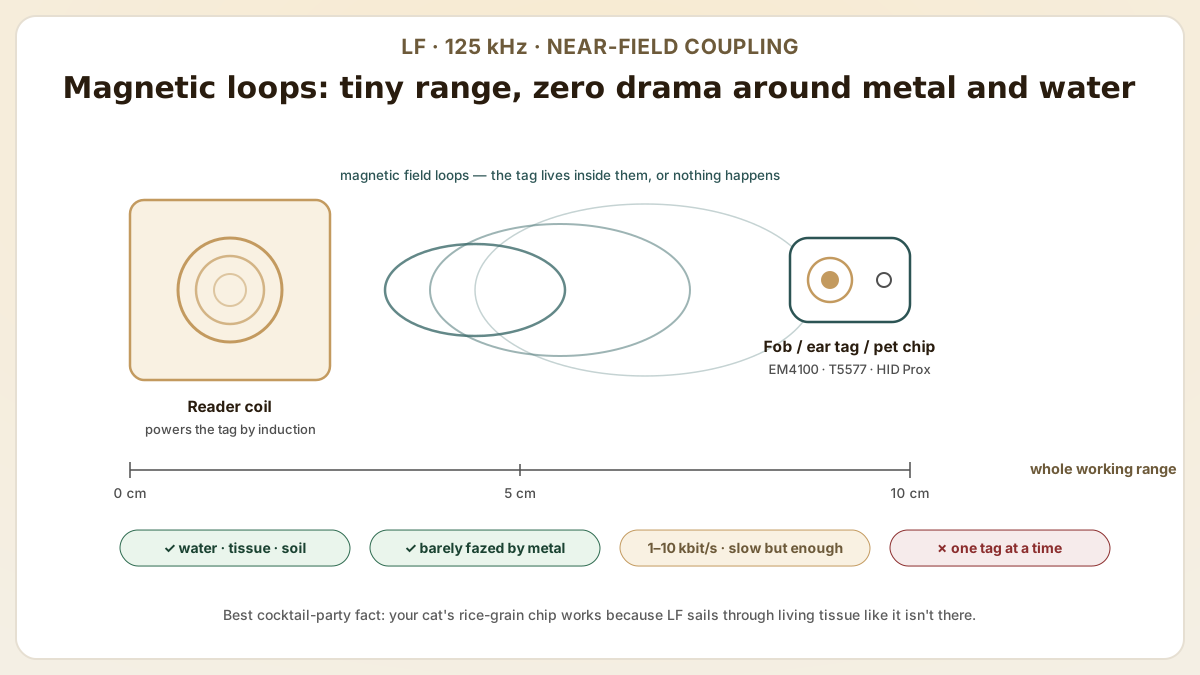
Best cocktail-party fact: the reason your cat has a rice-grain-sized chip under its skin is pure physics — LF sails through living tissue like it isn't there. Try that with UHF and the signal drowns before it leaves the fur.
- Read range: 1-10 cm with standard readers. Enough to tap a proximity card or scan an ear tag; not enough to find anything you've lost.
- Data rate: 1-10 kbit/s. Glacial — but plenty for coughing up a short ID number.
- Environmental performance: excellent through water, animal tissue, soil and thin metal — the reason it owns livestock tags, implantable pet chips and underground assets.
- Common chip families: EM4100/EM4200 (read-only), T5577 (rewritable), HID Prox (access control).
- The catch: tiny range, slow reads, limited data capacity, and in most legacy protocols no anti-collision — one tag at a time, no crowd scanning.
How does HF RFID at 13.56 MHz work?
If LF is the tortoise, HF is the diplomat — the band that gets along with everyone. It's in your phone, your hotel key, your transit card and every "tap to pay" you've done without a second thought. That's not a coincidence: NFC is simply a subset of HF RFID. HF trades LF's brute penetration for genuine data speed, real anti-collision, and standards so mature that a tag made in Shenzhen just works on a phone in Chicago.
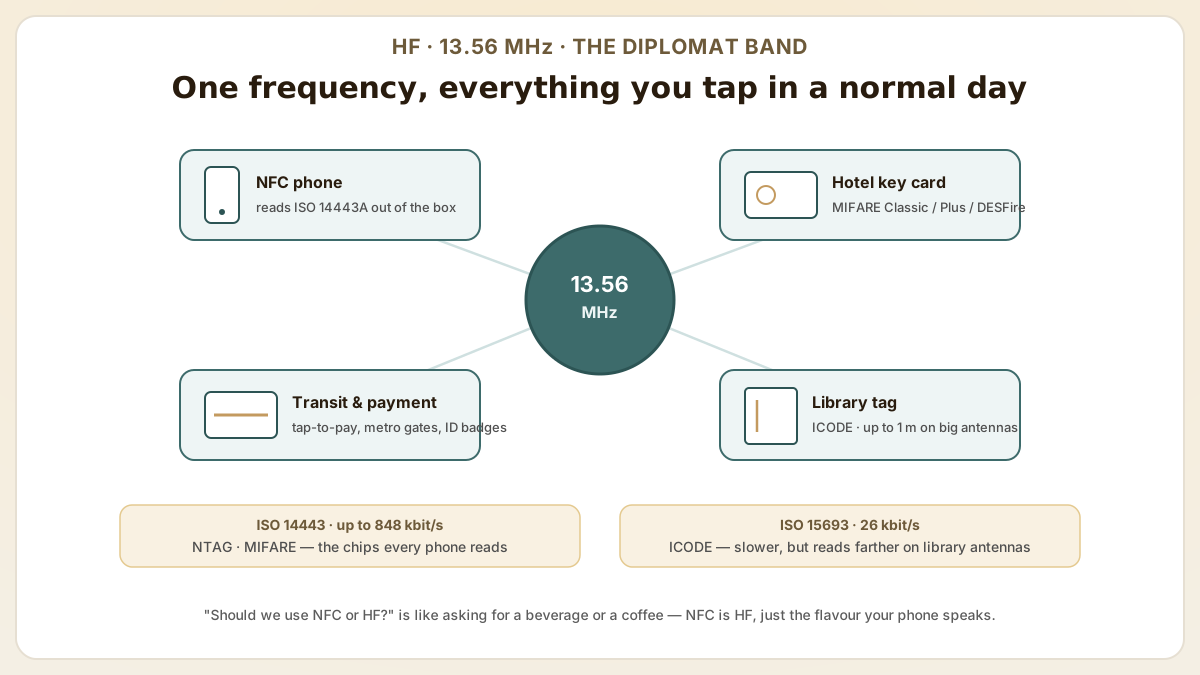
Translation for the meeting: "Should we use NFC or HF?" is a bit like asking whether you'd like a beverage or a coffee. NFC is HF — just the flavour your phone happens to speak.
- Read range: 1-30 cm for passive tags; up to 1 metre with larger antenna readers in library or industrial settings.
- Data rate: 26-848 kbit/s depending on the protocol (ISO 14443 up to 848 kbit/s, ISO 15693 at 26 kbit/s). Fast enough for real payloads, not just an ID.
- NFC compatibility: NFC is a subset of HF RFID. All NFC-enabled smartphones read ISO 14443A tags (NTAG, MIFARE), and most support ISO 15693 (ICODE).
- Common chip families: NXP MIFARE (Classic, Plus, DESFire) for access and transport; NXP NTAG (213, 215, 216) for NFC marketing; NXP ICODE for library and supply chain; STMicroelectronics ST25 series.
- Crowd control: ISO 14443 and ISO 15693 both support multi-tag environments — realistically 10-50 simultaneous tags depending on reader power and antenna geometry.
How does UHF RFID at 860-960 MHz work?
UHF is the overachiever of the family. It reaches metres, not millimetres, and can inventory hundreds of tags a second — which is exactly why supply chains, retail floors and toll booths are built on it. It uses far-field radiation instead of cosy magnetic loops, so range explodes… and so does its sensitivity. Put it near water or bare metal and the confident 12-metre read collapses into an embarrassed shrug. Magnificent in the open air; high-maintenance everywhere else.
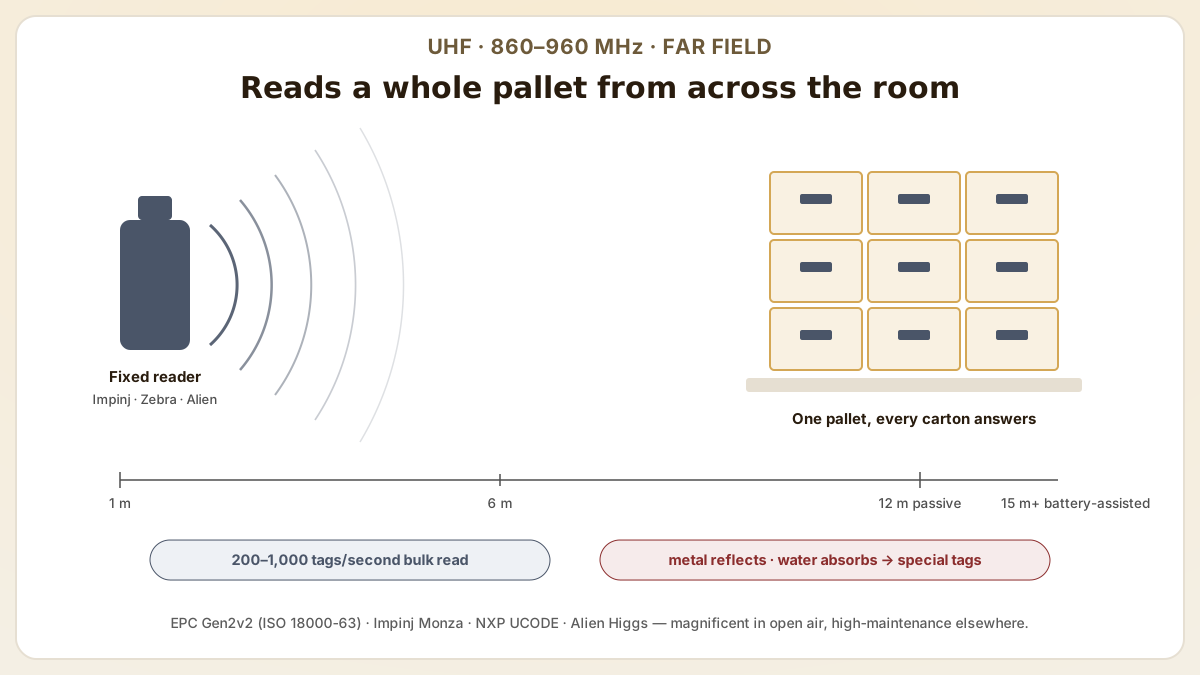
- Read range: 1-12 metres for passive tags with fixed readers; 15+ metres for semi-passive (battery-assisted) tags.
- Data rate: 40-640 kbit/s under the EPC Gen2v2 (ISO 18000-63) air interface.
- Bulk read speed: a single UHF reader can inventory 200-1,000 tags per second — pallet-level and room-level scanning.
- Regional variation: 865-868 MHz in Europe (ETSI), 902-928 MHz in North America (FCC), 920-925 MHz in China. Tags designed for global use cover the full 860-960 MHz range.
- Common chip families: Impinj Monza (R6, M700 series), NXP UCODE (7, 8, 9), Alien Higgs. All conform to RAIN RFID (GS1 EPC Gen2) standards.
- The catch: UHF signals are absorbed by water and reflected by metal. Tags on liquid containers or metal assets need specialized antenna designs (on-metal tags, far-field patches) that add cost.
How to choose the right RFID frequency
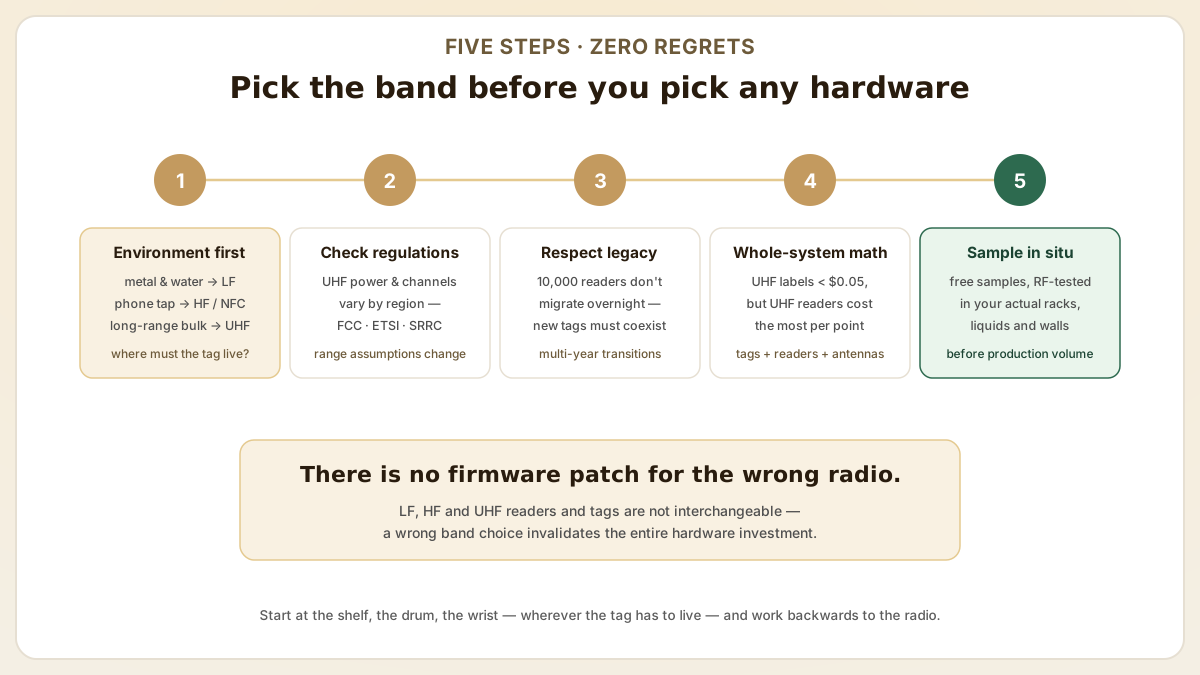
This is the first and most consequential call in the whole project, because LF, HF and UHF readers and tags are not interchangeable. There is no firmware patch for the wrong radio. So don't start with the spec sheet — start with where the tag physically has to live.
Numbers are typical ranges for passive tags; your mileage varies with antenna, reader power and how much metal and water you insist on standing nearby.
- Start with the application environment: tags on or near metal and water (livestock, underground pipes) → LF is strongest. Smartphone interaction → HF/NFC is required. Long-range bulk reading → UHF is the only realistic option.
- Check regulatory requirements in the deployment country. UHF power limits and frequency allocations vary by region and quietly change your real-world range assumptions (see the next section).
- Respect existing infrastructure. Migrating a 10,000-reader access control system from LF to HF is a multi-year saga; new tags must coexist with legacy readers during the switch.
- Do the whole-system math: UHF tags are cheapest at volume (under $0.05 for simple labels) but UHF readers and antennas cost more than HF equivalents. LF tags and readers are mid-range in cost but limited in capability.
- Request application-specific samples and test in the actual operating environment before committing to production volumes.
| Parameter | LF 125 kHz | HF 13.56 MHz | UHF 860-960 MHz |
|---|---|---|---|
| Read range (passive) | 1-10 cm | 1-30 cm | 1-12 m |
| Data rate | 1-10 kbit/s | 26-848 kbit/s | 40-640 kbit/s |
| Multi-tag reading | Limited | 10-50 tags | 200-1,000 tags/s |
| Water/metal tolerance | Excellent | Good | Poor (needs special tags) |
| Smartphone compatible | No | Yes (NFC) | Limited (some Android) |
| Typical tag cost (volume) | $0.10 – $0.30 | $0.06 – $0.25 | $0.03 – $0.15 |
| Key applications | Access control, animal ID | NFC, smart cards, libraries | Supply chain, retail, tolling |
Regional regulatory power and channel rules every UHF buyer must follow
LF and HF are globally harmonized — they behave the same in Boston and Bangkok. UHF is the only band that needs a passport: the same physical reader that's perfectly legal in Dallas can be an illegal transmitter in Düsseldorf. Regions carve up the band differently and cap power differently, so specify the regional radio profile at purchase-order time, not after customs opens the box.
- FCC Part 15.247 (USA, Canada, Mexico) — 902-928 MHz, 4 W EIRP maximum, 50 channels of 500 kHz each with frequency hopping spread spectrum (FHSS) over 50+ channels and 0.4 s dwell. The widest band in the world — sustained 8-10 m read range with a high-gain reader and circular antenna; supports dense reader environments at 3-5 m reader-to-reader spacing.
- ETSI EN 302 208 (Europe, UK, Australia, parts of Africa) — 865.6-867.6 MHz (4 channels) and 916-919 MHz (extended band). 2 W ERP (≈ 3.28 W EIRP) maximum. Listen-Before-Talk (LBT) protocol is mandatory to prevent reader-to-reader interference; this caps practical multi-reader density at half the FCC throughput.
- China (SRRC) — 920.5-924.5 MHz, 2 W ERP, FHSS over 16 channels of 250 kHz. China-built supply chains often default to this profile; reader firmware needs explicit China region setting.
- Japan (ARIB STD-T106) — 916.7-923.5 MHz, 4 W EIRP, 9 channels available with LBT. South Korea (915-921 MHz, 4 W EIRP), Singapore (866-869 MHz / 920-925 MHz), Brazil (902-907.5 / 915-928 MHz) — each with its own channel mask and certification requirement (Anatel, KCC, IDA).
- Tag chip global compatibility — Modern UHF Gen2v2 chips like Impinj M730/M750/M770, NXP UCODE 9, Alien Higgs-9 are tuned for global 860-960 MHz and self-adjust to the reader's profile. Older M4/M4QT and Higgs-3 designs were optimised for FCC and lose ~30% range under ETSI. Specify the chip generation when sourcing inlays for multi-region deployments.
Frequency-aware tag selection and physics gotchas
Frequency choice isn't only a range trade-off — it's a physics decision about how the tag's antenna couples to whatever it's stuck to. Pick the wrong band for the surface or the surrounding liquid and you can lose 50-90% of your read budget before the system ever leaves the lab. Two villains cause most of the carnage: metal and water.
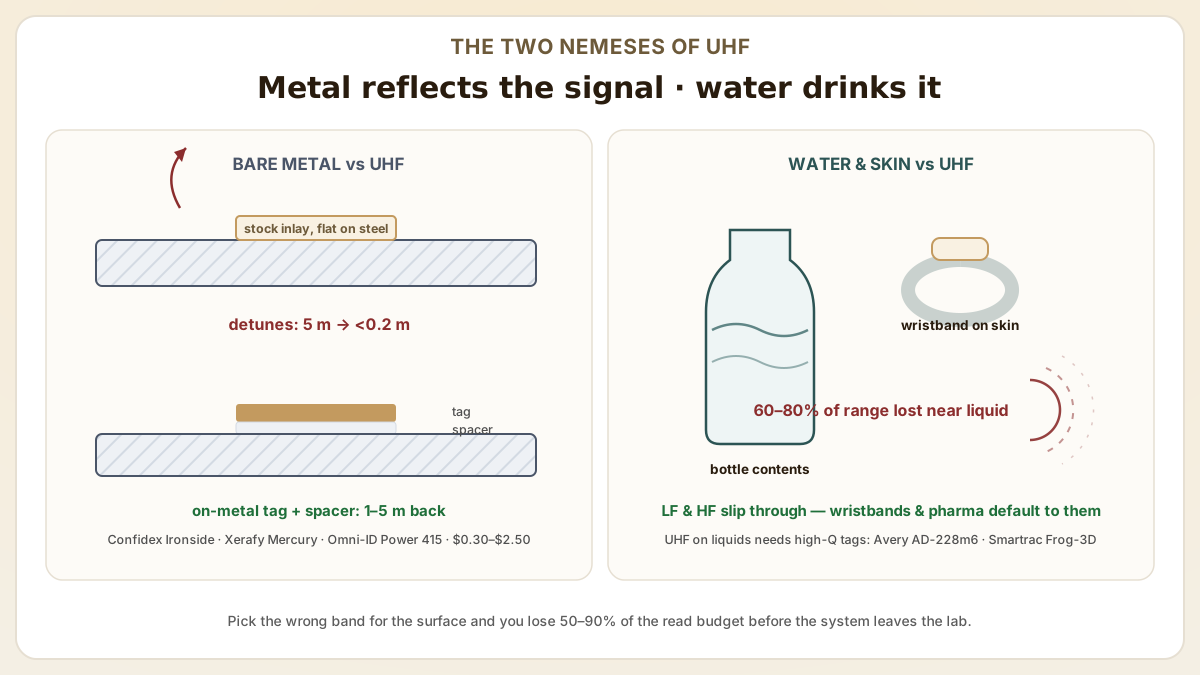
- Metal detunes UHF catastrophically (LF barely notices) — LF 125 kHz uses inductive near-field coupling and is barely affected by adjacent metal. UHF uses far-field radiation; place a stock UHF inlay on bare metal and the antenna detunes hard — read range collapses from 5 m to under 0.2 m. Fix it with on-metal UHF tags on a foam, ceramic or PET spacer (Confidex Ironside, Xerafy Mercury, Omni-ID Power 415) at $0.30-$2.50 each.
- Water swallows UHF whole (HF and LF slip through) — water absorbs 860-960 MHz strongly, so UHF on bottles or worn near skin loses 60-80% of range. HF 13.56 MHz penetrates water and tissue far better — exactly why hospital wristbands, pharmaceutical packs and subcutaneous transponders default to LF/HF. UHF works on liquid loads only with high-Q tags built for water-rich content (Avery Dennison AD-228m6, Smartrac Frog-3D).
- Size follows physics — UHF antennas scale with wavelength (~32 cm at 902-928 MHz; even a quarter-wave antenna is 8 cm), so long-range UHF inlays run 70-100 mm long (Avery AD-237, Alien ALN-9762). LF and HF use compact loops: a credit-card HF antenna hits full ISO 14443 range, and a 5 mm subcutaneous LF transponder still reads at 5 cm. Choose the band that fits your form factor, not the other way around.
- Readers are where the money hides — fixed UHF reader: $800-$3,000 (Impinj R700, Zebra FX9600, Alien ALR-F800), antennas $80-$300 each. Fixed HF/NFC reader: $50-$300 (FEIG ID CPR.40, ELATEC TWN4 Multitech, ACS ACR1252U). Fixed LF reader: $60-$250 (HID Prox readers, ELATEC). For the same hardware budget you can deploy roughly 10x more LF/HF reader points than UHF ones — worth remembering before you promise "readers everywhere."
- That's why the big players go hybrid — Decathlon, Inditex and Macy's pair HF NFC for shopper engagement (smart shelves, in-store pickup) with UHF for back-room and logistics inventory. Hotels run LF/HF for door access and UHF for asset tracking. Two radios, each doing what it's good at, beats one radio doing everything badly.
What's inside the card: PVC, PET, PETG and PC, compared
Here's the thing nobody tells you at check-in: your HF smart card, access badge and tap-to-pay card aren't a solid slab of plastic. They're a laminated sandwich — several thin sheets, an RFID inlay tucked in the middle, all fused under heat and pressure and then punched out to standard CR80 size. The sheet material you pick decides whether the card survives one festival season or ten years in a wallet.
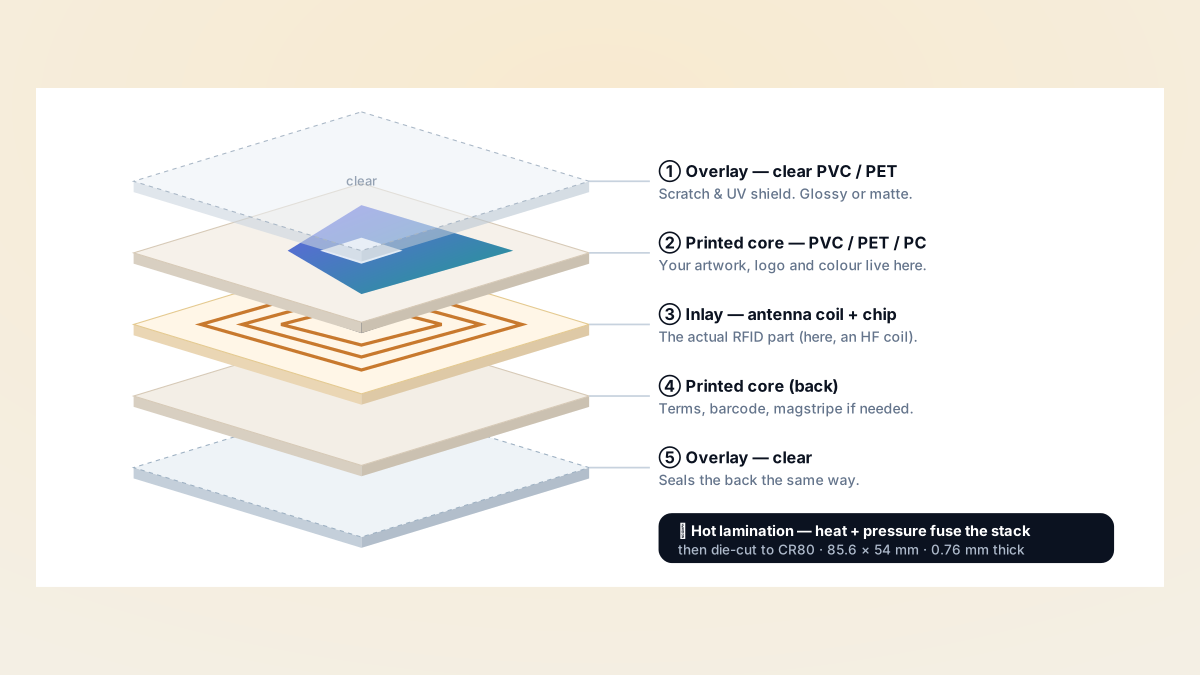
- PVC — cheap, prints like a dream, laminates at roughly 140-150 °C. The default for hotel keys, loyalty and access cards. Lasts a few years — not forever, but nobody expects a loyalty card to outlive them.
- PET — tougher and more heat-tolerant than PVC, recyclable and more environmentally friendly. The pick when a card needs to last longer or your brand cares about the "no chlorine" story.
- PETG — PET that hit the gym. Extra impact resistance, excellent clarity, and it laminates cleanly without the delamination sulks. For cards that get bent, dropped and generally mistreated.
- PC (polycarbonate) — the premium, high-security choice. Layers fuse into one monolithic, tamper-resistant block; it's laser-engravable and shrugs off heat. This is what national IDs and e-passports are made of. Pricey, and worth it when security is the point.
- Honorable mentions: ABS for rugged moulded fobs, Teslin synthetic paper for in-house inkjet printing, and PLA bio-plastics for brands chasing a plant-based card. Different sandwich, same idea — the inlay doesn't care what it's wrapped in, as long as the frequency was right in the first place.
Useful next pages
Use these linked product, guide and comparison pages to keep the next click specific and practical.
Frequency-specific products
Browse RFID products by frequency band to find the right tag or card for your application.
Related resources
Deeper comparisons and guides for specific RFID frequency applications.
RFID frequency standards and regulatory references
GS1 EPC, FCC, ETSI and ISO documents that govern RFID frequency selection and certification.
FAQ
Can I use one reader for all three RFID frequencies?
No. LF, HF and UHF use fundamentally different radio architectures, antennas and protocols, so each needs its own reader hardware. A few multi-frequency readers exist (usually HF+UHF) for specialized testing, but they cost more and aren't how normal deployments are built.
Which RFID frequency works best near metal?
LF (125 kHz), hands down — its long wavelength shrugs off metallic reflection and detuning. HF does okay with ferrite shielding. UHF is the most metal-sensitive, but on-metal designs with spacer layers and patch antennas can still hit 1-5 metre read range on metallic surfaces.
Is NFC the same as RFID?
NFC is a subset of HF RFID at 13.56 MHz (ISO 14443 and ISO 18092). Every NFC device can read compliant HF tags — but NFC adds peer-to-peer and card-emulation modes that go beyond plain tag reading. So all NFC is RFID; not all RFID is NFC.
What is the cheapest RFID frequency for high-volume tagging?
UHF passive tags, easily — down to $0.03-$0.05 each for simple adhesive labels in quantities above 100,000. HF is a touch pricier at $0.06-$0.10 in volume. LF tends to be the most expensive per unit, thanks to lower production volumes and larger antenna requirements.
Do RFID frequencies require regulatory approval?
LF and HF are globally harmonized with minimal variation. UHF is the headache: the FCC (North America), ETSI (Europe) and national regulators across Asia each specify different sub-bands and power limits. Tags and readers must comply with the regulations of the country where they are deployed.
Can a single reader operate across all three frequency bands (LF, HF, UHF)?
Not in a single radio. The antenna geometry and front-end electronics for 125 kHz inductive coupling, 13.56 MHz inductive coupling, and 860-960 MHz radiative coupling are physically different. Vendors offer 'multi-technology' readers that combine an HF/NFC module with a 125 kHz LF module in one enclosure (HID Signo, ELATEC TWN4 Multitech, RFIDeas pcProx Plus) — these are common for access-control transition deployments. UHF is almost always a separate reader because the antenna and RF stage are physically larger. Combined LF + HF + BLE devices exist; combined LF + HF + UHF in one credible enclosure does not in 2026.
Why are UHF tags the cheapest despite having longer range?
Three reasons converged. First, EPC Gen2 standardisation (GS1 Gen2v2 ratified 2013) created a single global protocol and chip ecosystem with 5+ chip vendors competing on the same spec — the resulting volume and competition drove inlay prices below $0.05 in 100K+ quantities. Second, UHF antennas are printed copper or aluminium etched in roll-to-roll converters at speeds of 400-1,000 inlays per minute, dramatically faster than HF wound-loop antennas. Third, retail mandates (Walmart, Macy's, Decathlon, Lululemon, John Lewis) created the demand floor that justified converter capex. HF/NFC tags remain $0.10-$0.30 because the wound-loop antenna manufacture is slower and consumer NFC use cases haven't reached the same volume per SKU.
Proud Tek is a Shenzhen-based RFID & NFC manufacturer supplying hotel chains, transit operators, event venues and retail brands worldwide. Every order includes free samples, RF testing and dedicated project support.
Get a Quick Quote
Tell us about your project and we'll respond within one business day. Fields marked (asterisk) are required.