
RFID Technology
DESFire EV1 vs EV2 vs EV3 Security Levels

Quick answer
A generation-by-generation comparison of NXP MIFARE DESFire EV1, EV2 and EV3 smart cards — and a straight answer to the question every buyer actually asks: do I really need the newest one? Covers security architecture, cryptographic capabilities, transaction speed, memory options and migration considerations for B2B access-control and transit deployments.
- DESFire EV3 introduces Secure Dynamic Messaging (SDM) for NFC-phone verification without a backend reader infrastructure, enabling tap-to-verify use cases.
- Each generation is backward-compatible at the air interface level — EV3 readers can authenticate EV1 and EV2 cards — simplifying phased migration.
- B2B buyers should select the DESFire generation based on required security level, feature set and lifecycle cost, not solely on the latest revision.
At a glance
Use these short answers to decide whether this page matches the project before moving into the detail.
Key takeaway
DESFire EV3 introduces Secure Dynamic Messaging (SDM) for NFC-phone verification without a backend reader infrastructure, enabling tap-to-verify use cases.
What is DESFire product family?
Every couple of years a security lead walks in holding a vendor briefing, points at the letters 'EV3,' and says 'we want the newest one' — usually without being able to...
Next step
Ready to move forward? Start your inquiry to get specific answers for this project.
Request DESFire samplesWhat is DESFire product family?
Every couple of years a security lead walks in holding a vendor briefing, points at the letters 'EV3,' and says 'we want the newest one' — usually without being able to say what that trailing number actually buys. Sometimes it earns its keep; sometimes you are paying for features that stay dark until a few firmware upgrades from now. The DESFire generations are a real, measurable march forward in security, but 'newest' and 'what you need' are not always the same card. MIFARE DESFire is NXP's flagship contactless smart-card platform for security-sensitive applications. Unlike MIFARE Classic, DESFire uses true symmetric-key authentication (DES, 2K3DES, 3K3DES, AES-128) and provides a flexible file-system structure for multi-application deployments.
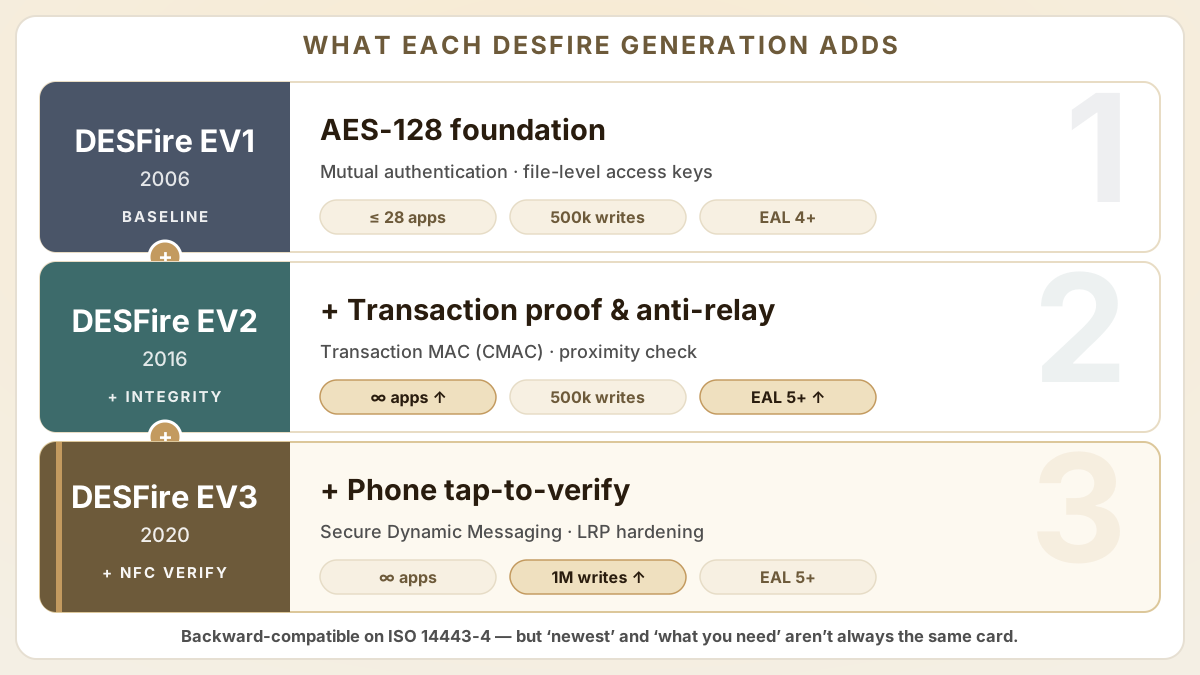
NXP has released three major DESFire generations: EV1 (2006), EV2 (2016) and EV3 (2020). Each generation adds security hardening, new cryptographic features and performance improvements while maintaining backward compatibility with the ISO 14443-4 air interface and the DESFire command set.
How do generation compare?
The following table compares the three DESFire generations across security, memory, performance and feature dimensions.
| Capability | DESFire EV1 | DESFire EV2 | DESFire EV3 |
|---|---|---|---|
| Crypto algorithms | DES, 2K3DES, 3K3DES, AES-128 | Same + CMAC-based session keys | Same + SUN/SDM (Secure Unique NFC) |
| Authentication modes | Legacy, ISO (3-pass) | Legacy, ISO, AuthEV2First/NonFirst | Same as EV2 + LRP (Leakage Resilient Primitive) |
| Memory options | 2 KB, 4 KB, 8 KB | 2 KB, 4 KB, 8 KB | 2 KB, 4 KB, 8 KB |
| Transaction MAC | No | Yes: CMAC-based | Yes: enhanced with LRP option |
| Secure Dynamic Messaging | No | No | Yes: SUN (Secure Unique NFC) messages |
| Proximity check | No | Yes: relay-attack countermeasure | Yes: improved timing |
| Common Criteria | EAL4+ | EAL5+ | EAL5+ |
| NFC forum compliance | Type 4 Tag | Type 4 Tag | Type 4 Tag with SDM NDEF |
| Anti-cloning | UID-based + key diversification | Same + transaction MAC verification | Same + SUN one-time codes |
How does security architecture work in depth?
Each DESFire generation builds on its predecessor's security model. Understanding these layers helps B2B security architects select the right generation for their threat model.
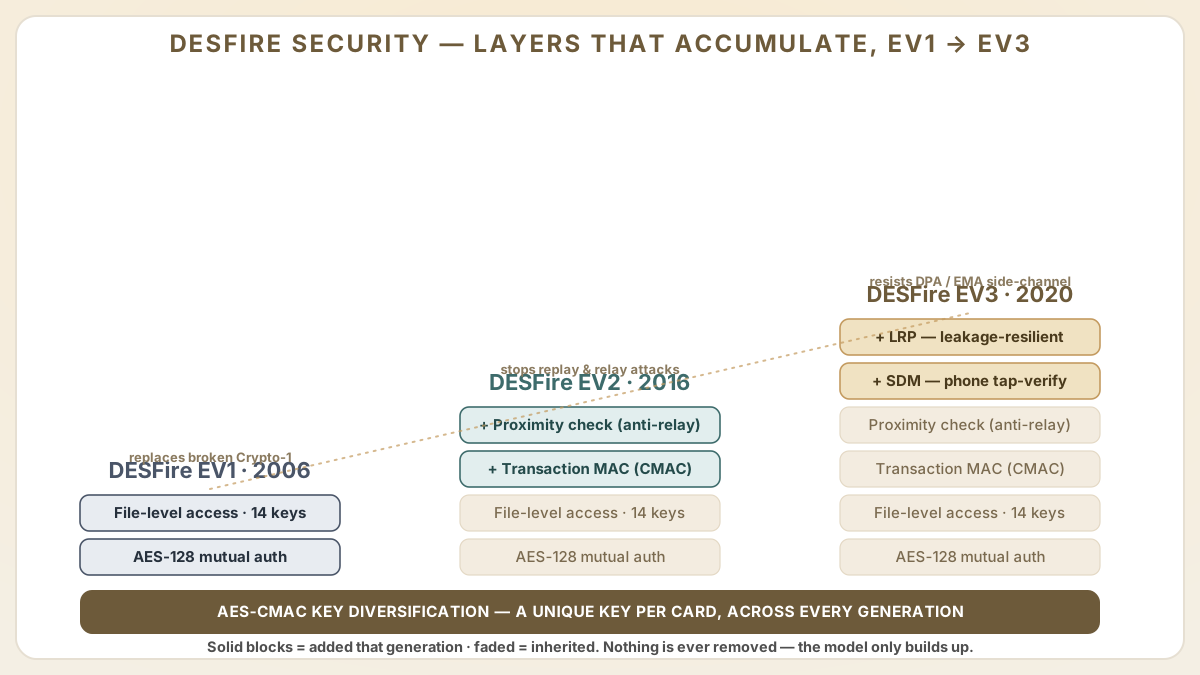
DESFire EV1 introduced AES-128 mutual authentication, replacing the compromised Crypto-1 algorithm used in MIFARE Classic. It provides file-level access control with up to 14 application keys per application.
EV2 added transaction MAC capability, allowing backend systems to verify that a transaction was genuinely executed on a physical card rather than replayed or simulated.
EV3 introduced Secure Dynamic Messaging (SDM), which embeds a one-time cryptographic code in the card's NDEF message, enabling any NFC-capable smartphone to verify card authenticity without specialized reader hardware or backend connectivity.
- EV1 is vulnerable to side-channel attacks on early silicon revisions. NXP recommends EV2 or EV3 for new deployments.
- EV2's proximity check measures round-trip signal timing to detect relay attacks, which are increasingly common in high-value access-control scenarios.
- EV3's LRP (Leakage Resilient Primitive) authentication mode provides additional resistance to differential power analysis (DPA) and electromagnetic analysis (EMA) attacks.
- Key diversification using AES CMAC remains the recommended approach for all generations to prevent one compromised card from revealing system-wide keys.
How do you migrate from EV1 to EV2/EV3?
Plenty of B2B deployments still run DESFire EV1 cards issued back when the threat model was simpler and the side-channel papers had not been written yet. A phased migration strategy lets organizations upgrade security without turning daily operations into a week of help-desk tickets.
- EV3 readers are fully backward-compatible with EV1 and EV2 cards at the command level. Upgrade readers first, then issue new cards as existing ones expire.
- During the transition period, configure the access-control system to accept both EV1 and EV3 authentication modes.
- New card orders should default to EV3 even if the current system does not yet use SDM or LRP. The cost premium is minimal and future-proofs the credential.
- Plan for a full EV1 phase-out within 24–36 months of starting migration to close the side-channel vulnerability window.
- Test key diversification schemes on EV3 cards before mass issuance. EV3's LRP mode requires different diversification inputs than EV1's legacy mode.
What use-case recommendations are there by generation?
Not every deployment needs the latest generation — putting military-grade authentication on a coffee-shop loyalty card makes neither the latte nor the budget more secure. Selecting the right DESFire version balances security requirements, integration complexity and per-card cost.
- EV1: Legacy system maintenance only. Not recommended for new deployments due to known side-channel vulnerabilities on older silicon.
- EV2: General-purpose access control, transit fare collection, loyalty and campus cards where transaction MAC verification is valuable and relay-attack resistance is needed.
- EV3: High-security access control, digital product authentication (SDM), government ID, pharmaceutical anti-counterfeiting and any application where NFC-phone verification without backend infrastructure adds value.
Performance and lifecycle differences buyers actually feel
Beyond the marketing comparison of cryptographic features, the three DESFire generations have measurable differences in transaction speed, application capacity, and write endurance that show up in real deployments — particularly transit, multi-tenant campuses, and any program that uses the card for cashless or stored-value transactions. The points below are drawn from NXP's published datasheets, application note AN12752, and typical integrator field benchmarks.
- Application capacity. EV1 is hard-capped at 28 simultaneous applications per card, which becomes a constraint for converged campus deployments that want building access, library, food service, vending, transit, and sports facility entry on the same credential. EV2 and EV3 lift this to a practically unlimited number of applications (bounded by available memory), which is the single biggest reason most multi-tenant universities and corporate campuses standardize on EV2 or EV3 today.
- Read/write endurance. EV3 is rated for up to 1,000,000 write cycles per memory page versus 500,000 on EV1 and EV2. For loyalty, gift, or transit cards that update an on-card balance after every transaction, this doubles practical card life and reduces card-replacement budget — usually the largest line item in a credential program.
- Transaction throughput. EV2 introduced AuthenticateEV2First/NonFirst command pairs that allow multiple file operations within a single authenticated session. Combined with CMAC session keys, this typically cuts a multi-file transit transaction from two air-interface authentications to one, which is the difference between a smooth gate transit and a re-tap at peak hours.
- Memory layout. All three generations ship in 2 KB, 4 KB, and 8 KB SKUs, but EV3's 4K SKU is the only widely available DESFire chip with EAL5+ certification — required for some EU government and transit specs. Specify the certified SKU explicitly when issuing tenders that reference Common Criteria.
- Backward compatibility shim. NXP also publishes a DESFire EV3C variant that maps a Classic 1K layout into a DESFire file structure, intended specifically for sites migrating away from cloned MIFARE Classic systems. The cost is slightly lower per-card than full EV3 and the migration risk drops because legacy readers continue to see a Classic-shaped credential during the transition window.
Procurement and personalization checklist for DESFire programs
DESFire's strongest features only deliver value if the cards arrive personalized correctly and your readers are configured to use them. Most failed DESFire rollouts trace back to incorrect key diversification, wrong AID/file numbering, or readers that never had the EV3 firmware enabled. Use the checklist below before you place a production order.
- Confirm the chip variant in writing. DESFire EV3 ships in 2K, 4K, 8K, EV3C (Classic-compatible), and combo cards bundled with HID Prox or iCLASS antennas. The price and lead time differ noticeably between SKUs, so the purchase order should name the exact NXP part number rather than just 'DESFire EV3'.
- Decide on key diversification before personalization. AES master keys should never be loaded directly onto field cards. The standard pattern is AES CMAC diversification using the chip UID plus a system constant, which limits the blast radius if one card is recovered and reverse-engineered. Lock this scheme down in a key ceremony document before the first card is encoded.
- Match Application IDs (AIDs) to your reader configuration. Building access typically uses one AID, transit another, vending a third, each with independent key sets. Document the AID/file/key map in a single source-of-truth spreadsheet that travels with the integration package — drift between encoding scripts and reader configs is the most common 'mystery deny' source in production.
- Pre-encode in volume only after a pilot. Encode 50-200 cards, run them through every reader and panel firmware combination in production, and validate edge cases (offline mode, low battery on mobile readers, OSDP Secure Channel reconnect) before placing the full production order. NXP and most card bureaus require non-cancellable orders above a quantity threshold, so a failed pilot avoids a six-figure write-off.
- Plan for SDM mirror data layout if you want phone-tap verification. EV3's Secure Dynamic Messaging encodes the URL plus a rolling cryptographic value into the NDEF record. Choose your verification endpoint, URL template, and CMAC field offsets at personalization time — retrofitting SDM onto already-issued cards usually means re-encoding every card.
Useful next pages
Use these linked product, guide and comparison pages to keep the next click specific and practical.
MIFARE DESFire card products
DESFire EV1, EV2 and EV3 cards in standard and custom form factors for access control, transit and identity.
Smart card readers for DESFire
USB and network readers supporting DESFire authentication and personalization.
Primary-source DESFire references
Official NXP and HID documentation for specification work and integrator briefings.
FAQ
Are DESFire EV1 cards still secure enough for access control?
EV1 cards using AES-128 authentication with proper key diversification still provide significantly more security than MIFARE Classic or 125 kHz proximity cards. However, early EV1 silicon revisions are vulnerable to side-channel attacks. For new deployments, NXP recommends EV2 or EV3.
Can DESFire EV3 cards work with existing EV1 readers?
Yes. DESFire EV3 is backward-compatible with EV1 reader commands. The card will authenticate using the legacy or ISO authentication modes supported by the EV1 reader. However, EV3-specific features like SDM and LRP will not be available until the reader firmware is updated.
What is Secure Dynamic Messaging (SDM) and why does it matter?
SDM embeds a one-time cryptographic authentication code in the card's NDEF message. When tapped with any NFC smartphone, the phone reads the NDEF URL containing the dynamic code and sends it to a verification server. This enables card-authenticity checks without deploying dedicated RFID readers. Useful for product authentication, document verification and event ticketing.
How much do DESFire EV3 cards cost compared to EV1?
DESFire EV3 carries a 15–30 percent price premium over EV1 at comparable memory sizes and order volumes. For most B2B deployments ordering 5 000+ cards, the per-unit difference is $0.20–$0.50, which is negligible relative to total credential lifecycle cost including issuance, management and eventual replacement.
Is the recently disclosed Fudan FM11RF08 'static-nonce' MIFARE Classic backdoor a reason to move from DESFire EV1 to EV3?
The Quarkslab disclosure in 2024 of a hardware backdoor in Shanghai Fudan Microelectronics FM11RF08 chips affects MIFARE Classic-compatible cards, not DESFire. DESFire EV1, EV2, and EV3 do not use Crypto-1 and are not impacted by that specific finding. That said, the disclosure underscores why anything still depending on Classic-family cryptography should already be on a migration plan. If your buildings are running EV1 today, the better drivers for moving to EV3 are the side-channel hardening on EV2/EV3 silicon, the larger application count, the EAL5+ certification on the 4K SKU, and the option to add SDM for smartphone tap verification — not the Fudan finding itself.
When should we pick HID Seos instead of MIFARE DESFire EV3?
Both are AES-128 credentials and both resist cloning when properly configured, so the choice is rarely about raw cryptographic strength. Pick HID Seos if you are already standardized on HID Signo or multiCLASS SE readers, want HID Mobile Access on iOS and Android out of the box, or need the SIO data wrapper to move the same credential identity across cards, fobs, watches, and phones. Pick DESFire EV3 if you want vendor-neutral procurement (NXP licenses the chip widely, so you can buy from many card bureaus), need to host independent applications from multiple tenants on one card, or want the SDM tap-to-verify feature for product authentication and event tickets. Many enterprise sites end up running both — Seos for employee badges and DESFire for facility-specific applications like cafeteria and visitor passes.
Proud Tek is a Shenzhen-based RFID & NFC manufacturer supplying hotel chains, transit operators, event venues and retail brands worldwide. Every order includes free samples, RF testing and dedicated project support.
Get a Quick Quote
Tell us about your project and we'll respond within one business day. Fields marked (asterisk) are required.