
RFID Technology
How RFID Readers Work
USB, Bluetooth, Fixed
Quick answer
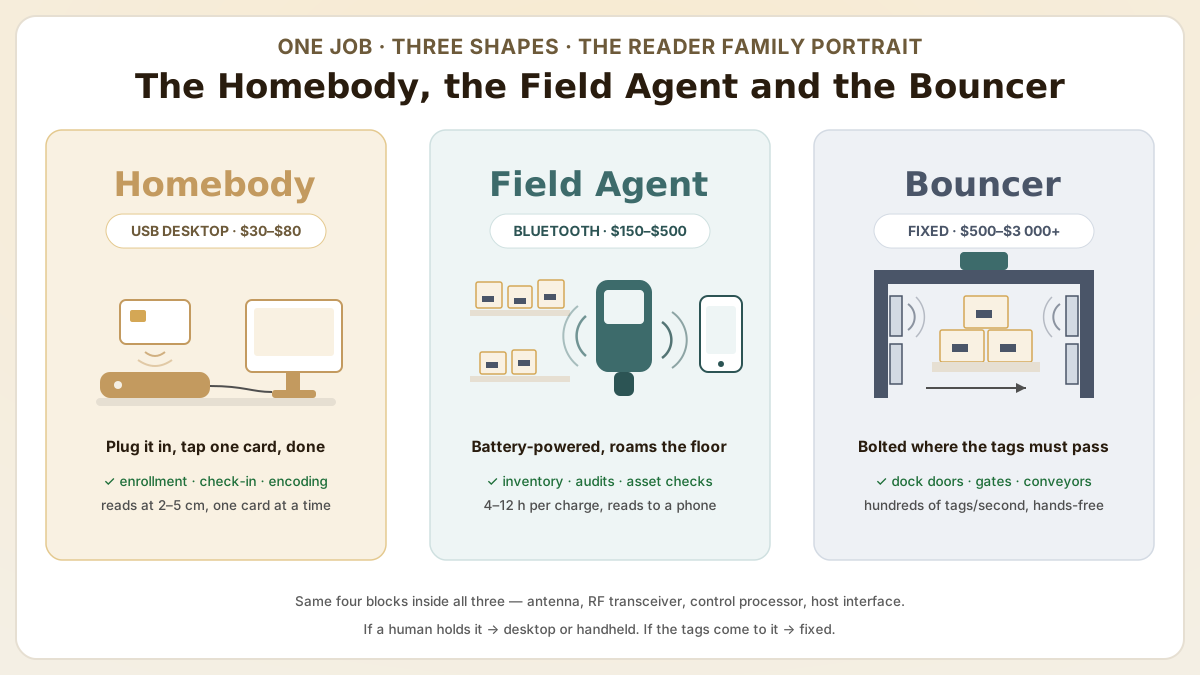
RFID readers come in three shapes — USB desktop ($30–$80), Bluetooth handheld ($150–$500) and fixed ($500–$3 000+) — all built on the same four blocks. Antenna, RF transceiver, control processor, host interface: the form factor just decides who holds them. Humans hold the first two; fixed readers make the tags come to them and clear hundreds per second. Pick by job, not by spec sheet, and the deployment runs instead of stalling.
- USB desktop readers (the ACR122U class, $30–$80) read one card at 2–5 cm over PC/SC or keyboard emulation — built for enrollment desks, hotel check-in and encoding exactly one card on purpose.
- Bluetooth handhelds ($150–$500) pair with a phone or tablet over BLE or SPP and run 4–12 hours per charge — inventory counts and asset audits while the operator walks the floor.
- Fixed readers ($500–$3 000+) bolt to dock doors and turnstiles, take PoE, and clear hundreds of tags a second (UHF EPC Gen2) with nobody holding anything.
At a glance
Use these short answers to decide whether this page matches the project before moving into the detail.
Key takeaway
USB desktop readers (the ACR122U class, $30–$80) read one card at 2–5 cm over PC/SC or keyboard emulation — built for enrollment desks, hotel check-in and encoding exactly one card on purpose.
What are the core components of an RFID reader?
Every RFID reader — the $30 desktop puck, the $3 000 dock-door monster and everything in between — contains the same four functional blocks: an antenna, an RF transceive...
Next step
Ready to move forward? Start your inquiry to get specific answers for this project.
Get reader recommendationsWhat are the core components of an RFID reader?
Every RFID reader — the $30 desktop puck, the $3 000 dock-door monster and everything in between — contains the same four functional blocks: an antenna, an RF transceiver, a control processor and a host interface. The form factor is just the costume, and there are exactly three: USB desktop (the Homebody), Bluetooth handheld (the Field Agent) and fixed infrastructure (the Bouncer). Nobody thinks about the reader until it stops reading — the tag gets the marketing photos while the humble box on the door frame does all the actual interrogating — so learn the four blocks once and every reader on the market stops looking like magic and starts looking like a very polite radio.
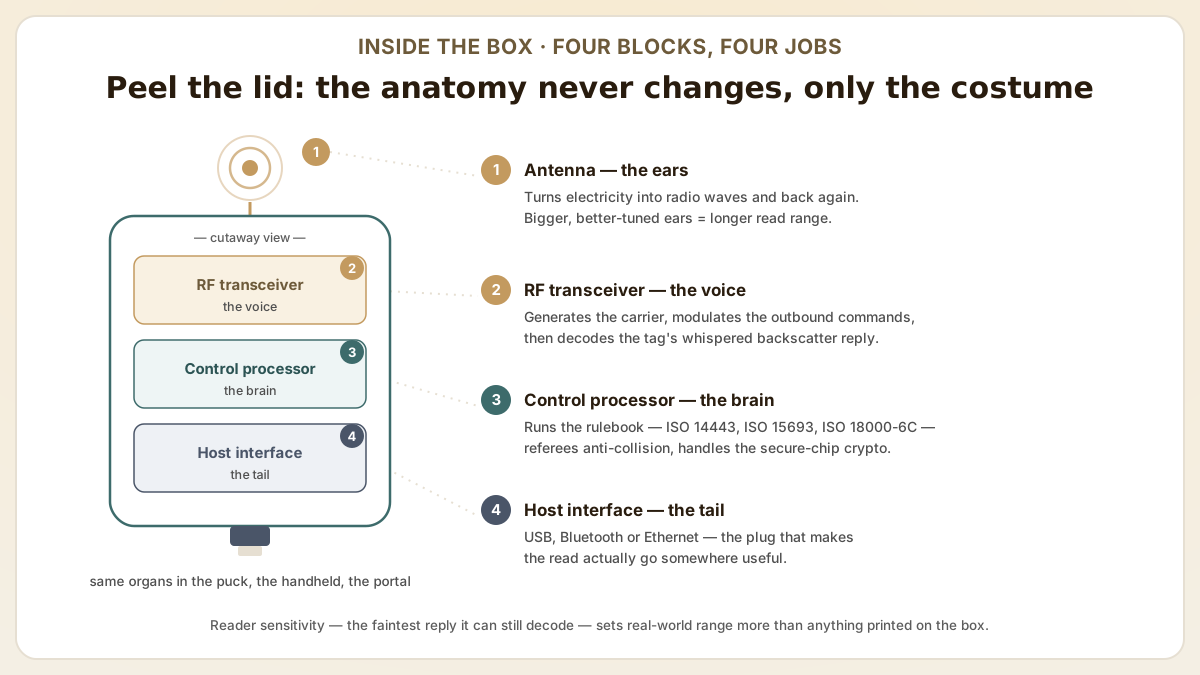
In slightly more grown-up language: the RF transceiver generates the carrier signal, modulates the outbound commands and demodulates the tag's backscatter or load-modulated reply. The control processor runs the air-interface protocol (ISO 14443, ISO 15693, ISO 18000-6C and friends), manages the anti-collision sequencing that lets many tags answer without stepping on each other, and handles the cryptographic handshakes for secure chips like MIFARE DESFire or Java Cards. The host interface and antenna are where the three form factors go their separate ways:
- USB desktop readers sip power straight from the USB bus and chat over a virtual COM port, CCID (the smart-card interface) or plain old HID keyboard emulation.
- Bluetooth readers pack their own battery and pair with smartphones, tablets or laptops over BLE or Bluetooth Classic SPP profiles.
- Fixed readers run on Ethernet or RS-485 and happily take Power over Ethernet (PoE), so one cable does both jobs across a big install.
- Reader sensitivity — the faintest tag reply the receiver can still decode — is the real headline number: for a given antenna and tag combination it sets your maximum read range far more than the marketing figure on the box.
How do USB desktop readers handle enrollment and verification?
USB desktop readers are the workhorse of card-enrollment stations, hotel front desks, membership kiosks and developer workbenches — cheap, compact and driver-free on any modern operating system. If RFID readers were roommates, the Homebody is the one who never leaves the apartment and genuinely thrives that way: the default answer whenever the job is "read or write exactly one card, on purpose."
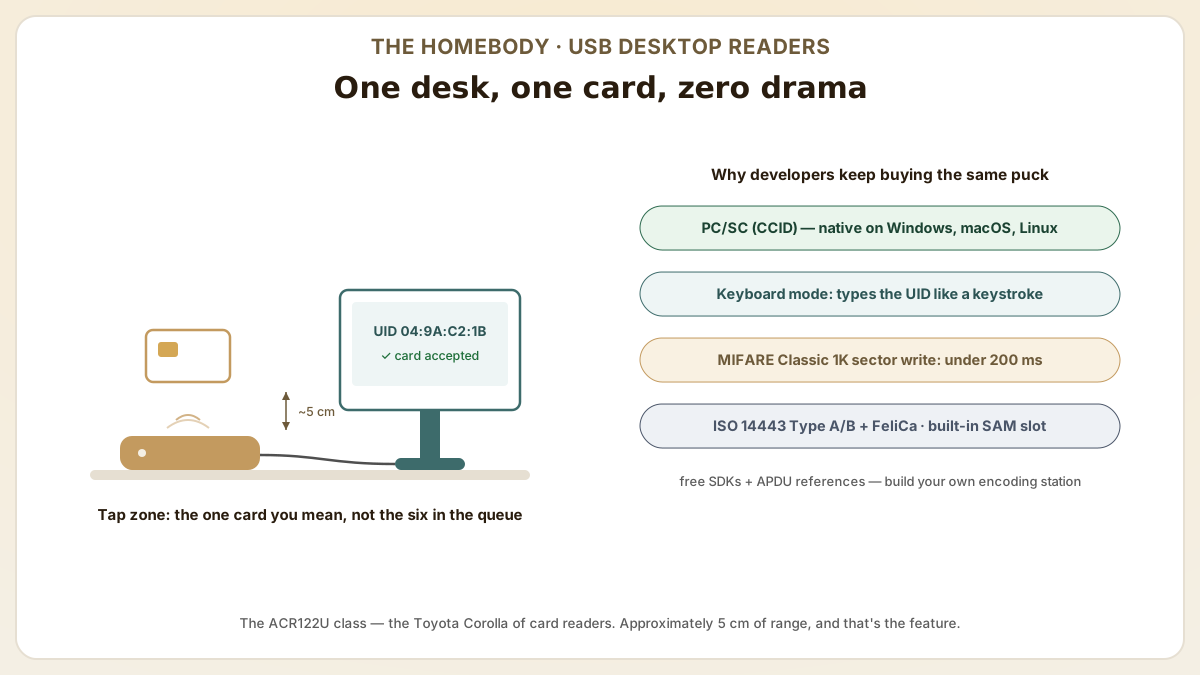
The undisputed celebrity of the class is the ACR122U from ACS — the most widely deployed USB NFC reader in the B2B channel, basically the Toyota Corolla of card readers. It speaks ISO 14443 Type A/B and FeliCa, talks to your computer over PC/SC (CCID) and carries a built-in SAM slot for secure applications. Its read range — approximately 5 cm, limited by the small integrated antenna — sounds feeble right up until you remember that's the entire point: at an enrollment desk you want the one card you're holding, not the six loitering in the next person's back pocket.
- CCID-class readers show up to the OS as ordinary smart-card readers, so they drop into standard PC/SC middleware with zero custom drivers.
- Keyboard-emulation readers simply type the card's UID out as keystrokes — instant, code-free integration with literally any text box.
- Read/write speed for MIFARE Classic 1K is typically under 200 ms for full-sector operations on USB readers.
- Free SDKs and APDU command references let developers build their own encoding and verification software without reinventing the radio.
How do Bluetooth handheld readers power mobile workflows?
Bluetooth RFID scanners cut the cord, and the reader gets a promotion: asset audits, inventory counts, laundry tracking and field-service checks all run from a smartphone or tablet while the operator walks the floor. Three specifications decide whether a handheld is a joy or a very expensive paperweight — battery life, operating frequency and pairing protocol.
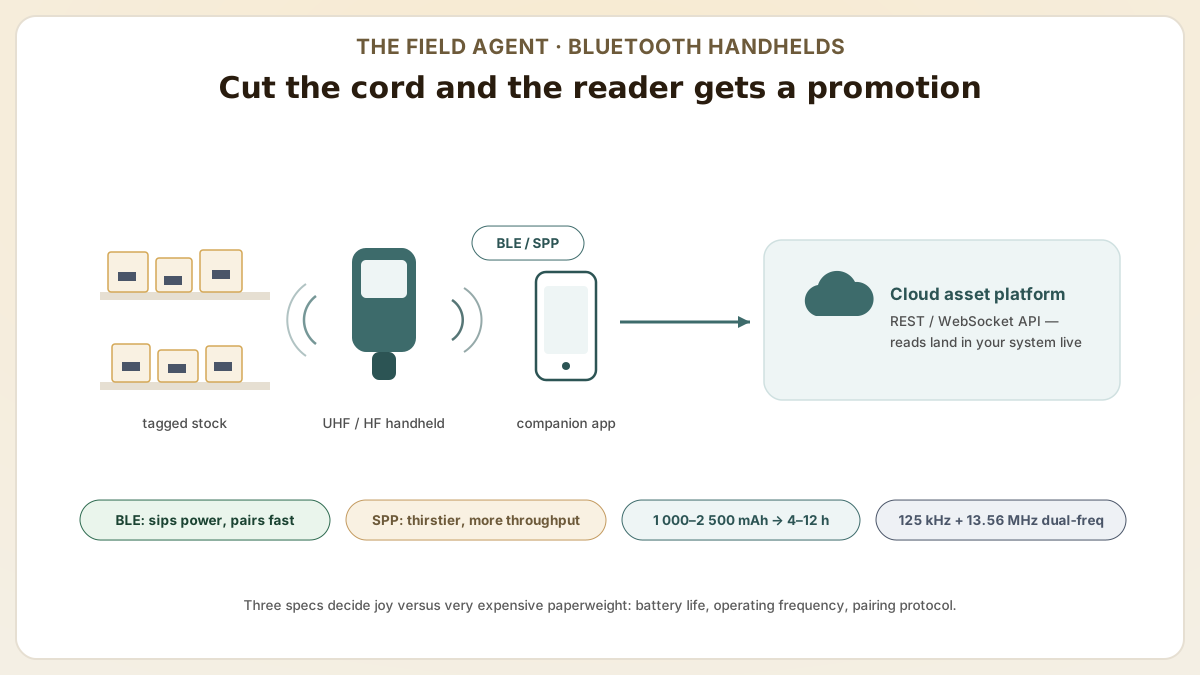
- Step 1BLE (Bluetooth Low Energy) sips power and pairs fast; Classic Bluetooth SPP is thirstier but pushes higher sustained throughput for bulk reads. Pick by workload.
- Step 2Dual-frequency handhelds that read both 125 kHz and 13.56 MHz are the diplomats of an access-control migration — one device covers the legacy and the modern card populations.
- Step 3Battery capacity of 1 000–2 500 mAh buys 4–12 hours of continuous scanning, depending on read frequency and how much you poke the screen.
- Step 4The companion mobile app typically exposes a REST or WebSocket API, so reads flow straight into your cloud asset-management platform.
How do fixed readers handle infrastructure-level identification?
Fixed RFID readers are permanently installed at the chokepoints — loading docks, conveyor branches, access gates, toll plazas — identifying tagged items, vehicles and personnel automatically, hands-free, all day. Bolt a reader to a doorway and it stops asking questions and starts taking names: the Bouncer is the muscle of any serious deployment.
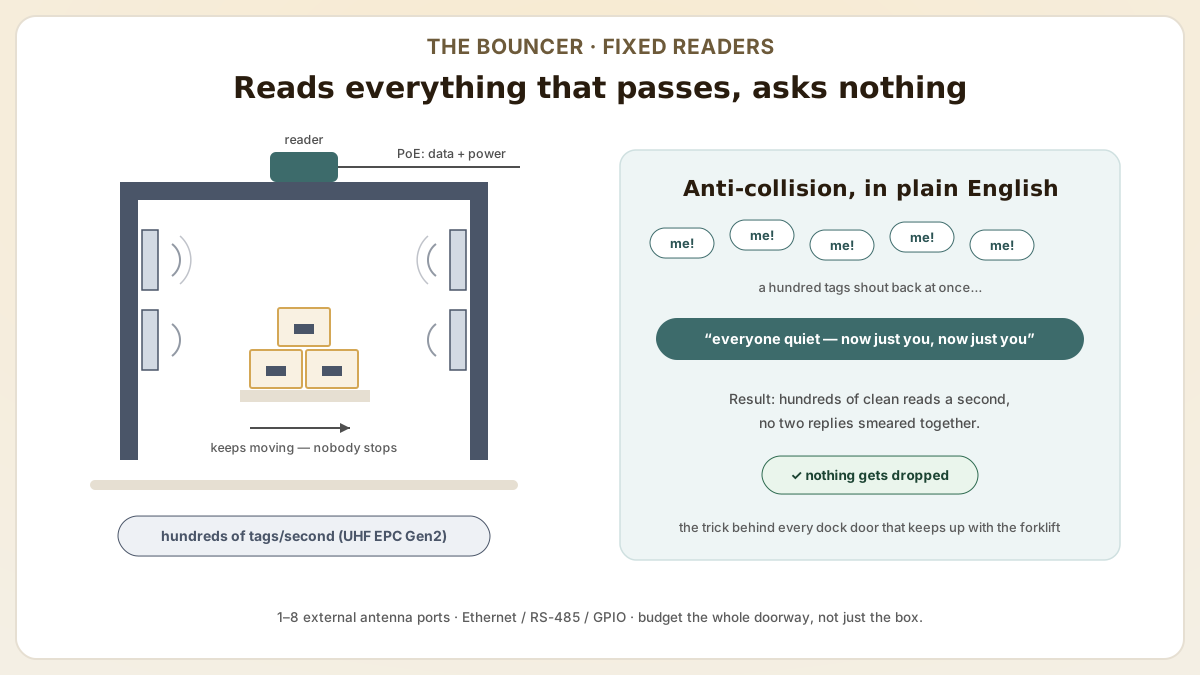
Plain-English translation of the datasheet's favourite word, "anti-collision": when a hundred tags shout back at once, the reader plays a lightning round of everyone-quiet-now-just-you so no two replies smear together. That's how a fixed UHF reader clears hundreds of tags a second without dropping one. Here's how the three form factors stack up on the numbers that actually decide deployments:
| Parameter | USB desktop | Bluetooth handheld | Fixed infrastructure |
|---|---|---|---|
| Typical read range | 2–5 cm | 3–10 cm (HF) / 1–5 m (UHF) | 1–12 m (UHF) / 5–30 cm (HF) |
| Power source | USB bus (500 mA) | Internal battery | PoE / DC mains |
| Antenna configuration | Built-in PCB antenna | Built-in or stubby external | 1–8 external antenna ports |
| Multi-tag capability | Single card | Single or low-count batch | Hundreds per second (UHF EPC Gen2) |
| Host interface | USB (CCID / HID) | BLE / Bluetooth SPP | Ethernet / RS-485 / GPIO |
| Typical unit cost | $30–$80 | $150–$500 | $500–$3 000+ |
How do you select the right reader for your application?
Reader selection should be driven by the job, not by whichever spec sheet brags the loudest — over-buying just piles on cost and integration complexity for features you'll never switch on. The quick test: if a human holds the reader, you want desktop or handheld; if the tags come to the reader, you want fixed. The decision matrix below maps common B2B use cases to the right category and settles the rest.
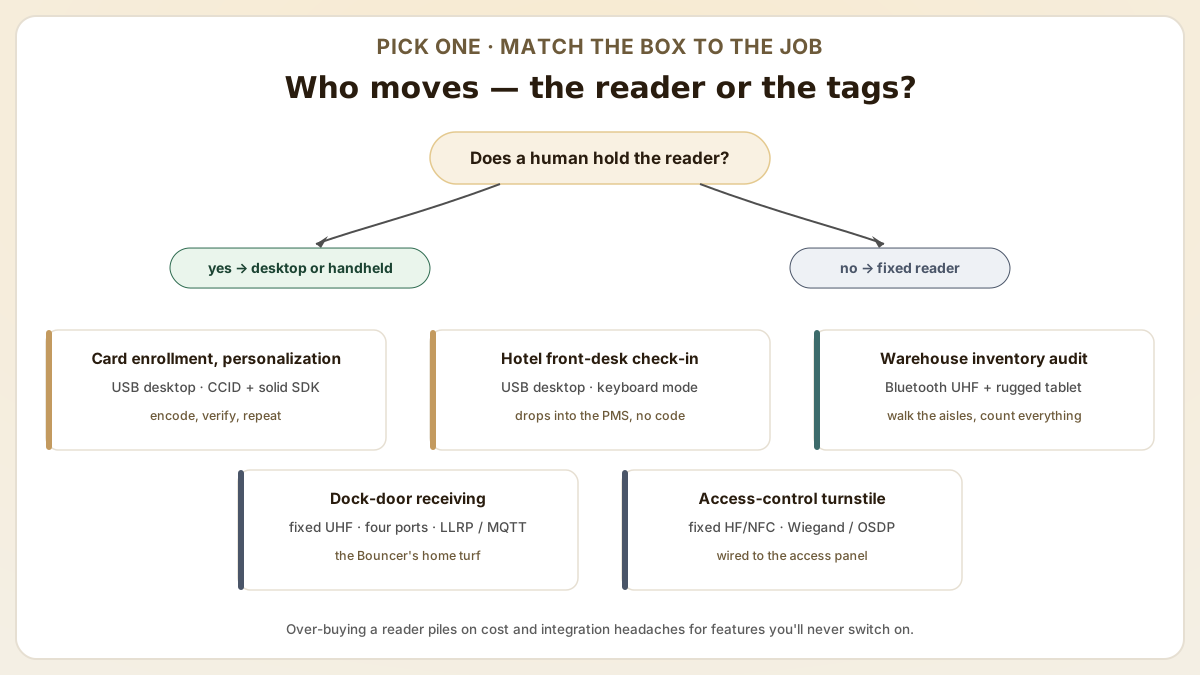
- Card enrollment and personalization stations: USB desktop reader with a CCID interface and solid SDK support. Encode, verify, repeat.
- Hotel front-desk check-in: USB desktop reader in keyboard-emulation mode, so it drops into the PMS with no code at all.
- Warehouse inventory audit: Bluetooth UHF handheld paired with a rugged Android tablet — walk the aisles, count everything.
- Dock-door receiving: fixed UHF reader with four antenna ports and LLRP or MQTT integration. The Bouncer's home turf.
- Access-control turnstile: fixed HF/NFC reader with Wiegand or OSDP output wired to the access-control panel.
Reader vendor and model reference matrix — what's deployed at scale in 2026
Five vendors soak up most of the volume RFID reader market in 2026, and each has a personality as distinct as its hardware. Knowing who's who shortens the RFP shortlist and spares you the very expensive pain of swapping brands halfway through a rollout.
- Impinj — the 800-lb gorilla of fixed UHF: R420 (legacy), R700 (current flagship), R720 (high-density), plus the xPortal and xSpan ceiling arrays. LLRP-native with Octane firmware and ItemSense middleware — the default behind Walmart, Target and Macy's mandate dock doors and the Auburn RFID Lab benchmark stack. Reader pricing $1,200-$2,800 fixed, $400-$800 for the R200 and R500 USB desktop class.
- Zebra Technologies — the everything store: handhelds (RFD8500, RFD40, RFD90, MC3300xR), fixed (FX9600, FX7500), gateways and printers (ZT411, ZT421 for source tagging), with strong tooling in Zebra DataServices and MotionWorks. Pricing $800-$1,800 fixed; $1,200-$3,500 per handheld bundle.
- Honeywell — the hospital-and-warehouse veteran: IH40 handheld and IF61 fixed RFID lines, strong in healthcare, warehousing and 3PL accounts where the Vocollect voice + RFID combination is already deployed, and often paired with Intermec scanners. Pricing $700-$1,500 handheld and $900-$2,400 fixed.
- Nordic ID (Wirepas) — Europe's mesh-native option: Sampo S2/S3 fixed reader and EXA51 handheld, with OSDP, MQTT and REST natively supported. A strong fit for European retail and IoT-mesh deployments where Wirepas/LoRaWAN already sit alongside the RFID.
- ThingMagic / Novanta — the module hiding inside other people's products: embedded UHF modules (M6e Nano, M7e, USB Pro, Sargas) that OEM integrators bake into kiosks, vehicles and self-service machines. Lowest per-unit cost ($150-$650 per module) for high-volume embedded builds. Acquired by Novanta in 2017; the product line is still going strong in 2026.
Reader-to-host integration protocols — LLRP, MQTT, REST, Wiegand, OSDP, PC/SC and when each wins
Great reader hardware only matters if it can actually talk to the system you need to feed. The protocol layer is where projects quietly get stuck: choose the wrong language and you're buying costly middleware or locking yourself to one vendor. The good news is that the reader is a polyglot — it just needs to know which room it's speaking to.
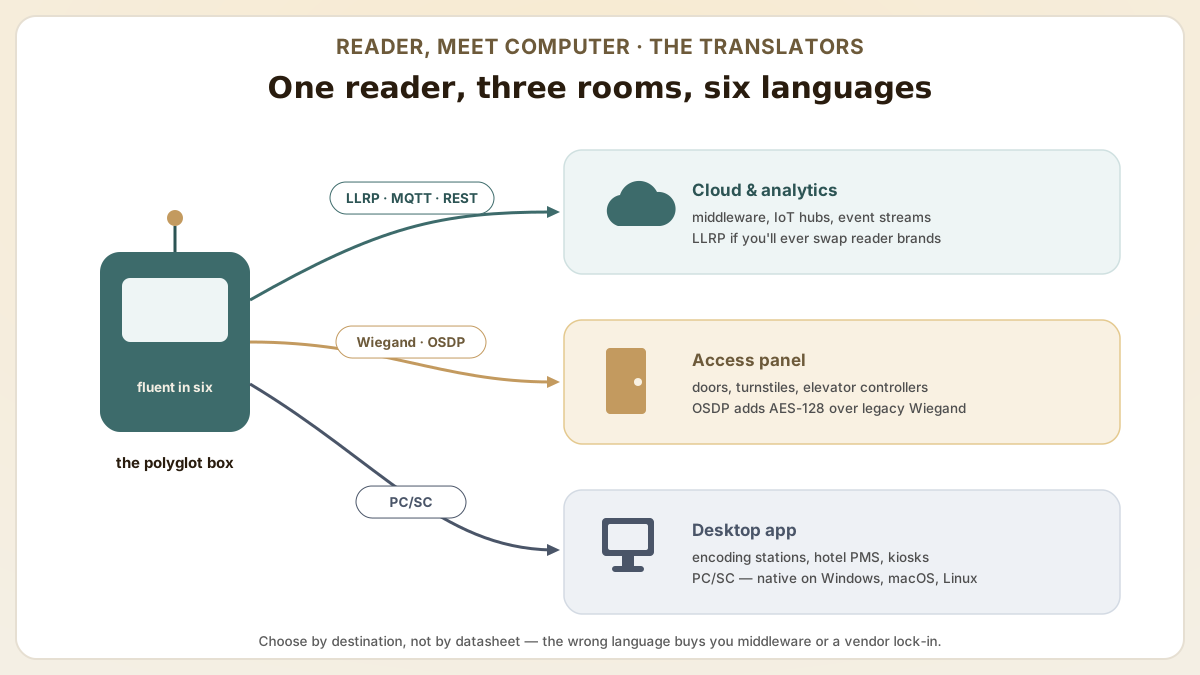
- LLRP (Low Level Reader Protocol, EPCglobal-ratified) — the vendor-neutral binary standard spoken by Impinj, Zebra, Honeywell, Nordic ID and most fixed UHF readers. Non-negotiable if you might swap reader brands later, or want middleware like Impinj ItemSense, Zebra MotionWorks, RFID4U TagMatiks or Avery Dennison Atma.io.
- MQTT — the lightweight pub/sub darling of the IoT world (AWS IoT Core, Azure IoT Hub, Google Cloud IoT), increasingly the default for cloud-connected fixed readers and a clean fit for streaming read-events into Snowflake, Databricks or BigQuery for analytics.
- REST/HTTP and WebSocket — typical of vendor cloud platforms (Impinj IoT Interface, Zebra DataServices, Cvent OnArrival event registration). The fastest path to integration when you control the backend stack and don't need 1000+ tag/second throughput.
- Wiegand and OSDP — the two languages of physical access control. Wiegand is the legacy 26/35-bit protocol still wired into HID, Honeywell, Lenel and AMAG panels; OSDP (Open Supervised Device Protocol, SIA-defined) is the modern, secure replacement with AES-128 and bidirectional commands. Required whenever a reader feeds a door, turnstile or elevator-floor controller.
- PC/SC (Personal Computer/Smart Card) — the desktop card-reading standard supported natively on Windows, macOS and Linux. The ACR122U, HID Omnikey 5022 CL, Identiv uTrust 4700F and Feitian R502 all expose it, which is why they're the developer-friendly pick for encoding stations, hotel PMS, kiosks and software-house integrations.
Useful next pages
Use these linked product, guide and comparison pages to keep the next click specific and practical.
RFID reader classes by form factor
Pillar and SKU pages for the three reader form factors covered in this article. Desktop NFC encoder, handheld UHF and fixed UHF.
Head-to-head comparisons and selection guides
Deeper reading for the specific fixed-reader or selection-framework decision that usually follows this article.
Reader vendor catalogues and protocol references
Manufacturer datasheets and standards documents for the dominant reader lines.
FAQ
Can a USB NFC reader write data to RFID cards as well as read them?
Both — and most people forget the write half. Nearly every USB NFC reader, the ACR122U included, supports read and write: you can encode NDEF records, write custom data to MIFARE sectors or program DESFire applications using the appropriate APDU commands via the PC/SC interface.
What is the maximum read range of a Bluetooth RFID scanner?
Two ranges — don't mix them up. For HF/NFC (13.56 MHz) Bluetooth scanners, typical read range is 3–10 cm; UHF handhelds operating at 860-960 MHz achieve 1–5 meters depending on tag type and antenna design. The Bluetooth link back to the paired phone or tablet is a separate 10–30 meters.
Do fixed RFID readers require special network infrastructure?
Usually just an Ethernet cable. Most fixed readers support PoE (802.3af/at), so a single run carries both data and power. Some models add Wi-Fi or cellular connectivity for locations where cabling is impractical, and RS-485 still shows up in legacy industrial installations.
Can one reader handle both 125 kHz and 13.56 MHz cards?
Yes — dual-frequency readers are common in access-control migrations, where a facility is limping off legacy 125 kHz proximity cards onto modern 13.56 MHz smart cards. These readers contain two separate RF front-ends and automatically detect the card's frequency the moment it is presented.
What software is needed to integrate a USB RFID reader?
Less than you'd fear. On Windows, macOS and Linux, CCID-class readers are supported natively through the PC/SC framework, and free manufacturer SDKs add higher-level APIs for card detection, authentication and data read/write. No proprietary drivers are required for basic operation.
How does throughput differ between handheld, fixed and tunnel readers?
It's a huge spread. USB desktop readers (ACR122U, Omnikey 5022 CL) handle 1-3 cards per second — built for one-at-a-time enrollment. Bluetooth UHF handhelds (Zebra RFD90, TSL 1153, Bluebird RFR900) read 100-300 tags per second on a sweeping motion. Fixed UHF readers (Impinj R700, Zebra FX9600) sustain 700-1,000+ tags per second per port across 4-8 antenna ports — typical dock-door configuration. Tunnel readers (Times-7 A5020, Impinj xSpan, Datalogic gateway) read 200-500 items per second at 0.5-1.2 m/s conveyor speed. For a Walmart-mandate apparel sortation lane, plan on 4-8-port fixed readers; for a hotel front desk, a single PC/SC USB reader is the right call.
Can I run BLE-enabled mobile RFID dongles instead of dedicated handhelds for retail-mandate workflows?
For low volume, sure — BLE sled-style readers (Zebra RFD8500, TSL 1128/1153, Pepwave HC1, Hand Held Products HHP) attach to iPhone or Android devices and run sub-$300 to $800 per unit. They sustain 50-150 tags per second, sufficient for store cycle counts, BOPIS pick-and-pack and store-to-store transfers. They are NOT a replacement for high-throughput dock-door fixed readers (where you need 700+ tags per second per port). Major caveat: enterprise rollouts often standardise on a single reader brand for IT support purposes — mixing BLE dongles into a Zebra MotionWorks or Impinj ItemSense fleet adds management complexity.
Proud Tek is a Shenzhen-based RFID & NFC manufacturer supplying hotel chains, transit operators, event venues and retail brands worldwide. Every order includes free samples, RF testing and dedicated project support.
Get a Quick Quote
Tell us about your project and we'll respond within one business day. Fields marked (asterisk) are required.