
NFC Card Solution
NFC Business Cards
Custom Chip, Material & Encoding

Quick answer
Procurement-grade NFC business-card guide for solo professionals, executive teams, and corporate rollouts. Covers chip selection (NXP NTAG213 144 B / NTAG215 504 B / NTAG216 888 B baselines plus NTAG 424 DNA SUN authentication for luxury / anti-clone variants), material options (PVC / recycled PVC / FSC wood / FSC bamboo / brushed metal + ferrite isolator / ceramic / paper), the iPhone XS+ background-tag-reading model (iOS 13 system-level scanning, no app required) versus the iPhone 7-X app-and-tap-icon legacy, vCard 4.0 (RFC 6350) record format, Apple Wallet / Google Wallet contact-pass adjacency, and — uniquely — the procurement-narrative on SaaS platform-extinction risk after Linq sunset its digital-card business in early 2025. Frames the OEM advantage: you own the URL, the data and the brand; no per-card subscription; no platform-orphan risk.
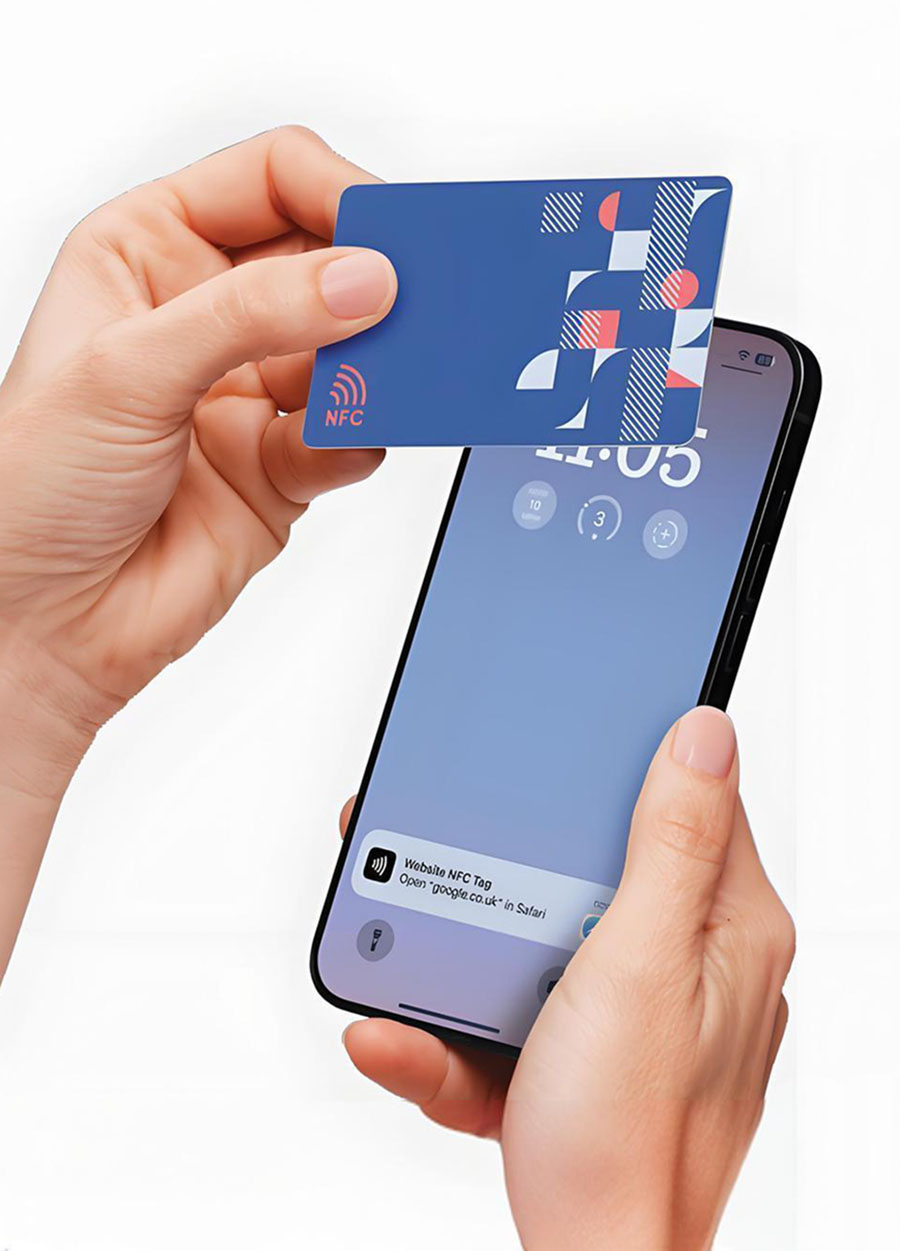
- Works on every iPhone XS or newer (Sept 2018+) without an app — background tag reading shipped in iOS 13. iPhone 7 / 8 / X require tap-on-icon in Control Center. Every Android phone with NFC reads tags via the OS NDEF dispatch.
- Pick the chip by memory + security tier. NTAG213 (144 B) for URL-only tap-to-LinkedIn. NTAG216 (888 B) for full vCard embedded directly. NTAG 424 DNA for SUN per-tap unique URL authentication on luxury / executive / anti-clone cards.
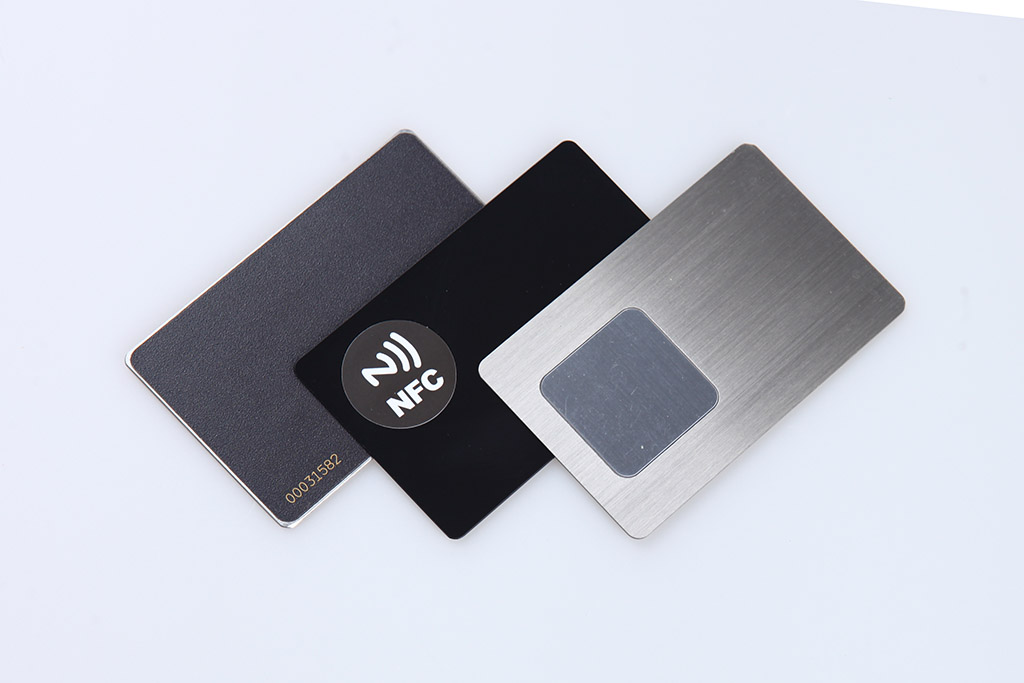
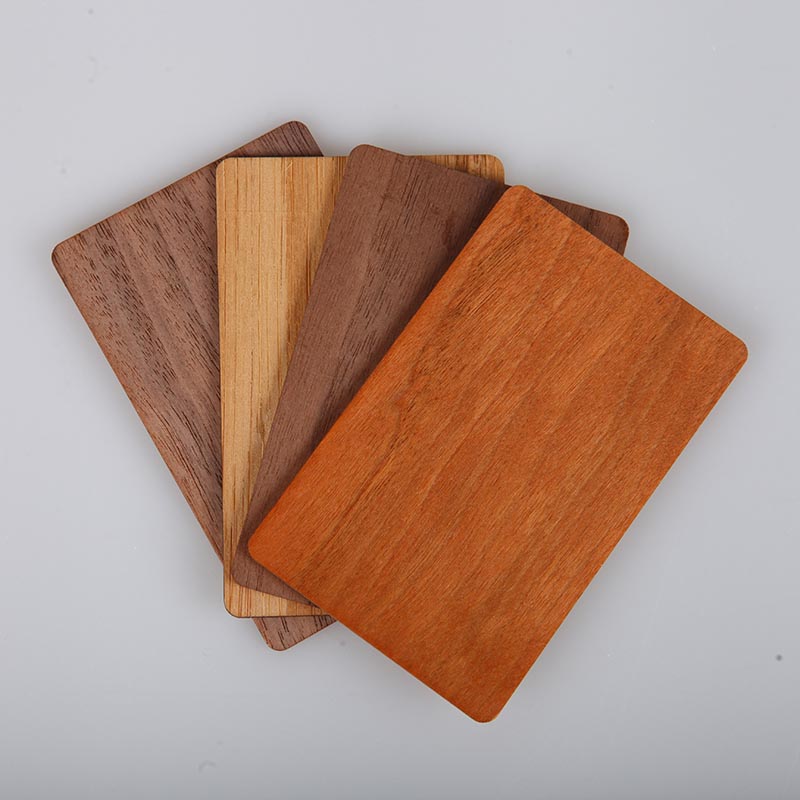
- Pick the material by brand tier + iPhone read-distance constraints. PVC works everywhere. FSC wood and bamboo read at 0.85–0.95× of PVC range. Brushed metal needs a ferrite isolator behind the chip; expect halved read distance.
- Own the URL, own the data, own the brand. Linq sunset its digital business-card business in early 2025; every Linq customer's card pointed at a vendor domain that stopped routing. OEM-purchased cards point at YOUR domain — vendor risk on the URL routing layer is zero.
Featured NFC Business Cards Products
SKUs we typically deploy for nfc business cards. Tap a card for specs and samples.
At a glance
Use these short answers to decide whether this page matches the project before moving into the detail.
Audience
Solo professionals replacing paper cards with a tap-to-vCard credential. Executive teams (10–500 cards) rolling out branded NFC cards across sales / BD / partnerships.
Decision sequence
Programme target — solo card, team rollout (10–100), corporate (100+), luxury / anti-clone. Chip: NTAG213 (URL-only) vs NTAG215 (small vCard) vs NTAG216 (full vCard) vs...
Next step
Ready to move forward? Start your inquiry to get specific answers for this project.
Get custom NFC card quote- Direct catalogue links
Why most NFC business-card programmes go wrong — the four buyer-side risks SaaS-led vendors don't mention
Every paper business card ends up in a desk drawer, a fishbowl by the register, or the bin. NFC cards were supposed to end that — tap, and your details land in the one device the recipient actually takes home. The catch nobody prints on the product page: the chip almost never fails, but the URL it points at can, and a card whose link has gone dark is just a costlier way to be forgotten. The top-ranking SERP pages for "NFC business card" are almost all SaaS-led brands (Linq, Popl, V1CE, Mobilo, Wave, Blinq, TAPiTAG). They underplay four buyer-side risks that an OEM-direct procurement path eliminates. A corporate buyer running a 100-employee rollout should understand all four before committing to any platform.
**Risk 1 — Platform-extinction.** In early 2025 Linq, one of the top-3 NFC business-card SaaS platforms by user count, exited the digital-card business and pivoted to AI messaging APIs. Every Linq-issued card pointed at a `linq.app` URL that subsequently stopped resolving the way customers expected. Customers had to either re-order cards from a different vendor or accept that their existing card stock had a deteriorating routing layer. The lesson: every SaaS card platform is one strategic pivot away from orphaning your card inventory.
**Risk 2 — Per-card subscription drag.** Popl, Mobilo and similar SaaS platforms charge per-user-per-month subscriptions (typically $6.99–$15.99/user/month) for the full feature set. At 200-employee scale that is $17,000–$38,000 / year in perpetuity for what is functionally URL redirection plus analytics. An OEM-direct purchase is a one-time cost; self-hosted analytics (Plausible, Matomo, Google Analytics) run separately at minimal cost.
**Risk 3 — Data residency.** SaaS routing platforms put PII (contact captures, lead-form submissions) on a third-party server in a vendor-chosen region. For enterprise buyers under GDPR Article 28 controller / processor obligations, that means negotiating a DPA, auditing the vendor's sub-processor list, and accepting their data-residency regions. A self-hosted vCard URL on the company's own domain keeps contact data inside the existing compliance perimeter.
**Risk 4 — Brand consistency at scale.** SaaS routing layers brand the landing page. A V1CE-routed card opens a V1CE-styled profile page by default; custom domain support is a paid add-on. An OEM card pointing at `https://yourcompany.com/contact/{name}` gives the buyer 100% brand control. For luxury and executive cards, the routing layer should be a branded experience, not a SaaS chrome.
Chip-family decision — NTAG213, NTAG215, NTAG216, NTAG 424 DNA
The chip family decides memory capacity and security tier. Memory matters when you embed the full vCard inside the NDEF payload (NDEF tap reads contacts immediately even when the phone is offline). Security matters when you need anti-clone authentication for luxury, executive or high-value-relationship cards.

- NTAG213 (NXP MF0ICU2; 144 bytes user memory; 13.56 MHz ISO/IEC 14443 Type A) — the entry chip. 144 bytes is enough for a URL plus a 25-character vCard fallback; full vCard does not fit. Standard for tap-to-LinkedIn, tap-to-Calendly, tap-to-portfolio URL cards. ~$0.05–0.10 per chip; commodity priced.
- NTAG215 (504 bytes user memory) — mid-tier. Holds a full vCard 3.0 with name, title, phone, email, company, plus a fallback URL. Best for executive cards where the embedded vCard means contacts load even without the recipient's phone being online.
- NTAG216 (888 bytes user memory) — full vCard 4.0 (RFC 6350) with multi-language `LANG` parameters, longer titles, multi-line addresses, ORG / TITLE / X-SOCIALPROFILE custom fields. Standard for international / multi-region team rollouts where vCard payload exceeds 504 bytes.
- NTAG213F / NTAG216F — field-detect variants that wake the chip into an event when the field is sensed. Niche; useful for app-integrated interactive cards but not a default for general procurement.
- NTAG 424 DNA (NXP NT4H2421Gx; SUN message authentication) — the security-tier chip. Each tap generates a unique URL via AES-CMAC authentication. The URL changes per tap, making clone detection trivial — a duplicate URL signals a copied card. Premium positioning for luxury executive cards, anti-counterfeit credential programmes, and limited-edition collector cards. ~$0.40–0.80 per chip at OEM volume.
- Read distance — all NTAG variants top out at ~10 cm on a PVC card with iPhone XS+ at 0–10° angle; degrades on metal (5 cm with ferrite isolator) and on thick wood / bamboo (8–9 cm).
iPhone XS+ background tag reading, iPhone 7-X legacy, Android NDEF dispatch
The single largest source of NFC business-card programme failure is mis-targeting the iPhone install base. iPhone XS or newer (released September 2018) reads NFC tags in the background without an app, but iPhone 7, 8 and X require the user to open Control Center and tap a scanner icon. Specifying a card programme that assumes iPhone XS+ behaviour for a recipient pool that includes older phones produces avoidable friction.
- iPhone XS / XR / 11 / 12 / 13 / 14 / 15 / 16 (Sept 2018+) — system-level background tag reading shipped in iOS 13. Tap the card to the top of the phone; iOS scans automatically and presents the URL preview. No app required. Allow-listed URL schemes (https, tel, sms, mailto, geo, facetime, x-callback-url) work in the OS prompt; custom schemes require a wrapper app.
- iPhone 7 / 8 / X — NFC hardware present but no background scanning. User must (a) install an NFC reader app like NFC Tools, NXP TagWriter or a vendor-supplied app, or (b) open Control Center → tap NFC Tag Reader → tap the card. The user experience is materially worse and visibly dated to younger recipients.
- iPhone 6S and older — no NFC support. Cards do not work at all. (iPhone 6S userbase in 2026 is small but exists in long-tail enterprise environments.)
- Android — every Android phone with NFC has read tags since Android 4.0 (2011). Modern Android (Q+) handles tags through the NfcAdapter / Tag platform API with NDEF dispatch. Android Beam (the deprecated device-to-device transfer) is unrelated — that was for phone-to-phone NFC, not tag reading. Quick Share replaced Beam for phone-to-phone, but tag reading remains universal.
- iOS Core NFC — Apple's developer framework for NFC tag interaction. Background tag reading uses CoreNFC entitlements + URL-scheme allowlists; custom apps unlock arbitrary tag interactions including SUN authentication on NTAG 424 DNA.
- Android NfcAdapter / Tag platform — the equivalent Android API. NDEF tag dispatch is automatic; non-NDEF tag handling requires an app.
Material decision — PVC, FSC wood, FSC bamboo, brushed metal, ceramic, paper
The material decides brand tier, iPhone read distance, and sustainability claim. The matrix below maps each material to its read-distance impact, cost range, lead time and the certification body to cite in an enterprise RFP response.
- Metal cards require a ferrite isolator (a thin permeable-magnetic-material layer between the antenna and the metal substrate) to detune the parasitic eddy current that otherwise kills the read. Without ferrite, metal cards do not work; with ferrite, read distance is roughly halved.
- FSC certification — the chain-of-custody standard (FSC-STD-40-004) is what chain procurement audits cite. Bamboo and wood card claims should include the FSC certification number in the supplier's RFP response, not just the supplier's own marketing language.
- GRS recycled content — Global Recycled Standard requires ≥50% post-consumer recycled material for the product-level claim. Common formulations are 65–80% recycled PVC.
- Lead-time tradeoff — premium materials (metal, hardwood, ceramic) typically add 2–3 weeks to lead time vs PVC. Plan accordingly for executive-rollout deadlines.
| Material | iPhone read distance vs PVC | Cost per card (MOQ 100) | Lead time | Sustainability cert |
|---|---|---|---|---|
| Standard PVC (ISO/IEC 7810 ID-1) | 100% (baseline) | $2–5 | 2 weeks | — |
| Recycled PVC (GRS ≥50% recycled) | 98% | $3–6 | 2–3 weeks | Global Recycled Standard (GRS) |
| FSC bamboo | 85–95% | $5–9 | 3 weeks | FSC chain-of-custody (FSC-STD-40-004) |
| FSC wood (birch / maple / walnut) | 85–95% | $5–10 | 3 weeks | FSC chain-of-custody |
| PLA bio-based | 95% | $4–7 | 3 weeks | TÜV Austria OK biobased + BPI ASTM D6868 |
| Brushed aluminum + ferrite isolator | 50% | $15–35 | 4–5 weeks | — |
| Stainless steel + ferrite isolator | 45–55% | $20–45 | 4–5 weeks | — |
| Ceramic | 90% | $25–60 | 4–6 weeks | — |
| Glass | 95% | $30–80 | 5–6 weeks | — |
| Coated paper + NTAG inlay | 95% | $0.80–2.50 | 2 weeks | FSC paper stock available |
Routing layer — static URL, self-hosted vCard, or SaaS platform
The card hardware is half the programme; the URL the card points at is the other half. The buyer's-side decision is whether to route through a SaaS platform (Linq / Popl / V1CE / Mobilo / Wave / Blinq / TAPiTAG) or self-host on the company's own domain. The hardware you can hold in your hand; a rented routing layer lasts exactly as long as it stays on someone else's roadmap.
- Static URL pointing at your own domain — `https://yourcompany.com/contact/jane-doe`. Lowest total cost; no per-card subscription; survives any vendor pivot. Requires you to host the landing page (low engineering effort for any company with a website).
- Static URL with self-hosted analytics — same as above plus Plausible, Matomo or Google Analytics tracking tap events. Per-tap analytics without SaaS lock-in.
- SaaS routing (Linq, Popl, V1CE, Mobilo, Wave, Blinq, TAPiTAG) — vendor-hosted landing page + per-card analytics + lead capture forms. $6.99–$15.99 per user per month for full features. Useful for sales teams that want CRM integration out of the box; risky for long-term programmes due to platform-extinction risk.
- Hybrid — static URL on your domain that redirects through a self-hosted analytics endpoint before resolving to the contact page. Captures analytics, keeps full control.
- Multi-URL routing — the URL on the card can change without re-issuing the card if the company's URL routing layer supports per-tap redirect rules. Useful for A/B testing the landing experience or rotating campaign destinations.
- Apple Wallet / Google Wallet contact pass — adjacent product, not a replacement. Wallet passes share contact data when scanned; NFC business cards write contact data to the recipient's NFC stack via NDEF. Many executive programmes pair the two.
Programming workflow — NXP TagWriter, GoToTags, bulk encoding, SaaS programmers
Programming workflow depends on programme scale and the company's IT capability. A solo card can be programmed in 30 seconds with a free app; a 500-card team rollout needs a different workflow.
- Step 1NXP TagWriter (free, iOS + Android) — the first-party NXP encoder app. Writes NDEF URI / vCard records to any NTAG chip. Best for solo cards or small (< 10) batches.
- Step 2NFC Tools (free / pro) — community-favoured alternative; useful for advanced NDEF record types and lock/password operations on NTAG 424 DNA.
- Step 3GoToTags Desktop (Windows / Mac, paid) — bulk encoding tool. Generates per-card unique URLs, encodes via USB NFC reader, validates write. Best for 100–1,000 card team rollouts.
- Step 4Vendor-supplied pre-encoding — the OEM writes the URL during card manufacture. Faster at scale; supplier needs the URL list. Common for executive rollouts where the buyer wants cards arriving ready-to-hand-out.
- Step 5SaaS programmers (Linq, Popl, V1CE, etc.) — the SaaS platform programs the card during fulfilment. Locked to that vendor's routing layer (per the platform-extinction risk above).
- Step 6NTAG 424 DNA SUN encoding — requires AES key injection during programming. NXP TagWriter + NXP NTAG 424 DNA SDK; or supplier-provided pre-encoding with the SUN base URL and AES key escrowed by the customer.
NTAG 424 DNA SUN — anti-clone authentication for luxury and executive cards
NTAG 424 DNA (NXP NT4H2421Gx) is the security-tier NFC chip for high-value cards. Its SUN (Secure Unique NFC) feature generates a unique URL on every tap, signed with AES-CMAC. A genuine card produces a sequence of URLs that the server can validate; a cloned card cannot reproduce the cryptographic signature. The SUN model is the basis for luxury anti-counterfeit cards from Louis Vuitton, Bvlgari, and similar brands; the same chip works for high-value executive cards.
- SUN message format — `https://yourbrand.com/auth?picc_data={hex}&cmac={hex}` where picc_data encodes the card UID and an incrementing counter; cmac is an AES-CMAC signature. Both rotate per tap.
- Server-side validation — the brand's backend decrypts picc_data with the AES key (stored server-side), validates the counter has incremented, validates the cmac signature, then renders the contact / brand page. Failure modes (clone, replay, key compromise) are detectable at the server layer.
- Use cases — executive cards for C-suite; limited-edition luxury cards; anti-counterfeit collector items; pharmaceutical / electronics authenticity tags. The cost premium ($0.40–0.80 / chip vs $0.05–0.10 for NTAG213) only pays back when authentication actually matters.
- Key management — customer must escrow the AES key securely (HSM, cloud KMS, or split-key custody). Loss of the AES key means losing the ability to validate cards.
- Compliance — SUN authentication satisfies anti-counterfeit requirements under EU Digital Product Passport (ESPR), various luxury-brand IP protection programmes, and pharmaceutical-track regulations (FDA DSCSA, EU Falsified Medicines Directive).
Compliance, privacy and enterprise governance
Corporate rollouts (100+ cards) need a governance layer that solo or small-team rollouts can skip. The compliance overlay matters for any programme operating under GDPR, CCPA, HIPAA-adjacent privacy regimes, or industry-specific data-handling rules.
- GDPR (EU Regulation 2016/679) — contact data captured via the card's landing page is personal data. The company controlling the URL is the data controller; any SaaS vendor routing the URL is a processor and needs a DPA. Self-hosted URLs eliminate the processor relationship entirely.
- CCPA (California Consumer Privacy Act) — similar controller / processor framework applied to California residents. Self-hosted contact-capture endpoints avoid CCPA processor-disclosure obligations.
- Multi-language / multi-region vCard support — RFC 6350 vCard 4.0 supports UTF-8 (Section 3.1) for non-Latin character sets, plus the `LANG` parameter for multi-locale entries. A single NTAG216 card can carry vCard records in multiple languages.
- SSO / SCIM provisioning — enterprise IT can provision and de-provision card URLs through SSO + SCIM if the routing layer supports it. SaaS platforms vary; self-hosted URL services on the company domain integrate with existing identity providers (Okta, Azure AD).
- Offboarding workflow — on employee departure, the card's URL should be revoked (redirect to a generic company page or 410 Gone). Self-hosted URLs make this trivial; SaaS routing typically requires logging into the vendor console.
- Card destruction policy — for high-trust environments, the policy may require physical destruction of departing-employee cards. Document this in the programme charter rather than discovering it ad-hoc.
Pricing tiers and MOQ — what to expect on a 2026 RFQ
NFC business-card pricing has three drivers: chip family, material and programme volume. Custom artwork (full-colour CMYK, foil stamping, embossing, debossing) typically adds 10–25% to base cost.
- Pre-encoding adds 5–10% to per-card cost but means cards arrive ready-to-hand-out.
- Custom artwork: foil stamp +10%; embossing +15%; multi-pass CMYK +5%; laser etching on wood / metal varies by complexity.
- Volume discounts kick in around MOQ 250 and 1,000 typically. Per-card cost at 1,000-card volume is usually 30–50% below the 50-card price.
- Sample lead time — 5–8 working days for PVC / bamboo / wood samples; 10–14 working days for metal samples; 14–21 working days for NTAG 424 DNA SUN samples (requires AES key provisioning).
| Configuration | MOQ floor | Indicative cost/card | Lead time |
|---|---|---|---|
| PVC + NTAG213, plain stock | 50 | $2–4 | 2 weeks |
| PVC + NTAG216, full-colour CMYK | 50 | $3–6 | 2–3 weeks |
| FSC bamboo + NTAG216, laser-etched | 100 | $5–9 | 3 weeks |
| FSC wood (birch/maple/walnut) + NTAG216 | 100 | $5–10 | 3 weeks |
| Recycled PVC (GRS) + NTAG216 | 100 | $3.50–6.50 | 2–3 weeks |
| Brushed metal + ferrite isolator + NTAG216 | 50 | $15–35 | 4–5 weeks |
| Metal + NTAG 424 DNA SUN (luxury / executive) | 50 | $25–55 | 5–6 weeks |
| Paper card + NTAG213 (event / conference) | 500 | $0.80–2.00 | 2 weeks |
Useful next pages
Use these linked product, guide and comparison pages to keep the next click specific and practical.
NFC card products
Starting points for the chip + material combination identified in the decision matrix above.
Comparisons and decision tools
Side-by-side pages for chip family and material decisions.
Related editorial
Background reading on NFC business-card programmes.
FAQ
Do NFC business cards work on iPhones without an app?
Yes on iPhone XS and newer (September 2018 release onwards). Background tag reading shipped in iOS 13 and works for any URL using the allow-listed URL schemes (https, tel, sms, mailto, geo, facetime, x-callback-url). The user taps the card to the top of the phone and the URL preview appears at the lock screen or banner. iPhone 7, 8 and X have NFC hardware but require the user to open Control Center and tap the NFC Tag Reader icon, then scan. iPhone 6S and earlier have no NFC support — cards do not work at all. Android phones with NFC (universal since 2011) have always read tags through OS-level NDEF dispatch.
Which NTAG chip should I pick for my programme?
NTAG213 (144 B) — URL-only programmes (tap-to-LinkedIn, tap-to-Calendly). Cheapest. NTAG215 (504 B) — embedded vCard plus URL fallback. Standard for executive cards. NTAG216 (888 B) — full vCard 4.0 with multi-language and multi-line fields. Best for international or corporate rollouts. NTAG 424 DNA — anti-clone authentication with SUN unique-URL per tap. Use for luxury, executive or high-value-relationship cards where clone detection matters. Most team rollouts converge on NTAG216 + premium material as the default; NTAG 424 DNA is reserved for executive / luxury tier.
Will metal NFC cards work reliably on iPhones?
Yes, but only with a ferrite isolator behind the chip and at roughly half the read distance of an equivalent PVC card. Without the ferrite layer, the metal substrate produces a parasitic eddy current that detunes the antenna and kills the read. Read distance on a brushed-aluminum NTAG216 card with ferrite isolator is typically 4–6 cm vs 8–10 cm on PVC. Cost premium is roughly 4–8× PVC. Metal works well for executive cards where the recipient is intentional about the tap; less well for high-volume events where the recipient is fumbling. Pilot the specific finish (brushed, mirror, etched) on the actual chip variant before scaling.
What happened with Linq sunsetting its NFC business-card platform?
In early 2025 Linq exited the digital business-card business and pivoted to AI messaging APIs. Every Linq-issued card pointed at a Linq-controlled domain that subsequently stopped routing the way customers expected. Customers either re-ordered cards from a different vendor or accepted that their existing card stock had a degraded routing layer. The procurement lesson: every SaaS routing platform is one strategic pivot away from orphaning your card inventory. OEM-direct cards pointing at your own company domain do not have this risk — the URL routing layer is under your control, not a vendor's. This is the single largest reason a corporate rollout should evaluate self-hosted URL routing alongside or instead of a SaaS platform.
Should I use a SaaS platform like Popl or V1CE, or self-host the URL?
Depends on programme scale and engineering capability. SaaS platforms (Linq, Popl, V1CE, Mobilo, Wave, Blinq, TAPiTAG) provide turnkey landing pages, lead capture forms, per-card analytics and (often) CRM integration. Cost is $6.99–$15.99 per user per month for full features — $17K–$38K per year at 200-employee scale. Self-hosted URLs on your own domain cost ~zero per card per year and survive any vendor pivot, but require engineering work to build the landing page, the analytics stack and any lead-capture flow. The hybrid path (static URL on your domain that redirects through a self-hosted analytics endpoint) is the most common enterprise approach. For solo cards or teams under 10, SaaS turnkey is fine; for 100+ corporate rollouts, self-host.
Can I update the URL after the card is printed?
Yes if the chip is rewritable (NTAG213, 215, 216) and not write-locked. Use NXP TagWriter, NFC Tools or any NDEF-capable encoder to re-write the URI record. Programme caveat: rewriting requires physical access to the card, so for a deployed corporate rollout you can't update 500 cards by clicking a button — you'd need to re-issue or physically re-program. The pragmatic solution: program a stable URL on the card (`https://yourcompany.com/contact/{name}`) and use server-side redirect rules to change the actual destination per campaign / per A/B test. The card never needs to change once issued.
What is NTAG 424 DNA SUN authentication and when is it worth the premium?
NTAG 424 DNA (NXP NT4H2421Gx) is a security-tier NFC chip with the SUN (Secure Unique NFC) feature. Each tap generates a unique URL signed with AES-CMAC. A genuine card produces a sequence of URLs the server can validate against the AES key; a cloned card cannot reproduce the cryptographic signature. The chip costs ~$0.40–0.80 vs $0.05–0.10 for NTAG213 — the premium pays back only when authentication actually matters: luxury executive cards, anti-counterfeit collector items, pharmaceutical / electronics provenance, EU Digital Product Passport compliance. SUN encoding requires AES key injection at programming time; key management (HSM, cloud KMS, split-key custody) is part of the programme design.
What sustainability claims actually pass enterprise audit?
Four certifications matter for chain procurement RFP audits: (1) Forest Stewardship Council chain-of-custody (FSC-STD-40-004) for wood and bamboo cards — cite the FSC certification number, not just "sustainably sourced"; (2) Global Recycled Standard (GRS) ≥50% recycled content for recycled-PVC claims; (3) TÜV Austria OK biobased (EN 16640) for PLA bio-based claims; (4) BPI ASTM D6868 / ASTM D6400 compostability for biodegradable claims. Marketing language like "eco-friendly" or "sustainable" without a certification body backing the claim does not pass audit; brand procurement teams now ask for the cert number specifically.
Do NFC business cards support multi-language vCard?
Yes via RFC 6350 vCard 4.0. UTF-8 character set (Section 3.1) supports any non-Latin script (CJK, Cyrillic, Arabic). The `LANG` parameter (Section 5.10) tags individual fields with a locale, so a single vCard can carry name + title + company in multiple languages. NTAG216 (888 B) is the practical chip for multi-language vCard; NTAG215 (504 B) usually fits 2 languages; NTAG213 (144 B) is URL-only. For international team rollouts where the recipient might be in any of 5+ regions, NTAG216 with multi-LANG vCard is the standard configuration.
Sources & references
Primary standards, OEM datasheets and regulatory documents cited by this article. All URLs were verified on the access date shown below.
- NXP NTAG213 / NTAG215 / NTAG216 datasheet
Authoritative chip-family reference — 144 B / 504 B / 888 B user memory, 13.56 MHz ISO/IEC 14443 Type A, ~10 cm read range.
- NXP NTAG213F / NTAG216F datasheet (field-detect variants)
Field-detect variants that wake into an event when the field is sensed.
- NXP NTAG 424 DNA datasheet (NT4H2421Gx)
Security-tier chip with SUN (Secure Unique NFC) authentication — AES-CMAC per-tap unique URL signing.
- NXP NTAG 424 DNA SUN application note
SUN message format reference for anti-clone luxury / executive card programmes.
- IETF RFC 6350 — vCard 4.0 specification
Authoritative vCard 4.0 spec including multi-language LANG parameter and UTF-8 encoding.
- RFC 6350 HTML view (RFC Editor)
Section 10.1 `text/vcard` MIME type; Section 3.1 UTF-8 character set.
- Apple Developer — Adding Support for Background Tag Reading
Authoritative reference for iPhone XS+ background tag reading; iOS 13; allow-listed URL schemes.
- Apple Developer — Core NFC framework
iOS NFC tag-interaction framework reference; required for any custom-app workflow on iPhone.
- Android Developers — NFC Basics
Authoritative reference for Android NfcAdapter, Tag platform API and NDEF dispatch.
- NFC Forum Specifications portal
Authoritative source for NFC Forum Type 2 Tag specification, Digital Protocol Technical Specification and NDEF format.
- ISO/IEC 14443 — Identification cards — Contactless integrated circuit cards
13.56 MHz Type A air interface used by all NTAG chips.
- Seritag — On-Metal NFC Tags
Authoritative technical reference for ferrite isolator necessity behind metal-card NFC chips.
- Seritag — Apple Adds iPhone Background NFC Tag Reading
Industry-press confirmation of iOS 13 background tag reading shipping on iPhone XS+.
- NFCW — Apple Core NFC update (September 2018)
Independent press confirmation of iPhone XS+ background tag reading launch.
- GoToTags — iOS Background NFC Tag Reading reference
Programming workflow constraints and URL-scheme allow-list.
- NXP TagWriter (App Store)
First-party NXP encoder app for NTAG NDEF writes.
- Forest Stewardship Council chain-of-custody (FSC-STD-40-004)
Required certification for wood and bamboo NFC business-card claims.
- Global Recycled Standard (GRS)
≥50% recycled content for recycled-PVC claim.
- TÜV Austria OK biobased
EN 16640 bio-based content certification for PLA NFC card claims.
- BPI ASTM D6868 compostable plastics
Compostability certification for PLA biodegradable claim.
- GDPR Article 28 (EUR-Lex)
Controller / processor framework for SaaS routing DPA negotiation.
Proud Tek is a Shenzhen-based RFID & NFC manufacturer supplying hotel chains, transit operators, event venues and retail brands worldwide. Every order includes free samples, RF testing and dedicated project support.
Get a Quick Quote
Tell us about your project and we'll respond within one business day. Fields marked (asterisk) are required.