
RFID Manufacturer for US Market
RFID Manufacturer for USA
Factory-Direct China

Quick answer
Proud Tek ships FCC-band (902-928 MHz) UHF tags and labels, 13.56 MHz NFC products, and ISO/IEC 14443 access cards from Shenzhen to all 50 states — DDP, 10-14 days door-to-door. US import duty and Section 301 tariffs are settled in the quote, so the price you sign is the landed price. American businesses, system integrators, and resellers get factory-direct pricing 25-40% below domestic distributors on the same chip and material specifications, ISO 9001:2015 quality documentation with every shipment, free pre-production sample kits, and English-speaking project managers available on US business hours.
- Band-correct by default: UHF products antenna-tuned for the US 902-928 MHz band under FCC Part 15.247, plus 13.56 MHz NFC and access credentials meeting ISO/IEC 14443 and ISO/IEC 15693 — so the tags you receive perform on the readers you already own.
- Factory-direct pricing from Shenzhen saves US buyers 25-40% versus domestic distributors, with 100% electrical testing and the same ISO-certified production line behind every order.
- Landed-cost clarity: DDP delivery to any US address in 10-14 days door-to-door with duties, Section 301 tariffs, and customs brokerage handled before your dock — plus free sample kits before any production commitment.
At a glance
Use these short answers to decide whether this page matches the project before moving into the detail.
US band and radio rules
UHF RFID in the United States operates at 902-928 MHz under FCC Part 15.247 (47 CFR 15.247): up to 1 W conducted output / 4 W EIRP with a 6 dBi antenna, frequency hoppin...
Federal procurement fit
NDAA Section 889 (FAR 52.204-25) bars covered telecom/video-surveillance equipment from five named manufacturers — Proud Tek is not one, and passive tags and cards canno...
Next step
Ready to move forward? Start your inquiry to get specific answers for this project.
Request a quote for US RFID supply- Landed cost
-
Most RFID cards and tags enter the US under HTS 8523.52.00 ("smart cards"), general duty rate Free; China-origin goods add 25% under Section 301 List 3 (heading 9903.88.03). Proud Tek DDP quotes include duty, tariff, and brokerage, so the quoted price is the landed price.
- Lead times to the US
-
Production 5-7 business days after artwork approval; express air (DHL, FedEx, UPS) 5-7 business days to any US address; 10-14 days door-to-door for most orders; sea freight 18-22 days to West Coast ports for 50,000+ unit volumes.
- Verification
-
ISO 9001:2015 certified facility, 100% electrical testing, per-shipment compliance pack (Certificate of Origin, FCC/CE documentation, RoHS/REACH declarations, HTS-coded invoice), free samples with RF test data, and in-house pre-shipment inspection by your QC agent at no charge.
RFID products for the US market
Everything below ships from one Shenzhen production line with US-market spec sheets: band-correct UHF inlays for retailer mandate programs, credentials that drop into existing access control systems, and NFC formats for marketing teams. China manufactures over 70% of the world's RFID products — the skill is buying the portion built for your radio rules.
- UHF RFID tags and labels. FCC Part 15-compliant tags operating at 902-928 MHz for retail inventory (retailer mandate compliance), warehouse management, asset tracking, and supply chain applications across US distribution networks.
- RFID access control cards. MIFARE, DESFire, and HID-compatible cards for corporate offices, government facilities, healthcare campuses, and educational institutions throughout the United States.
- NFC business cards and marketing tags. NTAG 213/215/216 NFC products for the growing US market in digital business cards, restaurant review cards, and marketing engagement campaigns.
- Hotel key cards: MIFARE Classic and DESFire cards compatible with all major lock systems installed in US hotels, from budget chains to luxury properties.
- RFID wristbands: silicone and fabric wristbands for US music festivals, theme parks, water parks, and conference events with cashless payment and access control functionality.
Get the band right: 902-928 MHz under FCC Part 15
The most expensive mistake in cross-border RFID sourcing is band mismatch. US UHF runs at 902-928 MHz under FCC Part 15.247; Europe's workhorse band is 865-868 MHz. An inlay tuned for Frankfurt performs beautifully in Frankfurt and sulks in a Fresno dock door — radio physics does not read purchase orders. New to frequency planning? Start with our LF vs HF vs UHF guide.
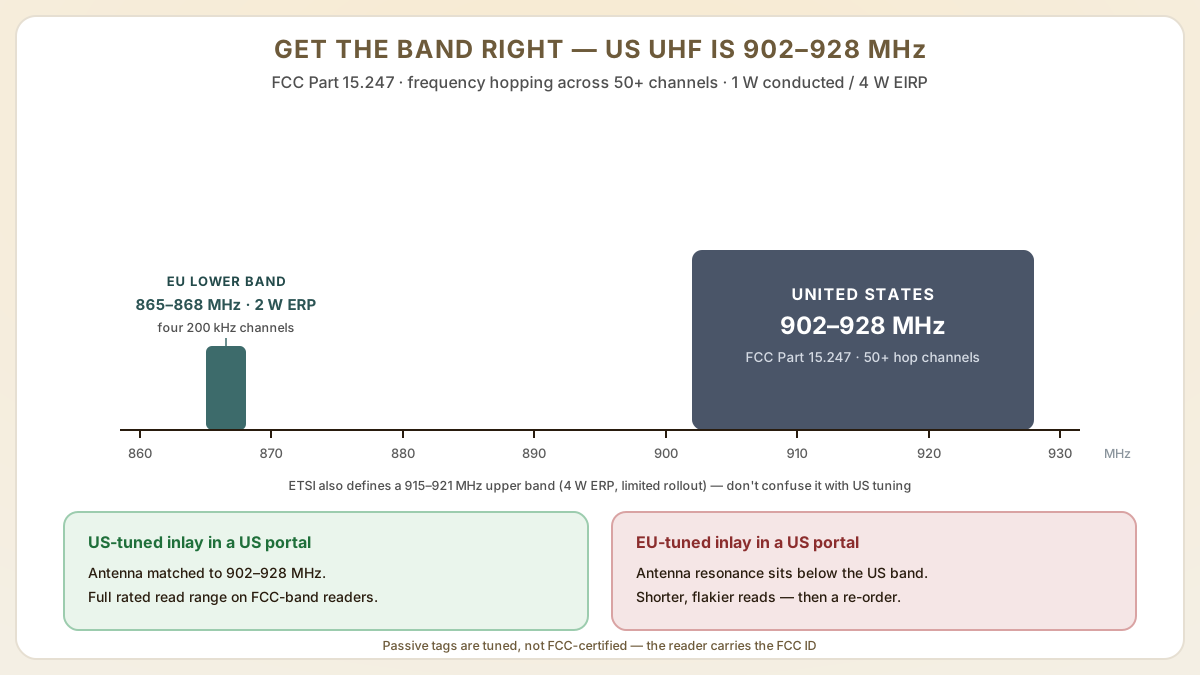
| Parameter | United States (FCC Part 15.247) | European Union (ETSI EN 302 208) | Why it matters to your order |
|---|---|---|---|
| UHF RFID band | 902-928 MHz | 865-868 MHz lower band, plus 915-921 MHz upper band (limited rollout) | Inlay antennas are tuned per band — specify US tuning on the PO |
| Reader power ceiling | 1 W conducted / 4 W EIRP with a 6 dBi antenna | 2 W ERP (lower band); 4 W ERP (upper band) | US portals can run harder; EU site layouts don't transfer 1:1 |
| Channel plan | Frequency hopping across at least 50 channels | Four 200 kHz high-power channels | Dense multi-reader US sites tolerate more readers side by side |
| Who holds the certificate | The reader — the intentional radiator — carries the FCC ID | The interrogator is the regulated device | Passive tags are tuned, not certified; ask for tag tuning data plus the reader's FCC ID |
| Tag silicon | Gen2 (ISO 18000-63) silicon covers the global 860-960 MHz UHF allocations; the antenna sets the sweet spot | Same silicon, different antenna tuning | "Global-tuned" inlays are a compromise — acceptable for mixed fleets, wrong for maximum range |
NDAA §889, TAA, and other federal questions, answered straight
If you sell to the US government — or to a contractor who does — the acronyms start flying. Below is the honest map, including the row where the answer is "don't source this contract from China." A supplier who can't tell you that is selling, not advising. For credential-level standards (UL 294 listing, FIPS 201), our access control page covers the full stack, and the California RFID privacy guide maps the state statutes.
| Rule | What it actually covers | Straight answer for China-sourced RFID |
|---|---|---|
| FCC Part 15.247 | Radio rules for UHF readers operating in 902-928 MHz; tags are passive field devices | Fully compatible — order US-band tuning and file the reader's FCC ID, not the tag's |
| NDAA Section 889 (FAR 52.204-25) | Bars federal contracts from covered telecom and video-surveillance equipment made by five named manufacturers (Huawei, ZTE, Hytera, Hikvision, Dahua) and their subsidiaries | Proud Tek is not a covered entity, and passive tags and cards cannot route or redirect user data traffic. Federal contractors should still run their own Section 889 review |
| Trade Agreements Act (FAR Part 25) | TAA-covered procurements — GSA Schedules above the threshold — require end products from designated countries; China is not on the list | Honest no: China-origin RFID generally cannot be offered as a GSA Schedule end product. Commercial and open-market purchases are a separate analysis |
| UL 294 | US safety standard for access control system units — panels, readers, controllers — with four security performance levels | Applies to system electronics, not to cards and fobs; pair our credentials with UL 294-listed hardware from your PACS vendor |
| CCPA / CPRA (California) | Personal information encoded on credentials or collected in read logs | Encode the minimum and keep personal data in your access-controlled back end; our California privacy guide maps each statute |
Landed cost: HTS 8523.52, Section 301, and your Incoterms
The unit price is the headline; the landed cost is the story. For US buyers the plot has three characters — the HTS line, the Section 301 tariff, and the Incoterm that decides who pays what. Our RFID RFP template shows the quote-comparison math in full; the short version is below.
- Tariff lines move: Section 301 rates have been reviewed and revised repeatedly since 2018, and a DDP quote transfers that volatility to us — the price you sign is the price you pay.
- Every commercial invoice lists the HTS classification per line item, so your broker (or ours) enters the goods correctly the first time.
| Incoterm | Freight | US duty + Section 301 | Customs brokerage | Choose it when |
|---|---|---|---|---|
| EXW Shenzhen | You arrange from our dock | You pay at entry | Your broker | You run your own freight program and want maximum control |
| FOB Shenzhen / Yantian | We deliver to the port; you book the vessel | You pay at entry | Your broker | Sea-volume buyers with an established forwarder |
| DDP to your door | We book air or sea end to end | Included in the quoted price | Handled by us | You want one landed number and no surprise invoices — the default for US orders |
Logistics: Shenzhen to any US address in 10-14 days
Shenzhen's workday starts as America's ends, which is quietly useful: an RFQ sent at your 6 p.m. is usually quoted before your next morning coffee, and production runs while your office sleeps. For the freight-mode math, see air vs sea freight for RFID orders.
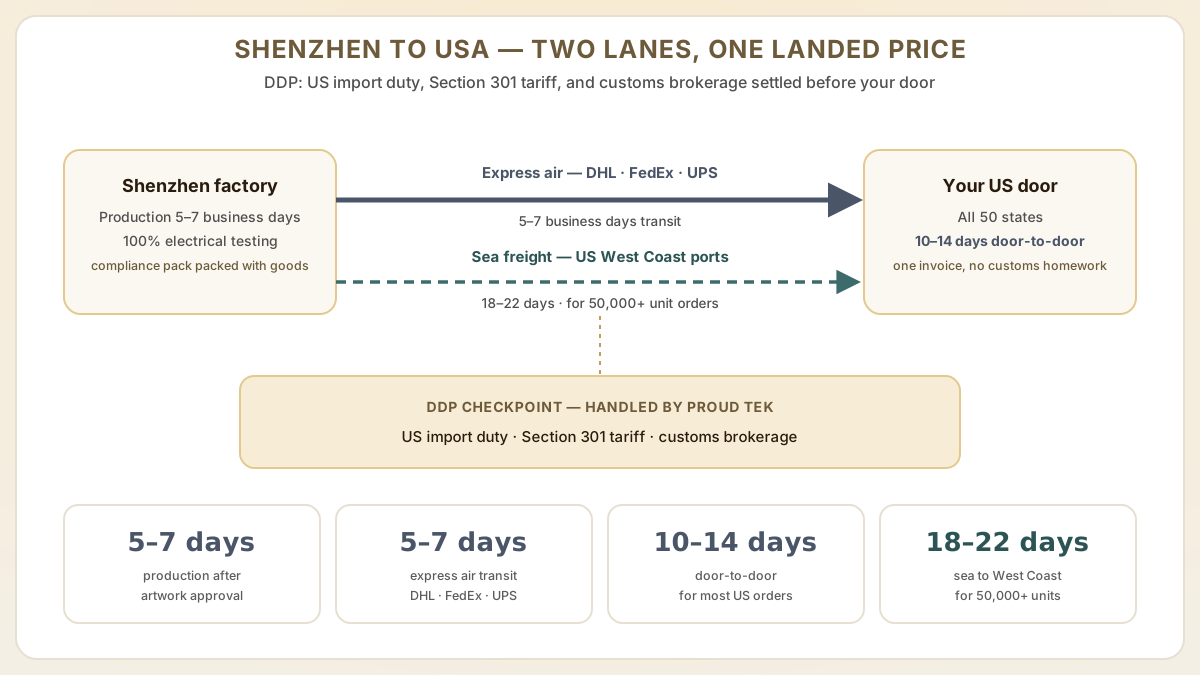
- Express air freight via DHL, FedEx, and UPS delivers from Shenzhen to any US address in 5-7 business days. Combined with 5-7 day production time, most orders arrive within 10-14 days of confirmation.
- Bulk sea freight is available for large-volume orders (typically 50,000+ units) with 18-22 day transit to US West Coast ports, providing maximum cost savings for price-sensitive, non-urgent shipments.
- DDP (Delivered Duty Paid) shipping means all import duties, customs brokerage, and Section 301 tariff considerations are handled before the goods reach your door.
- Dedicated English-speaking project managers with US business hours availability run your order from artwork approval to delivery confirmation.
How a US order runs, step by step
No mystery, no time-zone roulette — this is the cadence a first order follows from RFQ to receiving dock.
- Day 0 — RFQ
Send specs, artwork, or a competitor datasheet. Quotations come back within one business day, itemized by chip, material, and print process.
- Days 1-7 — free samples
Sample kits ship by DHL express to any US address at no charge, with RF test data so you can validate on your own readers. Custom-printed samples take 7-10 days.
- Artwork approval — the gate
Production starts only after you sign off artwork and encoding spec. Changes cost nothing before this gate.
- Days 5-12 — production + QC
Standard production runs 5-7 business days with 100% electrical testing; every encoded card gets a functional read test before packing.
- Days 10-14 — DDP delivery
Express air lands the goods at your door with duties and brokerage settled. The compliance pack travels with the shipment, not on request.
Proof a US buyer can verify without a plant visit
Proud Tek currently supplies system integrators, resellers, hotels, and enterprises across the United States — but don't take a market page's word for it. Verify us the way you would audit any China factory: check certificates with the issuing registrar using our ISO certification verification guide, then work through the China RFID factory audit checklist remotely or in person.
- ISO 9001:2015 certified quality management system — verify the certificate number with the issuing registrar, not just the PDF
- 100% electrical testing on every card and tag (chip response, antenna resonance, read range), with a functional test report included in the shipment
- Standards conformance: ISO/IEC 14443, ISO/IEC 15693, and ISO 18000-6C (now 18000-63) as applicable to the chip family
- Per-shipment compliance pack: Certificate of Origin, FCC/CE radio-compliance documentation, RoHS/REACH declarations, and an HTS-coded commercial invoice
- Quality records retained for seven years; third-party and buyer audits accommodated, including pre-shipment inspection by your QC agent in-house at no charge
- NDA and exclusivity agreements for custom designs, meeting the IP-protection standards US technology companies expect
Useful next pages
Use these linked product, guide and comparison pages to keep the next click specific and practical.
Popular products for US customers
Browse RFID products frequently ordered by American businesses.
US compliance and cost reading
The guides US procurement teams pair with this page.
FAQ
Are your UHF RFID products FCC-compliant for use in the United States?
Yes. Our UHF RFID tags and labels are designed for the 902-928 MHz frequency band as required by FCC Part 15 for unlicensed UHF RFID devices in the United States. We use chips (Impinj Monza, NXP UCODE) that are fully characterized for the US frequency band and can provide compliance documentation upon request.
Do passive RFID tags need their own FCC certification?
No. Under FCC Part 15 the certification obligation sits with the reader — the intentional radiator — which must carry an FCC ID. Passive UHF tags are not transmitters; they backscatter the reader's signal, so what matters is that the tag antenna is tuned for the US 902-928 MHz band. When evaluating suppliers, ask for the reader's FCC ID and the tag's tuning and performance data rather than a certificate for the tag itself.
How do tariffs and import duties affect pricing for US buyers?
We offer DDP pricing that includes all applicable import duties, customs brokerage fees, and tariff costs in the quoted price. This gives US buyers a fully landed cost with no surprise charges. Our logistics team is experienced with US import regulations and HTS classification for RFID products.
What Incoterms can US buyers choose?
US buyers can order EXW Shenzhen, FOB Shenzhen/Yantian, or DDP to door. Most US customers choose DDP: the quote includes freight, US import duty, Section 301 tariff, and customs brokerage, so the quoted price is the landed price. EXW and FOB suit buyers running their own freight programs or consolidated sea shipments.
Can I resell your products on a GSA Schedule or other TAA-covered federal contract?
Generally no for China-origin end products: the Trade Agreements Act requires designated-country end products on TAA-covered procurements, and China is not a designated country under FAR Part 25. Commercial and open-market purchases are a separate analysis. NDAA Section 889 is a different rule — it bars covered equipment from five named manufacturers; Proud Tek is not among them, and passive tags and cards cannot route or redirect user data. For a specific solicitation, have your contracts counsel review the clauses.
Can I get product samples before placing a large order?
Yes. We provide free sample kits including RFID cards, tags, labels, and wristbands shipped via DHL express to any US address at no charge. Samples typically arrive within 5-7 business days. Custom-printed samples with your artwork are also available with a 7-10 day lead time.
What is the minimum order quantity for US buyers?
MOQs for US orders match our standard factory minimums: custom-printed PVC cards start at 500 pieces (digital printing accepts runs as low as 100), NFC inlays and labels at 1,000 pieces (one roll), and silicone wristbands at 500 pieces. Recurring production programs typically run 1,000-5,000 pieces per SKU.
Sources & references
Primary standards, OEM datasheets and regulatory documents cited by this article. All URLs were verified on the access date shown below.
- 47 CFR § 15.247 — Operation within the bands 902-928 MHz, 2400-2483.5 MHz, and 5725-5850 MHz
Primary source for the US UHF band (902-928 MHz), 1 W conducted power limit for 50+ hopping channels, the 6 dBi antenna-gain allowance (4 W EIRP), and the intentional-radiator framework covering readers.
- ETSI EN 302 208 V3.3.1 — RFID equipment in 865-868 MHz (up to 2 W) and 915-921 MHz (up to 4 W)
Primary source for the EU comparison rows: 865-868 MHz lower band at 2 W e.r.p., 915-921 MHz upper band at 4 W e.r.p. (limited implementation), and the four 200 kHz high-power channels from 865.7 MHz.
- FAR 52.204-25 — Prohibition on Contracting for Certain Telecommunications and Video Surveillance Services or Equipment (NDAA §889)
Defines covered telecommunications equipment as products of Huawei, ZTE, Hytera, Hikvision, and Dahua (and subsidiaries), and excepts equipment that cannot route or redirect user data traffic.
- FAR Part 25 — Foreign Acquisition (Trade Agreements Act designated countries)
FAR 25.003 lists the designated countries for TAA-covered procurement; China is not on the WTO GPA, FTA, least-developed, or Caribbean Basin lists.
- USITC Harmonized Tariff Schedule — HTS 8523.52.00 "Smart cards" and Section 301 heading 9903.88.03
HTS 8523.52.00 general duty rate is Free with cross-reference to 9903.88.03, which applies "the duty provided in the applicable subheading + 25%" to articles the product of China (Section 301 List 3).
- GS1 EPC UHF Gen2 Air Interface Protocol
The RAIN/EPC Gen2 protocol behind US-band UHF tags; its normative references include ISO/IEC 18000-63, the air interface for 860 MHz to 960 MHz Type C — the global tuning span cited in the band table.
- UL 294 — Access Control System Units (Edition 8)
Scope: construction, performance, and operation of physical access control equipment and systems, with four security performance levels (I-IV). Applies to system units, not passive credentials.
Proud Tek is a Shenzhen-based RFID & NFC manufacturer supplying hotel chains, transit operators, event venues and retail brands worldwide. Every order includes free samples, RF testing and dedicated project support.
Get a Quick Quote
Tell us about your project and we'll respond within one business day. Fields marked (asterisk) are required.