
Walmart RFID Mandate
Walmart RFID Tagging Mandate 2026
Supplier Guide
Quick answer
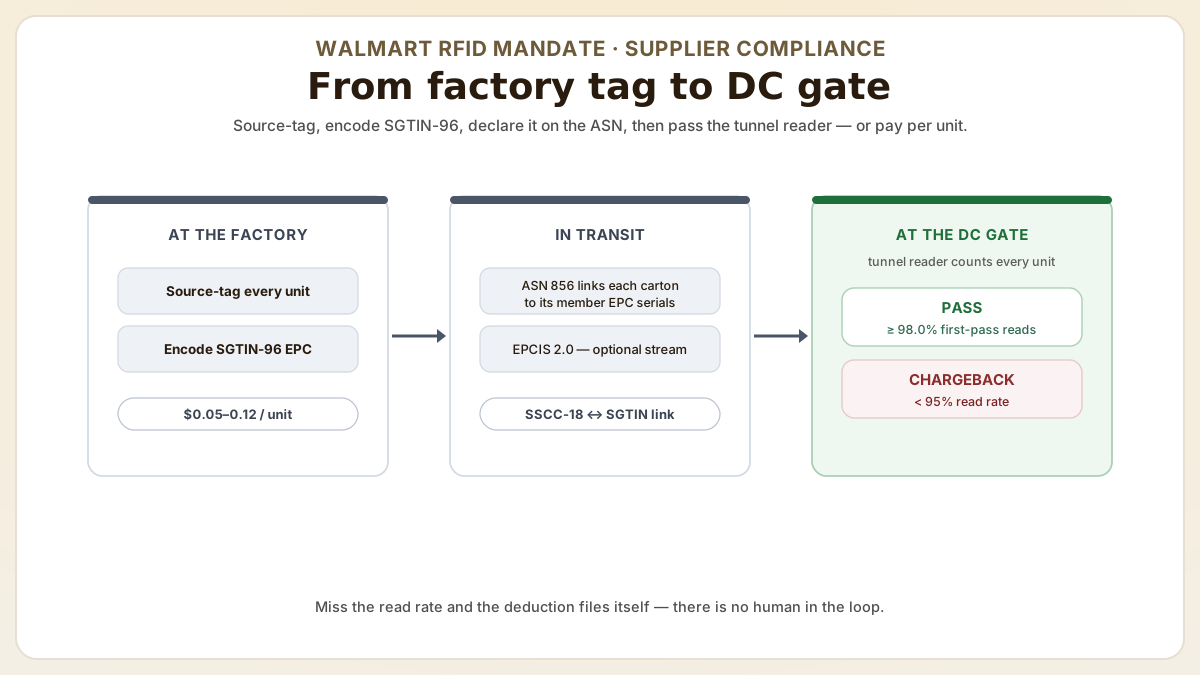
Walmart's item-level RFID mandate now spans apparel (2022), home goods (2023), sporting goods and footwear (2024), toys (2025), and hard goods (2026). Every unit needs a GS1 SGTIN-96 EPC — Company Prefix + GTIN + unique 38-bit serial — verified by tunnel readers at DC receiving against Walmart's 98.0% first-pass read target. Non-compliance means automated per-unit chargebacks; source tagging at the factory runs $0.05-0.12 per tag versus $0.20-0.50 for DC tagging.
- Category expansion through 2026 — Walmart has extended item-level RFID tagging beyond the original 2022 apparel mandate into home goods, sporting goods and toys, with additional hard-goods categories in the 2026 rollout wave.
- EPC/SGTIN-96 encoding is required. Every tag must carry a GS1-compliant SGTIN-96 EPC that combines the supplier's GS1 Company Prefix, the item GTIN and a unique per-unit serial number, linked to Walmart's inventory visibility system via ASN data.
- Proud Tek supplies Walmart-compliant UHF labels. Pre-encoded EPC inlays on roll, hang tags and sewn-in care labels ready for source tagging at the factory, tested against Walmart's ARC-certified inlay performance specifications for your product category.
At a glance
Use these short answers to decide whether this page matches the project before moving into the detail.
Category timeline
Apparel enforced October 1, 2022; home goods September 2023; sporting goods and footwear January 2024; toys February 2025; hardlines/electronics/automotive accessories Q...
Encoding requirement
SGTIN-96 per GS1 TDS: header 0x30, GS1 Company Prefix, item GTIN and a unique 38-bit serial (≈274.8 billion per GTIN); filter value 1 for item-level retail. A shared or...
Next step
Ready to move forward? Start your inquiry to get specific answers for this project.
Get Walmart-compliant RFID tags- Read thresholds and chargebacks
-
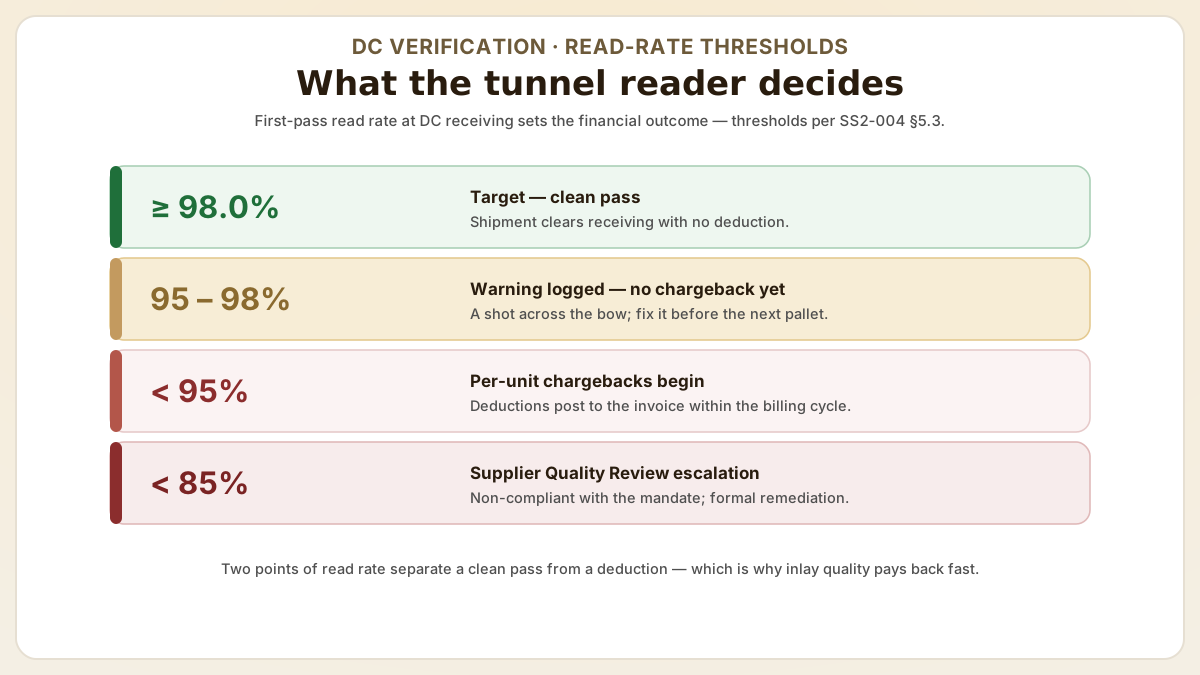
Tunnel readers verify at DC receiving: 98.0% first-pass is the target, 95-98% triggers a warning, under 95% triggers per-unit chargebacks, under 85% escalates to Supplier Quality Review (SS2-004 §5.3).
- Source tagging wins
-
Factory source tagging runs $0.05-0.12 per unit versus $0.20-0.50 for DC tagging; the break-even sits near 200K units/year, and Walmart estimates over 95% of apparel and home-textile inventory is source-tagged as of 2026.
The mandate: scope, encoding and enforcement
Most suppliers meet the Walmart RFID mandate the hard way — as a deduction on an invoice, discovered weeks after the shipment that earned it has already shipped and sold. A pallet rolls through a tunnel reader at the receiving dock, the antennas count what they find, and the math runs itself; there is no human in the loop to talk it over with. The reassuring part is that the program is deterministic. Walmart's RFID program is structured around item-level tagging, SGTIN-96 encoding and DC-level verification. Each element is a specific requirement rather than a suggestion, and non-compliance has measurable financial exposure. Supplier-portal dashboards show real-time compliance percentages and aggregated chargebacks updated every 24 hours. The ladder below turns that dashboard into four rows: where your first-pass read rate lands is the entire difference between a clean pass and a deduction that files itself.
- Item-level tagging: Walmart requires an EPC-encoded UHF RFID tag on every individual unit, not at case or pallet level. Each item arriving at a Walmart DC or store must be independently identifiable via RFID at the sales-unit level (what GS1 calls the consumer unit. A single selling SKU). This contrasts with the 2003-era Walmart Top-100 pallet/case mandate, which was pilot-scale and abandoned by 2009 due to tag-cost economics that did not yet work below US$0.10 per tag.
- SGTIN-96 encoding: tags must carry a Serialized Global Trade Item Number that combines the supplier's GS1 Company Prefix, the item GTIN and a unique 38-bit serial number per unit, all packed into the 96-bit EPC memory bank (EPC memory, bank 0x01, starting at word 0x02). The encoding standard is defined by GS1 EPC Tag Data Standard (TDS) — current version 2.3 (October 2025), which adds web-native domain-name-bearing schemes and date-prioritised SGTIN encoding while remaining backward-compatible with the SGTIN-96 binary used at retail. The encoding is non-negotiable; it is how Walmart's Inventory Platform deduplicates and links serial numbers to the item master.
- ARC-certified inlay performance: Walmart specifies minimum read sensitivity and read-range requirements tied to the Auburn ARC program (Auburn University RFID Lab, Harbert College of Business; ARC founded 2009). ARC works on an end-user-defined Spec model: each end user defines a Spec capturing use case, product/packaging types, environment and reader infrastructure, and the ARC Lab benchmarks candidate inlays against that Spec in standardized anechoic-chamber conditions. Approved inlays are listed in the end user's RFID playbook. Walmart's published Specs cover apparel, on-metal hardlines, footwear, small items and high-attenuation packaging, with Walmart-specific approved-inlay lists communicated through the Retail Link Supplier Enablement workflow. Suppliers should treat 'ARC-approved' as per-Spec rather than universal — an inlay approved for Walmart's general apparel Spec is not automatically approved for the on-metal Spec.
- ASN (Advance Ship Notice, EDI 856) data linkage: the supplier's ASN 856 transaction must link carton contents (SSCC-18) to their member RFID EPC serial numbers via the SN01 and SN02 segments per GS1 EDI guidance, so the DC receiver can verify which items arrived in which cases without opening every box. Walmart also accepts an EPCIS event stream per GS1 EPCIS 2.0 (2022) as an alternative to ASN segments for advanced suppliers.
- Chargeback enforcement: non-compliant shipments receive financial deductions on the invoice via Walmart's 'OTIF' (On-Time In-Full) and RFID-specific compliance codes. Enforcement is automated at DC-receiving tunnel readers (RFID Receiving Portal, typically Impinj xPortal or Zebra FX tunnel); the shipment either passes or fails RFID verification at 98-99% read threshold, and the chargeback follows within the billing cycle. Chargebacks appear as line items on the next supplier-invoice settlement.
- Category expansion cadence: Walmart expanded mandates approximately once a year in the post-2022 period, covering progressively more categories. The rollout is coordinated via the Retail Link Supplier Portal (rebuilt 2021-2022 on Azure) under the 'RFID Supplier Enablement' workflow. Suppliers in not-yet-mandated categories receive 180-270 day advance notice per the Walmart Supplier Standards (SS2-004 Item-Level RFID) before enforcement begins.
- Read-rate threshold: Walmart's internal performance target for tunnel-reader verification is 98.0% of received items must be successfully read on the first pass (ARC-spec condition). Shipments at 95-98% trigger a warning but no chargeback; shipments <95% trigger per-unit chargebacks; shipments <85% are considered non-compliant with the mandate and can trigger Supplier Quality Review escalation per SS2-004 §5.3.
Category expansion timeline
The mandate has expanded steadily since 2022. Understanding where each category sits in the expansion helps suppliers forecast when their own category will be pulled in. Walmart's category-expansion cadence has been consistent: Apparel (2022) → Home Goods (2023) → Sporting Goods/Footwear (2024) → Toys (2025) → Hardlines/Electronics/Auto (2026). Each new category gets roughly 9-12 months of supplier onboarding before active chargeback enforcement begins. The timeline below traces that march department by department, and the broader item-level RFID mandate landscape shows the same physics playing out across other retailers.
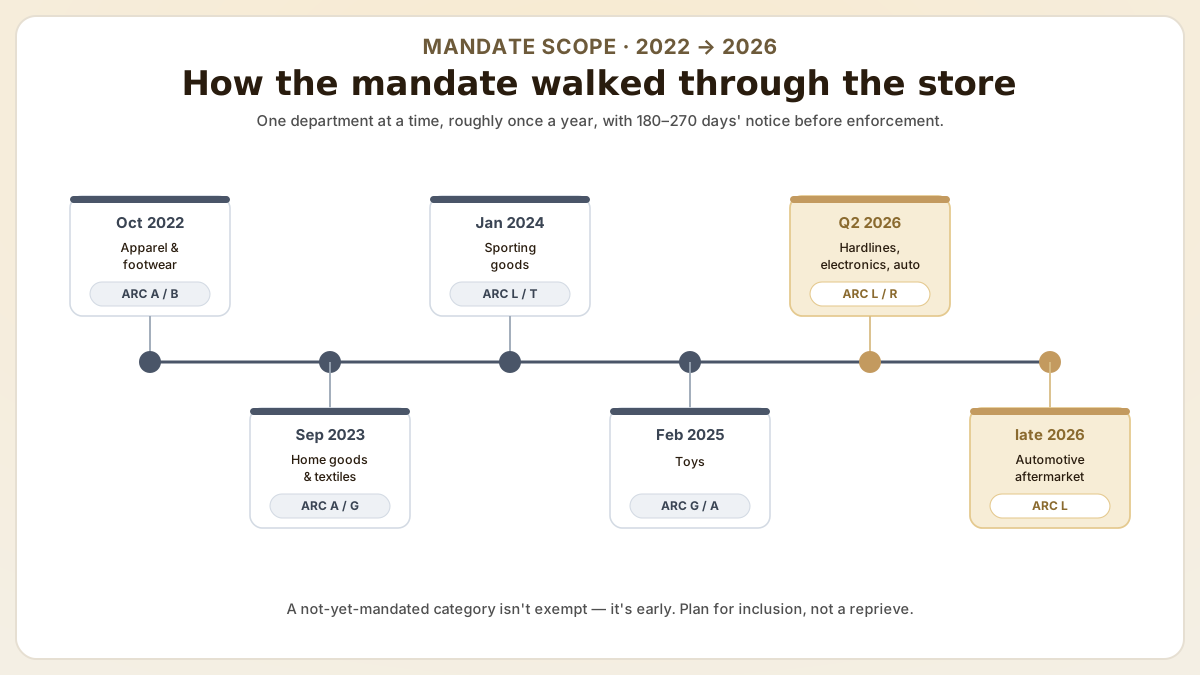
- Apparel and footwear (Phase 1 — 2022): the original category, fully enforced since October 1, 2022 via Walmart Supplier Standard SS2-004. All clothing, shoes and accessories require item-level RFID. The apparel mandate is the baseline against which subsequent category expansions are benchmarked. ARC Spec A (general apparel) or Spec B (dense/multi-layer garments) is the minimum. Notable apparel suppliers complying: Hanesbrands, VF Corporation (The North Face, Dickies, Vans before divestiture), Levi Strauss, Gildan, Fruit of the Loom, Carter's, Wrangler.
- Home goods and home textiles (Phase 2 — September 2023): covers towels, bedding, curtains, decorative pillows and related textiles. Tagging is typically on the sewn-in care label (woven white RFID label, approx. 70×15 mm) or on a hang tag at retail-packaged SKUs. ARC Spec A inlays are sufficient for textile-only products; Spec G (small items) for packaged linens. Major suppliers: Welspun (towels), Hollander (pillows), Pacific Coast (down products), Trident Group.
- Sporting goods and outdoor (Phase 3 — January 2024): covers fitness equipment, outdoor gear, sporting accessories. Harder packaging materials (metal, composite) require different inlay selection than fabric-based apparel. ARC Spec L (on-metal) or Spec T (near-metal tolerant) inlays where the product contains metallic frames or components. Major categories: hunting gear, camping equipment, fishing tackle, bicycles (with on-frame labels).
- Footwear expansion (Phase 3b — January 2024): separate ARC Spec M certification for athletic and work footwear, addressing the dense-rubber + fabric composite nature of shoe packaging. Suppliers include Nike (selected retail channel SKUs), New Balance, Skechers, Brooks, Dr. Martens, Crocs, Saucony.
- Toys (Phase 4 — Q1 2025): enforced from February 2025. Tags are applied to the product packaging (typically a hang tag inside the blister card or a sticker on the carton). Child-safety compliance (sharp edges, choking hazards) is a packaging rather than a tag concern, but ASTM F963-17 certification is required for any label touching children's products. Major suppliers: Mattel, Hasbro, Spin Master, MGA Entertainment, LEGO Group (selected SKUs).
- Hardlines / Electronics / Automotive accessories (Phase 5 — 2026): Q2 2026 enforcement wave. Metal-adjacent products need on-metal-capable inlays (ARC Spec L or Spec R for high-attenuation packaging), which is a different inlay SKU than apparel, typically 2-3× the unit cost. Electronics accessories (chargers, cables, cases, headphones) and automotive accessories (car audio, wiper blades, fluids) are in-scope. Consumer electronics with integrated batteries (power banks, laptops) remain out-of-scope for now due to HAZMAT RFID metallurgy concerns.
- Automotive aftermarket (Phase 5b — late 2026): Walmart's Auto Care Centers and automotive aisle expansion, covering oil filters, air filters, windshield wipers, floor mats, car care chemicals (where RFID-safe packaging exists).
- Categories yet to come: consumables (grocery/pharmacy). Each has regulatory overlays that slow RFID adoption. Pharmacy RFID is governed by DSCSA serialization rather than Walmart's own mandate. Grocery RFID remains economically marginal below ~US$0.02 per tag, which is not yet achievable in volume production. Walmart has signalled continued expansion as per-unit tag cost falls below $0.03 in the 2028-2030 horizon.
- Sam's Club parallel program: Sam's Club (Walmart subsidiary) runs a coordinated but separately administered program. Suppliers selling into both channels must ensure Club-pack SKUs (bulk configurations) are tagged at the multipack level with a distinct SGTIN from the standard retail SKU. The encoding must be unique and aligned with the Sam's item master.
SGTIN-96 encoding and GS1 prefix mechanics
SGTIN-96 is not abstract; it is a specific 96-bit encoding format that tag manufacturers write into the tag's EPC memory bank (EPC memory = bank 01 in Gen2 v2 terminology, distinct from the TID memory bank 10 and USER memory bank 11). Getting the encoding right is a precondition for passing DC verification. A single misencoded bit flags the entire tag as unreadable. The field map below shows where every bit goes, and the GS1 EPC encoding guide walks the same structure end to end.
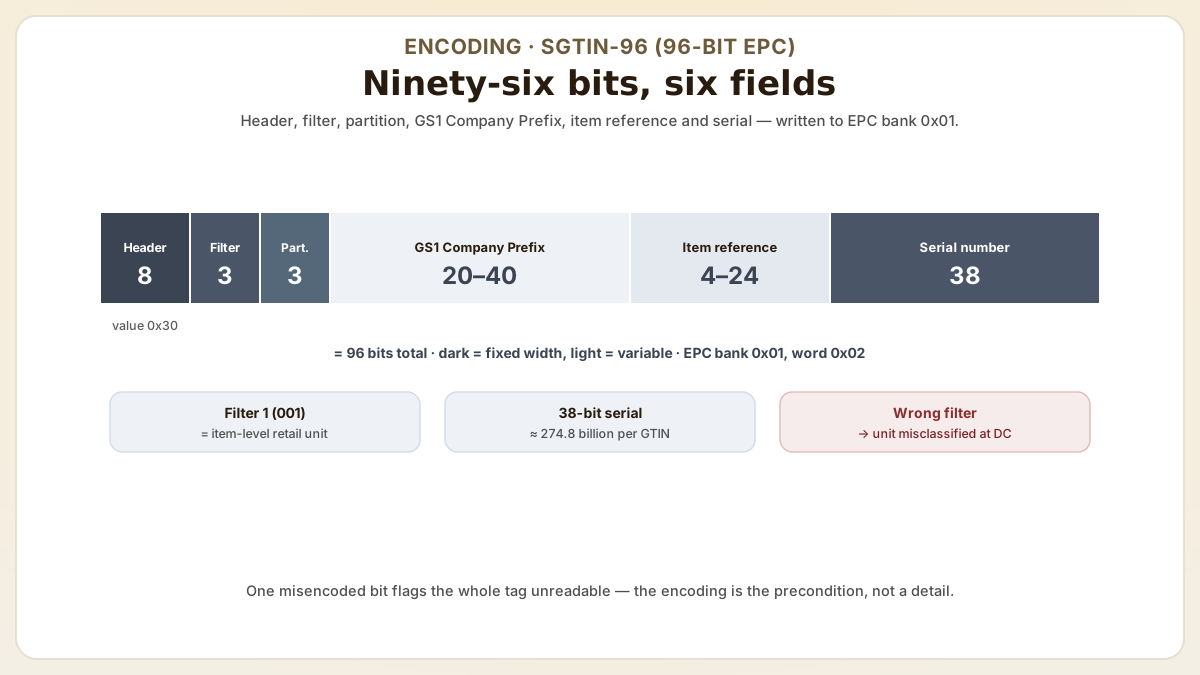
- The 96-bit structure per GS1 EPC TDS 2.1 Section 14.5.1: header (8 bits, value 0x30 for SGTIN-96) + filter (3 bits) + partition (3 bits) + GS1 Company Prefix (variable, 20-40 bits) + item reference (variable, 4-24 bits) + serial number (38 bits). The partition value (0-6) selects how the 44-bit Company-Prefix-plus-Indicator field splits. Partition 5 is most common: 7-digit GCP (24 bits) + 7-digit item reference (20 bits); Partition 4 is next: 8-digit GCP + 6-digit item reference.
- GS1 Company Prefix (GCP): suppliers must hold a GS1 Company Prefix registered with GS1 US (or the local GS1 member organization. GS1 Canada, GS1 UK, GS1 China under Article Numbering Center of China / ANCC). The prefix is the supplier's unique identifier inside the encoding, a 6-12 digit number. The prefix plus GTIN item reference plus check digit forms the 14-digit GTIN barcode; the RFID encoding drops the check digit (it's recomputed on decode). A shared or unregistered prefix is not acceptable. The supplier-portal validation will flag it as 'unknown GCP' and reject the shipment.
- GTIN source: the item's 14-digit GTIN is the basis of the SGTIN encoding. The GTIN must match the barcode (typically UPC-A or EAN-13) on the product. SGTIN linking only works if the RFID encoding and the barcode refer to the same product master. Walmart's item-master system (Item 360, replacing the legacy Item File) is the authoritative source; any mismatch between encoded GTIN and item-master GTIN flags the unit as exception-class 'unknown-GTIN' at DC receiving.
- Serial number uniqueness: the 38-bit serial space gives each item a 2^38 ≈ 274.8 billion serial numbers within a single GTIN. The supplier's encoding process must guarantee no duplicate serial numbers within a given GTIN, even across multi-site production, multi-year runs and multi-encoder fleets. Typical implementation: central serialization server (e.g. Tracelink Track & Trace, SAP Global Batch Traceability, Systech Tracelink-compatible, or Optel Vision InSite) allocates serial-ranges per encoder per GTIN, and encoders report back exhausted ranges. Never use random serial generation. Collisions are virtually guaranteed after ~2^19 ≈ 500 K tags (birthday-paradox bound).
- Filter value: Walmart expects filter value 1 (binary 001) for item-level retail on the tag per GS1 TDS 2.1. Filter 2 (binary 010) is reserved for transport units (cartons, pallets) and should not appear on item-level units. Encoding with the wrong filter causes inventory-system misclassification. The inventory platform may treat an item-level tag as if it were a carton, inflating case-count inventory and depleting item-count. This is one of the most common encoding errors in early-stage supplier deployments.
- EPC Tag Data URI (pure-identity URI form): the canonical representation of an SGTIN-96 encoding is urn:epc:id:sgtin:<GCP>.<ItemRef>.<Serial> per GS1 TDS 2.1 §8. The supplier's ASN should reference this URI or the equivalent hex EPC in segments SN01/SN02.
- Verification: after encoding, every tag is read back and verified against the expected EPC. A typical inline encoder (e.g. Printronix SL5000R thermal-transfer printer with Zebra encoder module, or Zebra ZT411R, or Honeywell PX940 with RFID module) performs a write-then-read-compare at ~15 tags per second. Rejected tags are perforated with a physical kill-mark (Void pattern printed over the label), diverted to a reject tray, and do not enter the production stream. The rejection rate is a supplier-quality KPI tracked against the tag manufacturer's SLA. Proud Tek's SLA is <0.5% reject rate on dry-inlay, <1% on wet-inlay, <2% on sewn-in labels where converting yield is inherently lower.
- Kill password and Access password: Walmart does not require or prohibit these Gen2 v2 password fields (EPC memory bank 0x00, reserved memory). For source-tagged apparel the tags typically ship with default 0x00000000 kill password and 0x00000000 access password, meaning any reader can read/write. For in-store theft-resistance applications some retailers write a non-default kill password to prevent adversarial tag deactivation at the shelf.
Source tagging vs DC tagging — the economics
Walmart accepts both source-tagged and DC-tagged inventory, but source tagging at the factory is the standard practice. The alternative — shipping untagged, then paying someone at the distribution center to open the cartons you just sealed and tag the items by hand — is exactly as economical as it sounds. Walmart estimates >95% of apparel and home-textile inventory is source-tagged as of 2026. Understanding the economic gap explains why. The comparison below puts the two side by side, and a documented source-tagging case study shows how the read-rate math plays out in production.
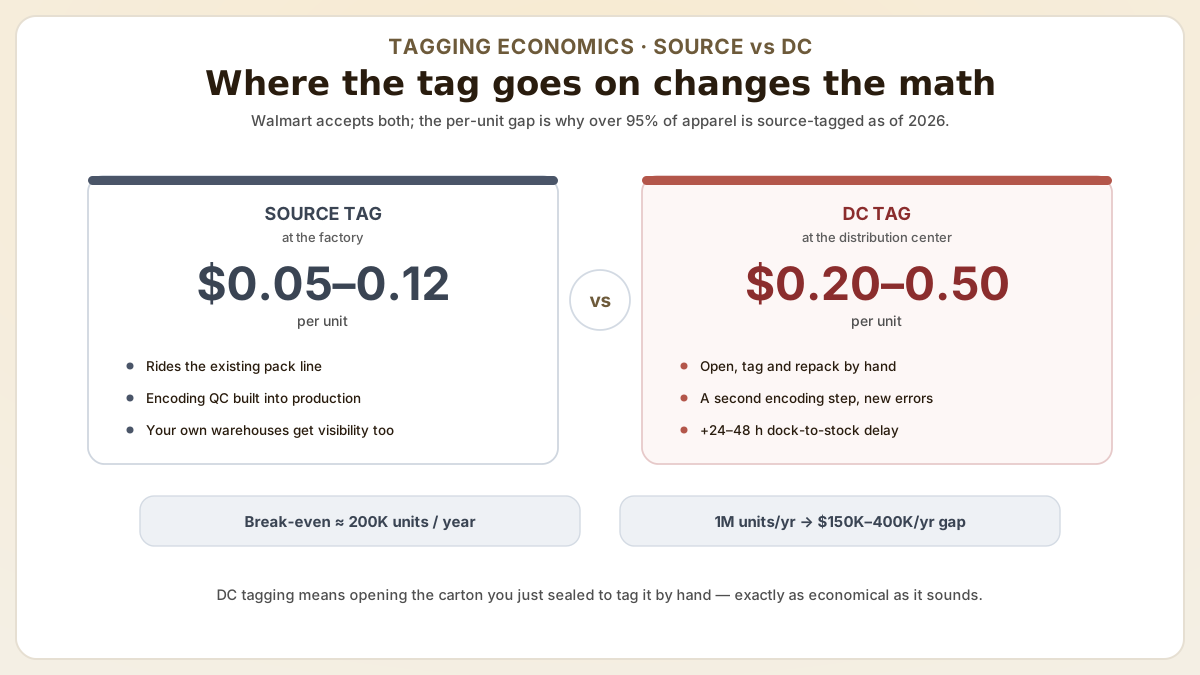
- Source tagging per-unit cost: $0.05-0.12 per tag depending on inlay, format and volume. Applied during the factory packaging process, no additional handling step beyond the labeling line. Breakdown: $0.04-0.08 for the inlay (Impinj Monza R6-P or NXP UCODE 8 dry-inlay), $0.01-0.02 for converting (label substrate, adhesive, die-cut), $0.005 for encoding compute + verification. Apparel hang tags add a $0.02-0.04 printing cost.
- DC tagging per-unit cost: $0.20-0.50 per tag including the labour to open cases, apply tags and repackage. Breakdown: $0.06-0.10 for the tag itself (same inlay but in sticker-label form), $0.12-0.35 for manual labour (one worker tagging ~150-250 items/hour at ~US$18-25/hour loaded), plus DC overhead (space, reader fixtures, rework area). Plus the additional lead time at the DC. Typically adds 24-48 hours per shipment dock-to-stock, which affects replenishment velocity and creates back-of-DC inventory buffers.
- Volume economics: for a supplier shipping 1 million units annually, the source-vs-DC gap is $150,000-$400,000 per year in additional cost alone, before any quality or lead-time impact. For a supplier at 10 million units annually the gap is $1.5-4 million; below 100,000 units DC tagging can be competitive once setup costs of source tagging are amortized. The break-even point typically sits at ~200K units/year.
- Encoding integrity: source tagging integrates the tag into the factory's existing label-and-pack process with encoding verification as part of the production QC step. DC tagging introduces a second encoding step with its own error surface. DC workers use handheld encoders (Zebra MC3330R, Honeywell IH45 with imprinting modules) where the error rate is typically 0.5-1.5% vs <0.1% for a calibrated inline inline thermal-transfer printer-encoder. The rework chain for DC-tagged errors sits inside Walmart's supplier-chargeable window.
- Supplier visibility benefit: suppliers who source-tag get RFID-enabled inventory visibility in their own warehouses and distribution centers, which amortises the RFID infrastructure across their own operations as well as Walmart's. Typical ROI for a supplier's own WMS/WMS-integrated RFID is 18-24 months from cycle-count reduction (manual cycle-counting labor), shipment-accuracy improvements (reducing their own customer chargebacks from accounts like Costco, Target, Kohl's), and work-in-process visibility on the factory floor.
- Walmart preference: Walmart strongly prefers source tagging and provides technical support to suppliers moving to source tagging, including the Retail Link RFID Supplier Enablement portal, sandbox testing environment (connected to a test DC), and quarterly supplier summits run from Bentonville. The preference is operational more than contractual. Source-tagged inventory flows through DCs faster and with fewer errors, contributing to Walmart's DC labor productivity KPI.
- Hybrid model: a few categories use a hybrid approach where the factory ships untagged to a 3PL-operated tagging center (often run by Checkpoint Systems, SML Group, Avery Dennison RBIS, or Impinj's Wiliot subsidiary) that tags before the Walmart DC. 3PL tagging sits at ~$0.15-0.25 per unit. Midway between source and DC. Suitable for suppliers who lack an integrated labeling line at the factory, such as fragmented garment-assembly supply chains in Bangladesh, Vietnam or Indonesia.
- Labor-intensive format premiums: sewn-in care labels (washable RFID) cost +$0.03-0.08 per unit over a simple adhesive label because the converter must laminate the inlay between two woven-polyester layers, ultrasonic-weld the edges, and pass a 25-wash durability test per AATCC 135 before shipment. Hang tags with printed graphics cost +$0.02-0.05 per unit for the offset-printing step. On-metal labels (foam spacer or ceramic PCB) cost +$0.08-0.20 per unit.
Chargeback mechanics and compliance exposure
Walmart's compliance enforcement is automated at DC receiving and financial at the invoice level. The specifics of the exposure guide how suppliers prioritise compliance investment. Chargebacks are itemized on the supplier's payment remittance under OTIF-RFID exception codes and settle within the Net 30/60 payment window.
- Tunnel-reader verification: incoming pallets pass through a UHF tunnel reader at the DC (typically 4-12 antenna ports arranged in a tunnel, using Impinj R700, Zebra FX9600 or Alien ALR-F800 reader hardware). The reader captures all EPCs simultaneously in a 60-90 second read window using 'FastID' or Impinj TagFocus session control to minimize duplicate reads. Missing, unreadable or unrecognized EPCs become exceptions in Walmart's receiving system. Walmart operates 40+ automated DC receiving portals across its ~180 US DCs as of 2026, with full rollout targeted by 2027.
- Chargeback calculation: deductions apply per non-compliant unit, not per shipment. The per-unit amount varies by category; apparel historically sits at US$0.03-0.05 per unit, home-goods at $0.03-0.07, sporting goods/footwear at $0.04-0.08, toys at $0.05-0.10, hard goods at $0.07-0.15 per unit (higher penalty reflects higher-value SKUs and more complex remediation). The penalty schedule is published in Walmart Supplier Standards SS2-004 Appendix B (updated April 2025).
- Cumulative exposure: for a supplier shipping millions of units with a 5-10% non-read rate in early deployment, the cumulative chargeback can be tens of thousands of dollars per month. At 5% non-read on 1 M apparel units/month, that's 50 K × $0.04 = $2 K/month per SKU and potentially $25-50 K/month across a typical supplier's portfolio; at 10% non-read it roughly doubles. The business case for tag quality pays back fast. Spending an extra $0.01-0.02 per tag on better inlays to drop non-read from 10% to <2% is the cheapest investment most Walmart suppliers make.
- Loss of shelf space: beyond chargebacks, persistently non-compliant suppliers lose replenishment priority and face reduced shelf space in subsequent buying cycles, reviewed at the quarterly category-review meetings with Walmart Merchandising. The soft-cost exposure often exceeds the hard-cost chargeback. Losing 10% of shelf facings on a $5 M annual SKU is $500 K in lost revenue vs. perhaps $30 K of avoided chargeback. Repeated SS2-004 violations can also trigger a 'Supplier Improvement Plan' (SIP) requiring executive sign-off on remediation.
- Remediation process: Walmart provides supplier-portal reports (Retail Link RFID Analytics module) showing compliance rates by shipment, by DC, by SKU, by encoding batch, and by inlay family, updated nightly. Suppliers use these reports to target quality improvement at the inlay, encoding or application level. Root-cause-category reporting identifies whether the failure is in sourcing (wrong inlay), encoding (wrong EPC/wrong filter), application (tag fell off), or reading conditions (tag orientation against reader).
- Exception categories: no-read (tag not detected physically — usually bad inlay, dead tag, or adjacent-metal attenuation), wrong-EPC (encoded incorrectly — typo in GTIN, wrong partition, wrong filter), duplicate-EPC (serial collision — two units sharing the same 38-bit serial), unknown-GTIN (GTIN not in Walmart's Item 360 master — item not properly onboarded), GCP-mismatch (encoded GCP does not match the supplier's registered Company Prefix), tag-not-in-ASN (received tag was not declared on the Advance Ship Notice — often a carton-mix-up), ASN-unit-not-received (ASN declared unit was not detected — the inverse problem). Each has a different remediation path documented in SS2-004 Appendix C.
- Appeal process: suppliers can dispute chargebacks via the Retail Link Dispute Management Tool within 45 days of the chargeback posting. Disputes with documented tunnel-reader logs (timestamp, antenna-port, RSSI) showing successful reads that were mis-classified have a high overturn rate; disputes based on equipment-failure claims without supporting logs are generally upheld.
- Supplier-side quality gate: best-practice suppliers run their own 100% tunnel-reader read-verification before shipment, using Impinj xArray or Zebra FX-equipped tunnels at the factory loading dock. The read-rate reported from the supplier's own tunnel should match Walmart's within ±1%. Discrepancies suggest a transport-handling issue (tags crushed in transit, antenna-trace damage) rather than an encoding problem.
Inlay selection by product category
Walmart's ARC certification organises inlays into categories by product type (the ARC Spec letters A, B, G, L, M, R, T, etc.) based on standardized test fixtures at Auburn University's RFID Lab. Choosing the right inlay for the product is a technical selection, not a commercial one. An inlay that fails ARC Spec for a category cannot be used in a compliant Walmart source-tagging program. The matrix below maps each Spec to the packaging it was built for — the letter, not the price, is what makes an inlay compliant.
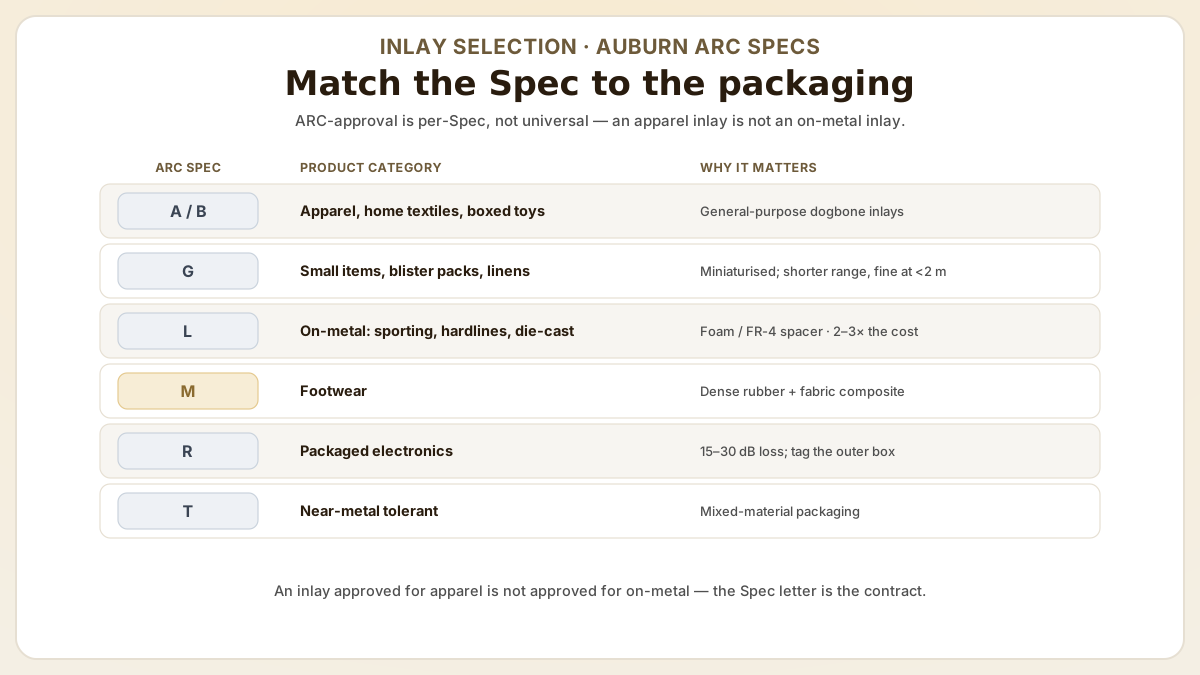
- Apparel (garment hang tags, care labels): ARC Spec A or Spec B general-purpose inlay. Impinj Monza R6-P (best power sensitivity, -22.1 dBm read sensitivity, 100% Auto-Tune enabled), NXP UCODE 8 (low-cost standard, -21 dBm), NXP UCODE 9 (best-in-class, -23.5 dBm, Crypto Suite capable), and Alien Higgs 9 (-22 dBm) inlays all qualify for Spec A on standard apparel. Common antenna designs: Smartrac Dogbone, Smartrac Miniweb, Avery Dennison AD-221r6, AD-383u9, Arizon AZ-9662. Read performance is not the constraint at apparel packaging densities.
- Home textiles: similar to apparel but with higher product density per carton (up to 500-1000 units in a 40×48×80 in shipping carton). Inlay selection needs to survive dense reader-on-pallet conditions without cross-talk. ARC Spec A or Spec B with sewn-in care-label form-factor (Avery Dennison AD-100u9, Smartrac Waterline) validated for 25-wash durability per AATCC 135. The sewn-in label is laminated between two woven polyester layers and ultrasonic-welded; industrial-laundry deployments use 50-wash variants at +$0.03 per label.
- Sporting and hard goods: often require on-metal-adjacent inlays when products include metal parts (bike frames, fitness equipment, golf clubs, firearms, tools). ARC Spec L (on-metal) tags use a foam-spacer or FR-4 PCB substrate to isolate the antenna from ground plane. Avery Dennison AD-338m4d, Xerafy Dash-On, HID IronTag 206M, and Omni-ID Fit 210 are typical Spec L inlays. On-metal inlays typically cost 2-3× general-purpose inlays ($0.15-0.35 vs $0.05-0.12), so hybrid strategies (on-package rather than on-product) are often preferred for price-sensitive categories.
- Footwear: ARC Spec M validated for athletic and work footwear. Inlay typically sits in a pocket in the shoe's tongue, on the underside of the tongue label, or inside the box. Smartrac Midas, Avery Dennison AD-662u9 and Impinj E52 (small-form-factor with Monza R6-P) are common Spec M choices. The sneaker-resale authentication use case (StockX, GOAT) often uses NFC (NTAG424 DNA) alongside the Gen2 UHF tag for dual-interface consumer verification.
- Packaged electronics: the product's own metal and liquid content (lithium-ion batteries, LCD screens, power bricks) attenuates UHF signal by 15-30 dB. Inlays need to be placed on the outer packaging (retail box exterior) rather than on the product itself. For products shipped in blister packs with a metallized backing, inlay placement 15+ mm from the metal is critical. ARC Spec R (high-attenuation) certification covers these cases.
- Small-item retail packaging: blister packs, clam shells and small cartons need small-form-factor inlays (30×15 mm or smaller). ARC Spec G certification covers these. Miniaturised inlays (Smartrac ShortDipole, Avery Dennison AD-101u8, Impinj H47) trade off read range (typically 3-5 m vs 8-12 m for a full-size dogbone) for form factor, which is usually an acceptable trade at retail packaging scale where tunnel-reader distance is <2 m anyway.
- Toys: ARC Spec G small-form-factor for blister-card packaged toys; Spec A general-purpose for boxed toys; Spec L on-metal for die-cast toys with metal body (Hot Wheels, Matchbox). Child-safety compliance requires ASTM F963-17 certification for any tag in direct product contact; the typical solution is to place the tag on the outside of the retail packaging rather than on the product, eliminating the safety consideration.
- Inlay testing against product: every new product type should be benchmarked with 2-3 candidate inlays on the actual packaging before specifying for production. Inlay performance varies materially (often ±3 dB, equivalent to a 50% read-range swing) with packaging material, placement and neighboring-item cross-coupling. Proud Tek's standard benchmarking uses a 3-m range measurement per ARC Spec conditions and a 60-s tunnel-reader aggregate read test at 50 items per pallet layer.
- ARC certification update cadence: Auburn ARC publishes updated spec revisions quarterly. Suppliers and inlay vendors must ensure their inlays meet the latest spec revision at the time of production. An inlay certified to ARC Spec A rev. 2023 Q2 may not meet Spec A rev. 2026 Q1 requirements. Proud Tek tracks the ARC spec versioning monthly and flags inlays approaching decertification.
Auburn Project Zipper and the supply-chain accuracy economics behind the mandate
Walmart's investment in RFID is grounded in measured supply-chain inaccuracy data published by Auburn RFID Lab's 'Project Zipper' initiative — a multi-year study, run by Justin Patton's team, that quantified discrepancies between supplier ASN data and retailer DC actual receipts across multiple participating retailers and brands. The Project Zipper findings (publicly summarized through Auburn RFID Lab releases and Supply Chain Dive coverage) frame the business case for the mandate and explain why per-unit verification at DC receiving is the central enforcement mechanism rather than statistical sampling.
- Project Zipper baseline: Auburn's published findings established that ASN-versus-actual-receipts discrepancy averaged in the high single digits to low teens across non-RFID supplier flows, even with mature supplier programs. Item-level RFID closed the gap to 1-3% in compliant flows. The remaining gap is the operational target the mandate is designed to close further over time.
- Per-unit accuracy compounds. Item-level inventory accuracy at the DC translates directly into store-level shelf accuracy, which translates into out-of-stock reduction and unsold-inventory reduction. Walmart's published RFID-vs-non-RFID inventory accuracy comparisons cite ~95% RFID inventory accuracy versus 60-70% with traditional cycle counting — the gap drives the mandate's category-by-category expansion.
- Out-of-stock reduction: GS1 US-cited industry data places item-level RFID's out-of-stock reduction at up to 50%, with corresponding lift in store-level revenue per square foot. The Walmart-internal business case for each category-expansion wave references the projected out-of-stock reduction as the primary lift mechanism, with chargeback revenue as a secondary effect.
- Justin Patton's annual industry summits. Auburn RFID Lab hosts annual industry summits (typically March in Auburn, AL) where Walmart, Target, Nordstrom, Macy's, Lowe's and other retailer programmes share results. The summit content is the public record for category-expansion intent and is the place where suppliers preview upcoming Spec revisions and category announcements 6-12 months ahead of formal SS2-004 publication.
- Cross-retailer accuracy contagion: as more US retailers adopt item-level RFID, the supplier-side investment pays back across all customers simultaneously. A supplier source-tagging for Walmart automatically meets Target, Nordstrom, Macy's and Kohl's specifications with the same encoded tag (subject to placement and ASN-format adaptation). The cross-retailer leverage materially shortens the source-tagging payback period for multi-retailer suppliers.
- Shrinkage and loss-prevention overlay. Item-level RFID also feeds Walmart's loss-prevention analytics, identifying high-shrinkage SKUs and store locations through inventory-versus-sales reconciliation. Auburn studies have placed RFID-enabled shrink reduction at 15-30% of the pre-RFID baseline depending on category. The shrink reduction is a non-mandate-related operational benefit but is part of the consolidated business case.
- Sustainability and circular-economy alignment. The same item-level identifier that satisfies the Walmart mandate also serves the EU Digital Product Passport for textile and consumer-electronics suppliers shipping into both markets. Walmart-mandate-driven source tagging therefore positions textile suppliers for the 2027-2028 EU DPP delegated-act window without additional infrastructure investment.
Supplier qualification workflow for Walmart compliance
Becoming a Walmart-compliant RFID supplier is a defined workflow published in SS2-004 §6 (Supplier Qualification Process). Following it produces a stable source tagging operation; skipping steps produces chargebacks. The full onboarding path typically takes 10-16 weeks from GCP registration to full production. Most of that is queue time — waiting on registrations, item-master approvals and a pilot slot — not anything technically hard. The workflow below lays out the steps in order; the ones that bite are the ones a supplier skips to save a week.
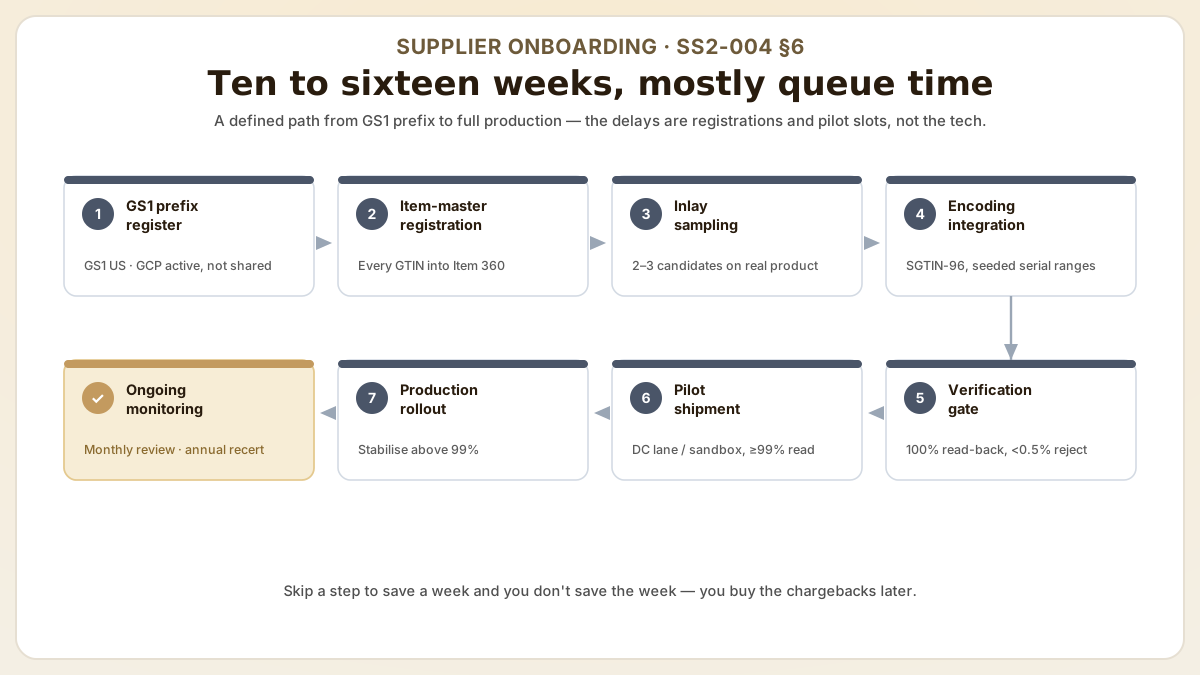
- Step 1GS1 prefix registration: register or renew the GS1 Company Prefix with GS1 US (https://www.gs1us.org/). Current pricing (2026) for a new 6-digit prefix is US$2,200 initial + $710/year renewal for small companies (<$1 M revenue), scaling up to $25,000+ initial + $5,800+/year for Fortune 500 companies with ≥10,000 product SKUs. Confirm the prefix is active and not shared; for Chinese-manufactured products destined for US retail, the supplier may use a GS1 China (ANCC) prefix as long as it is registered in the GEPIR global registry. This is the foundational step. Encoding cannot proceed without it.
- Step 2Item-master registration: upload every GTIN-to-be-tagged into Walmart's Item 360 platform. Each GTIN must include the standard GS1 attributes (description, brand, size, color, UPC/EAN) plus Walmart-specific attributes (Department, Category, Division). Incomplete items fail the RFID validation check at DC receiving even if the tag encoding is correct.
- Step 3Inlay sampling: request 2-3 candidate inlays from the tag supplier, tested on the actual product packaging. Measure read range at the distances Walmart specifies for the category per SS2-004 Appendix D. Proud Tek's sampling program ships 50-100 samples of each candidate inlay pre-encoded with test EPCs, with a full benchmarking report showing read-range at 1m/2m/3m/5m in free space and on the actual product.
- Step 4Encoding integration: configure the encoding process (desktop encoder like Zebra RFD8500, Impinj Speedway xSpan, or inline applicator like Printronix T8000 thermal-transfer printer with RFID module) to generate SGTIN-96 EPCs using the prefix, the GTIN and a unique serial-number sequence. The encoding software must support pre-seeded serial ranges to avoid collisions across encoder fleets. Recommended software: Avery Dennison RFID Encoding Service, Bartender Commander with RFID module, ZebraDesigner Pro, or NiceLabel Cloud.
- Step 5Verification gate: 100% read-back verification at the encoding step. Every tag is read immediately after write with a CRC-16 checksum validation and EPC comparison. Rejected tags are quarantined (typically perforated with 'VOID' marking and collected in a reject bin); rejection rate tracked against supplier SLA with a target of <0.5% on dry-inlay and <1% on specialty formats. Proud Tek's factory-QC log is exportable as a CSV/Excel report for supplier audit trails.
- Step 6Pilot shipment: ship 1-3 test cartons to a designated Walmart DC pilot lane or via the Retail Link RFID Supplier Enablement Sandbox (virtual DC that simulates tunnel-reader verification). Verify tunnel-reader pass-through at ≥99% read rate before scaling to full production. A failed pilot with root-cause-analysis report must be submitted before a re-pilot is approved.
- Step 7Production rollout: scale source tagging across all Walmart-destined SKUs, with exception reporting and quality-improvement loops. Expect 4-12 weeks of stabilisation before compliance rates reach steady-state above 99%. Walmart's Retail Link provides weekly compliance-rate trending reports during the stabilization phase, with dedicated Walmart Supplier Enablement Specialists available for remediation calls.
- Step 8Ongoing monitoring: after full rollout, compliance is reviewed monthly at the supplier-category-review cadence. A drop below 98% on any rolling-4-week window triggers a Supplier Alert and a 30-day remediation window before chargebacks resume. Suppliers with consistent <95% compliance over two consecutive quarters face a formal Supplier Improvement Plan and possible loss of preferred-supplier status.
- Step 9Annual recertification: once per calendar year, suppliers must recertify their inlay-and-encoding setup against the then-current ARC Spec revisions and submit a recertification attestation via Retail Link. Missed recertification automatically flags all shipments as 'uncertified' and subjects them to enhanced chargeback rates (1.5× the standard per-unit penalty) until recertification is complete.
Useful next pages
Use these linked product, guide and comparison pages to keep the next click specific and practical.
Walmart RFID compliance products
UHF RFID tags and labels that meet Walmart's item-level tagging requirements.
Encoding and standards context
GS1 encoding and UHF standards references that inform Walmart compliance.
Official Walmart and Auburn ARC references
Direct links to the Walmart supplier programme and the Auburn RFID Lab ARC certification programme.
Related mandate and supplier guides
Multi-retailer mandate context and related supplier-side compliance material.
FAQ
What happens if I ship to Walmart without RFID tags on mandated categories?
Walmart enforces compliance through automated chargebacks at DC receiving. Tunnel-reader verification identifies non-compliant shipments, and a per-unit financial deduction applies to the invoice. Beyond chargebacks, persistently non-compliant suppliers lose replenishment priority and face reduced shelf space in subsequent buying cycles. The soft-cost exposure from lost shelf space often exceeds the hard-cost chargeback.
Can I apply RFID tags at the Walmart DC instead of at my factory?
Walmart accepts DC-applied tags but strongly prefers source tagging at the factory. Source tagging costs roughly a quarter of DC tagging per unit, integrates with existing labelling processes, avoids DC processing delays that affect replenishment velocity, and gives the supplier RFID-enabled visibility in their own warehouses. The economic case for source tagging is clear at any meaningful shipment volume.
What UHF RFID inlay chip does Walmart recommend?
Walmart does not mandate a specific chip but requires tags to pass the ARC certification performance threshold for the product category. The most widely used chips for Walmart compliance are Impinj Monza R6-P, NXP UCODE 8 and UCODE 9, and Alien Higgs 9. The best chip depends on the product packaging material; Proud Tek tests and recommends inlays against the actual product before specifying for volume.
How does SGTIN-96 encoding differ from a regular EPC?
EPC is the umbrella term for the 96-bit (or longer) code stored in the tag's EPC memory bank. SGTIN-96 is one specific EPC encoding format (the serialized GTIN) that packs the GS1 Company Prefix, the item GTIN and a unique serial number into 96 bits. Walmart requires SGTIN-96 specifically because it links directly to the GS1 item-master data that the rest of retail also uses.
How many categories does the Walmart mandate now cover?
As of the 2026 rollout wave, the mandate covers apparel, footwear, home textiles, sporting goods, toys, and is expanding into additional hard-goods categories including electronics and automotive accessories. The category list expands roughly annually; suppliers in not-yet-mandated categories should plan for eventual inclusion rather than assume permanent exemption.
What is the minimum order quantity for pre-encoded Walmart-compliant tags?
Proud Tek ships pre-encoded Walmart-compliant UHF RFID labels from 10,000 pieces per order. For larger supplier programs tagging millions of items per year, contract pricing and scheduled deliveries with serialization management apply. Factory-direct lead times for standard labels are typically 7-10 business days; specialty inlays or on-metal labels add 1-2 weeks.
How does the Auburn ARC programme actually work, and what does Walmart-specific approval mean?
The Auburn ARC programme operates on a per-Spec model rather than a single universal certification. Each end user (Walmart, Nordstrom, DICK'S Sporting Goods, H&M, Lowe's, T-Mobile and 15+ other retailers/aviation/manufacturing programmes as of 2026) defines a Spec capturing their specific use case, product or packaging types, environment and reader infrastructure. The ARC Lab benchmarks each candidate inlay against that Spec in standardized anechoic-chamber conditions and stores the result in the ARC Database. Inlays meeting a Spec's threshold are 'ARC-approved' for that Spec only and are listed in the corresponding end-user playbook. For Walmart, the practical workflow is: Walmart's RFID Supplier Enablement (via Retail Link) provides the supplier with the relevant Spec and the list of approved inlays for the supplier's product category; the supplier selects from the approved list, source-tags at the factory, and verifies at the supplier's own pre-shipment tunnel-reader. An inlay approved for one Walmart Spec (general apparel) is not automatically approved for another Walmart Spec (on-metal hardlines or footwear). The ARC programme was founded in 2009 at the Auburn University RFID Lab in the Harbert College of Business and as of 2026 is the universal language for communicating passive UHF RFID inlay requirements across the retail RFID ecosystem.
What is the single biggest avoidable mistake in Walmart RFID rollout?
Selecting inlays on cost rather than on ARC performance against the actual product packaging. A cheap inlay that fails tunnel-reader verification generates chargebacks that dwarf the per-unit saving, and the supplier ends up paying the chargeback and then respecifying the inlay anyway. Pilot 2-3 candidate inlays on the actual product before specifying for volume production.
Sources & references
Primary standards, OEM datasheets and regulatory documents cited by this article. All URLs were verified on the access date shown below.
- Walmart Supplier Requirements — RFID Program
Primary source for supplier-facing RFID tagging mandate scope, category expansion waves, and compliance expectations.
- Auburn University RFID Lab — ARC (Auburn RFID Lab Certification) Program
Canonical source for the ARC performance grading methodology referenced by Walmart for inlay qualification (Spec L, M, S, and packaging-specific categories).
- GS1 Sunrise 2027 — Two-Dimensional Barcodes at Point of Sale
Cited for the GS1 Sunrise 2027 migration context and the parallel role of GS1 Digital Link in retail item identification alongside EPC/RFID.
- GS1 EPC Tag Data Standard (TDS) 2.3
Current GS1 TDS, October 2025. Authoritative specification for SGTIN-96 encoding used for retail items under the Walmart mandate; backward-compatible with TDS 2.1/2.2 SGTIN-96 binary.
- GS1 EPC Tag Data Translation (TDT) 2.0
- ISO/IEC 18000-63:2021 — Parameters for air interface communications at 860 MHz to 960 MHz Type C
Underlying international standard for the Gen2/Gen2v2 air interface used by all Walmart-compliant UHF RFID inlays.
- GS1 EPC Radio-Frequency Identity Protocols Gen2 UHF RFID (Gen2v2)
Gen2v2 air-interface protocol spec; defines EPC memory bank layout, access password, and read/write commands used by retail inlays.
- RAIN Alliance — Certification Program
Cross-vendor interoperability certification referenced as a baseline for UHF RFID inlay selection before ARC qualification.
Proud Tek is a Shenzhen-based RFID & NFC manufacturer supplying hotel chains, transit operators, event venues and retail brands worldwide. Every order includes free samples, RF testing and dedicated project support.
Get a Quick Quote
Tell us about your project and we'll respond within one business day. Fields marked (asterisk) are required.