
RFID Supplier for the African Market
RFID Manufacturer for Africa
Band-Correct by Country

Quick answer
Proud Tek ships RFID across Africa factory-direct from Shenzhen. The one fact that decides a UHF order: Africa is a continent, not a single band. Most of North, East and West Africa mirrors the EU 865-868 MHz band — Egypt, Kenya and Morocco all sit there — while South Africa runs 915.4-919 MHz under ICASA, roughly 50 MHz higher. There is no one "African band", so passive UHF inlays are tuned to the destination country you name on the RFQ; EU 865-868 MHz stock reads short on a South African portal, and the reverse is just as true. Access and ID cards at 13.56 MHz (HF) are globally harmonised and work continent-wide. Express air reaches African capital cities in 5-10 business days and sea freight serves Lagos, Mombasa, Dar es Salaam, Tema and Durban; import duty and VAT are country-specific, so they are quoted per destination rather than guessed.
- Band-correct by destination — because Africa has no single UHF band. Most of the continent mirrors the EU 865-868 MHz band (Egypt, Kenya, Morocco), while South Africa runs 915.4-919 MHz under ICASA, roughly 50 MHz higher. Name the destination country and inlays are tuned to match; EU-tuned stock reads short on a South African portal.
- Full range, factory-direct — MIFARE Classic and DESFire EV3 access and ID cards at 13.56 MHz (global), country-tuned UHF inlays and labels, NFC products and event wristbands, all from one Shenzhen production line at factory-direct pricing.
- Landed, not just priced — express air to African capital cities in 5-10 business days and sea freight to Lagos, Mombasa, Dar es Salaam, Tema and Durban; duty and VAT are country-specific, so we quote them per destination and offer DDP where the lane allows.
At a glance
Use these short answers to decide whether this page matches the project before moving into the detail.
Africa has no single UHF band
UHF RFID allocations vary by country across Africa, so a passive inlay must be tuned for the destination. South Africa uses 915.4-919 MHz (FHSS, up to 4 W EIRP) under IC...
Compliance varies by country
Radio type-approval is national — ICASA (South Africa), NTRA (Egypt), the Communications Authority (Kenya), ANRT (Morocco), NCC (Nigeria) and peers. The reader is the re...
Next step
Ready to move forward? Start your inquiry to get specific answers for this project.
Get RFID pricing for Africa- Landed cost
-
RFID cards and inlays commonly classify under HS 8523.52 ("smart cards"), a heading that is consistent worldwide. Applied duty and VAT are set by the destination country and its trade regime (AfCFTA, plus regional blocs such as ECOWAS, the EAC, SADC and COMESA), so there is no single African rate — we quote per country. DDP is offered where the lane allows; otherwise CIF or DAP with your broker. Confirm exact rates with your customs broker. [OWNER-CONFIRM specific country duty/VAT rates and DDP-lane coverage.]
- Logistics
-
Express air via DHL/FedEx from Shenzhen to African capital cities in 5-10 business days; sea freight to Lagos, Mombasa, Dar es Salaam, Tema and Durban for bulk card-issuance and tag programmes. Payment terms include T/T, Letter of Credit and milestone-based structures for government-funded projects with official procurement documentation. Free sample kits ship for band and reader-compatibility testing before a bulk order.
RFID products for African markets
Everything below ships from one Shenzhen line: the catalogue is the same across the continent — what changes by country is the UHF tuning. Access and ID cards run at 13.56 MHz (global), UHF inlays are tuned to the destination band, and the classic mistake is buying the cheapest generic inlay before fixing band and reader fit. New to frequency planning? Start with our LF vs HF vs UHF guide, and for credentials see the access control stack.
- Access and ID cards at 13.56 MHz — MIFARE Classic 1K and DESFire EV3 (AES-128) for access control, national ID, banking employee credentials and campus ID across African commercial, government and financial sites. HF is global, so this is the same card spec whatever the country.
- Country-tuned UHF inlays and labels — ISO/IEC 18000-63 (Gen2) inlays tuned for the destination band (865-868 MHz for most of the continent, 915.4-919 MHz for South Africa) for retail, warehouse, logistics and asset tracking.
- Livestock and agricultural tags — UHF ear tags and asset labels for traceability and export-certification programmes; tell us the deployment country so the band is right (see agriculture).
- Banking and financial-inclusion card bodies — dual-interface and contactless card bodies with EMV-compatible chips, supplied ready for your bureau's personalisation and payment-scheme certification (we supply the blank, not the EMV certificate).
- NFC products and event wristbands — NFC cards and tags plus silicone and fabric wristbands at 13.56 MHz for tourism, events and healthcare ID.
Get the band right: Africa has no single UHF band
The single most expensive mistake in cross-border RFID sourcing is band mismatch — and Africa makes it easy to get wrong, because there is no one African band. Most of North, East and West Africa mirrors the EU 865-868 MHz band, while South Africa sits roughly 50 MHz higher at 915.4-919 MHz under ICASA. An inlay tuned for Cairo or Nairobi reads short on a Johannesburg portal, and the reverse is just as true. So the rule is simple: name the destination country on the RFQ and the antenna tuning follows it. (Access cards at 13.56 MHz are global and unaffected.) The band table below lists only allocations we can source to a regulator; where a country is not listed, we confirm it with the national regulator before quoting.
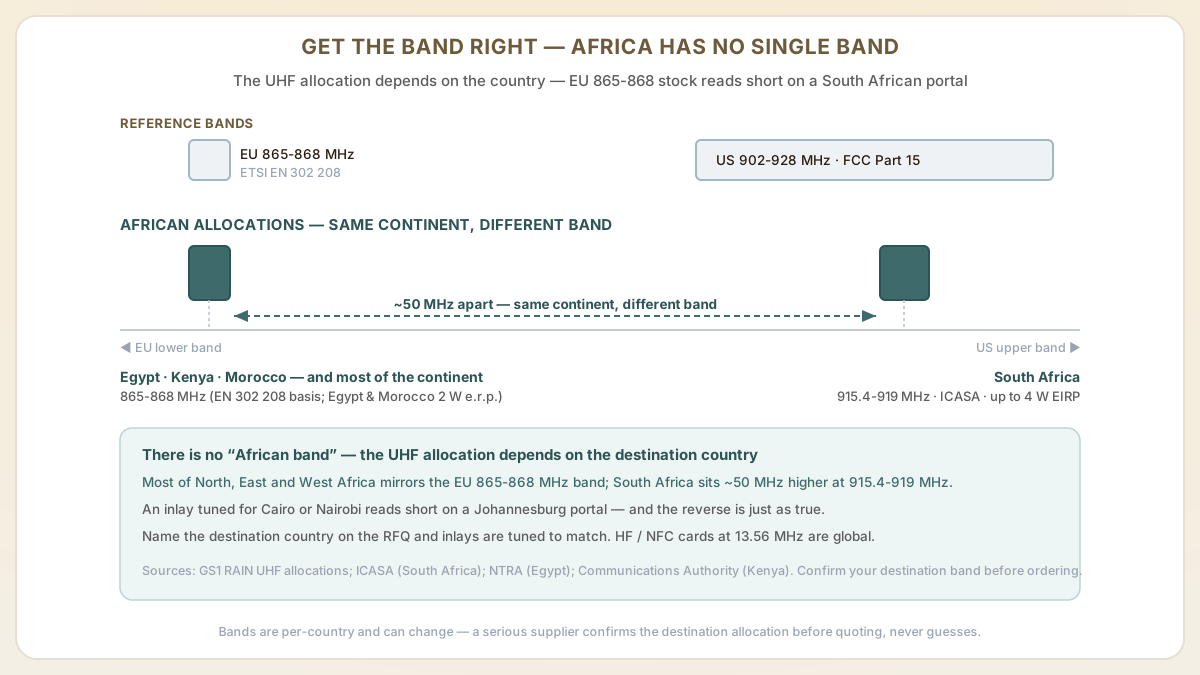
| Market | UHF RFID band | Regulator / basis | What it means for inlay tuning |
|---|---|---|---|
| South Africa | 915.4-919 MHz (FHSS, up to 4 W EIRP) | ICASA | Upper-band tuning — closer to the US band than to the EU band |
| Egypt | 865-868 MHz (four 200 kHz channels, 2 W e.r.p.) | NTRA | EU-style lower-band tuning (EN 302 208 channel plan) |
| Kenya | 865-868 MHz (EN 302 208 basis) | Communications Authority (CA) | EU-style lower-band tuning |
| Morocco | 865-868 MHz (incl. 865.6-865.8 MHz, 2 W e.r.p.) | ANRT | EU-style lower-band tuning |
| Reference — European Union | 865-868 MHz (2 W ERP) | ETSI EN 302 208 | The band most of Africa mirrors |
| Reference — United States | 902-928 MHz (4 W EIRP) | FCC Part 15 | The upper band South Africa sits inside |
Compliance varies by country: radio approval, data and standards
Two things decide whether a shipment is clean into an African country — radio type-approval and data — and both are national, not continental. What is continent-wide is the card physics and the air-interface standards. Below is the honest map for China-sourced RFID; for the credential-side stack see our access control page.
| What | Continent-wide or country-specific? | Straight answer for China-sourced RFID |
|---|---|---|
| UHF band and radio type-approval | Country-specific — ICASA, NTRA, CA, ANRT, NCC and peers | The reader is the regulated radiator and carries the national approval; passive tags are field devices. Order inlays tuned to the destination band |
| HF / 13.56 MHz cards | Continent-wide (global) | MIFARE Classic and DESFire cards at 13.56 MHz are globally harmonised — one card spec works in every African market |
| Air-interface standards | Continent-wide | UHF inlays are ISO/IEC 18000-63 (Gen2) and HF cards are ISO/IEC 14443 everywhere; the antenna tuning changes by country, the silicon and protocol do not |
| Data protection | Country-specific — e.g. South Africa (POPIA), Kenya (Data Protection Act), Nigeria (NDPA) | A concern for your credential system, not the card blank — encode the minimum and manage personal data in your back end; confirm the destination country's regime |
Landed cost: HS 8523.52, and why the duty line is country-specific
The unit price is the headline; the landed cost is the story — and in Africa that story has a different ending in every country, because duty and VAT depend on the destination and its trade regime. What is constant is the classification; what varies is the rate. Our RFID RFP template shows the quote-comparison math in full.
- The HS 8523.52 heading is the constant; the duty and VAT rate is the variable — it is set by the destination country, not the continent.
- Ask for the HS 8523.52 line and country-of-origin on the commercial invoice so your broker enters the goods correctly the first time.
- DDP availability is confirmed per lane; where it is not offered, CIF or DAP plus your broker is the honest alternative — we will not quote a duty we cannot settle.
| Incoterm | Freight | Duty + VAT at destination | Customs clearance | Choose it when |
|---|---|---|---|---|
| EXW Shenzhen | You arrange from our dock | You pay at entry | Your broker | You run your own freight and clearance |
| CIF / DAP port or city | We ship to your port or city | You pay at entry | Your broker | You want freight handled but clear in your own name |
| DDP your address | We handle door to door | Included where the lane allows | We arrange | You want one landed number — DDP availability confirmed per country |
Logistics: Shenzhen to African capitals and ports
Freight and clearance are the boring part done right. Shenzhen sits a few hours ahead of most of Africa, so an RFQ sent at your close of business is usually quoted by your next morning. For the freight-mode trade-off, our logistics work is the wider context.
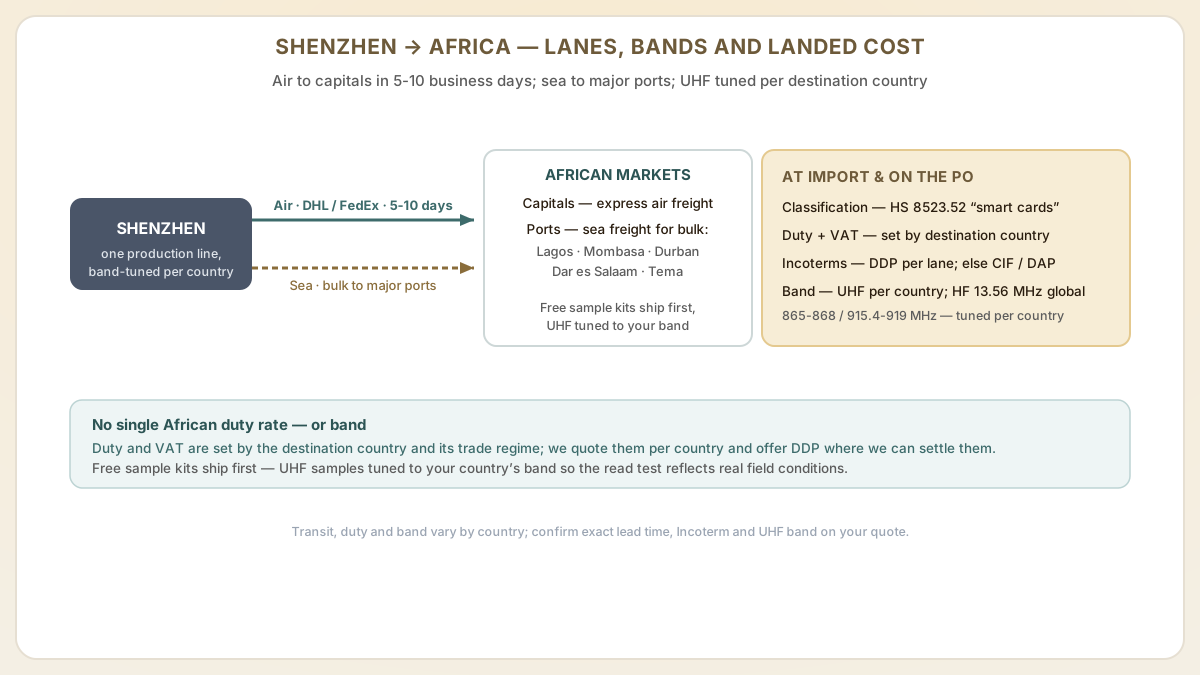
- Express air via DHL/FedEx from Shenzhen to African capital cities in 5-10 business days, with tracking and export documentation to support clearance at the destination port of entry.
- Sea freight to the major ports of Lagos, Mombasa, Dar es Salaam, Tema and Durban for bulk card-issuance and tag-deployment programmes, for maximum cost savings on non-urgent volume.
- Payment flexibility — T/T wire transfer, Letter of Credit and milestone-based terms for established customers and government-funded projects with official procurement documentation.
- Free sample kits ship for band and reader-compatibility testing — for UHF orders the samples are tuned to your destination country's band so the test reflects real field conditions.
How an African order runs, step by step
No guesswork on band or border — this is the cadence a first order follows, and it starts by pinning the destination country.
- Day 0 · RFQ
Send the destination country, the reader make/model, quantity and artwork. The quote comes back with the country's UHF band tuning specified — or, if the country's allocation needs confirming, verified with the national regulator first — and an Incoterm (EXW / CIF / DAP / DDP).
- Day 1-3 · Samples
Free sample cards or inlays ship to your address to test on your live readers before a production run — for UHF, tuned to your country's band so the read test is realistic.
- Production
Cards printed and encoded, or UHF inlays converted and tuned to the destination band; read-tested before packing.
- Delivery
Express air to your capital in 5-10 business days, or sea freight to a major port for bulk; duty and VAT settled on DDP lanes, or cleared by your broker on CIF/DAP.
Proof an African buyer can verify without a plant visit
Proud Tek supplies integrators, resellers, banks, government agencies and enterprises across Africa — but don't take a market page's word for it. Verify us the way you would audit any China factory: check certificates with the issuing registrar using our ISO verification guide, then work through the China factory audit checklist.
- Confirm the destination country's UHF band in writing on the PO — 915.4-919 MHz for South Africa (ICASA), 865-868 MHz for most of the continent — and hold the approved sample as the reference.
- Request free samples and read them on your own readers before any bulk order; for UHF, insist the samples are tuned to your country's band, not a generic global inlay.
- Ask for the ISO/IEC 14443 (HF cards) and ISO/IEC 18000-63 (UHF inlays) conformance, and for reader-side radio the national type-approval reference for your country.
- Get the HS 8523.52 classification and country-of-origin on the proforma, and confirm duty, VAT and DDP availability for your specific destination before you commit.
- For high-security or government credentials, specify DESFire EV3 (AES-128) rather than legacy MIFARE Classic.
Useful next pages
Use these linked product, guide and comparison pages to keep the next click specific and practical.
RFID products for African deployments
Browse RFID products commonly ordered for African markets.
Compliance and sourcing reading
The guides African procurement teams pair with this page.
FAQ
Which UHF frequency band should I order for my African country?
There is no single African band, so the answer is the destination country's allocation. Sourced examples: South Africa uses 915.4-919 MHz (up to 4 W EIRP) under ICASA; Egypt uses 865-868 MHz in four 200 kHz channels at 2 W e.r.p. under the NTRA; Kenya uses the 865-868 MHz band on the EN 302 208 basis under the Communications Authority; Morocco uses 865-868 MHz under the ANRT. If your country is not listed, we confirm the allocation with the national regulator before quoting. HF and NFC cards at 13.56 MHz are global and unaffected.
Why can't you just ship one "Africa" UHF tag?
Because the bands differ by roughly 50 MHz across the continent. Most of Africa mirrors the EU 865-868 MHz band, but South Africa runs 915.4-919 MHz — and passive inlay antennas are tuned per band. An EU-tuned 865-868 MHz inlay reads short on a South African 915.4-919 MHz portal, and a South-Africa-tuned inlay reads short in Egypt or Kenya. Specify the destination country and we tune to match; radio physics does not read purchase orders.
Are 13.56 MHz access and ID cards the same across Africa?
Yes. HF at 13.56 MHz (MIFARE Classic, DESFire, NFC) is globally harmonised, so one card spec works in every African market — the band split only affects UHF inlays and labels. That is why access control, national ID and banking-credential cards can be standardised continent-wide while UHF asset tags are tuned per country.
How do import duty and VAT work for African orders?
RFID cards and inlays commonly classify under HS 8523.52 ("smart cards"), which is consistent worldwide, but the applied duty and VAT are set by the destination country and its trade regime, so there is no single African rate. We quote duty and VAT against your specific destination and offer DDP where the lane allows so the quoted price is the landed price; otherwise we ship CIF or DAP and your broker clears. Confirm the exact classification and rate with your customs broker.
Can you deliver RFID products to any African country?
We ship across Africa via DHL, FedEx and UPS express to African capital cities, typically in 5-10 business days, with full export documentation to support customs clearance at the destination port of entry. For bulk programmes we use sea freight to major ports including Lagos, Mombasa, Dar es Salaam, Tema and Durban.
Do you offer payment terms for African government projects?
Yes. For government-funded projects with official procurement documentation (purchase orders, Letters of Award) we can structure payment terms including Letter of Credit, deferred payment and milestone-based invoicing, assessed on a project-by-project basis. We also accept T/T wire transfer for standard orders.
Can you supply EMV card bodies for African bank card programmes?
We manufacture dual-interface and contactless smart-card bodies with EMV-compatible chips. Full EMV certification is performed by the issuing bank's payment scheme (Visa, Mastercard) during personalisation — we supply the card body with embedded chip ready for your bureau's personalisation and certification process, not the EMV certificate itself.
Sources & references
Primary standards, OEM datasheets and regulatory documents cited by this article. All URLs were verified on the access date shown below.
- GS1 — Overview of UHF frequency allocations for RAIN RFID
Primary aggregated country table: records South Africa 915.4-919 MHz, Morocco's ANRT 865.6-865.8 MHz channel decision, and the EU-style 865-868 MHz allocations used across much of Africa.
- ICASA — National Radio Frequency Plan (South Africa)
South African regulator for the RFID short-range allocation at 915.4-919 MHz (FHSS, up to 4 W EIRP).
- NTRA — Radio Spectrum Guidelines for Short-range Devices (Egypt)
Egypt RFID interrogators in the 865-868 MHz band across four 200 kHz channels centred at 865.7, 866.3, 866.9 and 867.5 MHz at 2 W e.r.p.
- Communications Authority of Kenya — Guidelines on the Use of Radiofrequency Spectrum by Short-Range Devices
Kenya RFID in the 865-868 MHz band on the EN 302 208 basis.
- ETSI EN 302 208 — RFID equipment in the 865-868 MHz band (EU reference)
The EU lower-band allocation most of Africa mirrors; 2 W ERP high-power channels.
- 47 CFR § 15.247 — Operation within 902-928 MHz (US reference)
The US upper band (902-928 MHz, up to 4 W EIRP) that South Africa's 915.4-919 MHz allocation sits inside.
- GS1 EPC UHF Gen2 (ISO/IEC 18000-63) air-interface protocol
The UHF air-interface standard the country-tuned inlays implement; HF cards implement ISO/IEC 14443.
Proud Tek is a Shenzhen-based RFID & NFC manufacturer supplying hotel chains, transit operators, event venues and retail brands worldwide. Every order includes free samples, RF testing and dedicated project support.
Get a Quick Quote
Tell us about your project and we'll respond within one business day. Fields marked (asterisk) are required.