
Distributor Programs
RFID RFP Template
10 Supplier Questions
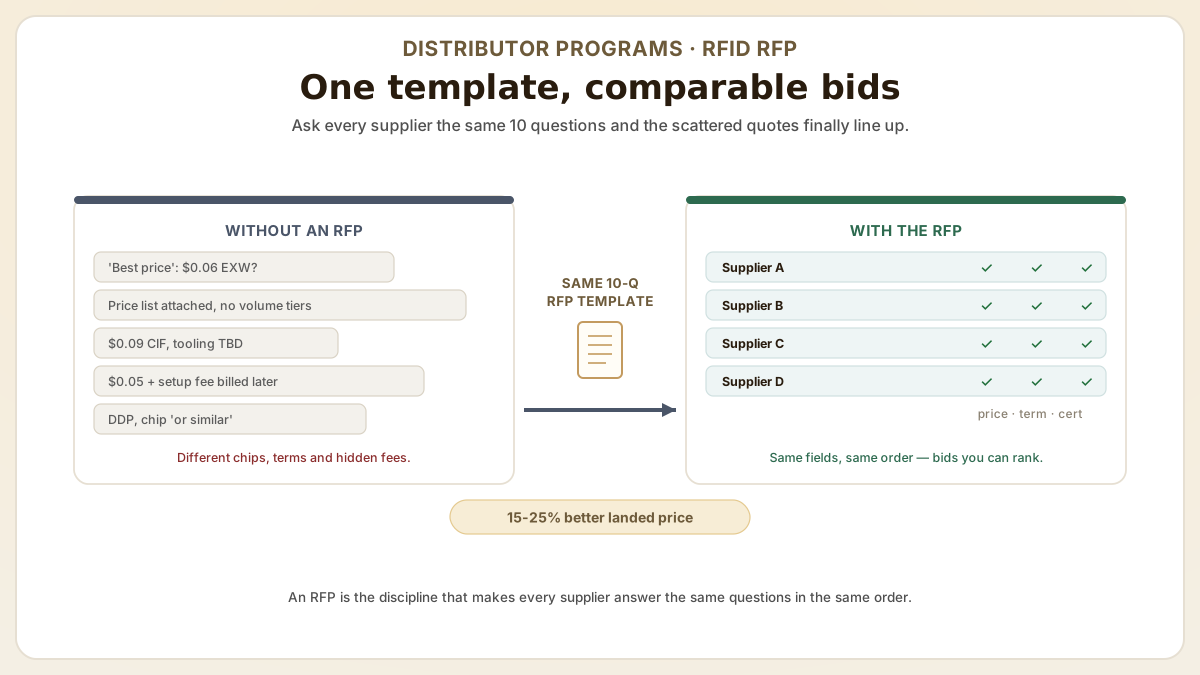
Quick answer
A strong RFID RFP asks every supplier the same 10 questions — pricing tiers, chip SKU, certification, QC, Incoterms and lead time — driving 15-25% better landed price than a generic 'send me your price list', and separating real factory partners from middlemen hoping you won't look too closely. Send it to 3-5 suppliers and negotiate from strength.
- Most distributor RFPs miss key questions — leaving gaps that factories exploit on pricing escalation, hidden fees and quality-control failures.
- A well-designed RFP drives 15-25% better landed price than a generic 'send me your price list' inquiry, and reveals supplier capacity and reliability before you commit.
- Use this 10-question template as the basis for any new factory engagement, then customize per your specific category (cards, labels, wristbands, hardware).
At a glance
Use these short answers to decide whether this page matches the project before moving into the detail.
Key takeaway
Most distributor RFPs miss key questions — leaving gaps that factories exploit on pricing escalation, hidden fees and quality-control failures.
Why RFPs matter for distributor programs
Ask five RFID factories for 'your best price' and you will get five numbers that cannot be compared — different chips, different shipping terms, different unspoken assum...
Next step
Ready to move forward? Start your inquiry to get specific answers for this project.
Submit your RFID RFPWhy RFPs matter for distributor programs
Ask five RFID factories for 'your best price' and you will get five numbers that cannot be compared — different chips, different shipping terms, different unspoken assumptions about who pays for the tooling. One quote looks cheapest right up until the tooling invoice lands. An RFP is just the discipline that makes every supplier answer the same questions in the same order, so the bids line up and the gaps show. RFID factories vary 30-50% in landed cost for ostensibly identical product. The difference comes from real factors (factory size, raw-material sourcing, certification cost) plus negotiating asymmetry. A structured RFP closes the asymmetry by making suppliers compete on the same fields.
- Comparability: same fields, same depth — apples-to-apples evaluation across 3-5 suppliers.
- Capacity discovery: suppliers reveal real production capacity by responding to your projected volume tiers.
- Hidden fee reveal: structured questions force suppliers to disclose tooling fees, sample fees and minimum-order surcharges they would otherwise hide.
- Certification verification: requesting certificate copies up front catches fakes and shortcuts before shipment.
- Negotiation leverage: 'Supplier X quoted Y' is your most powerful price-negotiation tool. Get all bids on the same template before starting price negotiation.
The 10 questions every RFID RFP must include
These ten questions cover the highest-leverage areas of an RFID supplier evaluation, grouped in the map below by pricing, product, certification, operations and references. Customize the wording per your category but keep all ten — each one closes a door a supplier would otherwise be glad to leave open. (Question 1 leans on real unit economics — see our apparel item-level tagging cost model.)
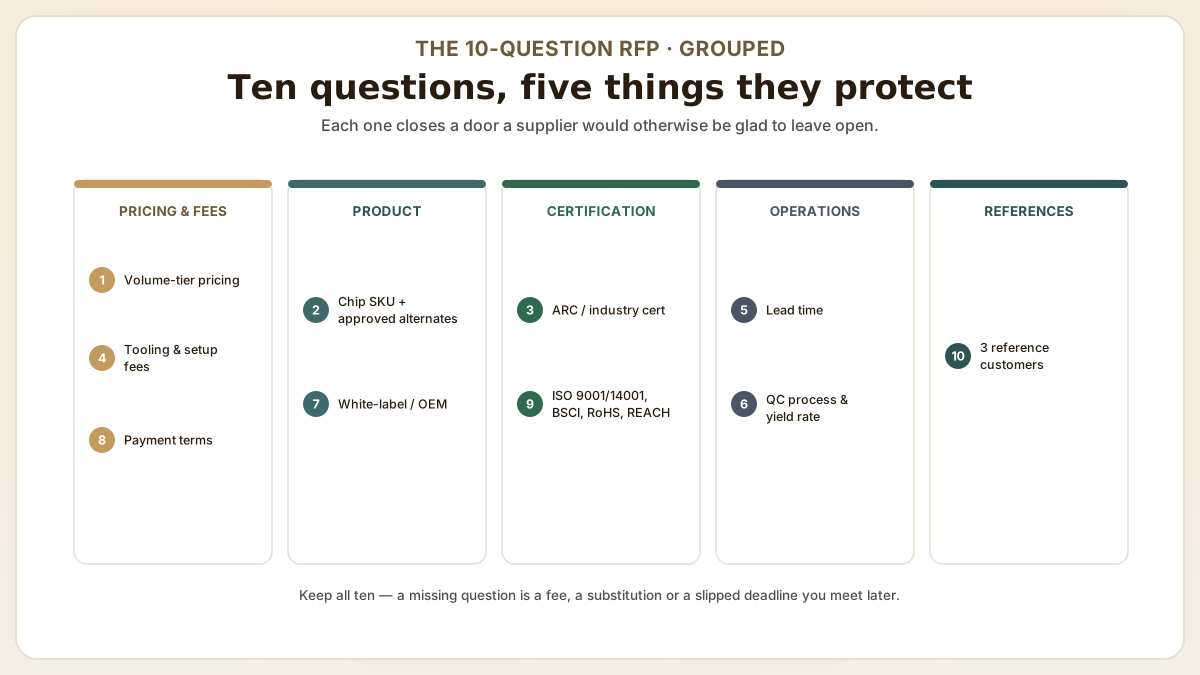
- 1. Volume-tier pricing for 10K, 100K, 1M units. Forces commitment to volume discounts.
- 2. Chip SKU and approved alternates with explicit name (e.g., 'NXP UCODE 9 or equivalent — list approved alternates'). Prevents silent chip substitution.
- 3. ARC certification (for retail mandate inlays) or relevant industry certification (ISO 13485 for medical). Require certificate copy + issuing-body URL.
- 4. Tooling, setup and sample fees. Itemize separately from unit price. Many suppliers hide $5K-25K of one-time fees inside 'first-order pricing'.
- 5. Lead time at first order, repeat order, and during Chinese New Year / factory holidays. Avoids last-minute deadline surprises.
- 6. Quality-control process: yield rate, inspection method, third-party-audit acceptance. 'No defective tags' is not an answer — request specific QC procedures.
- 7. White-label and OEM capability with MOQ and lead-time per option. Even if not needed today, lays groundwork for future expansion.
- 8. Payment terms (T/T 30/70, L/C, escrow). Distributors negotiating from a position of repeat business should expect 30/70 (30% deposit, 70% on shipment) at minimum.
- 9. Certifications: ISO 9001 (quality), ISO 14001 (environment), BSCI (social compliance), RoHS, REACH. Required documentation for many EU and US import markets.
- 10. Reference customers — at minimum 3 distributors of comparable size in your region who will speak by phone or email.
How to evaluate RFP responses
Compare suppliers on five evaluation dimensions, not just price. The cheapest is rarely the best — a 5% price advantage is wiped out by one quality-control failure or one missed shipment.
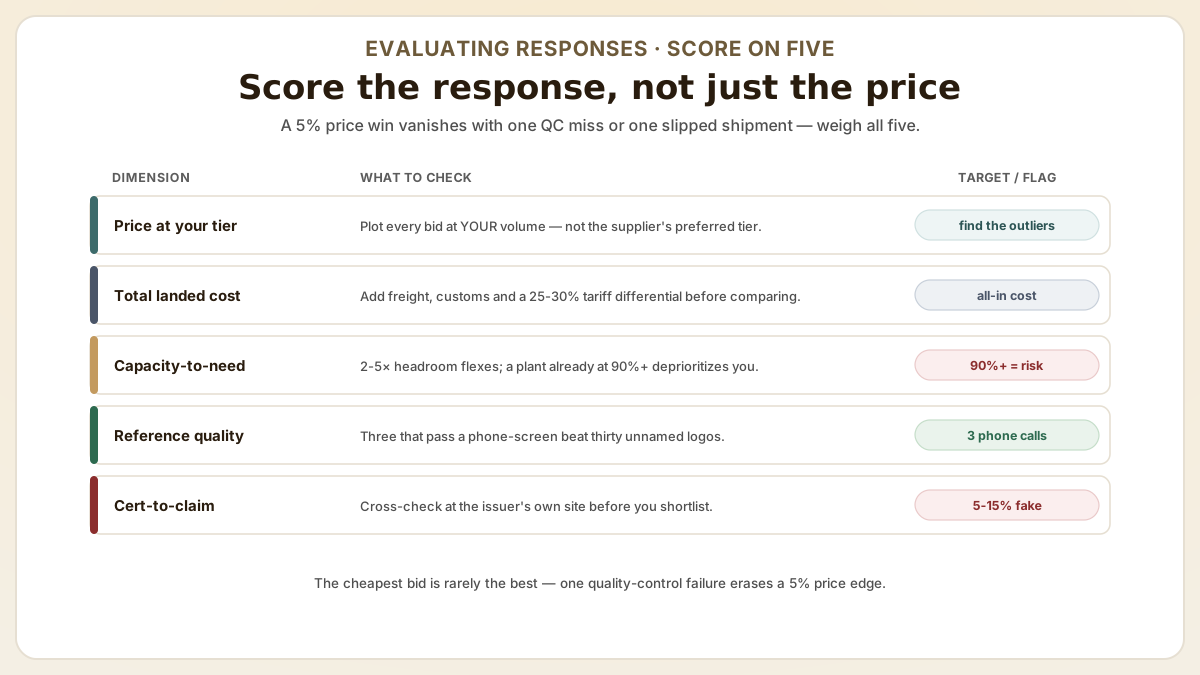
- Price competitiveness at YOUR volume tier (not the supplier's preferred volume): plot all suppliers' tier prices on a chart and identify outliers.
- Total landed cost including freight, customs, duties: a 'cheaper' supplier in a different region may be more expensive after freight + 25-30% tariff differential.
- Capacity-to-need ratio: suppliers with capacity 2-5× your projected volume run flexibly; suppliers running at 90%+ capacity will deprioritize you under load.
- Reference quality: 3 references that pass phone-screen are worth more than 30 unspecified ones. Drill into specific issues (quality, lead time, communication).
- Certification-to-claim ratio: cross-check certificate validity at issuing body's website. 5-15% of certificates received from RFP responses are fake or expired.
Incoterms 2020 and trade-term clauses every RFP must specify
RFPs that quote 'price per tag' without locking the trade term get apples-to-oranges responses that vary 15-30% on landed cost. The five Incoterms 2020 clauses below are the ones that matter for international RFID procurement, and the four supporting documents that travel with each shipment.
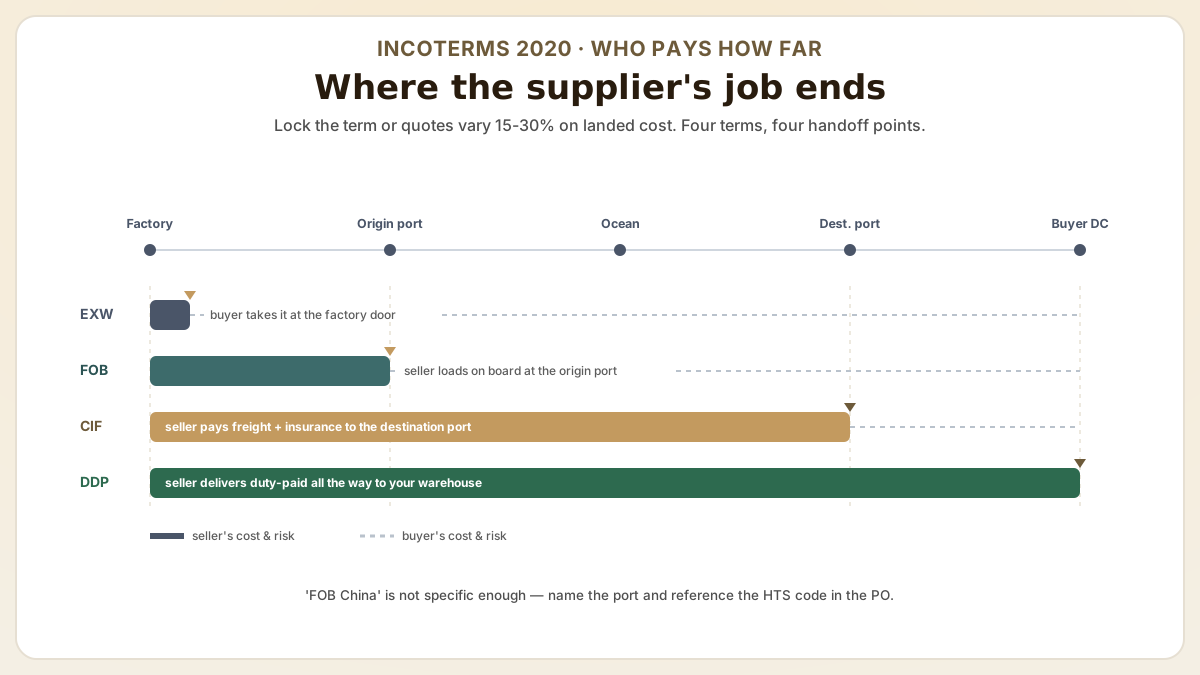
- EXW (Ex Works, factory door) — buyer takes risk and cost from the moment goods are placed at supplier's loading dock. Cheapest quote but buyer must arrange China-side trucking, customs export clearance, ocean / air freight, destination customs, duties, insurance and last-mile. Best for buyers with their own freight forwarder (DHL, Kuehne+Nagel, DSV, Expeditors). Often hides 10-15% extra unbilled supplier cost in 'arrangement fees' if you don't audit.
- FOB (Free on Board, port of departure) — supplier covers product to ship's loading at agreed Chinese port (Yantian, Shanghai, Ningbo, Qingdao). Buyer takes ocean freight, insurance and destination forward. Most common for RFID international sale because supplier handles the China-side complexity and buyer controls freight. Specify exact port — 'FOB China' is not specific enough.
- CIF (Cost, Insurance and Freight to destination port) — supplier pays freight and insurance to YOUR port of arrival (Long Beach, Hamburg, Felixstowe, etc.). Slightly higher quote but transparent shipping cost. Insurance minimum is ICC(C) which excludes water damage in transit — for high-value RFID cards always upgrade to ICC(A) all-risks via the supplier or directly.
- DDP (Delivered Duty Paid) — supplier delivers to your warehouse with all duties, taxes, customs, last-mile included. Highest quote but only one number to manage. Risk: in 2026, US Section 301 tariffs on China-origin smart cards (HTS 8523.52) and electrical equipment (HTS 8543.70) range 25-50% depending on chip class — supplier-paid DDP can hide tariff exposure if Section 301 changes. Always reference HTS code in PO.
- Required shipping documents — Commercial Invoice (with chip-level HS classification), Packing List (per-master-carton), Bill of Lading (Master and House for ocean), Certificate of Origin (Form A or RCEP for tariff preference where eligible), Fumigation Certificate / ISPM 15 stamp on wood pallets, and EU REACH SVHC declaration if shipping to EU. Missing documents = container held at port, $200-$2K per day demurrage.
HS codes, US Section 301 tariffs and EU duty math for 2026
Tariff classification determines whether your tag lands at $0.08 or $0.13 per unit. The four HS codes below cover 95% of RFID products, and the 2026 tariff posture for the three biggest import markets affects which products you can margin profitably.
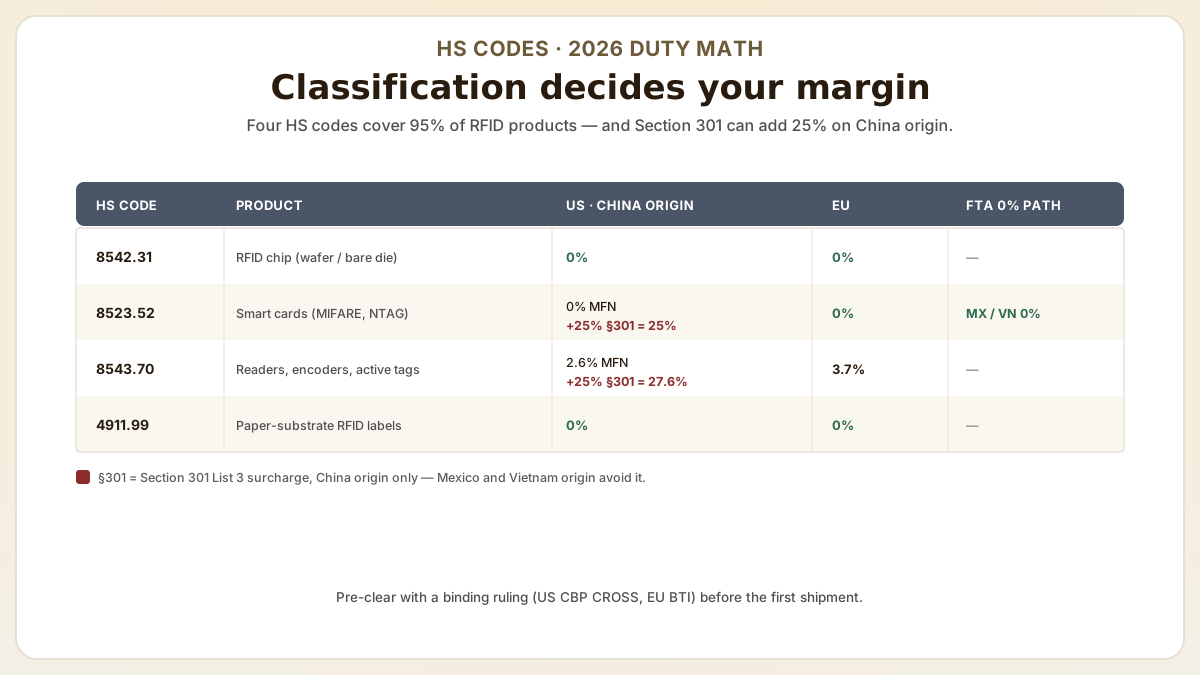
- HS 8542.31 — semiconductor devices (RFID chip in wafer or bare-die form). MFN duty 0% in US, EU, UK, Japan, Korea. This is the chip itself, before assembly into a tag.
- HS 8523.52 — smart cards (cards incorporating one or more electronic integrated circuits). Covers MIFARE / DESFire / NTAG / Java cards. US MFN 0% but Section 301 List 3 +25% on China origin; EU MFN 0% (no Section 301 equivalent); UK MFN 0%; Japan 0%; Australia 0%. Mexico and Vietnam origin currently 0% across all major markets — supply-chain diversification opportunity.
- HS 8543.70 — electrical machines and apparatus, having individual functions, not specified elsewhere (covers RFID readers, encoders, active tags). US MFN 2.6% + Section 301 List 3 +25% on China origin = 27.6% landed duty. EU MFN 3.7% (no Section 301). UK MFN 3.7%. Significant margin impact on reader hardware sourced from China.
- HS 4911.99 — printed matter not elsewhere specified (covers RFID labels with paper substrate where the inlay is not the primary classification, depending on customs broker interpretation). US MFN 0% + no Section 301 typical; EU MFN 0%; UK MFN 0%. Some brokers classify wet inlays here, others under 8542.31 — pre-clear with a binding ruling (CROSS database for US CBP, BTI for EU) to avoid surprise.
- Tariff-preference programmes — US-Mexico-Canada Agreement (USMCA) 0% on Mexico-assembled tags meeting regional-value-content rules; EU-Vietnam Free Trade Agreement (EVFTA) 0% on Vietnam-origin tags; RCEP tariff preferences within ASEAN+ Japan/Korea/Australia/NZ/China. Supplier should provide Certificate of Origin per the relevant FTA — captures 2.6-25% duty savings.
Useful next pages
Use these linked product, guide and comparison pages to keep the next click specific and practical.
Get the fillable template
This article covers the reasoning behind each question; the download is the actual document to send to suppliers.
RFID label and tag catalog
RAIN RFID and HF/NFC labels, with full datasheets and certification scope.
Reader and infrastructure references
Reader products and integration references suppliers should be ready to support.
Get an RFP-ready quote
We'll respond to your RFP with full pricing, MOQ, lead time, and certification scope.
Related supplier-vetting guides
Deeper playbooks for auditing, certifying and white-labeling the suppliers your RFP shortlists.
Incoterms 2020 and HS classification references
Official trade-term and tariff classification resources for international RFID procurement.
FAQ
How long should I give suppliers to respond to an RFP?
10-15 business days for a standard RFP. Shorter (5-7 days) for urgent procurement; longer (3-4 weeks) if RFP includes complex spec or sample-run requirement. Suppliers who request more than 15 days for a standard RFP are usually capacity-constrained — note this red flag.
Should I send the RFP to 3 or 10 suppliers?
3-5 is the sweet spot. Below 3 limits price discovery; above 5 dilutes supplier engagement (they sense long-shot opportunity and underinvest in response quality).
How do I verify a supplier's claimed certifications?
Each issuing body has a public verification page (ARC: arc.auburn.edu; ISO certificates: issuing certification body's website). Take 5 minutes to verify each certificate; it is the highest-ROI part of supplier evaluation.
What's a fair payment term for first orders?
30/70 (T/T 30% deposit, 70% on shipment after BL copy) is industry standard for established distributors. New distributors may face 50/50 or even 100% prepayment for first 1-2 orders. Establish payment-term reduction milestone in the contract for future orders.
Which payment terms can I realistically negotiate as a first-time buyer in 2026?
Most Chinese RFID factories accept these tiers. (1) 30/70 T/T — 30% wire transfer at PO, 70% wire on Bill of Lading copy, standard for established buyers; (2) 50/50 T/T — for first 1-2 orders to new buyers; (3) 100% T/T in advance — for very small orders or unknown buyers; (4) Letter of Credit at sight (L/C 0 day) — buyer's bank pays on doc presentation, common for $50K+ orders, costs 0.3-0.6% of order value; (5) L/C 60 / 90 / 180 day — supplier financed, costs 1-3% of order value. Avoid Western Union, PayPal, or Alibaba 'Trade Assurance' for orders above $20K — escrow protections are limited and recoveries take 6-12 months.
How do I structure penalty and SLA clauses in the RFP?
Three clauses are industry-standard and worth fighting for. (1) Liquidated damages for late shipment — 0.5-1.0% of order value per week late, capped at 5-10% (forcing supplier to escalate within their factory rather than absorb the delay quietly); (2) Defect-rate cap — supplier replaces defective tags free for first 1-2% defect rate; full credit + replacement above 2%. RFID retail-mandate inlay industry-norm defect rate is below 0.5%; (3) Chip-substitution penalty — full re-shipment + buyer's freight cost if supplier substitutes chip without written approval. Walmart, Target and Decathlon all use variants of these three clauses; pull from their public supplier manuals as starting language.
Sources & references
Primary standards, OEM datasheets and regulatory documents cited by this article. All URLs were verified on the access date shown below.
- ICC Incoterms® 2020 rules
- US Harmonized Tariff Schedule (HTS)
HS/HTS classification and Section 301 status lookup
Proud Tek is a Shenzhen-based RFID & NFC manufacturer supplying hotel chains, transit operators, event venues and retail brands worldwide. Every order includes free samples, RF testing and dedicated project support.
Get a Quick Quote
Tell us about your project and we'll respond within one business day. Fields marked (asterisk) are required.