
Distributor Programs
RFID Reseller Program
Distributor Margins
Quick answer
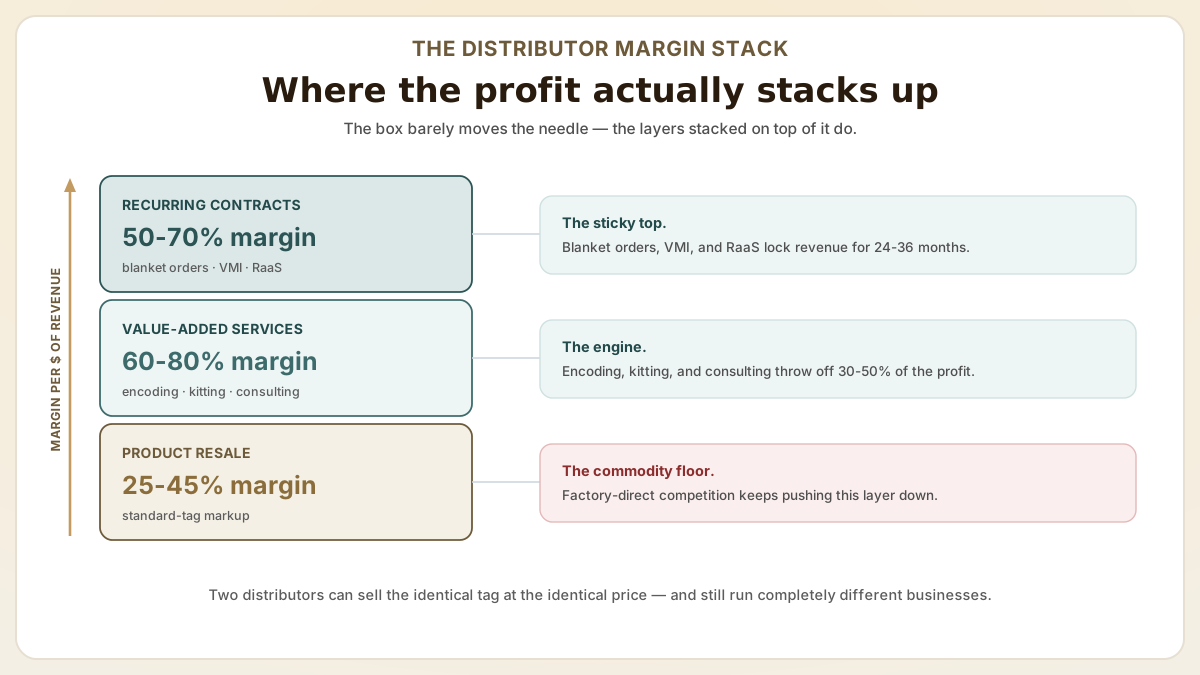
Healthy RFID distributor margins run 25-45% on standard tags and 35-60% on custom programs, but the real profit sits above the product: value-added services carry 60-80% margin, and a repeat customer is worth 3-5× a one-time buyer. This is the margin math that separates a markup reseller from a defensible business.
- Healthy RFID distributor gross margin runs 25-45% on standard tags and 35-60% on custom programs — wide variation reflects whether the distributor adds technical value or just marks up.
- Value-added services (encoding, application support, integration consulting) carry 60-80% margin and account for 30-50% of profit at well-run RFID distributors.
- Repeat customers deliver 3-5× the lifetime value of one-time buyers — programs that prioritize technical onboarding over price competition build sustainable margin.
At a glance
Use these short answers to decide whether this page matches the project before moving into the detail.
Key takeaway
Healthy RFID distributor gross margin runs 25-45% on standard tags and 35-60% on custom programs — wide variation reflects whether the distributor adds technical value or just marks up.
What's a healthy RFID distributor margin?
RFID distributor margins vary by product class, service depth and customer tier. Knowing the benchmarks tells you whether your existing pricing leaves money on the table...
Next step
Ready to move forward? Start your inquiry to get specific answers for this project.
Distributor partnership inquiryWhat's a healthy RFID distributor margin?
RFID distributor margins vary by product class, service depth and customer tier. Knowing the benchmarks tells you whether your existing pricing leaves money on the table or risks customer churn — and it starts with knowing what a single tag actually costs before you mark it up. The ladder below sorts the five product classes from thinnest commodity margin to fattest custom margin.
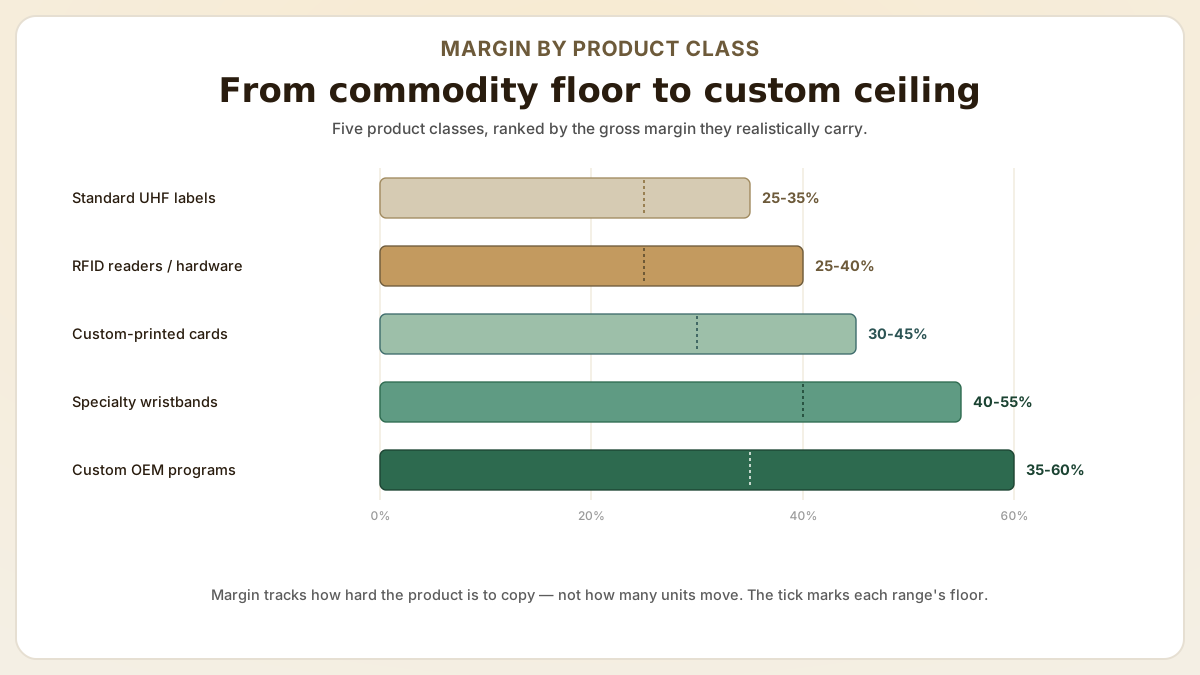
- Standard UHF labels (Walmart-mandate type): 25-35% gross margin. Commodity-priced; competitors abound. Margin pressure from direct-from-factory competition.
- Custom-printed RFID cards: 30-45% gross margin. Customization absorbs price comparison; longer customer relationship.
- Specialty wristbands and accessories: 40-55% gross margin. Lower volume but higher per-unit value; customers willing to pay for design and service.
- RFID hardware (readers, encoders): 25-40% gross margin. Lower than tags due to brand-pricing visibility (Impinj, Zebra publish list prices).
- Custom OEM programs: 35-60% gross margin. Highest variability — pricing power proportional to customization depth and switching cost.
Where does the real money come from?
Distributors who chase tag-resale revenue alone struggle on margin — the box moves, but almost none of the money sticks to it. The five revenue lines below are where a well-run RFID distributor actually earns its keep, ranked loosely by how much margin each one carries.
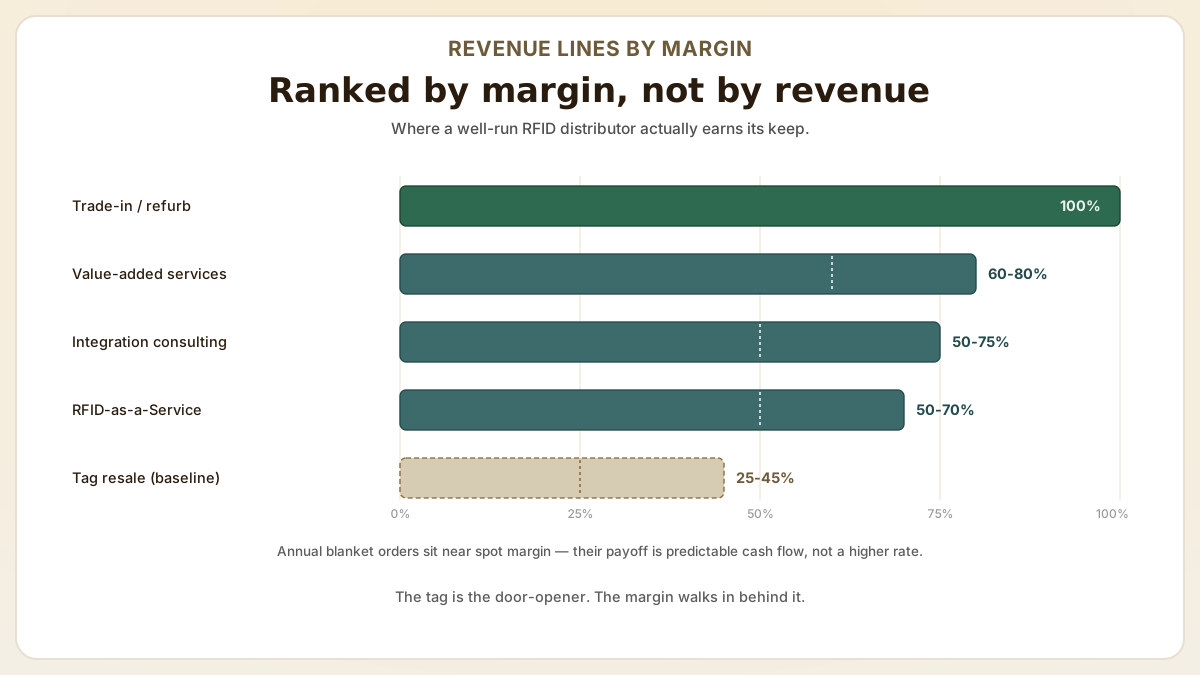
- Value-added services (encoding, programming, kitting): 60-80% gross margin. $0.05-0.50 per tag service charge on top of product price; nearly all incremental.
- Integration consulting and project work: 50-75% gross margin on day-rates ($800-2,000/day). Customers paying for project work convert to repeat product customers at 60%+ rate.
- Annual blanket orders with fixed pricing: lock customer for 12+ months and stabilize cash flow. Margin similar to spot but lower acquisition cost.
- RFID-as-a-service (RFID hardware lease + tag refill): emerging model with 50-70% margin and recurring revenue. Used by EAS-style and event-RFID distributors.
- Trade-in and refurbishment: take in old hardware, refurbish, resell. 100% margin on refurb sales; deepens customer relationship by managing lifecycle.
How do you protect margin against direct-from-factory competition?
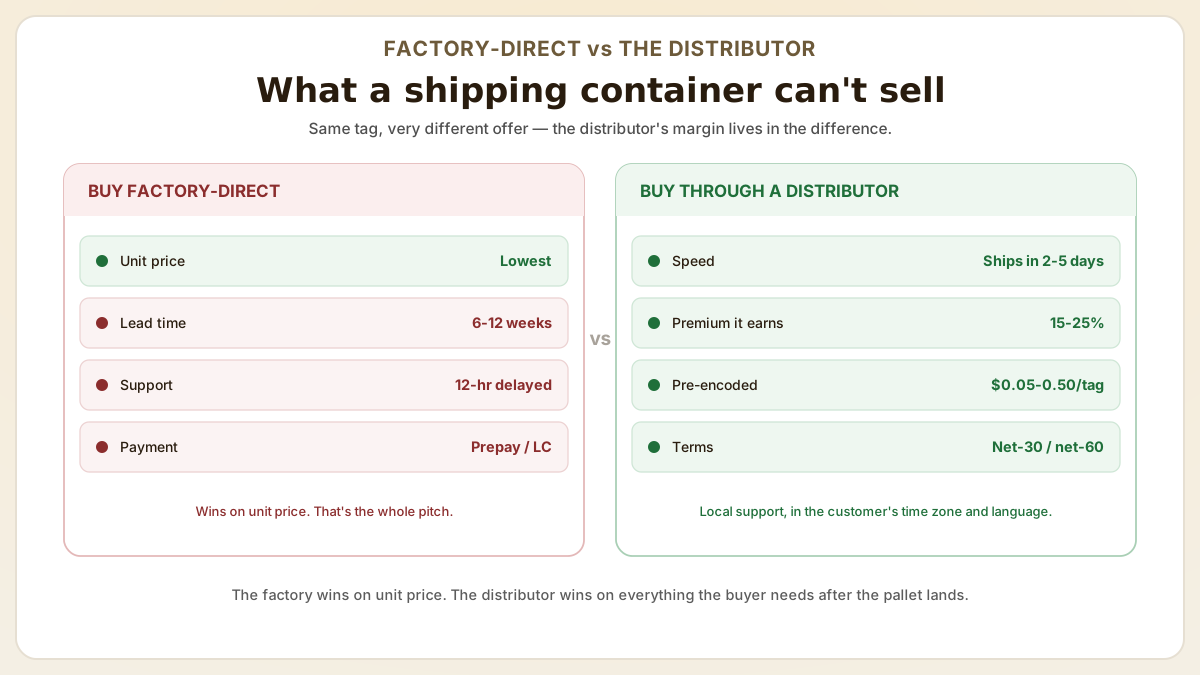
Chinese factories increasingly bypass distributors and sell direct online. Distributors who only resell tags get squeezed; those who add real value defend margin. (If you source from those factories yourself, a factory audit checklist is table stakes.) The five strategies below all come down to selling something a shipping container can't.
- Specialize by industry vertical: become THE healthcare RFID distributor or THE event-wristband distributor in your region. Vertical depth justifies pricing premium.
- Stock and immediate ship: factory-direct lead time is 6-12 weeks. Local stock turning in 2-5 days commands 15-25% premium for urgent need.
- Pre-encode and pre-program: factory ships generic; you ship customer-ready. Service charge $0.05-0.50 per tag; high margin.
- Provide local support: phone and email support in customer's time zone and language. Factory support is 12-hour delayed and language-limited.
- Offer financing and contracts: net-30 or net-60 payment terms; factory typically requires prepayment or letter of credit. Working-capital service is high-margin.
Annual contract structures that move margin from spot to recurring
Distributors that move 50-70% of revenue from spot to annual / recurring structures see 8-15 percentage points of margin lift, not because they raise prices but because they amortise customer-acquisition cost across 24-36 month relationships rather than single transactions. The five structures below are ordered roughly from the easiest to sell a customer on to the hardest.
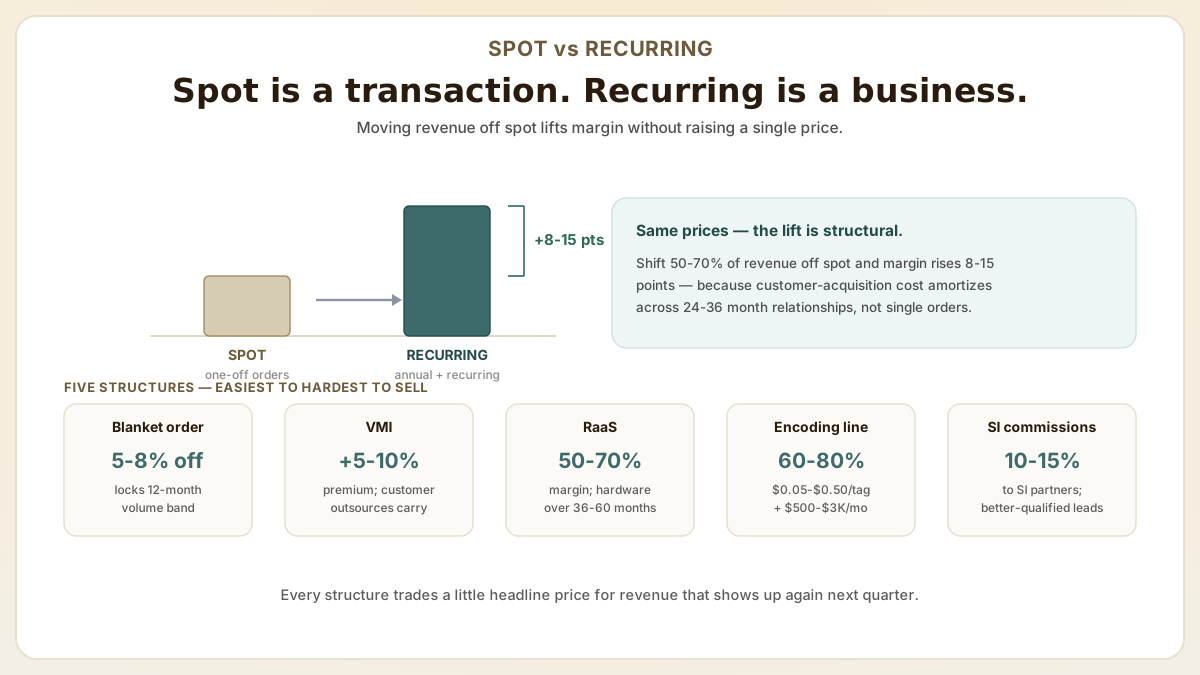
- Annual blanket order with rolling forecast — customer commits to 12-month volume range (e.g., 800K-1.2M units) at fixed unit price, with 90-day rolling forecast for shipping cadence. Distributor locks the factory price at ordered volume, gives customer 5-8% discount versus spot, and captures predictable cash flow. Most common for retail-mandate buyers (Walmart suppliers, apparel) and uniform / laundry programmes.
- Vendor-managed inventory (VMI) — distributor owns the stock at the customer's site or a 3PL bonded warehouse, replenishes per agreed min/max levels, invoices on consumption. Margin premium 5-10% versus traditional fulfilment because customer outsources inventory carrying cost. Standard for hospital asset-tracking (Cardinal Health / Owens & Minor model adapted to RFID), automotive Tier 1, and aerospace MRO.
- RFID-as-a-service (RaaS) — distributor leases the reader hardware (tunnel reader, fixed reader, handheld) and supplies tags as a service, charging $X per tag-cycle or per reader-month. Captures hardware margin over 36-60 months instead of single sale. Used by event-RFID (UHF wristbands for festivals, conferences), uniform rental, and pilot deployments. Margin 50-70% blended.
- Encoding and personalisation services as a recurring line — pre-encoded tags shipped daily / weekly to customer with serialised data tied to their ERP. Service fee $0.05-$0.50 per tag plus a $500-$3K monthly minimum. Margin 60-80% on the service fee.
- Channel partner / agent commissions to system integrators — 10-15% commission to SI partners (RFID4U, Avery Dennison Solution Partners, Impinj Authorized Solution Partners, Zebra PartnerConnect Gold) on referred deals. Lower top-line margin but better-qualified customers and 2-3x conversion rate versus cold direct sales.
Pricing-power benchmarks by vertical and product class for 2026
Understanding what other distributors actually charge by vertical anchors negotiation. The benchmarks below are aggregated from public bid data, RFID Journal annual price surveys, Auburn University RFID Lab benchmark reports, and industry distributor self-reported margins. (The retail-mandate row leans on GS1 serialization — the GS1 EPC encoding guide covers how those SGTINs are structured.)
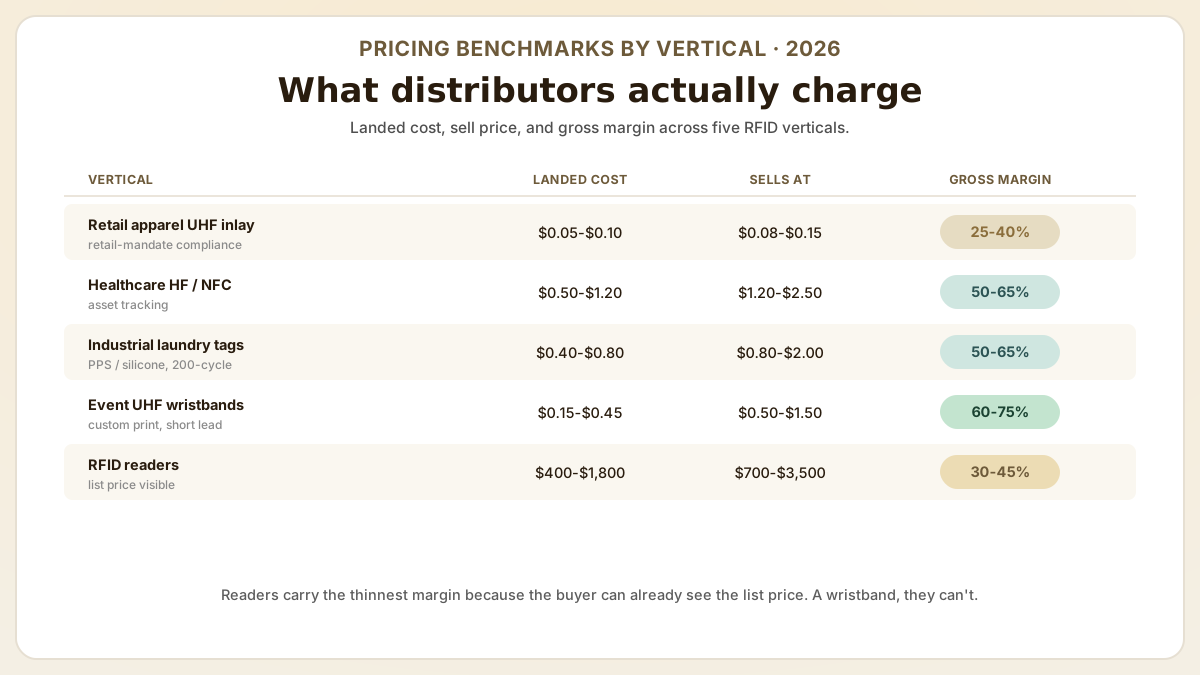
- Retail apparel UHF inlay (Walmart / Target / Macy's mandate compliance) — landed cost $0.05-$0.10, distributor sells at $0.08-$0.15, gross margin 25-40%. Highly competitive; Avery Dennison, SML Group, Checkpoint Systems and Walmart-direct programmes compress margin. Differentiator: in-house encoding, GS1 SGTIN management, ARC-certified tag support letter.
- Healthcare HF / NFC tags (DESFire EV3, NTAG 424 DNA, MIFARE Plus EV2) for asset tracking — landed cost $0.50-$1.20, distributor sells at $1.20-$2.50, gross margin 50-65%. Lower volume, higher service content. Customer base concentrated (Owens & Minor, Cardinal Health, Henry Schein, McKesson plus regional GPO suppliers).
- Industrial laundry tags (PPS / silicone, 200-cycle rated) — landed cost $0.40-$0.80, distributor sells at $0.80-$2.00, gross margin 50-65%. Bundled with sewing service ($0.50-$1.00 per piece) which is 70%+ margin. Cintas, UniFirst, ALSCO, Aramark, Sodexo Linen are the dominant US buyers.
- Event UHF wristbands — landed cost $0.15-$0.45, distributor sells at $0.50-$1.50, gross margin 60-75%. Event-specific custom print and short lead time justifies premium. Coachella, Bonnaroo, Tomorrowland, ID&T Sensation, Live Nation festivals are the volume buyers.
- RFID readers (Impinj R420 / R700 / R720, Zebra FX9600, ThingMagic M6e Nano, Nordic ID Sampo S2) — landed cost $400-$1,800, distributor sells at $700-$3,500, gross margin 30-45%. Lower margin than tags because list pricing is public; distributor value is integration, training, antenna mounting, and post-sale support.
Useful next pages
Use these linked product, guide and comparison pages to keep the next click specific and practical.
Reseller-tier RFID products
RFID label, card, tag, and keyfob SKUs available at distributor wholesale pricing.
Reader and accessory wholesale
Reader products with margin-friendly distributor pricing.
Apply for our reseller program
Volume tiers, NDR pricing, marketing co-op, and 30-day terms for qualified distributors.
Industry pricing references
Public benchmarks for RFID tag, reader, and service pricing across verticals.
Related reading
More RFID channel-partner guides from the blog.
FAQ
What's a fair markup on RFID tags?
Industry norm is 1.4-2.0× factory cost (40-100% markup, 28-50% gross margin) for standard tags. Custom programs warrant 1.6-2.5× (60-150% markup, 38-60% gross margin). Below 1.4× you cannot cover sales, support and inventory costs.
How much should I charge for encoding service?
$0.05-0.30 per tag for standard encoding (URL or simple data). $0.30-1.00 for custom encoding logic, batch tracking, or per-customer configuration. Most distributors charge as a separate line item to defend margin transparency.
How do I price an integration consulting engagement?
Day-rates $800-2,000/day depending on RFID-system complexity and consultant seniority. Project pricing $5K-50K for typical SMB integration; $50K-500K for enterprise. Always price by value delivered, not hours worked.
Should I drop-ship from the factory or stock locally?
Drop-ship for low-margin commodity tags where speed-to-market is critical. Stock locally for high-margin custom items, urgent-fulfillment scenarios and customers willing to pay for instant availability. Most distributors do both, depending on SKU.
How do I price a multi-year RaaS (RFID-as-a-Service) contract correctly?
Build the model bottom-up. (1) Tag cost per cycle = tag price / expected wash or re-use cycles (e.g., $0.60 PPS / 250 cycles = $0.0024 per tag-use); (2) reader CapEx amortised over 60 months (e.g., $5K tunnel reader / 60 = $83/month); (3) software / integration / monitoring labor $300-$1,500/month; (4) gross margin target 50-65%; (5) priced as a per-tag-cycle or per-month-per-reader subscription. Add 12-month auto-renewal with 60-day cancellation, 5-7% annual price escalator, and a make-whole clause if customer terminates early. Industry benchmark monthly RaaS for a single tunnel reader plus 5K active tags is $1,200-$2,800/month.
What's the realistic conversion from project consulting to recurring product revenue?
60-75% conversion if the consulting engagement was successful (pilot delivered on-time, on-budget, with ROI evidence). 30-40% if the pilot was late or under-delivered. Drives a strategic pricing decision: many distributors price consulting at break-even ($800-$1,500/day instead of typical $1,500-$2,500/day) explicitly to use it as a customer-acquisition channel for high-margin tag and service revenue. Tracking metric: lifetime value (LTV) of project-converted customers should be 3-5x acquisition cost (CAC), versus 1.5-2x for cold-acquired direct sales.
Sources & references
Primary standards, OEM datasheets and regulatory documents cited by this article. All URLs were verified on the access date shown below.
- GS1 — EPC Tag Data Standard (SGTIN encoding)
Defines the SGTIN serialization behind the retail-mandate inlays in the vertical pricing benchmarks.
- Auburn University RFID Lab — ARC Program
Tag performance and quality certification plus approved-inlay lists behind the ARC-certified tag and benchmark references.
Proud Tek is a Shenzhen-based RFID & NFC manufacturer supplying hotel chains, transit operators, event venues and retail brands worldwide. Every order includes free samples, RF testing and dedicated project support.
Get a Quick Quote
Tell us about your project and we'll respond within one business day. Fields marked (asterisk) are required.