
NFC Supplier for Japanese Market
NFC Supplier for Japan
Tags, Cards & Inlays

Quick answer
Proud Tek supplies NFC and UHF RFID to Japan factory-direct from Shenzhen with Japanese-market spec sheets. Japan runs contactless on two tracks: HF at 13.56 MHz — where our NFC Forum NTAG and MIFARE products sit alongside the FeliCa infrastructure behind Suica and Osaifu-Keitai — and UHF in the 920 MHz band for retail and logistics. The one fact that decides a UHF order: Japan's RAIN band is 916.7-920.9 MHz (high-power, up to 1 W / 4 W EIRP) under MIC's Radio Act and ARIB STD-T106, so inlays are tuned for the 920 MHz band — EU 865-868 MHz stock reads short. Express air reaches Tokyo, Osaka and Nagoya in 3-5 business days; RFID proximity cards and tags enter at 0% import duty (HS 8523.52) with 10% consumption tax, and DDP is available.
- Band-correct for Japan — UHF inlays tuned for the 920 MHz band (916.7-920.9 MHz, up to 1 W / 4 W EIRP) under MIC's Radio Act and ARIB STD-T106, not the EU 865-868 MHz band that reads short here; HF NFC products run at 13.56 MHz.
- NFC that fits Japan — NFC Forum NTAG 213, NTAG 216 and NTAG 424 DNA authentication tags, plus MIFARE and ICODE SLIX2, all tapping on Japanese phones alongside the FeliCa ecosystem (we supply NFC Forum and MIFARE, not FeliCa).
- Landed, not just priced — express air to Tokyo, Osaka and Nagoya in 3-5 business days, 0% import duty on proximity cards and tags (HS 8523.52), 10% consumption tax, and DDP quoted up front.
At a glance
Use these short answers to decide whether this page matches the project before moving into the detail.
Japanese band and radio rules
UHF RFID in Japan operates in the 920 MHz band under MIC's Radio Act: 916.7-920.9 MHz for high-power passive readers (up to 1 W conducted / 4 W EIRP) under ARIB STD-T106...
Type approval (Giteki)
Radio transmitters sold in Japan carry the Giteki (Technical Conformity Mark) under the Radio Act, assessed by MIC-registered certification bodies such as TELEC. For RFI...
Next step
Ready to move forward? Start your inquiry to get specific answers for this project.
Request NFC pricing for Japan- Landed cost
-
RFID cards and tags classify under HS 8523.52.010 ("Proximity cards and tags"), which Japan's tariff schedule lists at a Free — 0% — duty rate, because smart cards are covered by the WTO Information Technology Agreement. What remains is the 10% Japan Consumption Tax on the customs value at import. Incoterms EXW, FOB or DDP; DDP includes freight, tax and clearance.
- Logistics
-
Express air via DHL/FedEx from Shenzhen to Tokyo, Osaka and Nagoya in 3-5 business days — one of our fastest lanes; sea freight for bulk. Quality to Japanese incoming-inspection expectations: 100% electrical testing and AQL 1.0 sampling. Free sample kits ship to Japanese addresses for reader-compatibility testing before a bulk order.
RFID and NFC for the Japanese market
Everything below ships from one Shenzhen line with Japanese-market spec sheets: 920 MHz-band-tuned UHF inlays for retail and logistics, NFC Forum tags for consumer engagement and brand authentication, and 13.56 MHz cards that drop into access-control estates. Sourcing the cheapest generic inlay is the classic mistake — band and reader fit come first.
- UHF inlays and labels tuned for the 920 MHz band (916.7-920.9 MHz) — the Japanese RAIN band — for retail item-level tagging, apparel, logistics and asset tracking.
- NTAG 213 and NTAG 216 NFC stickers and tags — NFC Forum Type 2 — for consumer engagement, smart packaging and multilingual tourism information.
- NTAG 424 DNA authentication tags for Japanese luxury, cosmetics and electronics brands fighting counterfeiting at home and in export markets.
- NFC wet and dry inlays for Japanese label converters and packaging companies building custom solutions.
- ICODE SLIX2 (ISO/IEC 15693) tags for Japanese library systems and industrial applications.
- NFC and MIFARE cards — PVC, metal and premium materials — for business networking (meishi) and membership, alongside the FeliCa infrastructure Japanese phones also read.
Get the band right: Japan's 920 MHz band under MIC and ARIB
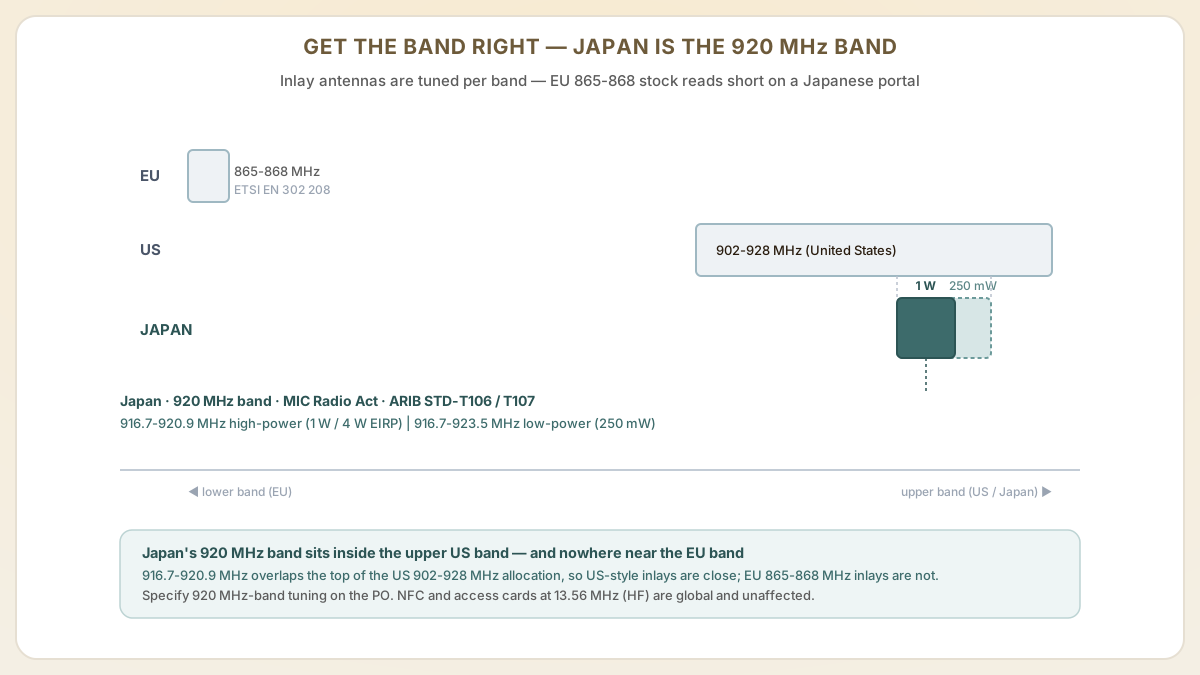
The single most expensive mistake in cross-border RFID sourcing is band mismatch. Japan's UHF RAIN band lives in the 920 MHz band — 916.7-920.9 MHz for high-power (up to 1 W / 4 W EIRP) readers under MIC's Radio Act and ARIB STD-T106, and 916.7-923.5 MHz for specified-low-power (250 mW) devices under ARIB STD-T107. It sits inside the upper part of the US 902-928 MHz allocation but nowhere near the EU 865-868 MHz band, so EU-tuned inlays read short. Order 920 MHz-band tuning on the PO, and see our LF vs HF vs UHF guide or RAIN RFID explainer if you are new to frequency planning.
| Parameter | Japan (MIC / ARIB) | European Union (ETSI EN 302 208) | Why it matters to your order |
|---|---|---|---|
| UHF RFID band | 916.7-920.9 MHz (high-power); 916.7-923.5 MHz (low-power) | 865-868 MHz | Inlay antennas are tuned per band — specify 920 MHz-band tuning on the PO |
| Max reader power | 1 W conducted / 4 W EIRP (ARIB STD-T106); 250 mW (ARIB STD-T107) | 2 W ERP (865-868 MHz) | Two device classes — the 1 W high-power reader is a registered premises or land-mobile station |
| Band-sharing method | Carrier sense (listen-before-talk) | Listen-before-talk plus four 200 kHz channels | Japan shares the band by LBT, not US-style pure frequency hopping — a site-design detail, not a tag-tuning one |
| Regulator and standard | MIC under the Radio Act; ARIB STD-T106 / T107 | ETSI EN 302 208 under the Radio Equipment Directive | Different rulebooks, same physics — the antenna, not the silicon, sets the band |
| Who holds the approval | The reader carries the Giteki mark; passive tags are field devices | The interrogator is the CE / RED-marked device | Passive tags are tuned, not certified — ask for the reader's Giteki number and the tag's tuning data |
| Access-control (HF) | 13.56 MHz — global (NFC Forum / MIFARE); FeliCa coexists | 13.56 MHz — global | HF cards are unaffected by the UHF band split |
Japanese compliance: the Radio Act, the Giteki mark and APPI
Two frameworks decide whether a shipment is clean into Japan — radio conformity and data. Below is the honest map for China-sourced RFID; for the credential-level stack, our access-control solution covers readers and encoding.
| Rule | What it actually covers | Straight answer for China-sourced RFID |
|---|---|---|
| Radio Act, administered by MIC | Authorises the 920 MHz band for RFID via ARIB STD-T106 (1 W) and STD-T107 (250 mW) | Order 920 MHz-band tuning; the reader is the regulated radio station, the passive tag is a field device |
| Giteki — Technical Conformity Mark | Type-conformity for radio transmitters under the Radio Act, assessed by MIC-registered bodies such as TELEC | The reader/interrogator carries the Giteki mark; passive backscatter tags fall below the threshold and are exempt — ask your reader vendor for the Giteki number |
| ARIB STD-T106 / STD-T107 | The technical standards for high-power (premises/land-mobile) and specified-low-power 920 MHz RFID | Our UHF inlays use ISO/IEC 18000-63 Gen2 silicon tuned to the Japanese band; conformance is a reader-plus-tag system property |
| APPI (Act on the Protection of Personal Information) | Handling of personal data, including cardholder credential data, under the PPC | A credential-data concern for your system, not the card blank — encode the minimum and manage it in your back end |
| ISO/IEC 14443 & 18000-63 | The HF card and UHF air-interface standards our products implement | MIFARE/DESFire cards are ISO/IEC 14443; UHF inlays are ISO/IEC 18000-63. Japan's domestic FeliCa is a separate JIS X 6319-4 ecosystem we do not supply |
Landed cost: HS 8523.52, 0% duty and 10% consumption tax
The unit price is the headline; the landed cost is the story. For Japan the plot is short — the HS line is duty-free and the tax is a flat 10%. Our RFID RFP template shows the quote-comparison math in full; the short version is below.
- Ask for the HS 8523.52 classification on the commercial invoice; RFID cards and tags fall under statistical code 8523.52.010, "Proximity cards and tags," at 0% duty.
- Consumption tax is charged on the customs value plus duty, and is generally creditable for a tax-registered importer — a cash-flow line, not a sunk cost.
- DDP converts a variable border bill into one fixed landed price agreed before the goods ship.
| Incoterm | Freight | Japanese duty + consumption tax | Customs clearance | Choose it when |
|---|---|---|---|---|
| EXW Shenzhen | You arrange from our dock | You pay 10% tax at import (duty is 0%) | Your broker | You run your own freight programme |
| FOB Shenzhen / Yantian | We deliver to the port; you book the vessel | You pay 10% tax at import | Your broker | Sea-volume buyers with a Japanese forwarder |
| DDP your address | We handle door to door | Included in the price (0% duty, 10% tax) | We arrange | You want one all-in landed number and no border admin |
Logistics: Shenzhen to Tokyo, Osaka and Nagoya in 3-5 days
Shenzhen sits a short hop from Japan, so this is one of our fastest lanes — and the time zones nearly overlap, which keeps an RFQ-to-quote loop inside a single working day. For the freight-mode math, see air vs sea freight for RFID orders.
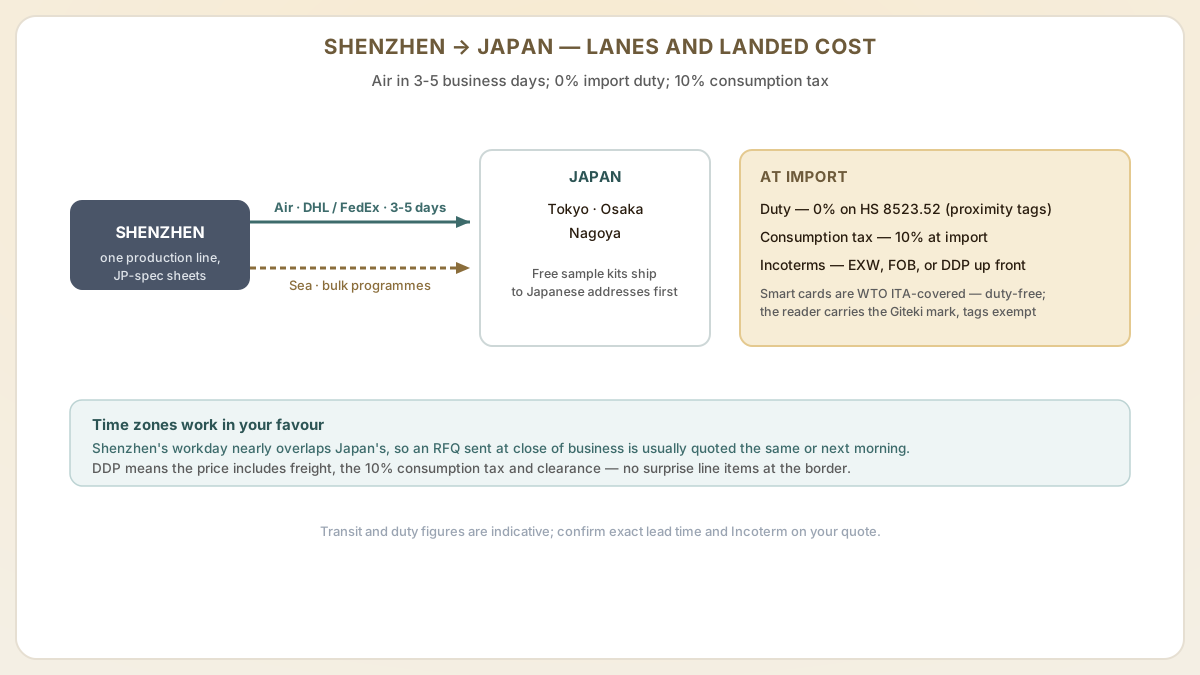
- Express air via DHL/FedEx from Shenzhen to Tokyo, Osaka and Nagoya in 3-5 business days — Japan is one of our fastest lanes; sea freight for bulk programmes.
- Free sample kits ship to Japanese addresses for compatibility testing against your existing readers before a bulk order.
- Quality documentation to Japanese incoming-inspection expectations: 100% electrical testing, AQL 1.0 sampling and per-shipment test reports.
How a Japanese order runs, step by step
No mystery, no time-zone roulette — this is the cadence a first Japanese order follows from RFQ to receiving dock.
- Day 0 — RFQ
Send specs, artwork or a competitor datasheet, plus the reader model for UHF. You get a quote with 920 MHz-band tuning specified and an Incoterm (EXW / FOB / DDP).
- Days 1-5 — free samples
Sample kits ship by DHL express to your Japanese address, UHF samples tuned to the 920 MHz band so the test reflects field conditions. Custom-printed samples take a few days longer.
- Artwork approval — the gate
Production starts only after you sign off artwork and encoding spec. Changes cost nothing before this gate.
- Days 5-12 — production + QC
Standard production runs 5-7 business days with 100% electrical testing and AQL 1.0 inspection; every encoded card gets a functional read test before packing.
- Days 8-12 — DDP delivery
Express air lands the goods in Tokyo, Osaka or Nagoya with the 10% consumption tax and clearance settled. The compliance pack travels with the shipment.
Proof a Japanese buyer can verify without a plant visit
Proud Tek supplies NFC and RFID to Japanese businesses, technology companies and system integrators — but don't take a market page's word for it. Verify us the way you would audit any China factory: check certificates with the issuing registrar using our ISO verification guide, then work through the China factory audit checklist.
- ISO 9001:2015 certified quality management system — verify the certificate number with the issuing registrar, not just the PDF.
- 100% electrical testing and AQL 1.0 sampling on every card and tag, with a functional test report in the shipment — the documentation Japanese incoming inspection expects.
- Standards conformance: ISO/IEC 14443 and 15693 for HF cards, ISO/IEC 18000-63 for UHF inlays, with 920 MHz-band tuning confirmed in writing on the PO.
- NXP chip authenticity: NFC chips sourced through authorised NXP distribution with full traceability documentation.
- Per-shipment compliance pack: Certificate of Origin, radio-compliance documentation, RoHS/REACH declarations, and an HS-coded commercial invoice.
- NDA and exclusivity agreements for custom designs, meeting the IP-protection standards Japanese technology companies expect.
Useful next pages
Use these linked product, guide and comparison pages to keep the next click specific and practical.
NFC products for Japanese customers
Browse NFC tags, stickers and inlays for the Japanese market.
Japan compliance and cost reading
The guides Japanese procurement teams pair with this page.
FAQ
Which UHF band do your tags use for Japan?
Japan's UHF RAIN band is the 920 MHz band: 916.7-920.9 MHz for high-power readers (up to 1 W conducted / 4 W EIRP) under ARIB STD-T106, and 916.7-923.5 MHz for specified-low-power (250 mW) devices under ARIB STD-T107, both regulated by MIC under the Radio Act. We tune passive inlays for the 920 MHz band. EU 865-868 MHz inlays read short on a Japanese portal and are not a drop-in. HF NFC and access cards at 13.56 MHz are global and unaffected — specify 920 MHz-band tuning only for UHF inlay and label orders.
Do your NFC products work with Japanese smartphones and alongside FeliCa?
Yes. Japanese iPhones and most Android phones sold in Japan (Sony Xperia, Sharp Aquos, Samsung Galaxy) read both FeliCa (Type F) and NFC Forum (Type 2/4). Our NTAG-based tags comply with NFC Forum Type 2 and Type 4 and tap on any NFC-enabled Japanese smartphone. Note that we supply NFC Forum and MIFARE/ICODE products, not FeliCa chips — FeliCa is Sony's separately licensed ecosystem (Suica, Osaifu-Keitai). Our HF products coexist with it; they do not replace it.
Do passive RFID tags need their own Giteki certification in Japan?
No. Under the Radio Act the type-conformity obligation — the Giteki (Technical Conformity Mark) — sits with the radio transmitter, which for RFID is the reader/interrogator. Passive UHF and NFC tags backscatter the reader's field and fall below the Radio Law's field-strength threshold, so they are exempt from mandatory Giteki certification. What matters is that the tag antenna is tuned for the 920 MHz band and the reader carries a valid Giteki number — ask your reader vendor for it, and ask us for the tag tuning data.
How do Japanese import duty and consumption tax work on an order?
RFID cards and tags classify under HS 8523.52.010 ("Proximity cards and tags"), which Japan's tariff schedule lists at a Free — 0% — duty rate because smart cards are covered by the WTO Information Technology Agreement. So there is no import tariff regardless of origin, and RCEP adds nothing on this line. The remaining cost is the 10% Japan Consumption Tax on the customs value at import, generally creditable for a registered business. On a DDP quote, freight, consumption tax and clearance are included in the price up front — confirm the classification with your customs broker.
What is the total delivery time to Japan including production?
Japan is one of our fastest destinations. Express air freight from Shenzhen to Tokyo, Osaka or Nagoya takes 3-5 business days; with standard production of 5-7 business days, most orders arrive within 8-12 days of confirmation. Bulk programmes on sea freight take longer and are planned against a blanket agreement.
What is the minimum order quantity for Japanese buyers?
MOQ depends on the product and personalisation and is quoted per order with your target tag or card, artwork and annual volume. Free samples for compatibility and quality testing are available before any commitment — request them with your reader model and use-case.
Sources & references
Primary standards, OEM datasheets and regulatory documents cited by this article. All URLs were verified on the access date shown below.
- ARIB STD-T106 — 920 MHz-Band RFID Equipment for Premises Radio Station and Land Mobile Radio Station
Primary source for Japan's high-power passive RFID band 916.7-920.9 MHz and the 1 W premises / land-mobile radio station class under MIC's Radio Act.
- ARIB STD-T107 — 920 MHz-Band RFID Equipment for Specified Low Power Radio Station
Primary source for the specified-low-power 916.7-923.5 MHz band at 250 mW — the licence-free RFID class.
- MIC Radio Use Portal — Technical Regulations Conformity Certification System (Giteki)
Radio Act conformity framework: radio transmitters carry the Technical Conformity (Giteki) Mark; MIC-registered bodies such as TELEC assess it. Passive backscatter tags are field devices, not certified transmitters.
- GS1 — Regulatory status for using RFID in the UHF band
Global country-by-country UHF RAIN allocation reference; cross-reference for Japan's 920 MHz band versus the US and EU allocations.
- ETSI EN 302 208 — RFID equipment in the 865-868 MHz band
The EU band cited in the comparison (865-868 MHz at 2 W ERP) — why EU-tuned inlays differ from Japanese 920 MHz tuning.
- Japan's Tariff Schedule (2026) — heading 85.23, HS 8523.52.010 "Proximity cards and tags"
Official schedule listing RFID proximity cards and tags (8523.52.010) at a Free (0%) general duty rate — smart cards are WTO ITA-covered.
- Japan Customs — Outline of Tariff and Duty Rates System (consumption tax on imports)
Consumption tax on imported goods is 10% (standard rate), assessed on the customs value plus customs duty payable.
Proud Tek is a Shenzhen-based RFID & NFC manufacturer supplying hotel chains, transit operators, event venues and retail brands worldwide. Every order includes free samples, RF testing and dedicated project support.
Get a Quick Quote
Tell us about your project and we'll respond within one business day. Fields marked (asterisk) are required.