
RFID Card Printing Service
Custom RFID Card Printing
Full-Color Branding

Quick answer
Proud Tek prints custom RFID and NFC cards in-house on the same Shenzhen lines that laminate and encode them — CMYK offset for volume runs, UV digital for short runs and white ink, screen printing for metallic and opaque effects, thermal transfer for variable data, and laser engraving for metal and premium cards. Every card is built to the ISO/IEC 7810 ID-1 format (85.6 × 54 mm, 0.76 mm), printed at 300 DPI with CMYK-plus-Pantone colour matching, then finished, personalised and chip-encoded to your data. This page is the print-and-finish reference: the process menu, the artwork-file specs prepress checks on every job, the proofing and colour-matching loop, and the QC records a procurement team can verify before a five-figure run goes to press. For chip data and programming detail, see the card encoding service.
- Five print processes in-house: CMYK offset for high-volume runs, UV digital for short runs and prototypes, screen printing for white-ink and metallic overlays, thermal transfer for variable data, and laser engraving for premium cards.
- Any RFID chip: combine custom printing with MIFARE, NTAG, DESFire, EM, T5577 or UHF chips based on your application.
- Premium finishing: spot UV, hot foil stamping, embossed numbering, magnetic stripes, signature panels and holographic overlays — with a digital or printed proof approved before any production run.
At a glance
Use these short answers to decide whether this page matches the project before moving into the detail.
What Proud Tek prints
Custom RFID and NFC cards printed and finished in-house — PVC, frosted and transparent PET, composite, metal and wood bodies — using CMYK offset, UV digital, screen, the...
Print, finish and personalise
Full-colour CMYK at 300 DPI with Pantone spot matching; finishes from spot UV, hot foil and matte lamination to magnetic stripe and signature panels; per-card names, pho...
Next step
Ready to move forward? Start your inquiry to get specific answers for this project.
Start your card printing project- How ordering works
-
A digital proof on every order and a printed, press-calibrated proof for Pantone-critical brands; free samples of standard products (typically 3-5 pieces) with credited custom proofs; UV digital short runs from 100 pcs, CMYK offset volume from 500 pcs, quoted per program by process and finishing.
- Proof to pull first
-
ISO/IEC 7810 dimensional QC, 100% chip read-verification on encoded cards, and ISO 9001, ISO 14001 and ISO 45001 quality records — with RoHS and REACH SVHC material declarations per shipment, all verifiable before you commit.
What custom RFID card printing actually covers
'Custom card printing' can mean a logo dropped onto a stock white card, or a credential engineered from the artwork in. Proud Tek means the second: five print processes run in-house on the same lines that laminate and encode the card, so the print, the finish and the chip data are one job with one owner — not three vendors pointing at each other. Match the process to your run size and the effect you need; the card material guide covers the bodies those processes print on. The numbers below are the ones a print buyer checks first.
- CMYK offset — photo-quality full colour at 300 DPI once the plates are made, the most consistent choice for volume runs and the reason it owns orders from 500 pcs up.
- UV digital — no plate-making, so it owns short runs from 100 pcs, prototypes and rush work, and prints opaque white ink on transparent and dark card bodies.
- Screen printing and hot stamping — opaque white, metallic and foil effects that four-colour process cannot reproduce, pressed into the card surface.
- Thermal transfer — per-card names, photos, sequential numbers, barcodes and QR codes for badges, student IDs and membership programs, run as their own pass over the base artwork.
- Laser engraving — permanent marking and serialisation for metal and wooden cards, the one process that cannot wear, fade or be lifted off.
- Security printing — micro-text, guilloche, UV-fluorescent ink and holographic overlay lamination for tamper-resistant government, corporate and financial cards.
The print-and-finish capability menu
This table is the fast way to see how your card gets built — body, print method, finish, personalisation and the chip encoding that rides along. Every card leaves on the ISO/IEC 7810 ID-1 footprint (85.6 × 54 mm), so it drops into any standard reader, wallet or issuance printer; the body and process decide the look and the run economics. Strong starting points are the printed loyalty card and the metal business card; the transparent NFC card shows what UV white ink does on a clear body.
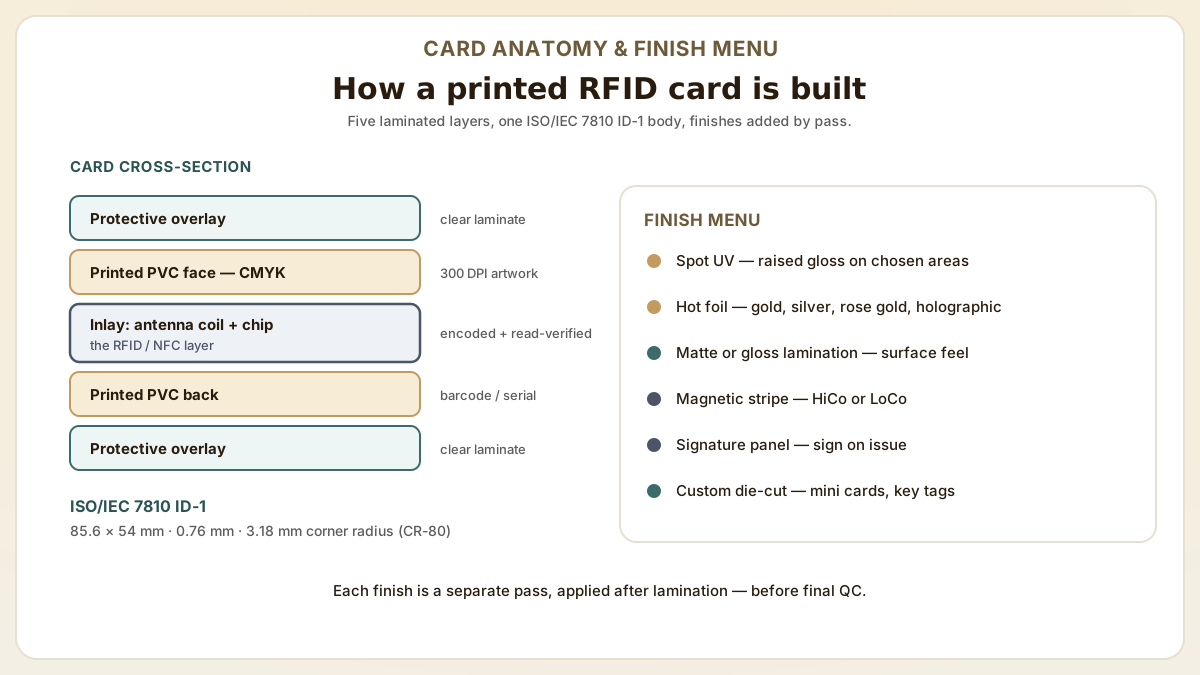
- Finishing is a separate production pass, so effects add cost individually — pick the one or two that carry the design rather than stacking all of them. Spot UV, hot foil (gold, silver, rose gold or holographic), embossed numbering, signature panels and custom die-cut shapes are applied in-house after lamination and before final QC.
- Magnetic stripe lamination — HiCo or LoCo — and a contact smart-card module (ISO 7816) can be added for hotel-lock, transit and dual-interface cards that need both contactless and legacy compatibility.
- Print on any card chip we stock and allocate directly from NXP, Impinj and EM — MIFARE Classic and DESFire, NTAG 213/215/216, NTAG 424 DNA, EM4200 or UHF UCODE 9 — each encoded and 100% read-verified to ISO/IEC 14443 before it ships (data detail on the encoding service).
| Card body | Print method | Finish options | Personalisation & encoding | Typical MOQ |
|---|---|---|---|---|
| Standard PVC card | CMYK offset or UV digital | Gloss or matte lamination, spot UV | Name / photo / serial + chip encoded & read-verified | 500 pcs offset / 100 pcs digital |
| Frosted / transparent PET | UV digital (white ink) | Matte, spot UV | Variable QR / serial + chip encoded | 100 pcs |
| Composite PVC/PET (dual-interface) | CMYK offset | Gloss, signature panel, magnetic stripe | Contact module (ISO 7816) + contactless encoding | 500 pcs |
| Metal / hybrid metal card | Laser engraving + screen print | Brushed, etched, hot foil | Laser serial + chip encoded | Quoted per program |
| Wood / eco card | UV digital + laser | Natural matte, laser mark | Laser serial + chip encoded | Quoted per program |
| Prelam / inlay for card makers | Screen or offset | To converter spec | Bare or pre-encoded | Quoted per program |
Artwork files that print right the first time
Most print delays are artwork delays, and nearly all of them are fixable at file handoff instead of on the proof. Prepress checks every incoming file against the specs below and flags anything that fails with a free correction pass — a web-resolution logo caught on day one costs nothing; the same logo caught on a printed proof costs a week. Send only brand guidelines and a logo and the design team builds the print-ready layout, chip and antenna zones included, at no charge.
| Requirement | What prepress needs | Why it matters |
|---|---|---|
| File format | Vector .ai or print-ready PDF (PSD, CDR, high-res PNG/JPEG accepted) | Vector art stays crisp at any size and separates cleanly for plates |
| Resolution | 300 DPI minimum at final card size | Web-resolution logos are the single most common rejection reason |
| Bleed | 3 mm on all sides | Trimmed cards show no white edge when cut |
| Safe zone | Keep text and logos ~3 mm inside the trim line | Protects content from the cutting tolerance |
| Colour mode | CMYK, with Pantone spot references called out separately | Screen RGB is not printable ink; Pantone locks exact brand colour |
| Card size | ISO/IEC 7810 ID-1 — 85.6 × 54 mm, 0.76 mm thick, ~3.18 mm corner radius | The universal CR-80 credential footprint every reader and wallet expects |
| Fonts | Convert all text to outlines | Type renders identically regardless of the prepress workstation's fonts |
Proofing, colour matching and production
Nothing prints at volume until you approve a proof. A digital proof settles layout, copy and colour intent on every order; for Pantone-critical brand work the press is calibrated to your references and a printed proof goes out before the run commits. The loop costs a few days and removes the most expensive failure mode in card printing — a five-figure run in the wrong colour. Offset colour is held to ISO 12647-2 process control, so brand blue means the same thing on reorder four as it did on the first press check; when the printed serial must also match the chip, print-and-encode is one workflow on the encoding line. Lead times are confirmed in writing with every quote - no batch enters production without an agreed delivery date.
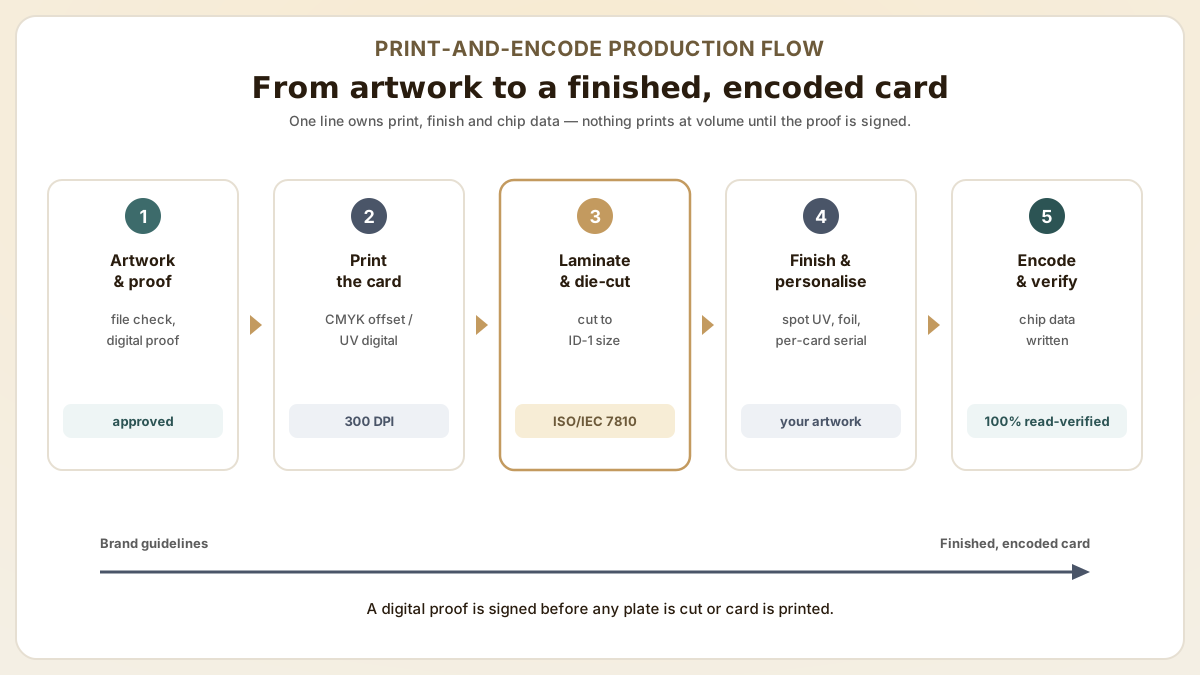
- 1. Artwork & file check
Send print-ready art or just brand guidelines; prepress checks format, resolution, bleed and colour, and corrects or builds the layout at no charge.
- 2. Digital proof
A production-accurate layout proof for your sign-off before any plate is cut or card is printed — layout, copy and colour intent locked in writing.
- 3. Colour match & printed proof
For Pantone-critical brands the press is calibrated to your references and a printed proof is sent; offset runs use Pantone spot inks, digital runs are calibrated to them.
- 4. Print, finish & personalise
The approved proof becomes the reference: CMYK or white-ink print, lamination and die-cut, then finishing and per-card personalisation, all on locked settings.
- 5. Encode, verify & ship
Chips are encoded to your data and 100% read-verified — printed serials matched to encoded data where required — then packed with the document set; typical runs complete 7-12 days after proof approval.
Proof and QC your team can verify
Trust on a first print order is not a feeling; it is a set of records your supplier-qualification team can check without us in the room. Everything below is verifiable before you commit — the certifications page lists each standard and how to confirm it with the registrar, and the factory page documents the plant behind the presses.
- ISO 9001, ISO 14001 and ISO 45001 certificates — certificate number and issuing registrar provided on request for independent verification.
- Colour control to ISO 12647-2 on offset runs, with Pantone spot inks and a signed proof held as the reference for every reorder.
- Dimensional QC to the ISO/IEC 7810 ID-1 card standard — 85.6 × 54 mm at 0.76 mm — so printed cards feed cleanly through issuance printers and lock readers.
- 100% chip read-verification on every encoded card, with the encoding log delivered alongside the shipment.
- Per-shipment documentation pack: Certificate of Conformity plus RoHS and REACH SVHC material declarations by SKU.
- Free re-proof loop — artwork corrections and re-proofs handled at no charge until you approve, with quality records retained seven years under ISO 9001.
Useful next pages
Use these linked product, guide and comparison pages to keep the next click specific and practical.
Verify us before you commit
The documents and records a card-buying team pulls first.
Start with the strongest cards
The most-ordered printed card formats and the pillar guide.
FAQ
What file format and setup do you need for RFID card artwork?
Vector Adobe Illustrator (.ai) or a print-ready PDF is preferred; high-resolution PSD, CDR and PNG/JPEG are accepted. Supply art at 300 DPI minimum at final card size, with 3 mm bleed on all sides, CMYK colour mode (Pantone spot references called out separately) and all text converted to outlines. Prepress checks every file for free and, if you only have a logo and brand guidelines, builds the print-ready layout — chip and antenna zones included — at no additional cost.
How do you match our brand's Pantone colours?
For offset printing we use Pantone spot inks for exact brand colour, and hold the run to ISO 12647-2 offset process control so the colour is repeatable on every reorder. For UV digital printing we calibrate the press to your Pantone references and send a printed colour proof for approval before the full run begins. Either way, colour is signed off on a proof before volume commits.
Can you print and serialise different data on each card in a batch?
Yes. Thermal transfer and variable-data inkjet print unique names, photos, sequential numbers, barcodes and QR codes per card within one production batch, and laser engraving marks permanent serials on metal and wooden cards. Supply a CSV or Excel file and each card prints against its row. When the printed serial must also match the chip's encoded data, that print-to-chip matching runs as one workflow on the encoding line and is 100% read-verified.
What size and thickness are the cards, and will they fit standard readers?
Standard cards are built to the ISO/IEC 7810 ID-1 (CR-80) format — 85.6 × 54 mm at 0.76 mm thick with a ~3.18 mm corner radius — the same footprint as a bank or access card, so they feed through issuance printers and read on standard 13.56 MHz and UHF readers and hotel locks. Mini cards, key tags and custom die-cut shapes are available where a non-standard form factor is the point.
How long does custom card printing take, and can I see a sample first?
Printed runs typically complete within 7-12 working days after proof approval, depending on process and finishing — UV digital short runs sit at the faster end; offset runs with multiple finishing passes take longer. International express shipping then adds 3-5 days to North America and Europe. Free samples of standard products (typically 3-5 pieces) ship first, and a custom printed proof of your own artwork carries a small setup fee credited against the production order.
Sources & references
Primary standards, OEM datasheets and regulatory documents cited by this article. All URLs were verified on the access date shown below.
- ISO/IEC 7810:2019 — Identification cards — Physical characteristics
Defines the ID-1 (CR-80) card format we print to — 85.6 × 54 mm, 0.76 mm thickness, rounded corners.
- ISO 12647-2:2013 — Graphic technology — Process control for offset lithographic processes
The offset colour and process-control standard our CMYK runs and printed proofs are held to for repeatable brand colour.
- ISO/IEC 14443-4:2018 — Contactless proximity objects (Part 4: Transmission protocol)
The 13.56 MHz proximity air-interface standard the RFID/NFC card chips we encode and read-verify are built to.
- ISO 9001:2015 — Quality management systems
The quality-management standard our print QC, 100% read-verification and seven-year record retention are certified against.
Proud Tek is a Shenzhen-based RFID & NFC manufacturer supplying hotel chains, transit operators, event venues and retail brands worldwide. Every order includes free samples, RF testing and dedicated project support.
Get a Quick Quote
Tell us about your project and we'll respond within one business day. Fields marked (asterisk) are required.