
Factory Card Encoding
RFID Card Encoding Service
MIFARE, DESFire, NDEF & EPC Pre-Encoded

Quick answer
Proud Tek runs card encoding as a dedicated, read-verified production service, not an afterthought at packing: a Shenzhen RFID factory direct since 2008 and shipping to 50+ countries, we pre-encode MIFARE sector keys, MIFARE DESFire AES application keys, NTAG NDEF records with password/AUTH protection, and GS1 SGTIN-96 EPC data — serialized from your CSV or ERP export — then read-verify 100% of the cards and ship the encoding database alongside them. What this page is not is a blank-card or minimum-order page: the deliverable is the DATA on the card, written to a published standard and locked to your spec. Below is the encoding capability menu, the encode-lock-verify workflow, the key-handling and QC controls a security team checks, and the objection FAQ procurement raises before the first order.
- Every encoding type on one line — UID capture, NDEF (URL, vCard, Wi-Fi), MIFARE Classic sector encoding, MIFARE DESFire AES-128 applications, NTAG password/AUTH and NTAG 424 DNA SUN, plus GS1 SGTIN-96 EPC — with the exact chip memory you write against (NTAG 213 at 144 bytes, NTAG 215 at 504 bytes, NTAG 216 at 888 bytes).
- Serialized from your data: variable fields mapped per card from a CSV or ERP export, the printed serial matched to the chip data on that same card, and the full card-to-value database (CSV, Excel or XML) delivered with the shipment.
- Key material handled procedurally — PGP-encrypted or secure transfer, air-gapped encoding stations, per-card key diversification for MIFARE Plus, MIFARE DESFire and NTAG 424 DNA, optional EPC and AUTH permalock, and secure key deletion or escrow on your written instruction.
At a glance
Use these short answers to decide whether this page matches the project before moving into the detail.
What this service is
Factory pre-encoding of RFID and NFC cards: UID capture, NDEF records, MIFARE sector keys, DESFire AES applications, NTAG password/AUTH and GS1 SGTIN-96 EPC written on a...
What it is not
Not a blank-card or minimum-order page (those live on the card manufacturing pages), and not a reader or software vendor. The deliverable is the encoded data itself — wr...
Next step
Ready to move forward? Start your inquiry to get specific answers for this project.
Send your encoding specifications- How a buyer starts
-
Send an encoding spec document, a CSV/ERP data file, or a working sample card we can read to reverse-engineer the format. We confirm the interpretation in writing, verify a first article on your reader or lock, then run the batch with 100% read-back verification.
- Proof to pull first
-
An ISO 9001 quality system with encoding records held seven years, 100% read-back on every card, the encoding database plus a functional test report per lot, and documented key handling — PGP transfer, air-gapped stations, per-card diversification and permalock on instruction.
What a factory card encoding service actually writes
'We can program those' is the easiest sentence in RFID sales to say and the hardest to prove at card 40,000. Proud Tek treats encoding as a dedicated production step with its own line, its own read-back gate and its own paper trail: the same controlled process writes a simple locked UID or a full DESFire application with diversified keys, and every format below is read-verified on 100% of cards before packing. If you want the underlying data model first, the RFID data encoding and memory guide is the primer; this page is the service.
- UID capture and database — the factory-assigned UID of every card is read and delivered as a CSV or Excel file mapping card number to UID, ready to import into your access or membership system.
- NDEF programming — URLs, vCards, Wi-Fi credentials, text and app-launch records written to NTAG 213, NTAG 215, NTAG 216 and NTAG 424 DNA in the NFC Forum NDEF format (Type 2 and Type 4), for tap-to-open experiences.
- MIFARE encoding — sector keys (Key A / Key B) and access-condition bytes on MIFARE Classic, and AES-128 keyed applications on MIFARE DESFire, for access control, transit, campus and loyalty programs.
- NTAG password and AUTH — a 32-bit password with AUTH0 lock on NTAG 213/215/216, and AES-128 SUN (Secure Unique NFC) configuration on NTAG 424 DNA so each tap returns a fresh cryptographic code for authentication.
- GS1 and EPC structures — SGTIN-96 and other EPC schemes written to the GS1 EPC Tag Data Standard for UHF retail-mandate cards, with EPC and access-password lock states set to spec.
- System and lock formats — HID iCLASS and prox formats plus hotel-lock encoding for VingCard, Salto, Dormakaba and Onity, matched to your deployed reader infrastructure so cards work on arrival.
The encoding capability menu — chip family, encoding type, key/lock service
The table is the fast way to see whether we cover your scheme. Each row pairs a chip family with the encoding type it carries, the key or lock service that protects it, and the data source we serialize it from. Chip names are the parts we stock and allocate directly; the full per-SKU list lives on the RFID cards pillar, and the security-grade families on the smart card page.
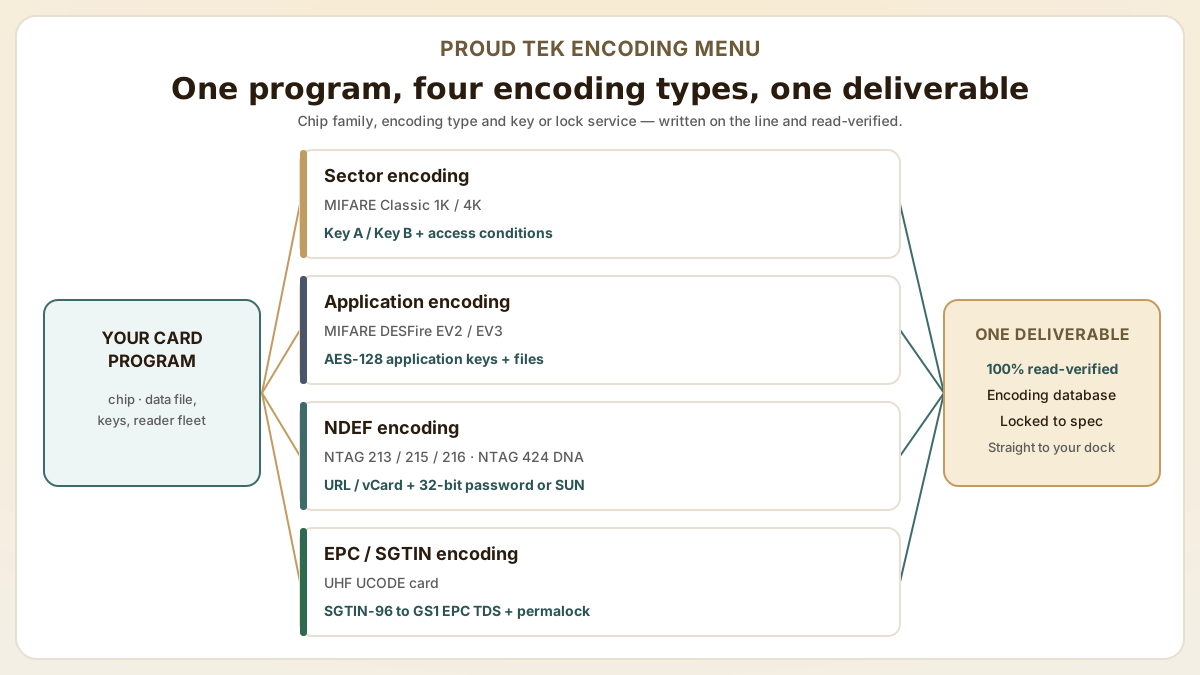
- NTAG 213 — 144 bytes of user memory (NFC Forum Type 2); NTAG 215 — 504 bytes; NTAG 216 — 888 bytes. We size the chip to the NDEF record you need to write, not the other way round.
- MIFARE Classic memory is split into sectors, each sealed by a sector trailer holding Key A, access bits and Key B; we write the exact sector map you specify (16-sector 1K or 40-sector 4K).
- MIFARE DESFire EV2/EV3 carries AES-128 keyed applications and files; we create the application directory and set file access rights so your credential app is cryptographically isolated from others on the card.
- NTAG 424 DNA writes an AES-128 SUN message: the tag mirrors a fresh, signed code into its URL on every tap, which your backend verifies — the basis for tap-to-verify brand protection.
- GS1 SGTIN-96 binds your company prefix, item reference and a per-card serial into a 96-bit EPC written to the GS1 EPC Tag Data Standard, the format UHF retail-mandate programs expect.
| Chip family | Encoding type | Key / lock service | Typical data source |
|---|---|---|---|
| MIFARE Classic 1K / 4K | Sector data + access conditions | Per-sector Key A / Key B, sector-key diversification | Access or loyalty CSV, or a sample card |
| MIFARE DESFire EV2 / EV3 | AES applications + files | AES-128 application keys, per-card diversified, key change | Transit/campus key ceremony + serial CSV |
| NTAG 213 / 215 / 216 | NDEF (URL, vCard, Wi-Fi) | 32-bit password + AUTH0 lock | URL template + serial CSV or ERP export |
| NTAG 424 DNA | NDEF + SUN message | AES-128 SUN, SDM mirror, config lock | Verification backend URL + key set |
| UHF EPC card (UCODE) | SGTIN-96 / EPC memory | EPC + access password, optional permalock | GS1 company prefix + serial range |
| HID iCLASS / prox, hotel lock | Site-code / credential or lock format | Format keys per system | Format spec or a sample credential |
Serialization, variable data and print-to-chip matching
The hardest encoding jobs are the ones where the printed card and the chip data must agree: a badge whose printed number matches its sector record, a UHF card whose printed code matches its SGTIN-96 serial. Splitting print and encode across two facilities is how those drift apart and surface at the help desk. We run them as one matched traveler on the same floor, verified per card before packing; the card printing page owns the artwork side, this page owns the data.
Desktop / on-site encoding
- A card printer encodes a few cards a minute — fine for a pilot, a staffing problem past a few thousand.
- No read-back proof and no database: you find the mis-encoded card when it fails at a door or a gate.
- Key files loaded onto a networked office PC, then left there.
- Printed serial and chip data reconciled by hand, if at all.
- Each new batch re-derives the format from memory.
Proud Tek's factory encoding line
- Encoding runs as a production step, so volume is throughput rather than overtime.
- 100% read-back verification with the encoding database and a functional test report delivered alongside the cards.
- Key sets loaded onto air-gapped stations, diversified per card, and deleted or escrowed on your instruction.
- Printed serial, UID and encoded fields matched and verified on the same card, delivered as one mapping file.
- The approved first article is locked on the traveler, so unit 1 and unit 40,000 are identical.
- Variable data from your CSV, Excel or ERP export — each row mapped to one card's encoded fields (URL, credential, EPC serial), written in the shipping order you specify.
- Printed serial matched to chip data and verified per card, so a badge's printed number equals its encoded record and a UHF card's printed code equals its SGTIN-96 serial.
- Laser serialization and variable-data inkjet run in the same traveler as the encoding pass, so numbering can never drift out of sync with the data.
- One mapping-file deliverable ties it together: printed number, UID, encoded fields and EPC per card, as CSV, Excel or XML for a clean system import.
- Mixed personalization in a single batch — per-card printed name or photo combined with per-card encoded credentials, common for employee badge and student ID programs.
Key handling, security and QC proof
Encoding routinely touches the most sensitive material a card program owns: master keys, access credentials, member data. Handling is procedural, not ad hoc — the same controlled steps run for a boutique hotel's lock cards and a transit authority's fare cards. The checklist below is what your security and supplier-qualification teams verify, and every item is confirmable before you commit; the certifications page shows how to check the ISO registrations with the registrar.
- 100% read-back verification on every encoded card; any card whose written data does not match specification is automatically rejected and replaced.
- Encoding database deliverable (CSV, Excel or XML) mapping each card's printed number or serial to its UID and encoded values, shipped with the order.
- Key material received PGP-encrypted or via secure file transfer — never as a plain email attachment.
- Air-gapped encoding stations: key sets are loaded onto isolated machines and never stored on networked systems.
- Per-card key diversification for MIFARE Plus, MIFARE DESFire and NTAG 424 DNA so no two cards share a secret, with optional EPC and AUTH permalock applied only on written instruction.
- Master keys securely deleted after production, or escrowed only on explicit instruction; NDAs and data-processing agreements signed as needed.
- Functional testing on your specified reader or lock, and full batch traceability — date, operator, equipment and verification results retained seven years per ISO 9001.
The encode-lock-verify workflow
Every encoding job follows the same documented path, and each step leaves a record in the quality archive. Buyers who have been burned by a mis-encoded batch will recognise what it is built to prevent: a specification ambiguity discovered at card 40,000 instead of card one. The first-article gate exists precisely so a disagreement about byte order or lock behaviour surfaces before the volume run — the same discipline the hotel key card encoding guide and the DESFire EV1 vs EV2 vs EV3 comparison walk through for their formats.
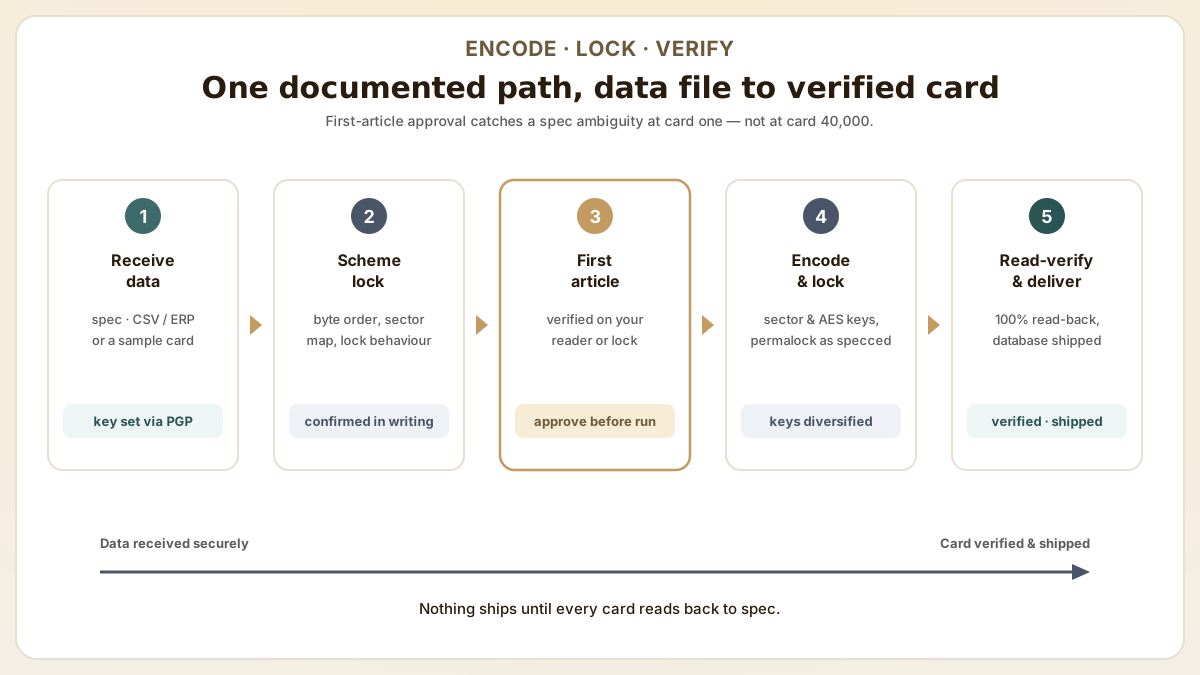
- 1. Receive data
You send an encoding spec, a CSV or ERP export, a key set (PGP-encrypted or via secure transfer), or a working sample card we read to reverse-engineer the format.
- 2. Scheme lock
We confirm the format interpretation in writing — byte order, sector map, AUTH and lock behaviour — and lock it on the production traveler with your data files attached.
- 3. First article
Initial cards are encoded and verified, and for access or hotel-lock formats tested on the actual reader or lock, so any disagreement surfaces before the run — not at card 40,000.
- 4. Encode & lock
The full run is encoded with 100% read-back; sector and AES keys are set, keys diversified per card, and EPC or AUTH permalock applied where your spec calls for it.
- 5. Read-verify & deliver
Every card is read back to confirm the written data matches specification, then ships with the encoding database and a functional test report on the lot.
Useful next pages
Use these linked product, guide and comparison pages to keep the next click specific and practical.
Verify us before you commit
The documents and access a supplier-qualification team pulls first.
The rest of the card program
Where encoding sits in the wider card sourcing path.
FAQ
How do you receive our key material securely?
Key files move via PGP-encrypted email or a secure file-transfer link — never a plain attachment. On our side they are loaded onto air-gapped encoding stations that are never connected to a network, used for the run, and then securely deleted per your retention instruction, or escrowed only if you explicitly ask for it. For MIFARE Plus, MIFARE DESFire and NTAG 424 DNA we diversify keys per card so no two cards share a secret, and we sign an NDA and a data-processing agreement where your compliance team requires one.
Can you serialize cards from our CSV or ERP export?
Yes — that is the common case. Send a CSV, Excel or ERP export and we map each row to one card's encoded fields (URL, credential, EPC serial), written in the shipping order you specify. Where the card is also printed with a serial, barcode or QR code, we match the printed value to the chip data and verify the pair on that same card. You get one mapping file back — printed number, UID and encoded values per card — so the import into your system is clean.
Do you permalock the cards?
Only when your spec calls for it, because a permalock is irreversible. For UHF EPC cards we can permalock the EPC and access-password memory so the serial can never be rewritten; for NTAG we set the 32-bit password and AUTH0 so the protected pages are read-only without the password; for DESFire the application and file keys govern what can change. Our default is to leave cards rewritable unless you ask for the lock — and we confirm the lock behaviour in writing at the scheme-lock step before any card is committed.
What is your read-verify rate, and how do we confirm it after delivery?
Every card is read back after encoding — 100%, not a sample — to confirm the written data matches specification exactly; any card that fails is automatically rejected and replaced. Each order ships with the encoding database (CSV, Excel or XML) mapping every card to its UID and encoded values, plus a functional test report on the lot. Batch records — date, operator and equipment — are retained seven years per ISO 9001, so a field question years later can still be traced to its batch.
Can you encode to match our existing access control or hotel-lock system?
Usually, yes. Give us the reader or lock model and either a sample encoded card or an encoding specification, and we reverse-engineer or replicate the format across your order — we have run MIFARE, DESFire, HID iCLASS and prox, and hotel-lock formats for VingCard, Salto, Dormakaba and Onity. We verify a first article on the actual reader or lock before the volume run, so a format mismatch is caught at sample stage rather than on the loading dock.
Sources & references
Primary standards, OEM datasheets and regulatory documents cited by this article. All URLs were verified on the access date shown below.
- ISO/IEC 14443-4:2018 — Contactless proximity objects (Part 4: Transmission protocol)
The 13.56 MHz proximity air-interface standard underlying the MIFARE Classic, MIFARE DESFire and NTAG cards we encode.
- GS1 EPC Tag Data Standard
The SGTIN-96 and EPC encoding reference our UHF card encoding writes for retail-mandate programs.
- NFC Forum Technical Specifications
The NDEF record format and Type 2 / Type 4 Tag operation our NTAG encoding writes and read-verifies.
- ISO 9001:2015 — Quality management systems
The quality-management standard our 100% read-verification and seven-year encoding-record retention are certified against.
Proud Tek is a Shenzhen-based RFID & NFC manufacturer supplying hotel chains, transit operators, event venues and retail brands worldwide. Every order includes free samples, RF testing and dedicated project support.
Get a Quick Quote
Tell us about your project and we'll respond within one business day. Fields marked (asterisk) are required.