
China RFID Card Factory
RFID Card Manufacturer in China
Factory-Direct

Quick answer
Proud Tek is a factory-direct RFID card manufacturer in Shenzhen, China — building cards in-house since 2008 and shipping to buyers in 50+ countries — that owns the whole card line end to end: inlay assembly, hot-roll lamination, die-cutting to the ISO/IEC 7810 ID-1 (CR80) format, printing, encoding and 100% electrical test, across PVC, PET, PETG, ABS, polycarbonate, PLA, bamboo-composite, wood and metal bodies. 'Manufacturer' here means the chip, the antenna, the card body and the data are all handled under one ISO 9001 quality system — not a logo printed on someone else's stock. This page walks the production line stage by stage, the card families and chips we laminate across LF, HF and UHF, the materials and finishes, and the MOQ, lead-time and QC records a procurement team checks before the first order.
- One factory owns the entire card — inlay assembly, hot-roll lamination, die-cutting, offset and digital printing, encoding and 100% electrical test all run on Proud Tek's own Shenzhen lines, not subcontracted to a converter down the road.
- The full card catalogue from one supplier: LF 125 kHz, HF 13.56 MHz and UHF chip families laminated into PVC, PETG, ABS, polycarbonate, PLA, bamboo-composite, wood, transparent and metal bodies — all built to ISO/IEC 7810 card dimensions.
- A qualifying path built for procurement — a free sample kit, a low-MOQ pilot, then locked-price production, with ISO 9001 / 14001 / 45001 certificates, per-shipment compliance paperwork and factory-audit access you can verify before you commit.
At a glance
Use these short answers to decide whether this page matches the project before moving into the detail.
What Proud Tek makes
A factory-direct RFID card manufacturer in Shenzhen: inlay, card body, print and encoding produced in-house across LF 125 kHz, HF 13.56 MHz and UHF chip families and PVC...
How a card is built
Five in-house stages — inlay assembly, hot-roll lamination (around 150°C), die-cutting to the 85.60 × 53.98 × 0.76 mm CR80 format, printing and finishing, then encoding...
Next step
Ready to move forward? Start your inquiry to get specific answers for this project.
Request factory-direct quote- What you can order
-
Custom-printed PVC cards from 500 pieces, digital-print short runs from 100 pieces, metal and specialty-material cards from 200 pieces, recurring programs at 1,000-5,000 pieces per SKU — with a free 5-10 card sample kit to verify chip and print before you buy.
- Proof to pull first
-
ISO 9001, ISO 14001 and ISO 45001 certificates (number and registrar on request), ISO/IEC 7810 / 14443 / 15693 conformance, per-shipment RoHS / REACH / FCC / CE documentation, and open factory-audit access — all verifiable before the first order.
What a factory-direct card manufacturer controls
'Card manufacturer' gets claimed by trading desks that never touch a lamination roll, so the honest test is which steps a supplier actually owns. Proud Tek owns all of them: we assemble the inlay, laminate the card body, die-cut it to ISO/IEC 7810 dimensions, print it, encode it and read-test every piece — the whole chain on our own Shenzhen lines since 2008. For the security-grade end of the range there is a dedicated smart-card manufacturing page, and for volume economics the bulk-card page; this page is the factory itself. The numbers below are the ones a procurement team checks first.
- Full in-house production — inlay assembly, hot-roll lamination, die-cutting, offset and digital printing, encoding and 100% electrical test under one roof, so one team is accountable from PO to dispatch rather than five subcontractors.
- Direct chip allocation from the major card-chip makers (NXP, Infineon, Fudan) with authorised-distribution backup, so a card program is not held hostage to one vendor's lead time.
- A direct factory, not a trading desk: two Shenzhen sites, ten automated lines and 305+ pieces of process equipment under one ISO 9001 management system, every encoded card read-tested before it ships.
- Export-ready fulfilment — ISO/IEC 7810, 14443 and 15693 conformance, per-shipment RoHS / REACH / FCC / CE paperwork, FOB Shenzhen / Yantian or DDP terms, and English-speaking project managers who reply within one business day.
How an RFID card is actually made — five production stages
Every Proud Tek card runs the same five stages, documented on a production traveller from PO to dispatch — and knowing them lets you read a quotation line by line, because each cost item maps to one stage. The factory encoding step and the printing step each have a page of their own; here is how they sit in the line. The operators who run your 100-piece pilot are the same ones who run the 100,000-piece order.
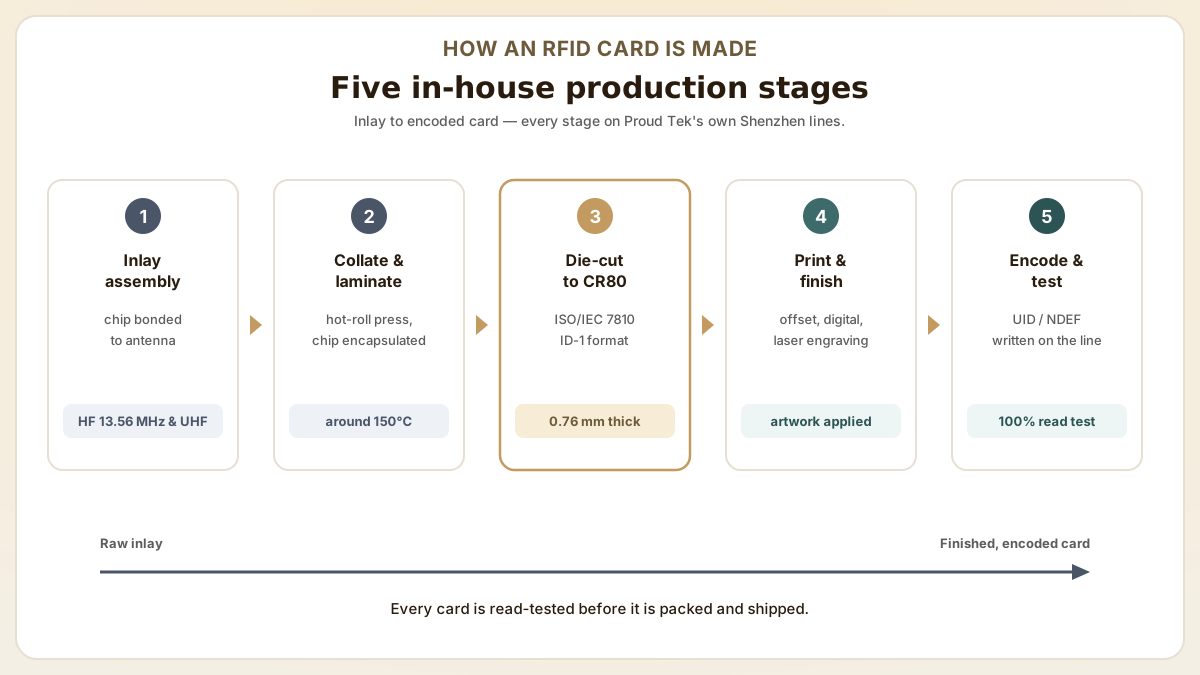
- 1. Inlay assembly
The chip is bonded to an etched or wire antenna in-house (HF 13.56 MHz and UHF wet-inlay assembly), and any inlay that fails a readability check is scrapped before it ever reaches card production.
- 2. Collate & laminate
Inlays are sandwiched between card-body layers and hot-roll laminated under controlled heat, pressure and dwell — around 150°C — permanently encapsulating chip and antenna into a single monolithic card.
- 3. Die-cut to CR80
Laminated sheets are punched to the ISO/IEC 7810 ID-1 (CR80) format, 85.60 × 53.98 × 0.76 mm — the payment-card footprint, so finished cards fit every standard reader, hotel lock and badge printer.
- 4. Print & finish
Four-colour offset for volume, digital for short runs, plus screen printing, hot stamping, laser engraving, signature panels, hologram and magnetic-stripe options — the full finish menu lives on the card-printing page.
- 5. Encode & 100% test
UID read, NDEF or sector data written on the line, then a functional read test on every encoded card — chip response, antenna resonance and read range — before it is packed.
Card capability menu — families, chips, materials and MOQ
The table is the fast way to see whether we make your card. We are chip-vendor agnostic, laminating LF 125 kHz, HF 13.56 MHz, vicinity and UHF silicon into any body in the materials list, printed and finished to your artwork. Chip names are representative of what we stock and allocate directly; security-grade selection — encryption, key handling, transit and payment-grade parts — is the territory of the smart-card manufacturing page, and per-SKU parts live on the RFID cards catalogue.
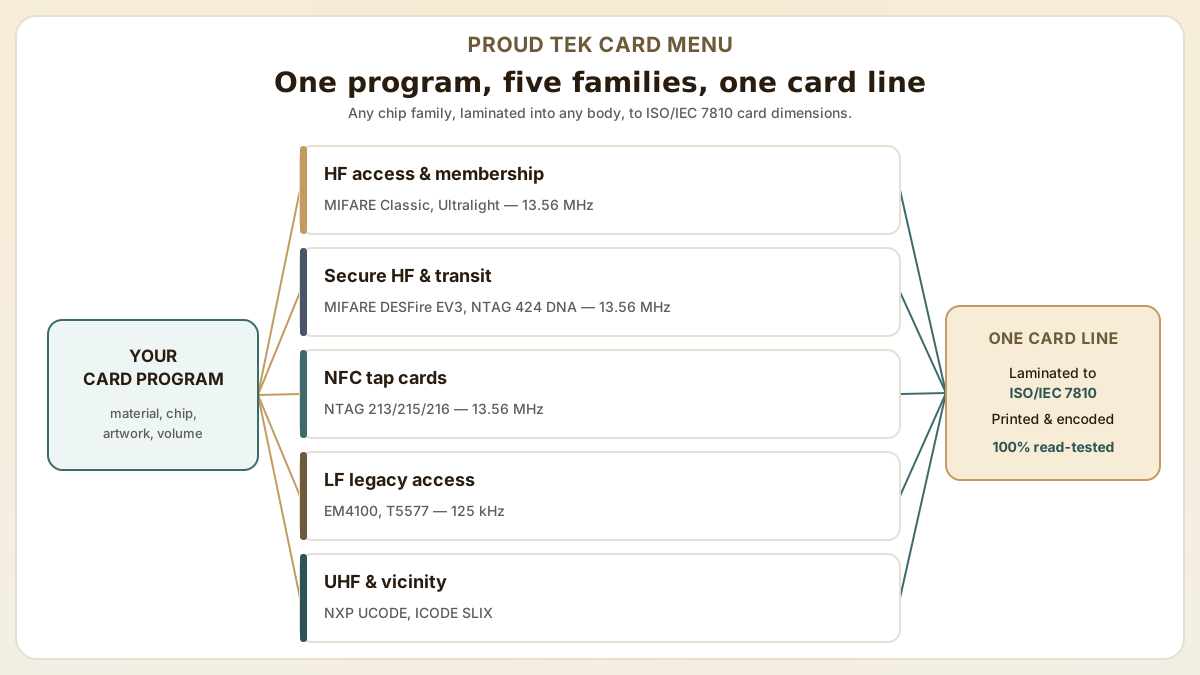
| Card family | Representative chips (LF / HF / UHF) | Body materials | Print & finish | Typical MOQ |
|---|---|---|---|---|
| HF access & membership | MIFARE Classic 1K/4K, MIFARE Ultralight | PVC, PETG, ABS | CMYK offset, digital, signature panel | 500 pieces |
| Secure HF & transit | MIFARE DESFire EV3, MIFARE Plus SE, NTAG 424 DNA | PVC, polycarbonate | Offset, laser-engraved serial | 1,000 pieces |
| NFC tap cards | NTAG 213/215/216 | PVC, PET, wood, metal | CMYK, UV, QR overprint | 500 pieces |
| LF legacy access | EM4100, EM4200, T5577 | PVC, ABS, clamshell | CMYK offset, thermal number | 500 pieces |
| Vicinity & library | ICODE SLIX | PVC, PET | Offset, barcode overprint | 1,000 pieces |
| UHF & dual-frequency | NXP UCODE, Impinj Monza | PVC, PET | Offset, digital | 1,000 pieces |
| Eco & premium bodies | Any family above | PLA, recycled PVC, bamboo-composite, wood, metal | Laser engraving, screen print | 200 pieces |
Card body materials we laminate
Material drives feel, durability and price more than any line item except the chip, and every stock in our range earns its place — wallet thinness, a sustainability mandate, a premium unboxing or a pool-deck beating. All of them run on the same lamination lines, so mixing materials across a program does not mean mixing suppliers. The points below are the stocks buyers ask for most.
- PVC — the standard card body: lowest cost, full-bleed print compatibility and years of normal wallet service. The volume default unless a requirement pushes elsewhere.
- PETG and ABS — tougher and more temperature-tolerant than PVC, specified for gym, pool, locker and other high-handling environments.
- Polycarbonate — the decade-of-daily-use option, laser-engravable for tamper-resistant personalisation on government and enterprise credentials.
- PLA, recycled-PVC and FSC-certified paper — lower-footprint bodies for sustainability mandates, with RoHS and REACH SVHC declarations on file by SKU; FSC paper and bamboo-composite offered on request for chain-of-custody programs.
- Wood and bamboo — laser-engravable natural stocks for hotel-key and premium-membership programs; see the wooden card and bamboo card SKU pages.
- Transparent and metal — clear PET for promotional cards, and stainless-steel bodies for premium business cards; metal detunes a 13.56 MHz antenna, so metal cards use a slot-antenna design to stay readable.
Where a trading desk stops — and where a card factory starts
A card program goes sideways in the gap between the quotation and the cards that actually arrive: a trading desk forwards your PO and hopes, while a factory owns the chip, the lamination and the read-test. When the cards carry your brand and your access-control estate — a MIFARE DESFire EV3 badge or a laminated hotel key — that difference is the whole order. The commitment numbers below are the ones we hold in writing.
What a trading desk hands you
- A logo printed on whatever stock and chip carried the best margin that week.
- Cards you encode yourself, or a vague 'we can program them' with no read-back proof.
- One chip datasheet, and no way to confirm the part in the box matches it.
- MOQ, price and lead time that drift after you have committed.
- Silence once the carton ships.
What Proud Tek's card line ships
- A card engineered to the job — chip, antenna, body material and finish matched to your reader, environment and brand.
- Cards pre-encoded on the line and 100% read-tested, with the functional test report delivered alongside the shipment.
- Genuine silicon from NXP, Infineon and Fudan allocation, verifiable on your own reader before the volume run.
- MOQ, pricing and lead time quoted in writing before anything is tooled, then held for the reorder.
- A named project manager through reorders, with artwork and encoding locked on a production traveller.
Proof your procurement team can verify
Trust on a first card order is not a feeling; it is a stack of documents your supplier-qualification team can check without us in the room. Every item below is verifiable before you commit — the certifications page shows each standard and how to confirm it with the registrar, and the factory page documents the plant behind the cards.
- ISO 9001, ISO 14001 and ISO 45001 certificates — certificate number and issuing registrar provided on request for independent verification.
- 100% electrical test on every card — chip response, antenna resonance and read range — with a functional test report included in the shipment.
- ISO/IEC 7810 dimensional conformance plus ISO/IEC 14443 (proximity) and ISO/IEC 15693 (vicinity) air-interface conformance as applicable to the chip family.
- Per-shipment compliance pack: commercial invoice and packing list with chip family and encoding lot, Certificate of Origin, radio-compliance Certificate of Conformity (FCC / CE as applicable) and RoHS / REACH SVHC material declarations.
- Open factory audits across two Shenzhen sites by appointment, in-house pre-shipment inspection by your QC agent at no charge, and quality records retained seven years under ISO 9001.
Useful next pages
Use these linked product, guide and comparison pages to keep the next click specific and practical.
Explore our RFID card product range
Browse specific card types to find the right chip and form factor for your project.
Related sourcing pages
Adjacent card-sourcing topics, each covered in depth on its own page.
FAQ
How do I verify your card factory before I place an order?
Three independent checks. First, request our ISO 9001, ISO 14001 and ISO 45001 certificate numbers and confirm them directly with the issuing registrar. Second, book a factory audit — engineering and quality-system audits across our two Shenzhen sites are by appointment, with virtual walk-throughs for buyers who cannot travel and third-party (SGS, TUV, Intertek) inspection when your program requires it. Third, order a free sample kit and read the cards on your own equipment. Every claim on this page is meant to be checked, not taken on faith.
What is the minimum order quantity for RFID cards, and can I sample first?
Free samples come first: a 5-10 card kit ships by courier so you can verify chip compatibility and print quality before buying. For production, custom-printed PVC cards start at 500 pieces, digital-print short runs at 100 pieces, and metal or specialty-material cards at 200 pieces; recurring programs typically run 1,000-5,000 pieces per SKU. Volume price breaks are detailed on the bulk-card page.
How long does card production and shipping take from China?
Standard production is 5-7 business days after artwork approval, with express production for urgent orders. Shipping to North America and Europe is 3-5 days by express courier or 15-25 days by sea freight for large volumes on FOB Shenzhen / Yantian terms — roughly 10-14 days door-to-door for an express order.
Can you match or replace an RFID card from another supplier?
Yes. Send a sample card or its specifications — chip type, frequency, memory size, artwork and dimensions — and we will produce an exact match or recommend an improved alternative. Our engineers can read the existing card's chip data to identify the IC and replicate the encoding format, then read-verify the replacement against your reader.
Which card material and chip family should I choose?
Match the body to the environment and the chip to the interaction. PVC suits most programs; PETG, ABS or polycarbonate suit heavy handling and long service; wood, bamboo and recycled stocks suit premium or sustainability programs. For chips, HF 13.56 MHz (MIFARE, NTAG) covers access and tap cards, LF 125 kHz (EM4100, T5577) covers legacy access, and UHF covers long-range identification; security-grade selection is covered on the smart-card page. A mixed sample kit lets you decide on the evidence.
Sources & references
Primary standards, OEM datasheets and regulatory documents cited by this article. All URLs were verified on the access date shown below.
- ISO/IEC 7810:2019 — Identification cards — Physical characteristics
Defines the ID-1 (CR80) card format — 85.60 × 53.98 × 0.76 mm — that every card is die-cut to.
- ISO/IEC 14443-4:2018 — Contactless proximity objects (Part 4: Transmission protocol)
The 13.56 MHz proximity air-interface standard behind MIFARE, NTAG and other contactless smart cards.
- ISO/IEC 15693-2:2019 — Contactless vicinity objects (Part 2: Air interface and initialization)
The 13.56 MHz vicinity air-interface standard behind ICODE SLIX library and vicinity cards.
- ISO 9001:2015 — Quality management systems
The quality-management standard our production, 100% read-verification and seven-year record retention are certified against.
Proud Tek is a Shenzhen-based RFID & NFC manufacturer supplying hotel chains, transit operators, event venues and retail brands worldwide. Every order includes free samples, RF testing and dedicated project support.
Get a Quick Quote
Tell us about your project and we'll respond within one business day. Fields marked (asterisk) are required.