
RFID Wristband Factory
RFID Wristband Manufacturer
Silicone, Woven, Tyvek & UHF Bands

Quick answer
Proud Tek is a direct RFID wristband factory in Shenzhen — molding, weaving, printing and encoding bands in-house since 2008 and shipping to buyers in 50+ countries. We make RFID and NFC wristbands in every construction a program actually needs: reusable silicone, woven fabric, single-use Tyvek and paper, PVC snap and nylon — on LF, HF (13.56 MHz NTAG and MIFARE) and UHF chips for events, cashless payment, access control, hotels, hospitals and waterparks. 'Manufacturer' here means the chip is embedded during molding or weaving, not glued on afterward: every band is pre-encoded to your platform and read-verified before it ships, with the certifications and QC records your procurement team can check first. Below is the material-and-chip menu, the sample-to-event-day path, and the proof to pull before your first order.
- Every wristband construction from one factory — reusable silicone, woven fabric, single-use Tyvek and paper, PVC snap and nylon — with the chip embedded during molding or weaving so antenna coupling stays identical from band 1 to band 100,000.
- Chip flexibility across the band: LF access chips (T5577, EM4200), 13.56 MHz HF for tap and cashless (NTAG 213, MIFARE Classic, MIFARE Ultralight, DESFire), and UHF (Monza R6, UCODE 9) for long-range race timing — matched to your reader fleet, not our stock.
- Full customization and encoding in-house: Pantone color matching, dye-sublimation and screen printing, laser or debossed marking, custom closures, and per-band NDEF or UID encoding — 100% read-verified before packing.
At a glance
Use these short answers to decide whether this page matches the project before moving into the detail.
What Proud Tek makes
A Shenzhen wristband factory, direct since 2008, molding and weaving RFID and NFC wristbands in silicone, woven fabric, Tyvek, paper, PVC and nylon — with the chip embed...
What you can order
Reusable silicone from 200 pcs, woven fabric and custom-printed Tyvek from 200 pcs, stock Tyvek from 100 pcs, with 10-20 sample bands per material to test on your own ga...
Next step
Ready to move forward? Start your inquiry to get specific answers for this project.
Request wristband samples and quote- How encoding works
-
We embed the chip during molding or weaving, then write your data on the line — MIFARE sector keys and DESFire application setup for cashless and access, NDEF URLs for phone-tap NTAG bands, sequential UIDs and names for patient ID — and 100% read-verify every band before packing.
- Proof to pull first
-
ISO 9001, ISO 14001 and ISO 45001 certificates (number and registrar on request), OEKO-TEX Standard 100 for skin-contact textile bands, open factory-audit access, and per-shipment RoHS / REACH SVHC / Certificate-of-Conformity declarations — all verifiable before you commit.
What a real RFID wristband manufacturer ships
'Wristband manufacturer' gets claimed by plenty of trading desks that forward your order to an actual factory and add a margin — so the useful question is what lands on your dock. Proud Tek makes and encodes the bands in-house: we pick the LF, HF or UHF chip, mold or weave it into the band, write your data, and read-verify every unit before it ships with its certifications and test records attached. Start with a free sample pack of bands to wear-test, or browse the full wristband range. The numbers below are the ones a procurement team checks first.
- Every construction from one factory — silicone, woven fabric, Tyvek, paper, PVC snap and nylon — so a mixed event, resort or hospital program consolidates with one supplier instead of five.
- In-house chip embedding — we laminate or injection-mold the NFC/UHF inlay into the band during manufacturing rather than retrofitting it, so antenna coupling and read range stay consistent across the whole run.
- Direct chip allocation — NTAG 213 and MIFARE at 13.56 MHz HF for tap and cashless, T5577 and EM4200 at 125 kHz LF for access, and Monza R6 or UCODE 9 at 860-960 MHz UHF for race timing, sourced from NXP, Impinj and EM rather than remarked.
- Encoding and data services on the line — NDEF URLs for phone-tap NTAG bands, plus sector-key and application setup for the MIFARE chips used in cashless and access programs — all 100% read-verified before packing.
- Compliance handled, not hand-waved — OEKO-TEX Standard 100 available for skin-contact textile bands, RoHS and REACH SVHC material declarations and a Certificate of Conformity per shipment, with quality records retained seven years under ISO 9001.
The wristband material and chip menu
This table is the fast way to see whether we cover your program. Each construction runs to a published air-interface standard — ISO/IEC 14443 for NTAG and MIFARE at 13.56 MHz, ISO/IEC 15693 for ICODE, ISO/IEC 18000-63 for UHF at 860-960 MHz — so a band encoded today keeps reading across a reader fleet's lifetime. Chip names are representative of what we stock; the silicone and Tyvek product pages list live parts.
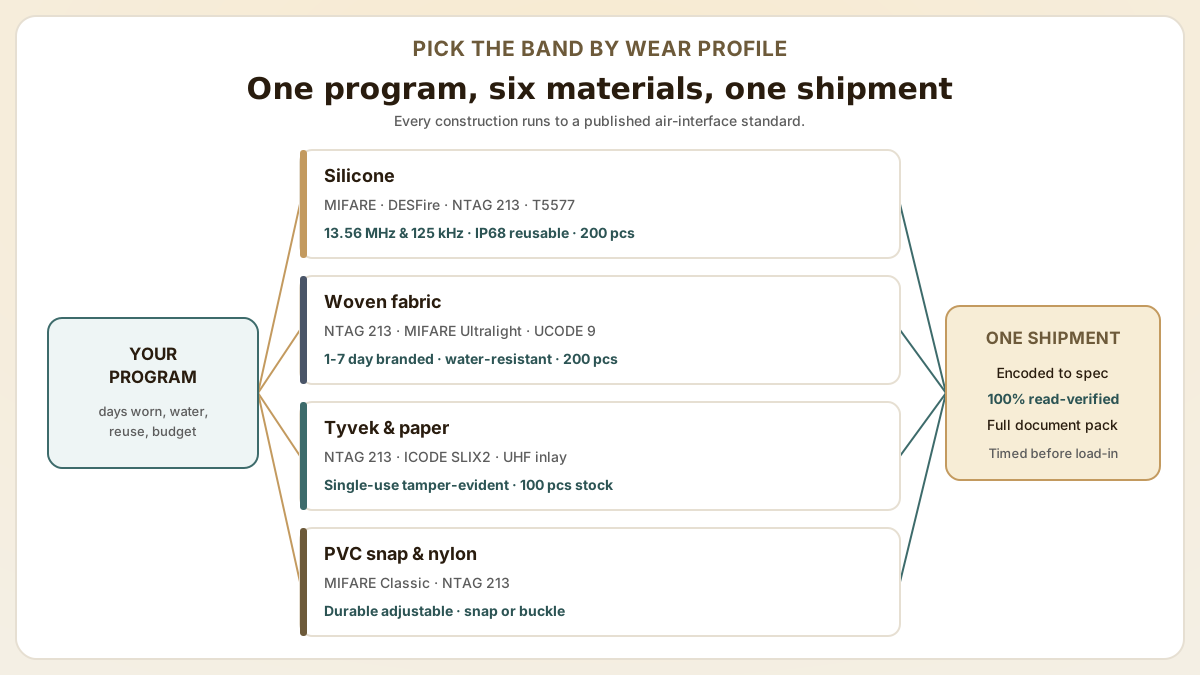
- Silicone: 3-10 days of continuous wear, fully waterproof for pool, shower and sea, and reusable for 15-30 guest cycles with sanitization between issues — the default for resorts, waterparks, cruise lines and gyms.
- Tyvek and paper: 1-3 day single-use bands with a tamper-evident adhesive closure; water-resistant but not waterproof. Stock Tyvek ships in 5-10 business days at MOQs as low as 100 pcs, while custom-printed disposables start at 200 pcs.
- Woven polyester: 1-7 day wear with thread-woven logos or full-color dye-sublimation — the brand canvas for multi-day festivals and corporate events, closed with a one-way slider rather than adhesive.
- PVC snap: a durable, adjustable mid-point between disposable and silicone, suited to waterparks and worker ID where bands are issued for days to weeks.
- Reuse economics: a reusable silicone program amortizes to roughly $0.08-0.10 per guest-use including sanitization and handling — below the per-guest cost of single-use bands at scale.
- Frequency note: thin disposable bands favor HF chips; a UHF inlay adds bulk and stiffness to Tyvek, so for race timing or other long-range reads at 4-6 m, silicone or woven is the better physical platform.
| Material | Representative chips | Closure / durability | Best-fit application | Typical MOQ |
|---|---|---|---|---|
| Silicone | MIFARE Classic, DESFire, NTAG 213, T5577 | Slip-on, cinch or snap-lock; IP68, reusable | Waterparks, resorts, gyms, access | 500 pcs |
| Woven fabric | NTAG 213, MIFARE Ultralight, UCODE 9 | One-way slider; 1-7 day, water-resistant | Festivals, conferences, VIP | 1,000 pcs |
| Tyvek | NTAG 213, MIFARE Ultralight | Adhesive tamper-evident; 1-3 day single-use | Single-day events, hospital ID, visitors | 100 pcs stock / 200 pcs printed |
| Paper | ICODE SLIX2, UHF inlay | Adhesive; single-use, lowest cost | Large-scale hospital and event ID | 1,000 pcs |
| PVC snap | MIFARE Classic, NTAG 213 | Metal snap; durable, days to weeks | Waterparks, worker identification | Quoted per program |
| Nylon | NTAG 213, MIFARE Classic | Adjustable buckle; premium reusable | Corporate events, VIP access | Quoted per program |
Closures, sizing, comfort and tamper evidence
More wristband programs fail on closure than on chip — applied too loose, seated wrong, or mismatched to the security requirement. Each construction carries specific closure options with distinct failure modes, and staff application technique matters as much as the hardware, so we include closure samples in every sample pack and recommend a closure audit during the pilot.
- Silicone closures: sized slip-on loops (five adult sizes, typically 140-220 mm inside circumference, plus a 120 mm kids size), adjustable pull-tight cinches, or one-way snap-locks that must be cut off — the tamper-evident choice for resort and waterpark security.
- Fabric and Tyvek closures: single-use tamper-evident adhesive — once bonded, the band cannot come off without cutting or tearing, which is exactly what makes it single-use.
- Woven closures: one-way plastic slider (most common), metal bead for a premium feel, or tear-tab where attendees remove their own bands at event end.
- Security variants: sonic-welded tamper-proof silicone for long-stay hospital and secure-facility programs, and breakaway closures for child-safety bands.
- Comfort and skin contact: latex-free silicone, rounded edges and OEKO-TEX Standard 100 textile keep multi-day bands wearable — the adhesive on a Tyvek band can irritate skin past 12-24 hours, which is one reason single-day programs stay single-day.
- Sizing calibration: for sized silicone programs, order the full size matrix in the pilot — size-mix miscalibration is the single most common pilot failure and shows up as guest-fit problems at scale.
Where a wristband reseller stops — and where a factory starts
A wristband program goes sideways in the gap between the sample photo and the pallet that shows up on load-in day. A trading desk forwards your PO and hopes; a factory owns the chip choice, the encoding and the read-test. When the bands are the only thing between 40,000 guests and your gates — a cashless payment rollout or a resort access program — that difference is the whole event.
What a catalogue wristband reseller hands you
- A stock band with your logo printed on it — chip and closure chosen for their margin, not your reader or your wear profile.
- Blank bands you encode yourself, or a vague 'we can program them' with no read-back proof.
- One size and one closure, whether or not it fits a child's wrist or survives a week in the pool.
- MOQ and lead time that drift after you have committed to an event date.
- Silence once the carton ships.
What Proud Tek's wristband line ships
- An engineered band — material, closure and chip matched to how long it is worn, how wet it gets, and the reader fleet at your gate.
- Bands pre-encoded on the line with your MIFARE keys, DESFire application or NDEF records, then 100% read-verified with the encoding log delivered alongside.
- A full size matrix and closure options — sized silicone, breakaway child bands, sonic-welded security bands — proven in the pilot.
- MOQ, pricing and lead time quoted in writing against your event date before anything is tooled, then held.
- A named account contact through reorders, with your artwork, size mix and encoding scheme locked on a production traveler.
From free sample to event day
Nobody should commit an event's entire credential to a band they have not worn and tapped. The path below front-loads the cheap, reversible steps — a free sample pack first, a small paid pilot second, and a locked-price production run only once the bands read cleanly on your own gate, lock and POS hardware, with the finished run timed to land before load-in.
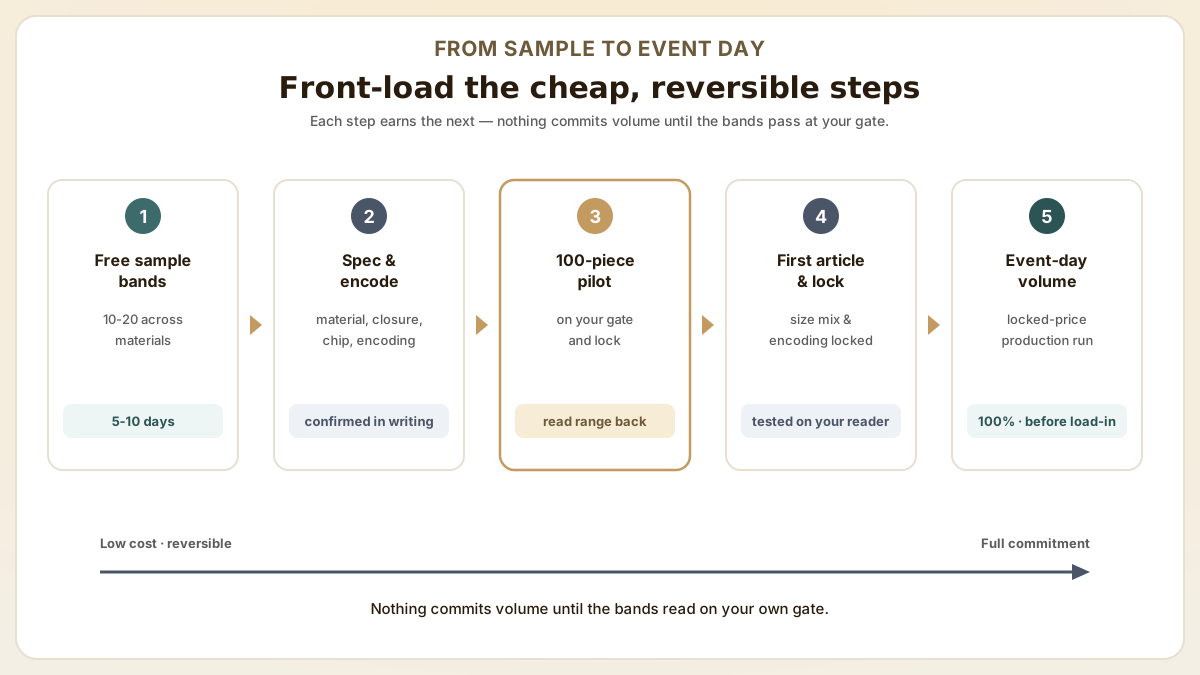
- 1. Free sample bands
Tell us the application and platform; we ship 10-20 encoded sample bands across the materials on your shortlist — a silicone, a woven and a Tyvek — so your team can wear-test fit and tap them on the readers they will actually meet.
- 2. Spec & encode
We confirm the material, closure, size matrix, chip and encoding scheme (MIFARE keys, DESFire application or NDEF) in writing, then quote MOQ, price and lead time against your event date — nothing is left implicit before tooling.
- 3. Pilot run
A 100-piece pilot encoded with your real data and returned so you can validate read range and fit against your gate antenna, lock and POS — a bench read is not a gate read.
- 4. First article & lock
The approved band becomes the reference: material, closure, size mix, artwork and encoding scheme are locked on the production traveler so band 1 and band 40,000 are identical.
- 5. Event-day volume
Full run at locked pricing with 100% read-back verification and the encoding log delivered with the shipment, scheduled to land before load-in; reorders quote from the same locked spec.
Proof your procurement team can verify
Trust on a first wristband order is not a feeling; it is a stack of documents your supplier-qualification team can check without us in the room. Everything below is verifiable before you commit — the certifications page shows each standard and how to confirm it with the registrar, and the factory page documents the plant behind the bands.
- ISO 9001, ISO 14001 and ISO 45001 certificates — certificate number and issuing registrar provided on request for independent verification.
- OEKO-TEX Standard 100 for skin-contact woven and fabric bands, confirming the textile is tested for harmful substances against skin.
- 100% read-back verification on every encoded band, with the MIFARE / NDEF encoding log delivered alongside the shipment.
- Wear and reuse evidence: wash-and-wear survival counts and closure-fatigue data for silicone reuse programs (15-30 cycles), plus IP68 submersion results, shared for your shortlisted bands.
- Open factory audits across two Shenzhen sites by appointment, with virtual walk-throughs and third-party (SGS, TUV, Intertek) inspection when a program requires it.
- Per-shipment documentation pack — Certificate of Conformity plus RoHS and REACH SVHC material declarations by SKU, with quality records retained seven years under ISO 9001.
Useful next pages
Use these linked product, guide and comparison pages to keep the next click specific and practical.
Verify us before you commit
The documents and access a supplier-qualification team pulls first.
Start with the right band
The most-ordered wristband constructions by wear profile.
Compare and see it in production
Weigh the constructions and read a production-scale deployment.
FAQ
What is the minimum order for custom RFID wristbands, and can I sample first?
Free samples come first: we ship 10-20 encoded bands across your shortlisted materials so you can wear-test and tap them before you buy. For production, silicone starts at 200 pieces, woven fabric and custom-printed Tyvek at 200 pieces, and stock (unprinted) Tyvek as low as 100 pieces; PVC, paper and nylon minimums depend on chip, size and encoding, so we quote them per program rather than post one number that would be wrong for half of them. Send your spec and target volume for written MOQ and pricing.
Which wristband material should we choose for a multi-day event?
Woven polyester is the standard multi-day choice: 1-7 day wear, premium thread-woven or dye-sublimated branding, and a one-way slider closure that survives the full event. If the program includes pool or water exposure, or bands will be collected and reused, specify silicone instead. Tyvek is strictly single-day — the adhesive closure can irritate skin after 12-24 hours and the band cannot withstand showering or swimming.
Are your silicone RFID wristbands waterproof, and can they be machine-washed?
Yes. Silicone bands are rated IP68 — the chip and antenna are fully encapsulated in the silicone during injection molding, so they are waterproof and dustproof and safe for pools, water parks and marine environments, surviving continuous submersion and repeated machine washing. Plan on 15-30 reuse cycles per band; the limiting factors are closure fatigue and print or deboss wear from sanitizer chemicals, not the chip.
Can you encode wristbands for our cashless payment and access system?
Yes — encoding is part of the build. For closed-loop cashless and access we write MIFARE Classic sector keys or DESFire application data; for phone-tap interactions we encode NDEF records on NTAG 213. Tell us the platform or lock brand (for example Assa Abloy, Salto, KABA or your ticketing and POS provider) and we select the chip, configure encoding to match, and 100% read-verify every band so it drops into the existing gate, lock and POS fleet.
How long does a wristband order take, and can you hit our event date?
Samples ship in about 5-10 business days; a pilot follows once the spec is confirmed. Production lead time depends on material, print method, quantity and encoding, so we quote it in writing against your event date and schedule the run to land before load-in rather than cut it fine. Bring us the date early — the failure mode on wristbands is a printer or closure change discovered the week of the event, which sampling and a locked first article are there to prevent.
Can you make bands compatible with our existing reader or lock system?
Yes. Tell us your reader model or system brand and we select the correct chip and configure encoding to match — we routinely make wristbands that run on hotel PMS and lock systems, event ticketing platforms, cashless payment providers and access-control panels, then validate the first article against your actual hardware before the volume run so a reader mismatch surfaces at sample stage, not at unit 40,000.
Sources & references
Primary standards, OEM datasheets and regulatory documents cited by this article. All URLs were verified on the access date shown below.
- ISO/IEC 14443-4:2018 — Contactless proximity objects (Part 4: Transmission protocol)
The 13.56 MHz proximity air-interface behind the NTAG and MIFARE chips in our HF and NFC wristbands.
- ISO/IEC 15693-2:2019 — Contactless vicinity objects (Part 2: Air interface and initialization)
The 13.56 MHz vicinity air-interface behind ICODE SLIX2 chips used in paper and long-range HF bands.
- ISO/IEC 18000-63:2015 — RFID for item management, Part 63 (860-960 MHz Type C UHF air interface)
The UHF RAIN air-interface (EPC Gen2v2) behind our long-range race-timing and access wristbands.
- ISO 9001:2015 — Quality management systems
The quality-management standard our molding, weaving, 100% read-verification and seven-year record retention are certified against.
- OEKO-TEX Standard 100 — textile certification framework
The skin-contact textile certification available for our woven and fabric wristbands.
Proud Tek is a Shenzhen-based RFID & NFC manufacturer supplying hotel chains, transit operators, event venues and retail brands worldwide. Every order includes free samples, RF testing and dedicated project support.
Get a Quick Quote
Tell us about your project and we'll respond within one business day. Fields marked (asterisk) are required.