
Case study · Events & venues
180,000 UHF Wristbands
Cashless Festival Entry

Quick answer
A European multi-day music festival deployed 180,000 single-use UHF RFID wristbands across a four-day event for gate access control, age verification, cashless payment top-up and re-entry tracking. Proud Tek shipped 200,000 wristbands FOB Shenzhen 28 days before the gates opened, with pre-printed barcode + serial-number cross-reference on every band so the festival could pre-pair credentials at the order-fulfilment stage.
- Customer profile — European multi-day music festival, 4-day attendance, ~45,000 daily peak, 180,000 wristbands across all ticket tiers.
- Chip selected — NXP UCODE 9, UHF RAIN, 96-bit EPC. Selected for fast bulk-encoding throughput at the order-fulfilment stage (32k bands / day encoder pace).
- Closure type — single-use locking textile-Tyvek hybrid with embedded UHF inlay, snip-lock plastic closure (cannot be re-tightened once removed).
At a glance
Use these short answers to decide whether this page matches the project before moving into the detail.
Customer profile
European multi-day music festival, 4-day attendance window, 45,000 daily peak attendance, 180,000 wristbands total across General, Premium and VIP tiers.
Chip & form factor
NXP UCODE 9 — UHF RAIN, 96-bit EPC, 64-bit TID, ISO/IEC 18000-63. Single-use Tyvek textile-hybrid wristband, 25 mm width, snip-lock plastic closure.
Next step
Ready to move forward? Start your inquiry to get specific answers for this project.
Request a UHF event wristband sample pack- Measured results
-
- Gate-lane throughput: 14 attendees / lane / minute (vs 9 / lane / minute on the prior barcode-scan workflow).
- Cashless payment top-up: $4.8M total transaction volume across the 4-day event, 0.04% transaction-fail rate.
- Wristband production-to-fulfilment lead time: 28 days FOB Shenzhen → customer fulfilment partner in Rotterdam.
- Counterfeit detection: 47 attempted entries with cloned barcode-only credentials caught at the gate (UHF chip presence forced the cross-check).
Why UHF (not HF / NFC) for festival access
Festivals choose UHF over HF/NFC for one reason: read range and lane throughput. A general-admission gate cannot afford a 2-second tap delay per attendee, and the queue behaviour breaks down at anything under 12 attendees / minute / lane. UHF RAIN reads at 50–80 cm range with circular-polarised antennas allow attendees to walk through the portal with their wrist at any angle, no tap required.
- UHF lane throughput: 14 attendees / minute / lane sustained (peak 18 / minute on cleanly-spaced flow).
- HF / NFC lane throughput: 9 attendees / minute / lane (tap required, single attendee at a time).
- Barcode-scan lane throughput: 9–11 attendees / minute / lane (requires line-of-sight + steady hand).
- Cashless payment is HF / NFC on a separate point-of-sale wristband area, where the slower lane throughput is acceptable (POS transactions are < 30 / hour / terminal).
Pre-event production and fulfilment workflow
The 28-day lead time between ticket close-of-sale and gate opening forced a tight production-to-fulfilment workflow. Proud Tek shipped chipped-but-not-encoded wristbands in bulk to the customer's fulfilment partner, where each band was paired with a ticket order at the pick-and-pack stage.
- Step 1Day 0: 200,000 bands shipped FOB Shenzhen by air freight (28-day lead time before gates).
- Step 2Day 7: bands arrive at the Rotterdam fulfilment partner.
- Step 3Day 7–25: fulfilment partner reads each band's chip TID, writes the EPC field with the ticket order ID, prints + pairs the barcode label, packages with the festival info booklet, and mails to the ticket buyer.
- Step 4Day 26: residual ~20,000 bands held at the festival site for day-of walk-up sales (encoded at the box office at sale time).
- Step 5Day 27–30: gates open, portal access + cashless payment + age verification + re-entry tracking.
Production & lifecycle economics
A single-use festival wristband is the inverse economics of a hotel key card — short lifespan, low unit cost, very high volume per event. The customer's procurement priority was unit cost and the artwork latitude to match the festival's brand identity.
- Wristband unit cost (FOB Shenzhen, 200k MOQ): $0.18–0.24 / band depending on artwork complexity.
- Lead time: 21 production days + 5 air-freight days = 26 days FOB-to-Rotterdam.
- Closure security: snip-lock plastic closure that cannot be re-tightened — attempting to remove the band breaks it.
- End-of-life: bands are landfill waste; Tyvek + plastic inlay is not currently recyclable through the festival's waste partner. Proud Tek is piloting a paper-based alternative for the 2027 event.
Day-of results across the 4-day window
The festival's operations team reported the cashless system covered 71% of all on-site spend by the end of day 4 (up from 52% on the festival's previous barcode + plastic-token system). Average top-up was €34, average per-attendee on-site spend was €87 (food, beverage and merch combined).
How the credential was built — one band, two radios
Access and payment want opposite things from a chip, so this band simply carries two. A UCODE 9 UHF inlay does the hands-free gate read; an NTAG213 NFC chip on a separate tap patch settles the bar tab. The EPC is only ever an identifier — every balance and entitlement lives in the festival's back-office, which is what lets one disposable Tyvek band stand in for a ticket, a wallet and an ID.
- Gate credential: a UCODE 9 UHF chip, chosen for walk-through range and bulk-encoding speed rather than on-chip crypto — the clone defence here is a TID-vs-EPC lookup at the portal, not a challenge-response.
- Cashless credential: an NTAG213 NFC chip read on a small tap surface at the point of sale, where one-at-a-time tapping is fine because a terminal handles well under 30 transactions per hour.
- Encoding: bands ship chipped-but-blank and are paired to a ticket order at the fulfilment stage, so the EPC, the printed barcode and the buyer's order ID all point at the same record before a band is ever mailed.
- Closure: a single-use snip-lock plastic closure that breaks on removal, so a credential cannot be quietly passed over a fence and re-tightened on another wrist.
The tap-through architecture — gate read and cashless read
One picture beats four paragraphs of hand-waving about 'the RFID system'. Here is exactly which radio does what, from the portal at the gate to the terminal at the beer tent — the event access-control workflow covers the portal build in full.
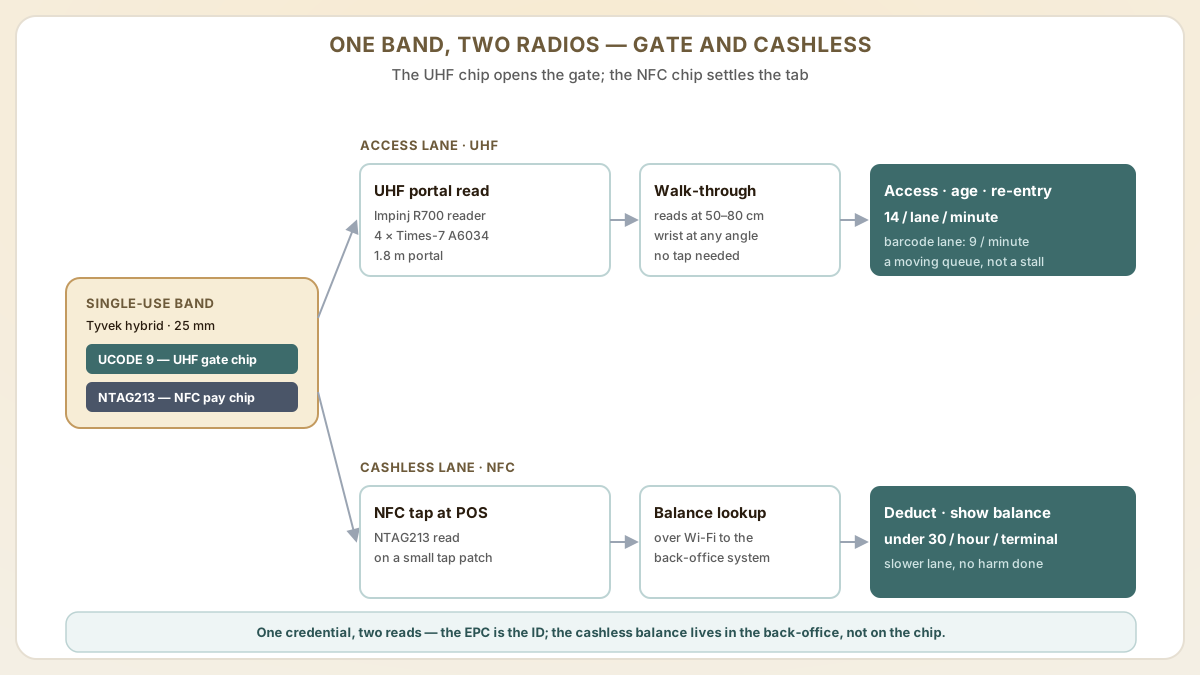
- At the gate, an Impinj R700 driving four Times-7 A6034 antennas in a 1.8 m portal reads the UHF chip at 50–80 cm, so attendees walk through wrist-at-any-angle — 14 through a lane each minute against 9 on the old barcode workflow.
- At the point of sale, the NTAG213 chip is tapped, the terminal looks up the balance over Wi-Fi, deducts the spend and shows the new balance — the chip never stores money, only the identifier that finds it.
- Two reads, one wristband: the UHF read is tuned for throughput, the NFC read for a deliberate, confirmable transaction, which is why the payment lane can run slower without hurting anyone.
The four-day scoreboard
The numbers the operations team went home with — throughput at the gate, money through the wristband, and how many cloned credentials the chip quietly turned away over the four-day window.
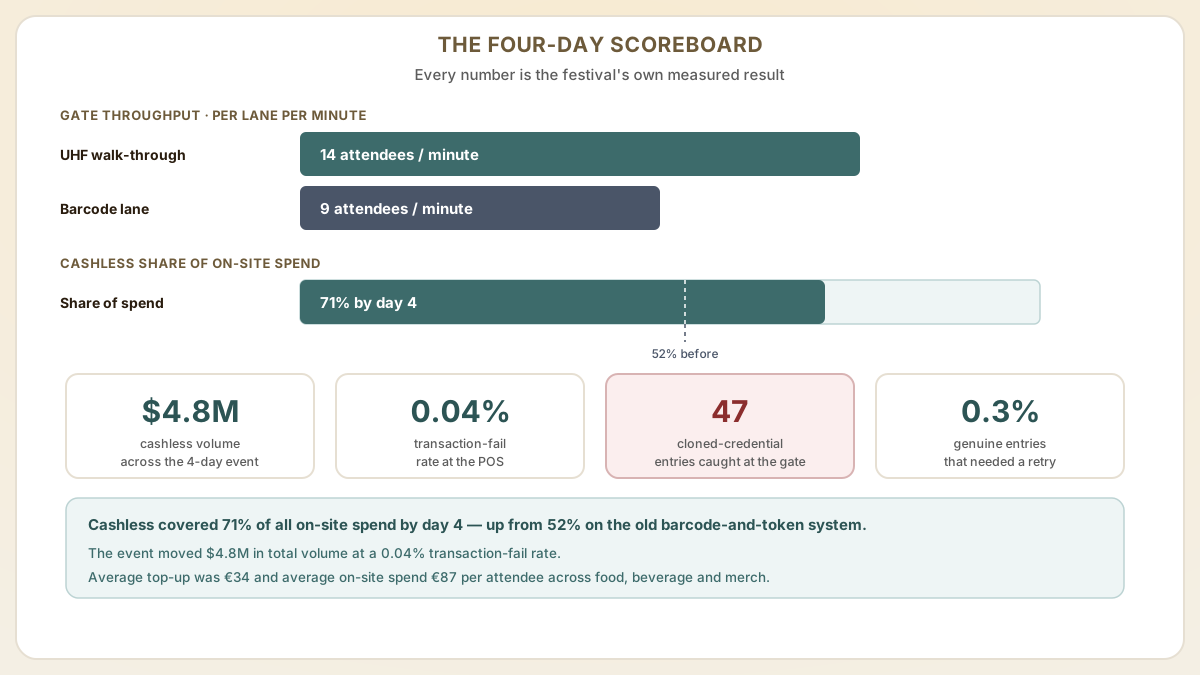
- Gate throughput held at 14 attendees per lane per minute, up from 9 on the previous barcode-scan lanes — the difference between a moving queue and a stalled one at peak.
- Cashless payment reached 71% of all on-site spend by day 4, up from 52% on the festival's previous barcode-and-token system, moving $4.8M in total volume at a 0.04% transaction-fail rate.
- Integrity held too: 47 attempted entries on cloned barcode-only credentials were caught at the portal because the UHF chip forced a TID cross-check, and under 0.3% of genuine entries needed a second read.
The deployment at a glance — chip, band and measured results
One table for the reviewer who wants the specification and the outcomes side by side. Every figure below is a value the festival shipped or measured — nothing here is modelled.
| Attribute | Value | Notes |
|---|---|---|
| Gate chip | UCODE 9 — UHF RAIN, ISO/IEC 18000-63 | 96-bit EPC; hands-free walk-through read |
| Cashless chip | NTAG213 — NFC, tap-to-pay lookup | Balance held in the back-office, not on the chip |
| Band + closure | Single-use Tyvek hybrid, 25 mm, snip-lock | Breaks on removal; artwork changes yearly |
| Gate throughput | 14 / lane / minute | vs 9 on the prior barcode lane |
| Read setup | Impinj R700 + 4 × Times-7 A6034, 1.8 m portal | Reads the UHF chip at 50–80 cm |
| Cashless result | 71% of on-site spend by day 4; $4.8M volume | Up from 52%; 0.04% transaction-fail rate |
| Integrity | 47 cloned-credential entries caught | TID cross-check at the portal; under 0.3% retry |
| Unit economics | $0.18–0.24 / band (FOB Shenzhen, 200k MOQ) | 200,000 shipped 28 days before gates |
What transfers — where this UHF-plus-cashless pattern fits
The deciding factors here — a queue that cannot stall, a payment that must clear fast, and a credential you throw away at the end of the weekend — recur across live events. The same two-radio band moves cleanly onto any of them; the event-wristband solution documents the workflow end to end.
- Multi-stage music and arts festivals — the exact profile here: high daily peaks, re-entry, age gates and cashless bars on one disposable band.
- Marathons, cycling and mass-participation sport — walk-through timing and gated zones where a tap delay is unacceptable in the start pen.
- Conferences and expos — badge-grade access plus cashless catering, where a reusable silicone band can pay off over a season; the silicone vs fabric vs woven comparison shows when to switch material.
- Resorts, theme parks and stadiums — longer-lived credentials where the wristbands for hotels vs events vs resorts trade-off decides the chip and closure.
Useful next pages
Use these linked product, guide and comparison pages to keep the next click specific and practical.
Wristband SKUs deployed
The exact chip + closure combination shipped for this festival.
Compare wristband chip & material before committing
How chip and closure trade-offs change with event type.
FAQ
Why not multi-use silicone bands?
Single-use Tyvek is roughly 5× cheaper than silicone and the festival's procurement model treats wristbands as a per-attendee disposable rather than a multi-event credential. For a customer running a 12-event annual festival circuit, silicone wristbands can be reused at three or four events with the appropriate cleaning cycle, and the math flips. This case study customer chose Tyvek because the event is once-yearly and brand artwork changes annually.
How is cashless top-up handled on the wristband?
The wristband EPC is the credential identifier; the cashless balance lives in the festival's back-office payment system, not on the chip. At the POS terminal the cashier scans the wristband (HF / NFC reader on a separate small surface area of the band, NTAG213 chip), the terminal looks up the balance over Wi-Fi, deducts the transaction, and shows the new balance. The UHF chip on the same band handles the gate-access read; the NFC chip handles the POS-payment read. The festival's POS partner is responsible for the offline-fallback flow when Wi-Fi drops.
What is the chip-clone resistance for a UCODE 9 wristband?
UCODE 9 carries a unique 96-bit factory-programmed Serialized TID. A cloned chip would need both the matching EPC and the matching TID, and TID cloning requires factory-level silicon access. In this case study the gate-portal software does TID-vs-EPC cross-validation on every entry, which is how the 47 cloned-credential attempts were caught — they had matching barcodes from photographed legitimate bands, but no matching TID. Note: UCODE 9 does not implement on-chip AES-128 cryptographic authentication — that's a UCODE DNA (UHF) or NTAG 424 DNA (HF) feature. The clone-detection here is TID-based lookup, not cryptographic challenge-response.
What about read range when attendees are wearing the band under a sleeve or jacket?
UHF reads through clothing without measurable degradation in the lane portal setup used here (Impinj R700 readers, 4× Times-7 A6034 antennas in a 1.8 m portal). Read range falls only when the band is pressed flat against a watch, phone or other metal-bodied wearable. Operations briefed attendees to wear the band on their non-watch wrist; less than 0.3% of entries needed a retry.
Sources & references
Primary standards, OEM datasheets and regulatory documents cited by this article. All URLs were verified on the access date shown below.
- NXP UCODE 9 UHF RAIN RFID IC (SL3S1206) — product data sheet
Confirms the UCODE 9 96-bit EPC, EPC Gen2v2 and UHF RAIN air interface behind the wristband gate credential.
- ISO/IEC 18000-63 — UHF RFID (RAIN) Type C air-interface standard
The UHF air-interface standard the UCODE 9 gate chip implements for walk-through portal reads.
- GS1 EPC UHF Gen2 (Gen2v2) air-interface protocol
The EPC Gen2v2 protocol underlying the 96-bit EPC written to each wristband at the fulfilment stage.
- NXP NTAG213 — NFC Forum Type 2 tag IC product data sheet
The HF/NFC chip used for the cashless point-of-sale read on the same wristband.
Proud Tek is a Shenzhen-based RFID & NFC manufacturer supplying hotel chains, transit operators, event venues and retail brands worldwide. Every order includes free samples, RF testing and dedicated project support.
Get a Quick Quote
Tell us about your project and we'll respond within one business day. Fields marked (asterisk) are required.