
Case study · Libraries
47-Branch ICODE SLIX2 Self-Service Migration

Quick answer
A US municipal public library system migrated 1.4 million catalogued items from a legacy 13.56 MHz proprietary chip to NXP ICODE SLIX2 (ISO 15693) RFID labels across 47 branches over 24 months. The migration enabled self-service check-out kiosks, security-gate EAS (AFI bit), and a robotic-arm sorter at the central distribution centre.
- Customer profile — US municipal public library system, 47 branches, 1.4 M catalogued items, ~4.2 M annual circulations.
- Chip selected — NXP ICODE SLIX2, ISO/IEC 15693, 13.56 MHz vicinity, 2,528-bit user memory (2,560-bit total EEPROM), AFI security flag for EAS.
- Form factor — 50 × 50 mm white paper square label, library-spine and book-cover-inside placements, custom artwork per branch.
At a glance
Use these short answers to decide whether this page matches the project before moving into the detail.
Customer profile
US municipal public library system, 47 branches across two counties, 1.4 M catalogued items, 4.2 M annual circulations, 78 full-time librarians plus paraprofessional sta...
Chip & form factor
NXP ICODE SLIX2 — ISO/IEC 15693, 13.56 MHz vicinity, 2,528-bit user memory (2,560-bit total EEPROM), AFI security flag, EAS-equivalent function. 50 × 50 mm paper square...
Next step
Ready to move forward? Start your inquiry to get specific answers for this project.
Request a library ICODE label sample pack- Measured results (post-rollout)
-
- Self-service check-out share: 78% of all circulations (vs 23% on the legacy chip, which only supported assisted check-out).
- Branch staffing redirected from circulation desk to community programming: equivalent of 12 FTE redeployed.
- Mis-shelved items found per quarter: -41% (sorter now flags wrong-branch returns before re-shelving).
- Security-gate false-alarm rate: -67% (AFI bit replaces unreliable HF-EAS strips).
Why ICODE SLIX2 (and not MIFARE / NTAG)
Library RFID is dominated by ISO 15693 chips because the standard supports anti-collision reads at vicinity range (up to 1 m on a stack of items) and integrated EAS via the AFI security flag — features ISO 14443 (MIFARE / NTAG) does not provide. The ALA's library RFID best-practice guide explicitly recommends ISO 15693 for circulation, and the major library RFID vendors (Bibliotheca, Envisionware, FE Technologies, Lyngsoe) all standardise on ICODE.
- ISO 15693 anti-collision — reads a stack of 20–30 items in a single sweep at the self-service kiosk.
- AFI security flag — built-in EAS function. Toggle the AFI bit at check-out to disarm the security gate; toggle back at check-in.
- Read range — 30–80 cm at the kiosk, 80–120 cm at the security gate.
- Cost — $0.12–0.18 / label at library MOQ (50k+).
- MIFARE Classic / NTAG were rejected because ISO 14443 anti-collision is slower at vicinity range and there is no native EAS bit.
The 24-month migration sequence
1.4 M items cannot be re-tagged in a single weekend. The customer ran a branch-by-branch migration with a dual-tag transition window of 90 days per branch, during which both legacy-chip and ICODE-tagged items circulated and the security gates read both protocols.
- Months 0–3: pilot at the central library, 80,000 items. Validate kiosk vendor, sorter vendor, label vendor.
- Months 4–6: 6 high-traffic branches converted, 280,000 items. Re-tagging at the branch by paraprofessional staff during off-peak hours.
- Months 7–18: rolling conversion of the remaining 40 branches. Average 35,000 items / branch / 2 weeks.
- Months 19–24: legacy-chip retirement, security gates re-tuned to ICODE-only, dual-tag transition window closes.
Operational results at year 2
The customer's library director publicly credited the RFID migration with enabling the system's 'community-first' strategy — librarians moved from transaction-processing roles at the circulation desk to programming and community-services roles in the public-facing rooms. Patron-facing impact was measured separately and reported a 14% increase in patron NPS over the 24-month rollout window.
How the migration was engineered — chip, encoding, and a branch-by-branch cutover
Re-chipping 1.4 M catalogued items without shutting a single branch is less a technology project than a logistics one. The architecture came down to a few deliberate calls: an ISO 15693 chip for stack reads and built-in security, a paper label cheap enough to buy by the pallet, and a rolling cutover that let each branch switch protocols without ever going dark. The ICODE SLIX chip encyclopedia covers the silicon; the RFID library management solution covers the workflow this case wired together.
- Chip choice: ICODE SLIX2 on ISO/IEC 15693 at 13.56 MHz, picked for anti-collision stack reads and the AFI security flag that folds EAS into the same tag — no separate security strip to buy, tune, or replace.
- Encoding: each label carries the library's catalogue ID in the EPC field; a trained paraprofessional retags 180–220 items / hour at 12–18 seconds per item, including the barcode read, the write, and the WMS update.
- Form factor: a 50 × 50 mm white paper square label — book-cover-inside on books, library-spine on DVDs and audiobooks, per ALA RFID guidance.
- Cutover: a dual-tag transition window of 90 days per branch, during which the security gates read both the legacy 13.56 MHz chip and ICODE, so no branch ever stopped circulating.
- Sequencing: an 80,000 items pilot at the central library, then 6 high-traffic branches, then a rolling conversion of the remaining 40 branches at roughly a 35,000-item branch every two weeks.
The self-checkout path — one AFI bit does the security
Here is the whole patron journey in one diagram. A stack of books hits the kiosk, ISO 15693 anti-collision reads all 20–30 items in a single sweep, the AFI security flag flips to disarm the gate, and the catalogue logs the loan. Walk out; the gate stays quiet because the bit now says the books are yours. If you are still weighing the protocol, compare 125 kHz vs 13.56 MHz RFID before committing.
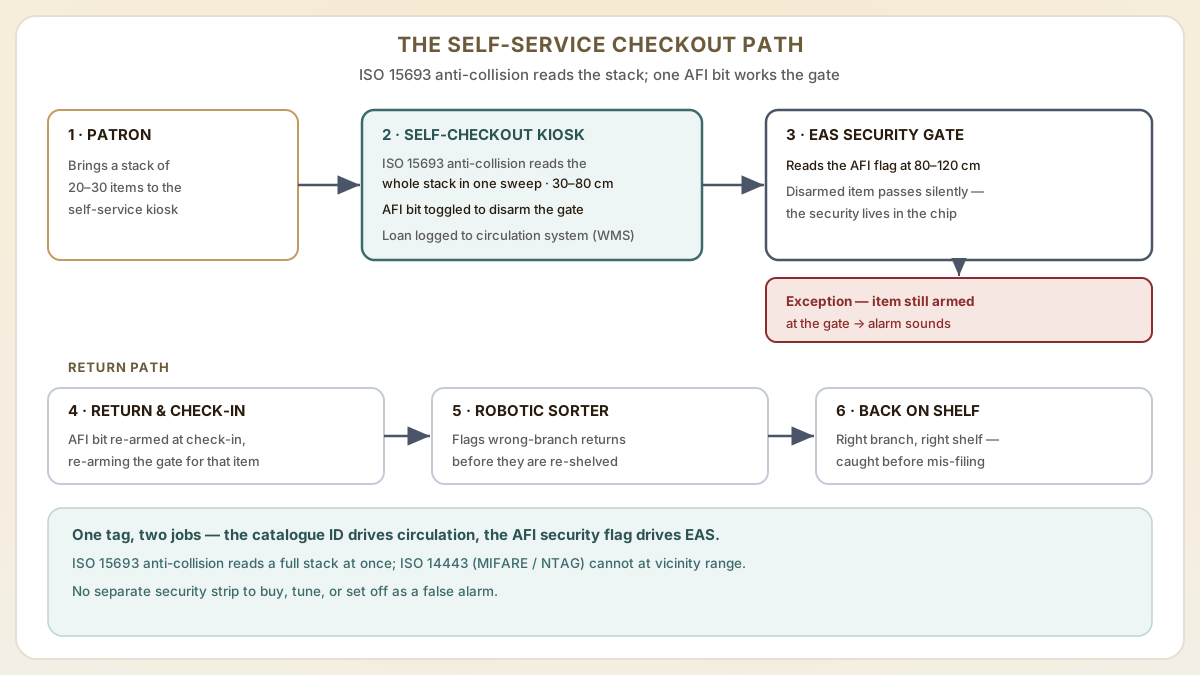
- At the kiosk: ISO 15693 anti-collision reads a stack of 20–30 items in one sweep at 30–80 cm, so the patron sets the whole pile down once instead of scanning book by book.
- Security handoff: the AFI bit is toggled to disarm at check-out and toggled back at check-in — the EAS function lives in the chip, not in a separate strip glued to the page.
- At the gate: the reader checks the AFI flag at 80–120 cm; a disarmed item passes silently, an item still armed trips the alarm.
- On return: the loan is closed in the circulation system (WMS) and returns run past the robotic sorter, which flags wrong-branch items before they are re-shelved.
The year-two scoreboard
Two years in, the figures the library director reports to the board are these. Self-service went from a fifth of circulations to more than three-quarters, and the security gate stopped crying wolf. Everything below is the customer's own measured result — nothing here is modelled.
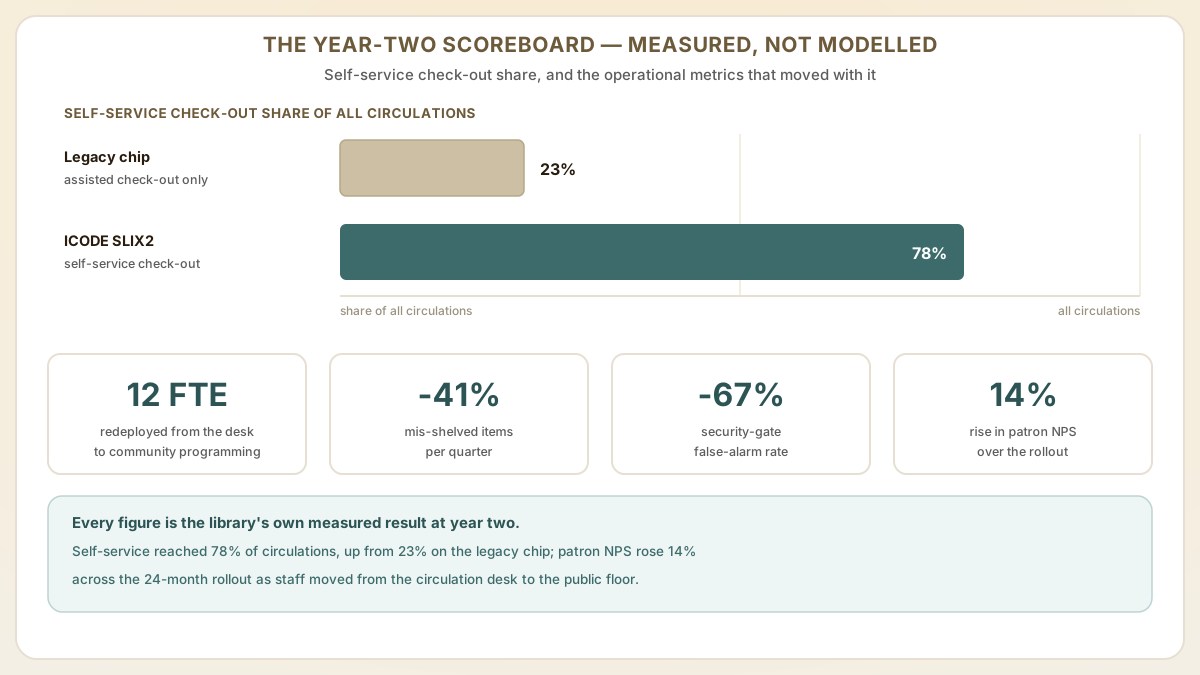
- Self-service check-out share reached 78% of all circulations, up from 23% on the legacy chip, which only supported assisted check-out.
- 12 FTE were redeployed from the circulation desk to community programming — the same staff, aimed at the public instead of the transaction.
- Two gate-and-shelf metrics moved the most: mis-shelved items per quarter at -41%, and the security-gate false-alarm rate at -67%, after the AFI bit replaced the unreliable HF-EAS strips.
- Patron NPS rose 14% across the 24-month rollout window, measured separately from the operational metrics.
The deployment at a glance — spec, scale, and measured results
One table for the reviewer who wants the chip, the scale, and the outcomes side by side. Every figure here already appears in this case study; nothing is modelled or rounded up for effect.
| Attribute | Value | Notes |
|---|---|---|
| Chip | ICODE SLIX2 — ISO/IEC 15693, 13.56 MHz vicinity | 2,528-bit user memory (2,560-bit total EEPROM) |
| Security | AFI security flag — EAS-equivalent function | Toggled to disarm at check-out, re-armed at check-in |
| Form factor | 50 × 50 mm white paper square label | Book-cover-inside on books; library-spine on DVDs / audiobooks |
| Read range | 30–80 cm at the kiosk · 80–120 cm at the gate | ISO 15693 anti-collision; a stack of 20–30 items per sweep |
| Scale | 47 branches · 1.4 M catalogued items · 4.2 M annual circulations | Two counties; 78 full-time librarians plus paraprofessional staff |
| Migration | 24 months · 90 days dual-tag window per branch | Pilot 80,000 items → 6 high-traffic branches → remaining 40 branches |
| Self-service share | 78% of circulations (vs 23% on the legacy chip) | Measured at year 2 |
| Staffing shift | 12 FTE redeployed to community programming | From the circulation desk |
| Mis-shelved items | -41% per quarter | Sorter flags wrong-branch returns before re-shelving |
| Gate false alarms | -67% | AFI bit replaces unreliable HF-EAS strips |
| Label cost / MOQ | $0.12–0.18 / label at library MOQ (50k+) | Peel-and-stick, glassine release liner |
| Label life | 10-year minimum expectation | Replacement budget 0.5% / year; EEPROM rated >50-year at 70 °C |
What transfers — where the ISO 15693 self-service pattern fits next
The deciding factors here — a large catalogue, stack reads at vicinity range, and EAS that rides inside the tag — are not unique to this system. Any circulation-heavy institution with a security gate and self-service ambitions inherits the same playbook. The RFID library management solution documents it end to end, and the library industry guide maps the wider estate.
- Academic and university libraries — larger catalogues and heavier reserve-desk churn, on the same anti-collision stack read and AFI-gate pairing.
- School and public-branch networks — where redeploying desk staff to programming is the entire point of going self-service.
- Museum, archive, and special-collection lending — item-level ISO 15693 tagging where the data model, not the read range, is the hard part.
- Media and equipment pools (tool libraries, AV lending) — mixed-media items on library-spine and book-cover-inside placements, checked out and returned through the same gate.
Useful next pages
Use these linked product, guide and comparison pages to keep the next click specific and practical.
Library SKUs and chip background
Get the same chip and form factor used in this deployment.
Compare ISO 15693 vs ISO 14443 before committing
The chip-protocol choice for library workflows.
FAQ
Can ICODE SLIX2 work with all major library kiosk vendors?
Yes. Bibliotheca, Envisionware, FE Technologies, Lyngsoe and 3M Library Systems all support ICODE SLIX and SLIX2 as the default ISO 15693 chip family. Confirm with your kiosk vendor that the firmware supports the AFI bit operations for EAS. The customer in this case used Envisionware kiosks and Bibliotheca security gates.
How long does re-tagging take per item?
12–18 seconds per item including reading the existing barcode, writing the EPC field with the library's catalogue ID, attaching the label and updating the WMS. A trained paraprofessional retags 180–220 items / hour. A 35,000-item branch takes 160–190 staff hours to fully re-tag — typically completed by 4–6 staff over a 5-week window in off-peak hours.
Does the chip survive being checked out for months?
ICODE SLIX2 EEPROM is rated for >50-year data retention at 70 °C, far beyond library temperature ranges. The mechanical failure mode is label delamination from the book paper after repeated wet exposure (children's-section books are the most vulnerable). The customer's specification calls for a 10-year minimum label-life expectation, and replacement labels are budgeted at 0.5% / year of catalogued items.
What happens to patron-privacy concerns?
ICODE SLIX2 stores only the library's catalogue ID, not patron data — the patron's link is in the library's circulation system. The chip can be read at vicinity range, so a patron walking past a UHF reader could in theory have their book inventory detected. The library mitigated this by issuing privacy-aware book covers for any patron who requests one, which contain a thin foil layer that blocks the HF read.
Sources & references
Primary standards, OEM datasheets and regulatory documents cited by this article. All URLs were verified on the access date shown below.
- NXP ICODE SLIX2 (SL2S2602) product page and short data sheet
Chip-level reference for the ICODE SLIX2 2,528-bit user memory (2,560-bit total EEPROM), 13.56 MHz ISO 15693 operation, and the AFI security flag used for EAS.
- ISO/IEC 15693-3:2019 — Vicinity cards, Part 3: Anticollision and transmission protocol
Defines the anti-collision stack read and the AFI (Application Family Identifier) flag the deployment uses for security-gate EAS.
- ISO/IEC 15693-2:2019 — Vicinity cards, Part 2: Air interface and initialization
The 13.56 MHz vicinity air interface for the ISO 15693 label family selected for circulation.
- ISO 28560-1:2023 — RFID in libraries, Part 1: Data elements and general guidelines for implementation
The library-RFID data model and implementation guidance for encoding the catalogue identifier onto the item tag.
Proud Tek is a Shenzhen-based RFID & NFC manufacturer supplying hotel chains, transit operators, event venues and retail brands worldwide. Every order includes free samples, RF testing and dedicated project support.
Get a Quick Quote
Tell us about your project and we'll respond within one business day. Fields marked (asterisk) are required.