
Case study · Hospitality
28-Property Hotel Key Card Rollout
2.4M/Year

Quick answer
A South-East Asia hotel group operating 28 properties under three sub-brands migrated from magnetic-stripe key cards to MIFARE Classic 1K contactless key cards across the entire estate over 18 months. Proud Tek shipped 2.4 million cards in year one, with same-day Shenzhen-to-property air freight on the front-desk replenishment SKU. Encoding lead time at the front desk dropped from 12 seconds (magnetic swipe-and-program) to 1.8 seconds (RFID tap-encode), and lost-card replacement cost fell 41% because the cards no longer carried magnetic data that demagnetised in mobile-phone wallets.
- Customer profile — South-East Asia hotel group, 28 properties across three brand tiers (4-star to luxury), 12,000 keyed rooms total.
- Chip selected — MIFARE Classic 1K, 1KB EEPROM, 13.56 MHz, ISO 14443 Type A. Selected for full backwards compatibility with the customer's existing Saflok RFID locks (already installed at 60% of properties) and same-day clone interoperability with Onity and Salto retrofits across the rest.
- Volume — 2,400,000 cards in year one, 1,800,000 cards in year two (steady-state replenishment). Median property consumes 7,500 cards / month including guest-pocket loss and front-desk re-encoding.
At a glance
Use these short answers to decide whether this page matches the project before moving into the detail.
Customer profile
Multi-brand hotel group, 28 properties, 12,000 keyed rooms, ~2.5 M annual guest stays. Customer name withheld under brand-standard NDA.
Chip & form factor
MIFARE Classic 1K (NXP) — 1KB EEPROM, ISO 14443A, 13.56 MHz. 0.84 mm PVC body, glossy CMYK print one side, semi-gloss spot UV brand mark, magnetic stripe omitted (saved...
Next step
Ready to move forward? Start your inquiry to get specific answers for this project.
Request a hotel key card sample pack- Measured results (year 1 vs year -1)
-
- Front-desk encoding time per card: 12.0 s (mag-stripe) → 1.8 s (RFID tap-encode). 85% time reduction.
- Lost-card replacement cost: -41% (cards no longer demagnetised in guest pockets next to phones).
- Guest 'card does not work' complaints at the lock: -68% (chip cards survive bending and water exposure that ruined mag stripes).
- Card unit cost: $0.31 / card (mag-stripe) → $0.34 / card (MIFARE Classic 1K) — +9% per card, offset 6× by the lifecycle saving above.
The procurement problem
The hotel group operated three brand tiers on three different lock platforms (Saflok at 60% of properties, Onity at 25%, Salto at 15%). The legacy magnetic-stripe key cards required brand-specific encoders, brand-specific consumables and frequent re-encoding because the magnetic strips demagnetised in guest pockets next to smartphone speakers and mobile wallets.
- Magnetic-stripe failure rate at the lock had climbed to 4.1% of guest interactions by 2024 — guests blamed the front desk, the front desk blamed the cards.
- Three encoding workflows (Saflok / Onity / Salto) meant property-by-property procurement and three different replenishment cycles.
- Brand-standard audit cited the cards as a CX risk and mandated a chip-card migration by the end of FY26.
Why MIFARE Classic 1K (and why not DESFire)
The hotel group's existing Saflok, Onity and Salto locks all support MIFARE Classic 1K natively. DESFire EV3 would have offered AES-128 mutual authentication and a much stronger anti-clone profile — but the lock platforms would have needed firmware upgrades at every door (estimated $1.7M across 12,000 doors) for negligible incremental guest benefit. The decision tree was therefore Classic 1K with a 36-month migration option to DESFire EV3 when the lock vendors complete their planned firmware cycle.
- MIFARE Classic 1K — universal lock compatibility, $0.20–0.30 chip cost, single-vendor production at Proud Tek Shenzhen.
- MIFARE Plus EV2 SL3 — considered, rejected for now because lock platforms only support Plus on the 2026+ firmware track.
- DESFire EV3 — planned migration target for FY28 once the lock platforms ship the AES-128 firmware update.
- Form factor — 0.84 mm PVC, mag-stripe omitted (customer's lock platforms no longer need it as a fallback).
Production & logistics that made the rollout work
A 28-property estate replenishing 7,500 cards / month per property cannot wait 4-week ocean freight on every shipment. Proud Tek runs a hybrid logistics model that consolidates ocean freight for the master replenishment SKU and routes air freight for branded launches and property-specific artwork batches.
- Master SKU (un-printed but chipped) shipped by ocean to the customer's regional warehouse — 30-day MOQ-of-500k, $0.21/card landed.
- Branded SKU (per-property artwork) shipped by air freight FOB Shenzhen — 7-day production + 3-day air = 10-day lead time, $0.34/card landed.
- Pre-encoded SKU (sectors 1–15 written at the Proud Tek factory under NDA, mailed direct to property) used only for new-property launches and brand events.
- Quality gate — 100% read-rate test at Proud Tek (Mühlbauer ICT2 inline test) plus 1% destructive sample test for chip-to-antenna bond.
Operational results after 12 months at steady state
The customer's CX team tracks a single composite KPI for front-desk friction (the 'arrival friction index') and reported a 17% improvement in the score across the estate within six months of the rollout. The procurement team separately tracked card lifecycle cost (purchase + encoding labor + replacement + lock-platform support tickets) and reported a 23% net annual saving once the encoding workflow stabilised.
How the rollout was built — encode, migrate, replenish
The rollout had three moving parts, and the chip was the least of them. The card is a MIFARE Classic 1K with the magnetic stripe deliberately left off; the work lived in the encoding desk, the property-by-property cutover, and a three-SKU supply line that kept 28 front desks stocked without air-freighting everything. The hotel key card solution documents the same workflow for a single property.
- Encoding: the card ships blank and the property's own lock-platform encoder writes sectors 1–15 at the front desk in 1.8 seconds, down from the 12.0-second magnetic swipe-and-program it replaced. Sector 0 stays fixed and the 7-byte UID anchors the credential.
- Lock estate: one chip, three platforms — Saflok at 60% of properties, Onity at 25%, Salto at 15% — all reading MIFARE Classic 1K natively, so no door hardware changed.
- Migration: property by property, in each brand tier's off-season, with a 30-day window where the front desk encoded both magnetic and RFID credentials and the locks accepted either. Calendar time 18 months; the manufacturing portion was an 8-month rolling production cycle.
- Supply line: a master ocean SKU (chipped, unprinted) landed at $0.21 per card on a 30-day cycle, a branded air SKU (per-property artwork) landed at $0.34 per card on a 10-day cycle, and a factory pre-encoded SKU covered new-property launches.
- Quality gate: 100% inline read-rate test on a Mühlbauer ICT2 plus a 1% destructive sample for the chip-to-antenna bond, before anything leaves Shenzhen.
From front-desk encode to a logged door open
A hotel credential only has to do two things well: get written in under two seconds at check-in, and open exactly one guest's door for exactly one stay. Here is the whole path, from the encoder at the desk to the audit line the lock writes when the card taps. Door hardware never changed — the Saflok compatibility profile shows why the 60 / 25 / 15 lock split all reads the same card.
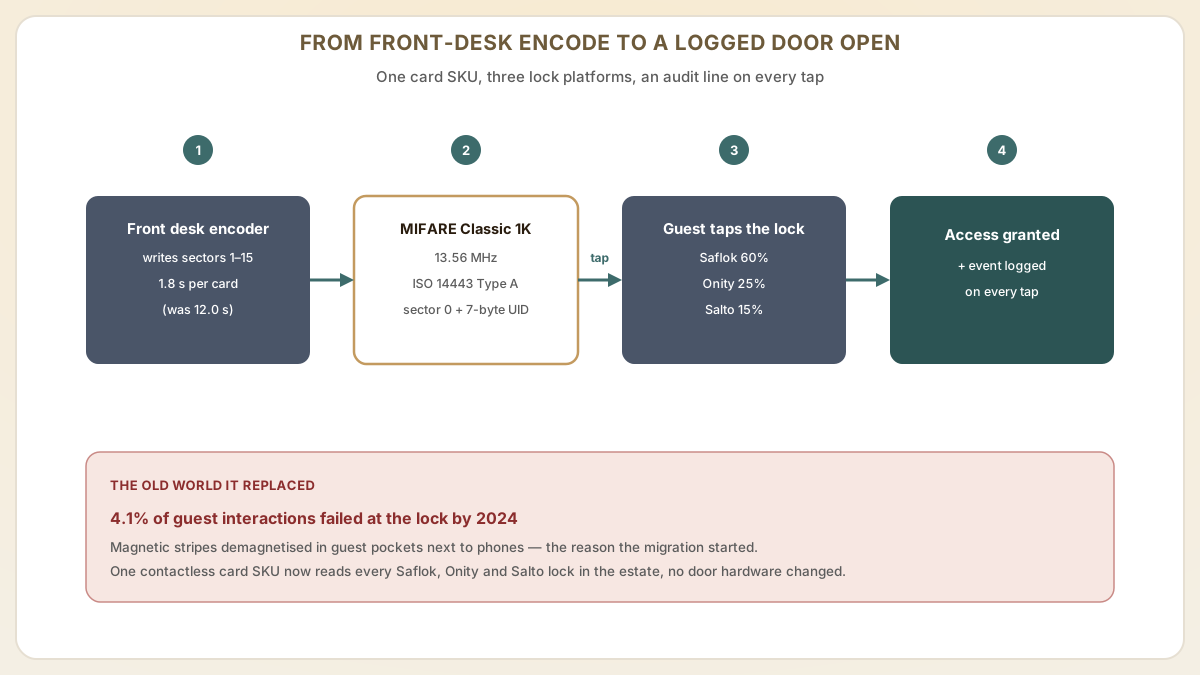
- Check-in: the front-desk encoder writes the stay's credential into sectors 1–15 of a MIFARE Classic 1K card in 1.8 seconds; sector 0 and the 7-byte UID stay fixed.
- Tap: the guest presents the card at 13.56 MHz over the ISO 14443 Type A air interface — no swipe, no direction, nothing to demagnetise in a pocket next to a phone.
- Decision and log: the lock checks the credential against the stay and writes an access event — the same audit line whether the door is Saflok, Onity or Salto.
- For contrast, the magnetic stripe it replaced was failing on 4.1% of guest interactions by 2024, which is where the whole migration started.
The numbers that closed the business case
Procurement did not approve a chip; it approved four numbers and a payback. Encoding got faster, complaints and lost-card spend fell, and the total lifecycle cost dropped even though each card costs a few cents more. The MIFARE Classic vs Plus vs DESFire comparison covers why the group bought the cheaper chip on purpose.
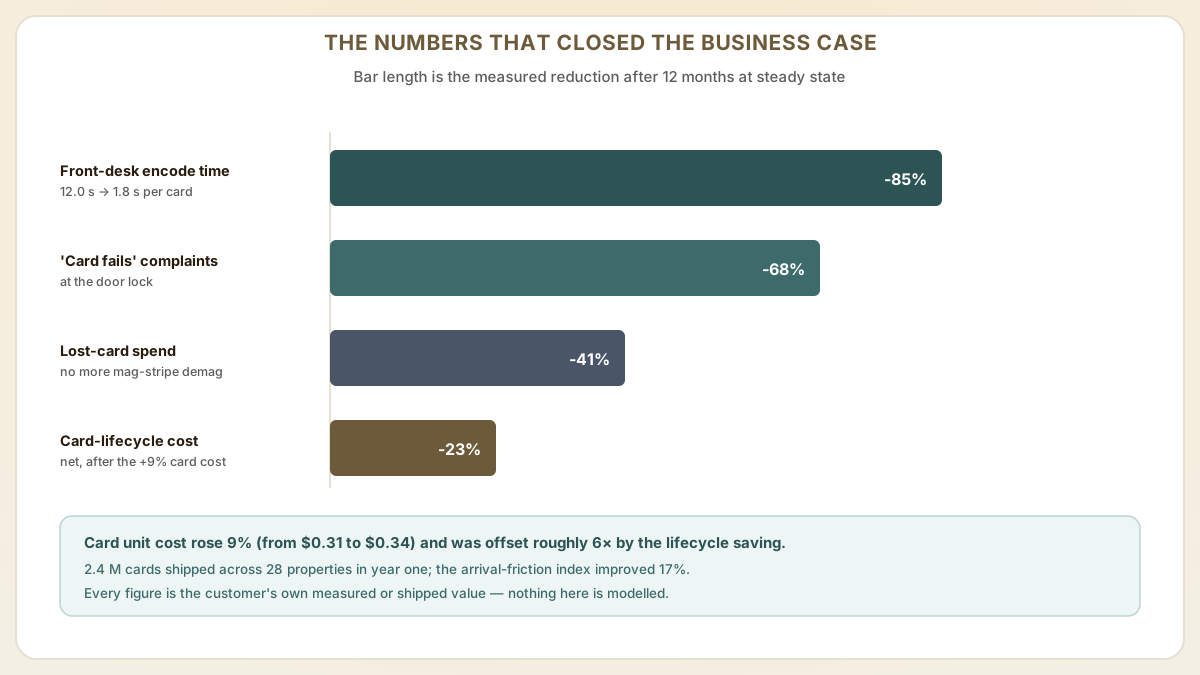
- Front-desk encoding time per card fell 85%, from 12.0 seconds on the magnetic swipe-and-program to 1.8 seconds on the RFID tap-encode.
- 'Card does not work' complaints at the lock dropped 68%, and lost-card replacement spend fell 41% — chip cards survive the bending, water and phone-pocket exposure that killed mag stripes.
- Card unit cost rose 9%, from $0.31 to $0.34 and was offset roughly 6× by the lifecycle saving; net card-lifecycle cost fell 23% once the workflow stabilised.
- The CX team's arrival-friction index improved 17% across the estate within six months, on 2.4 M cards shipped across 28 properties in year one.
The deployment at a glance — card, encoding, logistics, results
One table for the reviewer who wants the specification and the outcomes side by side. Every figure here is the customer's own shipped or measured value; nothing is modelled.
| Attribute | Value | Notes |
|---|---|---|
| Chip | MIFARE Classic 1K — ISO 14443 Type A, 13.56 MHz | 1KB EEPROM; sector 0 fixed, sectors 1–15 encoded at the desk |
| Card body | 0.84 mm PVC, CMYK one side, spot-UV brand mark | Magnetic stripe omitted — saved $0.07 per card |
| Lock estate | Saflok 60% · Onity 25% · Salto 15% | All read MIFARE Classic 1K natively; no door hardware changed |
| Encoding | 1.8 s per card at the front desk | Down from 12.0 s on the magnetic swipe-and-program (85% faster) |
| Logistics | Ocean master $0.21 · air branded $0.34 per card | 30-day ocean vs 10-day air; factory pre-encode for launches |
| Migration | 18 months, property by property | 30-day dual-credential overlap; 8-month rolling production |
| Measured results | Complaints -68% · lost-card spend -41% · lifecycle cost -23% | Arrival-friction index +17% within six months |
| Scale | 2.4 M cards year 1 · 28 properties · 12,000 rooms | 1.8 M cards year 2 at steady-state replenishment |
What transfers — where this MIFARE Classic key-card pattern fits
The deciding factors here — a mixed estate of installed locks, a front desk that re-encodes credentials all day, and cards that live in pockets next to phones — are not unique to one hotel group. The same MIFARE Classic 1K playbook moves onto any of the properties below; the hotel key card solution documents it end to end and the case-study library shows adjacent deployments.
- Multi-brand hotel and resort groups on mixed Saflok / Onity / Salto estates, where one card SKU has to read every installed lock without a firmware project.
- Serviced apartments and extended-stay brands, where high credential turnover makes the 1.8-second encode and the lower lost-card spend the whole business case.
- Casinos, conference hotels and campus housing that already run 13.56 MHz door hardware and want the audit trail without swapping locks.
- Any operator plotting a later move to DESFire EV3 for AES-128 credentials — the same card artwork and production line carry the chip swap when the lock firmware is ready.
Useful next pages
Use these linked product, guide and comparison pages to keep the next click specific and practical.
See the products that shipped to this customer
The exact SKUs referenced in this case study.
Compare before you commit
The chip and material trade-offs behind this deployment.
FAQ
Can a smaller hotel group (5–10 properties) get the same unit price you quoted here?
Within 15–25%. The $0.34/card branded SKU price quoted in this case study reflects 2.4 M cards / year across 28 properties on a 12-month rolling supply commitment. A 5-property group running 350,000 cards / year on a 6-month rolling commit typically lands in the $0.38–0.42 / card range for the same MIFARE Classic 1K chip and 0.84 mm PVC body. Below 100,000 cards / year the price ladder is steeper because lamination tooling amortises across fewer units.
How was the migration sequenced across 28 properties without disrupting guest stays?
Property by property, in the off-season window for each brand tier, with a 30-day overlap during which the front desk encoded both magnetic and RFID cards. New arrivals received an RFID card, existing guests who already had a magnetic card kept it until checkout. The lock platforms accepted both credential types during the overlap window. The full estate migration took 18 months calendar time, of which Proud Tek's manufacturing portion was the 8-month rolling production cycle.
What happens when the customer eventually moves to DESFire EV3?
Proud Tek produces both chip families on the same production lines and the artwork files are interchangeable, so the DESFire EV3 SKU is a back-end chip swap with no front-of-card visual change. The customer plans to begin the DESFire migration once the lock-platform vendors complete their AES-128 firmware update (currently scheduled for FY28). The chip cost step-up is approximately $0.20 per card and the encoder upgrade at each property is a software-only operation.
Did the customer evaluate a mobile-key alternative?
Yes, and they retained mobile keys as a premium-tier benefit for the luxury sub-brand. For mass-tier and mid-tier properties the physical card remained the primary credential because (a) guest mobile-key adoption stalled at 28% and (b) the card is also the in-room receptacle for the room-energy switch and the breakfast voucher punch. Mobile-key and physical-card coexist; the physical-card volume did not materially change after mobile-key launch.
Sources & references
Primary standards, OEM datasheets and regulatory documents cited by this article. All URLs were verified on the access date shown below.
- NXP MIFARE Classic EV1 1K — product page and datasheet
Confirms the card's air interface — ISO 14443 Type A at 13.56 MHz, 1KB EEPROM across 16 sectors, one unique serial per card — positioned by NXP for access control.
- ISO 14443-3 — proximity card initialization and anticollision (Type A)
Defines the Type A polling and anticollision the MIFARE Classic 1K card and the hotel locks use to select a single card in the field.
- NXP DESFire EV3 — AES contactless smart-card IC (the FY28 migration target)
The AES-128 chip the group plans to migrate to once its Saflok, Onity and Salto locks ship the firmware update; same card artwork and production line.
Proud Tek is a Shenzhen-based RFID & NFC manufacturer supplying hotel chains, transit operators, event venues and retail brands worldwide. Every order includes free samples, RF testing and dedicated project support.
Get a Quick Quote
Tell us about your project and we'll respond within one business day. Fields marked (asterisk) are required.