
Case study · Hospitality
3.1× Review Lift
Restaurant NFC Card Program

Quick answer
A US fast-casual restaurant chain deployed Proud Tek Google Review NFC cards at 412 stores, with one tabletop card per booth and a hand-held card at the takeout counter. Average Google reviews per store / month rose from 14 (control) to 43 (deployment) in the first 90 days — a 3.07× lift. The chain's overall Google rating moved from 4.2 to 4.4 stars chain-wide.
- Customer profile — US fast-casual restaurant chain, 412 stores across 12 states, ~2.4 M monthly transactions.
- Chip selected — NXP NTAG215, NFC Type 2, 504 bytes user memory, encoded with the store's unique Google Review URL.
- Form factor — 85 × 55 mm PVC NFC card, tabletop matte finish + spot UV brand mark, deployed one per booth + one at takeout counter.
At a glance
Use these short answers to decide whether this page matches the project before moving into the detail.
Customer profile
US fast-casual restaurant chain, 412 stores across 12 states, ~2.4 M monthly transactions, customer-experience team driving the Google review programme.
Chip & form factor
NXP NTAG215 — NFC Forum Type 2, 504 bytes user memory. 85 × 55 mm PVC card, tabletop matte finish + spot UV brand element + QR code fallback on reverse.
Next step
Ready to move forward? Start your inquiry to get specific answers for this project.
Request a Google Review NFC card sample- Measured results (90-day post-deployment vs control)
-
- Google reviews / store / month: 14 (control, last 90 days pre-deployment) → 43 (deployment, first 90 days). 3.07× lift.
- Chain-wide Google rating: 4.2 → 4.4 stars.
- Review sentiment: 91% 4 or 5 stars (vs 84% in the control period — the prompt lifts both volume and quality).
Why NFC cards (and not QR codes alone)
QR codes work but the friction is higher — the guest must open their camera app, frame the code, tap the link, then write the review. NFC reduces this to a single tap, no camera, no app. In a fast-casual setting where the guest is mid-meal or mid-pickup, the friction reduction is the lever.
- QR code conversion to a posted review: roughly 0.7% of tabletop impressions in the control period.
- NFC tap conversion to a posted review: 2.1% of tap events in the deployment period.
- Per-card tap rate at tabletop: 5–7 taps / card / day across 412 stores.
- Per-card tap rate at takeout counter: 12–18 taps / card / day (higher because the cashier verbally invites the guest).
Why NTAG215 specifically
NTAG215 is the workhorse of NFC marketing cards — 504 bytes of user memory is enough for a Google Review URL plus a fallback redirect, the chip is universally readable by every iPhone (since iOS 13) and every NFC-enabled Android (since Android 4.4), and the chip-cost economics work at the customer's volume.
- NTAG213 (180 bytes) — considered, sufficient for the URL alone but no room for a fallback redirect.
- NTAG215 (504 bytes) — chosen, room for the URL + the fallback redirect + a tap-counter tag (private chip memory).
- NTAG216 (888 bytes) — overkill, ~$0.04 / unit more expensive with no functional benefit for this use case.
- NTAG424 DNA — considered for the future programme expansion (authenticated taps for loyalty), not used in this case study.
Deployment logistics across 412 stores
Cards needed to be per-store-encoded (each store has a unique Google review URL) and shipped to the store with the artwork matching the chain's brand standards. Proud Tek ran the per-store encoding in Shenzhen using a database of store IDs supplied by the customer's IT team, then shipped one branded card set per store via FedEx ground.
- Per-store encoding at Proud Tek factory using a Mühlbauer encoding line — 8,000 cards / hour throughput.
- Master URL pattern — https://g.page/r/<store-id>/review, with <store-id> drawn from the customer's IT team's CSV.
- Quality gate — every card read post-encoding to verify the URL matches the store-ID database. 100% test, 0 mis-encoded cards in the deployment lot.
- Total production-to-store lead time: 28 days (production 18 days, FedEx 6 days, store-team activation 4 days).
Operational results at 90 days post-deployment
The customer's CX team modelled the Google review programme on a 'review velocity' KPI — reviews per store per month, normalised by transaction volume. The 3.07× lift held steady through month 6 and showed no sign of habituation decay in the year-1 data. The customer expanded the programme to include hand-held cards for shift leaders and is piloting NTAG424 DNA cards as a future authenticated-loyalty card.
How the card program was built — chip, encoding, artwork, rollout
A review card only works if the guest never has to think about it, so the build came down to four deliberate choices: a universally-readable chip, a per-store URL burned in at the factory, brand-matched artwork, and a two-placement drop that put a card exactly where the guest's hands already were. The same specification is documented on the Google Review NFC card solution page.
- Chip: NXP NTAG215 — an NFC Forum Type 2 tag with 504 bytes of user memory, room for the Google Review URL plus a fallback redirect, readable by every iPhone since iOS 13 and every NFC-enabled Android since Android 4.4.
- Encoding: each card was written with its store's own Google Review URL (https://g.page/r/<store-id>/review) on Proud Tek's Mühlbauer line at 8,000 cards / hour, then 100% read-verified against the store-ID database — 0 mis-encoded cards in the deployment lot.
- Form factor: an 85 × 55 mm PVC card, tabletop matte finish with a spot UV brand mark and a QR code fallback printed on the reverse for the few phones without a tap path.
- Placement: one card per booth plus one hand-held card at the takeout counter — the counter card sees 12–18 taps a day because the cashier says the words out loud, against 5–7 taps a day on a passive tabletop card.
- Rollout: production to store shelf in 28 days (18 days production, 6 days FedEx ground, 4 days store-team activation), shipped as one branded card set per store across all 412 stores.
The tap-to-review path — one gesture from booth to posted review
This is the whole product in one gesture. The guest taps the card, the phone opens the store's Google Review URL, and the rating posts — no camera, no app, no typing a search into Maps. Removing those steps is exactly what moved tabletop conversion from 0.7% on a QR code to 2.1% on a tap.
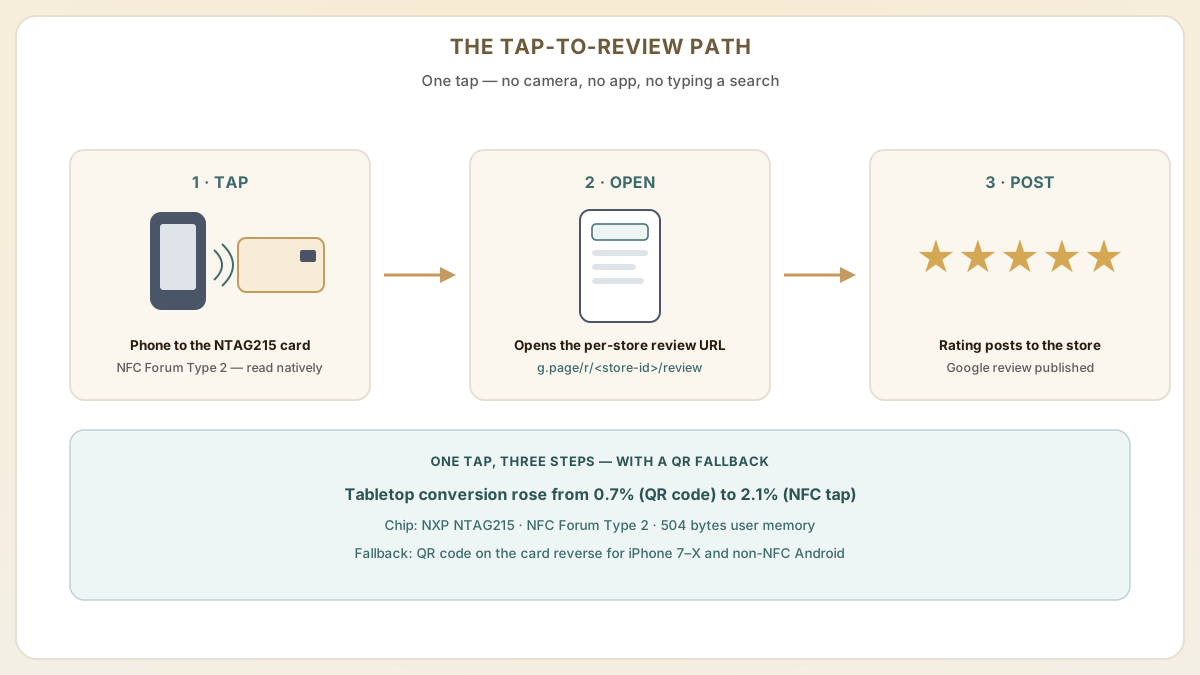
- Tap: the guest holds their phone to the NTAG215 card at the booth or takeout counter — NFC Forum Type 2 tags are read natively, with no app to open first.
- Open: the phone reads the encoded per-store URL (https://g.page/r/<store-id>/review) and opens it directly in the browser.
- Post: the guest lands on the store's own Google review screen and leaves a rating — the single step the card exists to make frictionless.
- Fallback: phones without a tap path (older iPhone 7–X, non-NFC Android) use the QR code on the card's reverse, so no guest reaches a dead end.
What 90 days changed — reviews, rating, and sentiment
Every figure here is the customer's own measured result over the first 90 days against the pre-deployment control — reported, not modelled. The headline is review velocity: monthly reviews per store went from 14 to 43.
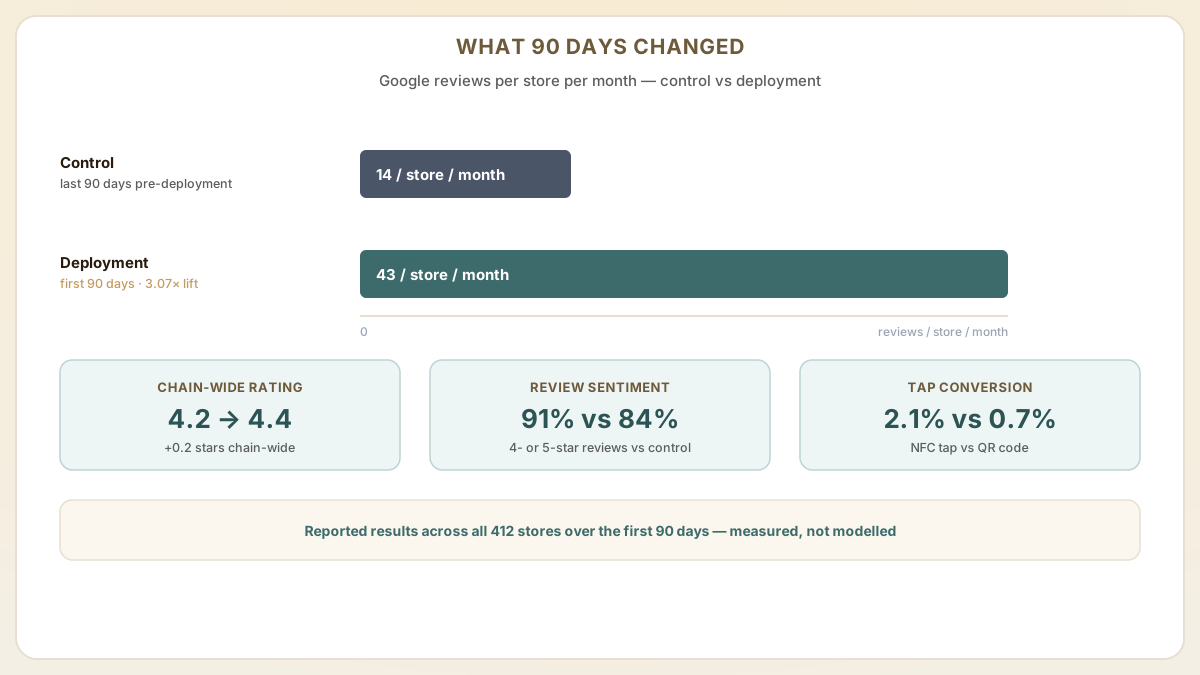
- Review volume: 14 reviews / store / month in the control period rose to 43 in the first 90 days — a 3.07× lift that held through month 6 with no habituation decay in the year-1 data.
- Rating: the chain-wide Google rating moved from 4.2 to 4.4 stars (+0.2 ⭐) as review volume climbed.
- Sentiment: 91% of deployment-period reviews were 4 or 5 stars, up from 84% in the control period — the prompt lifted review quality, not just count.
- Reach: the program ran across all 412 stores, and the customer has since expanded it to hand-held cards for shift leaders.
The deployment at a glance — chip, card, and measured results
One table for the reviewer who wants the specification and the outcomes side by side. Every figure is either the shipped specification or the customer's own reported result — nothing here is modelled.
| Attribute | Value | Notes |
|---|---|---|
| Chip | NXP NTAG215 — NFC Forum Type 2, 504 bytes user memory | Encoded with the per-store Google Review URL |
| Card | 85 × 55 mm PVC, tabletop matte + spot UV brand mark | QR code fallback printed on the reverse |
| Placement | One per booth + one hand-held at takeout | Tabletop 5–7 taps/day · counter 12–18 taps/day |
| Encoding & QA | Mühlbauer line, 8,000 cards / hour | 100% read-verified · 0 mis-encoded in the lot |
| Lead time | 28 days production-to-store | 18 days production · 6 days FedEx · 4 days activation |
| Reviews / store / month | 14 → 43 (3.07× lift) | First 90 days vs pre-deployment control |
| Chain-wide rating | 4.2 → 4.4 stars (+0.2 ⭐) | Held steady through month 6 |
| Review sentiment | 91% 4- or 5-star vs 84% control | Quality rose alongside volume |
| Tap → review conversion | 2.1% NFC vs 0.7% QR | Tap events vs tabletop QR impressions |
| Scale | 412 stores across 12 states | ~2.4 M monthly transactions |
What transfers — where a tap-to-review card fits next
The mechanics that made this work — a universally-readable NFC tag, a per-location review URL, and a card placed where the customer's hands already are — aren't specific to fast-casual restaurants. The same pattern moves onto any high-footfall, review-sensitive business; the Google Review cards for restaurants page documents the workflow, and the Google Review NFC card setup guide covers the per-store URL encoding end to end.
- Multi-location hospitality — cafés, bars, and quick-service groups where each site has its own Google Business Profile and its own review URL to encode.
- Personal-service chains — salons, clinics, gyms, and auto service, where a front-desk hand-off is the natural moment to invite a tap.
- Any counter with a verbal prompt — the takeout-counter pattern, where a staff member invites the tap, was the highest-converting placement and transfers to any service desk.
- Choosing the chip is the one real decision — the NTAG213 vs NTAG215 vs NTAG216 comparison covers when the extra memory of NTAG215 earns its keep over NTAG213.
Useful next pages
Use these linked product, guide and comparison pages to keep the next click specific and practical.
Get the same SKU
Google Review NFC cards available with per-store encoding.
Compare NFC chip families for marketing cards
NTAG memory ladder and the QR-vs-NFC choice.
FAQ
Does the NFC tap work on every modern smartphone?
Yes. NFC-Forum Type 2 tags (NTAG21x) are read natively by every iPhone since iPhone XS (iOS 13+) without opening any app, and every NFC-enabled Android since Android 4.4. The tap opens the encoded URL directly in the browser. For older iPhones (iPhone 7–X) the user must open the Camera app first; for Android phones without NFC the QR fallback on the reverse of the card handles it.
How is per-store encoding handled at scale?
The customer provides a CSV with two columns: store ID and Google Review URL. Proud Tek's Mühlbauer encoding line consumes the CSV and encodes each card in sequence, then prints the matching store ID on a small panel of the card so the store-receiving team can verify the right cards arrived. 100% of cards are read back after encoding to verify URL correctness.
What is the lifespan of a tabletop NFC card?
The chip is rated for 100,000 read cycles and 10 years of data retention. The mechanical lifespan is constrained by the PVC body — at the rate of 5–7 taps / card / day a tabletop card shows light wear at 12 months and is typically replaced at 18–24 months. The customer's chain budgets a card replacement every 18 months as a brand-refresh trigger.
Can the same card be repurposed for loyalty later?
NTAG215 has a writable user memory but not the cryptographic authentication required for secure loyalty (cloning protection). For an authenticated loyalty card the chip family must be NTAG424 DNA or MIFARE DESFire EV3. The customer is piloting NTAG424 DNA cards as the next-generation card; the current NTAG215 cards will remain the review-prompt SKU.
Sources & references
Primary standards, OEM datasheets and regulatory documents cited by this article. All URLs were verified on the access date shown below.
- NXP NTAG213/215/216 — NFC Forum Type 2 Tag compliant IC
Chip reference for the NTAG215 selection: NFC Forum Type 2, 504 bytes user memory, 10-year data retention and 100,000-cycle write endurance.
- NFC Forum — Type 2 Tag Technical Specification
Defines how an NFC-enabled phone in reader/writer mode reads the NDEF URL record on a Type 2 tag and opens it — the tap-to-open mechanic behind the card.
- Google Business Profile — Create a Google link or QR code to request reviews
Source for the per-store review link and QR fallback the card encodes; also notes that incentivised reviews are prohibited, so the card is a prompt only.
- Google Business Profile — Tips to get more reviews
Best-practice guidance on reminding customers to leave a review via a Google link or QR code — the compliant prompt this program automates at the table.
Proud Tek is a Shenzhen-based RFID & NFC manufacturer supplying hotel chains, transit operators, event venues and retail brands worldwide. Every order includes free samples, RF testing and dedicated project support.
Get a Quick Quote
Tell us about your project and we'll respond within one business day. Fields marked (asterisk) are required.