
Customer story
Case Study
99.2% Read Rate for Walmart RFID

Quick answer
Walmart handed a women's apparel brand a 14-week ultimatum: get compliant RFID onto 4 product categories, or start paying for the privilege of not. The brand had exactly zero RFID experience and a part-time team of two. It sourced GS1 SGTIN-96 hangtags, wired supplier-side encoding into 3 contract factories across Vietnam and Bangladesh, and cleared Walmart's first audit at 99.2% — comfortably above the 95% threshold and inside the deadline. Here is precisely how they pulled it off.
- 99.2% audit read rate vs Walmart's 95% threshold (3-batch sample, 1,200 units each)
- 14-week timeline from PO to first compliant shipment
- $0.07 hangtag fully encoded at Vietnam factory, GS1 SGTIN-96 verified by 3rd-party audit
At a glance
Use these short answers to decide whether this page matches the project before moving into the detail.
Key takeaway
99.2% audit read rate vs Walmart's 95% threshold (3-batch sample, 1,200 units each)
Walmart's mandate and the customer's starting position
A Walmart compliance email is not a suggestion — it is a countdown. It arrives with exactly three things attached: a list of your categories, a read-rate threshold you m...
Next step
Ready to move forward? Start your inquiry to get specific answers for this project.
Get a Walmart-compliant hangtag quoteWalmart's mandate and the customer's starting position
A Walmart compliance email is not a suggestion — it is a countdown. It arrives with exactly three things attached: a list of your categories, a read-rate threshold you must clear, and a hard date after which the chargebacks start landing whether you are ready or not. Our customer — a $48M-a-year women's apparel brand selling into Walmart, Target, and DTC — opened one of these to find 4 of its categories freshly bolted onto the RFID mandate roadmap and a 14-week supplier-compliance window already ticking. Its RFID experience at that moment: none. Its dedicated headcount: one part-time IT lead and one part-time ops lead. Here is how those two cleared the audit with room to spare. See our Walmart RFID tagging mandate guide for the full requirement matrix.
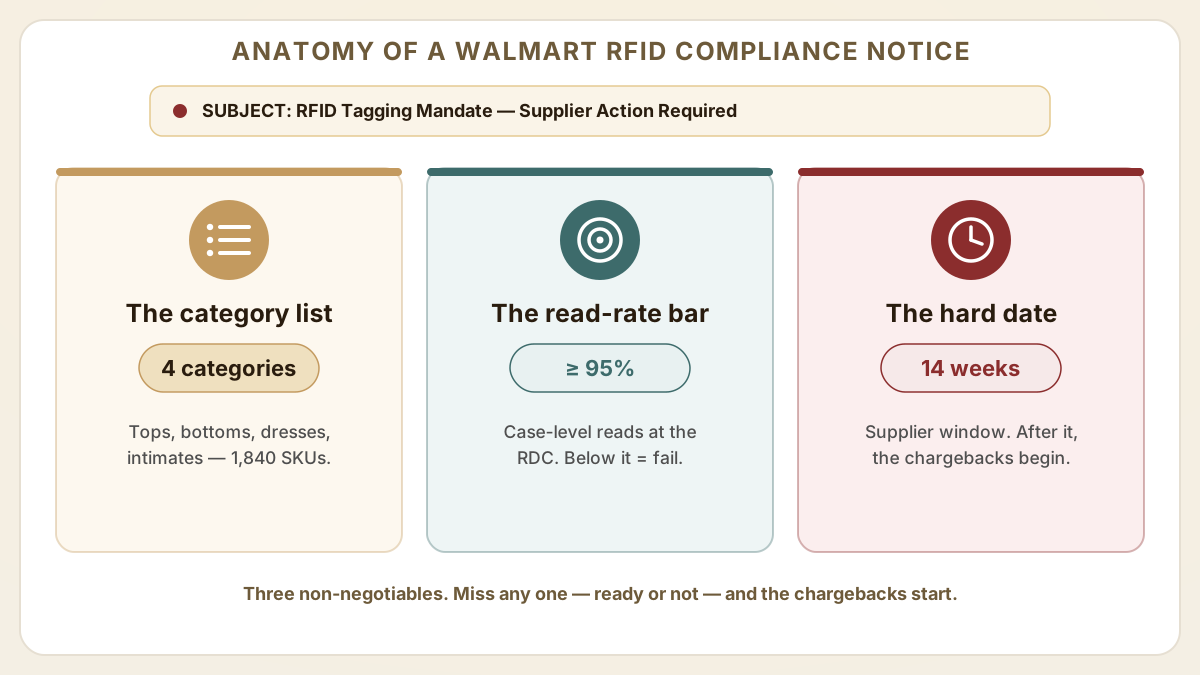
- Categories in scope: tops, bottoms, dresses, intimates — 1,840 active SKUs across 3 contract factories.
- Audit threshold: ≥95% case-level read rate at Walmart's RDC; failure means chargebacks and possible category exit.
- Encoding requirement: GS1 SGTIN-96 with brand's GS1 company prefix, encoded at point of garment manufacture (not US distribution).
- Tag location requirement: hangtag (not sewn-in label) for these specific categories — customer-driven supply choice.
- Internal capability: zero RFID experience pre-project; 1 IT staff and 1 ops lead assigned part-time.
Supplier-side encoding in 3 factories, 14 weeks
The tag was never the hard part. The hard part was persuading 3 factories in 2 countries to encode every garment at the point of manufacture without shaving a single unit off line throughput — because a factory floor that has to stop and think will, eventually, think wrong. So we removed the thinking: simple desktop encoder stations, pre-validated EPC ranges loaded in advance, and a finishing line that either read clean or did not ship. Our GS1 EPC encoding guide covers the operational playbook.
- Inlay spec + PO
A 73×23mm RAIN RFID inlay inside a printed kraft hangtag — $0.07 each, fully encoded at 100K MOQ.
- Encoder stations live
Two Zebra ZD500R desktop printer-encoders per factory; brand IT pushed fresh EPC ranges every week.
- 100% QC pass-through
Every tag read-confirmed before bagging at the finishing line; the 0.4% that failed went to scrap.
- Walmart pre-audit
A 3-batch, 1,200-unit sample tested at the US 3PL with handheld readers — 98.6% before any tuning.
- Placement tuning
Hangtag attachment moved from belt loop to neck-label tag on tops, clearing water-content interference.
- First audit: 99.2%
Walmart's formal audit cleared on the first attempt, comfortably above the 95% floor.
- Hangtag spec: 73×23mm RAIN RFID inlay (Impinj M730) inside printed kraft hangtag, $0.07 each fully encoded at MOQ 100K.
- Encoder stations: Zebra ZD500R desktop printer-encoders, 2 per factory, EPC ranges loaded weekly via brand IT.
- QC: 100% pass-through verification at factory finishing line (read confirmation before bagging) — 0.4% reject rate added to scrap.
- Walmart pre-audit: 3-batch 1,200-unit sample tested at brand's US 3PL with handheld readers — 98.6% rate before any tuning.
- Final tuning: hangtag attachment moved from belt loop to neck label tag for tops to clear water-content interference; jumped to 99.2%.
Audit pass, chargeback math, and what's next
Audit day is the only score that counts, and this brand cleared it without touching the retake Walmart grants everyone. The first formal audit logged 99.2% across the 3-batch sample — and with that, roughly $280K a year in projected non-compliance fees quietly stopped being a line item on anyone's risk register. For the broader audit-prep framework, see our Walmart RFID supplier compliance guide.
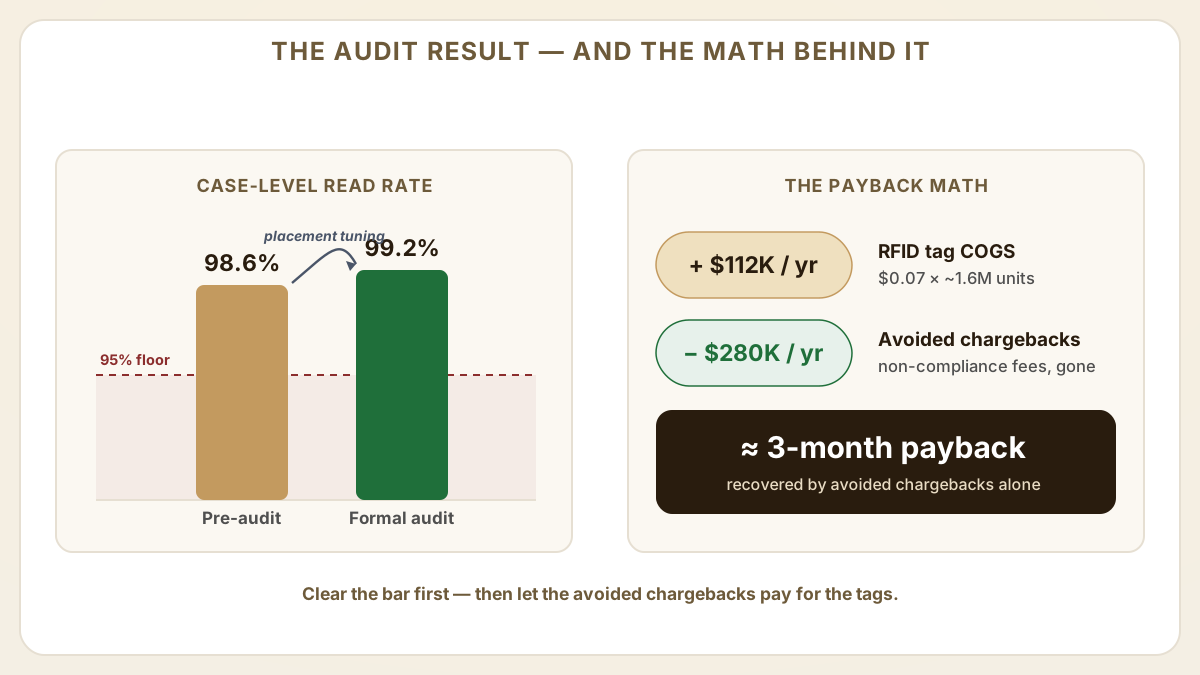
- Audit result: 99.2% — passed on first attempt (Walmart allows 2 attempts; 95% threshold).
- Avoided chargebacks: ~$280K/year on 1,840 SKUs at projected non-compliance fee schedule.
- Tag cost impact: $0.07 × 1.6M annual units = $112K added COGS — recovered in 3 months by avoided chargebacks alone.
- Next phase: Target accepted the same encoding scheme — additional retailer onboarding cost expected near zero.
- Lesson: spend the engineering effort to pre-validate EPC ranges weekly; one Vietnam factory had a 4-day gap that would have caused 8K duplicate EPCs without the gate.
How the brand benchmarked against industry data before building the program
Before signing the inlay PO, the brand spent 3 weeks doing the unglamorous thing: benchmarking against published reference points instead of gut feel. That homework is what let the CFO release capex inside Walmart's 14-week window without flinching. For most apparel programs the sequence is identical — gather the industry baseline, model what failure actually costs, then commit to a tag.
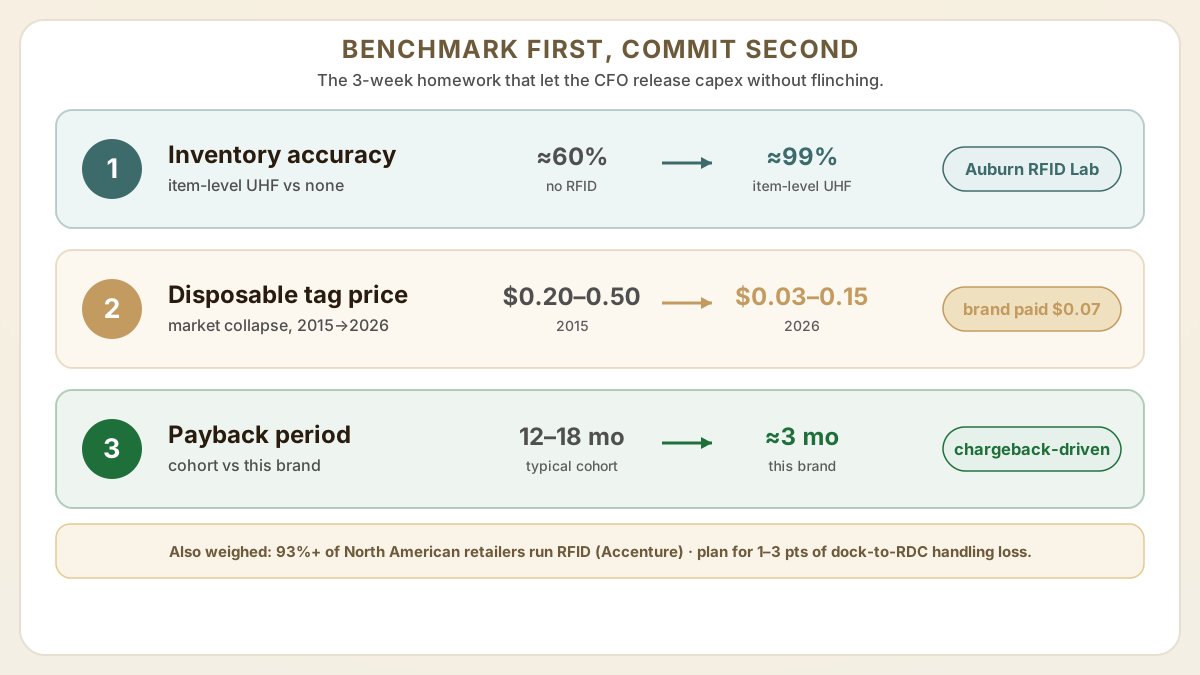
- Industry baseline: Auburn RFID Lab data shows 60% SKU-level accuracy without RFID climbing to ~99% with item-level UHF. The brand modeled its current ~70% accuracy gap against the Walmart 95% audit threshold and confirmed the upside math justified the tag spend even before chargeback avoidance.
- Adoption context: Accenture's surveys cited by SupplyChainBrain put 93%+ of North American retailers on RFID in some capacity; Walmart suppliers shipping below 98% RFID compliance face penalty stacking. The brand used this to set internal target at 98%+ from week one rather than the 95% audit floor.
- Tag-cost benchmark: industry pricing collapsed from $0.20-0.50/disposable tag in 2015 to $0.03-0.15 in 2026 (CPCON, RFID Tag); the $0.07 quote at 100K MOQ landed inside the upper-mid band, consistent with woven hangtag construction at sub-million volume.
- ROI envelope: Auburn RFID Lab's published Walmart-supplier cohort sees 12-18 month payback. The brand modeled 3-month payback because the chargeback-avoidance value swamped tag COGS — a more aggressive number that requires the chargeback fee schedule to actually be enforced (it was).
- Read-rate variance buffer: Walmart's stated 95% threshold leaves no headroom for handling losses (typically 1-3 percentage points between supplier dock and Walmart receiving). The brand built the program to hit 98%+ at supplier dock so a worst-case 3-point handling loss still cleared the audit — this single design choice is what produced the 99.2% audit number.
What scope-creep looks like: Walmart's mandate beyond apparel
When this brand started in 2024, the apparel mandate was the whole headline. By 2026, Walmart had quietly extended item-level RFID tagging across most of the general-merchandise floor — the mandate did not so much expand as annex new territory. Suppliers in adjacent categories should assume the same audit thresholds are already on their way; the lessons from this apparel program transfer directly. Cybra and Creative Displays maintain the current department scope.
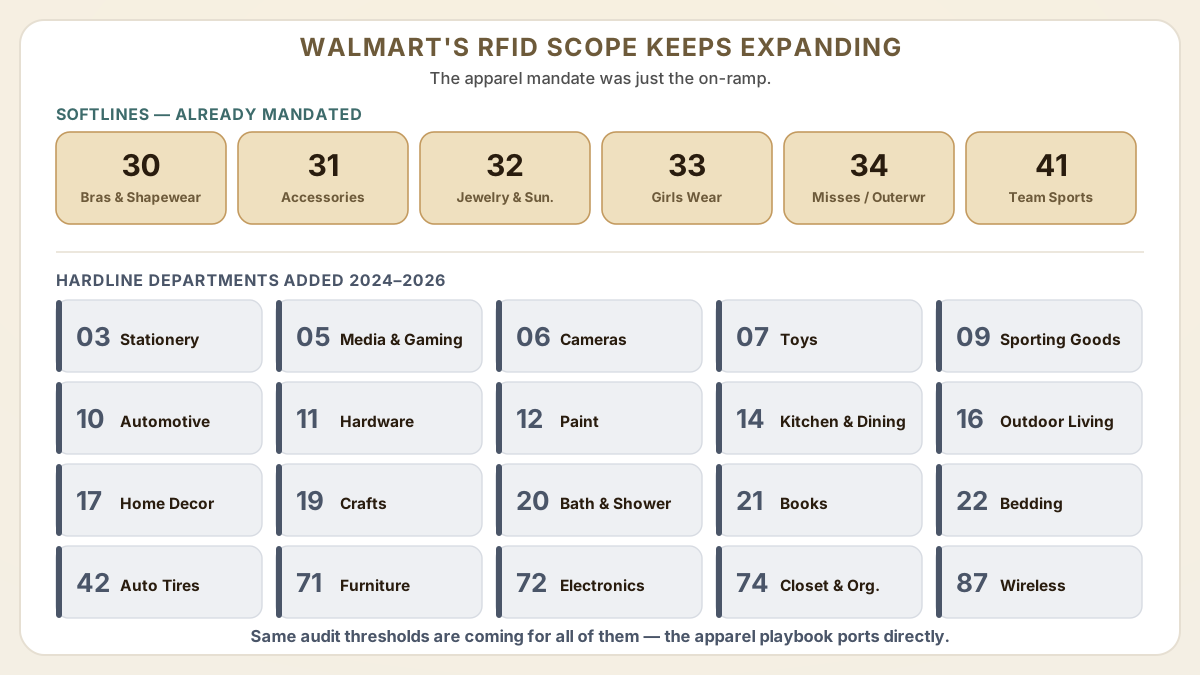
- Apparel/softlines departments now in scope: 30 Bras & Shapewear, 31 Accessories, 32 Jewelry & Sunglasses, 33 Girls Wear, 34 Misses & Juniors / Plus Size & Maternity / Outerwear & Sleepwear, 41 Team Sports.
- Hardline departments added 2024-2026: 03 Stationery, 05 Media & Gaming, 06 Cameras, 07 Toys, 09 Sporting Goods, 10 Automotive, 11 Hardware, 12 Paint, 14 Kitchen & Dining, 16 Outdoor Living, 17 Home Decor, 19 Crafts, 20 Bath & Shower, 21 Books, 22 Bedding, 42 Automotive Tires, 71 Furniture, 72 Electronics, 74 Closet & Organization, 87 Wireless.
- Seasonal program items also in scope (annual event 'hot market' items like Super Bowl championships are explicitly exempt).
- Out-of-scope explicitly: online-only brand apparel, drop-ship-vendor items, items where Auburn ARC has tested-and-failed for RFID compatibility (e.g., metalized cosmetic tubes that detune UHF beyond serviceable read rate).
- EPC symbol requirement: Walmart 2025+ requires the EPC symbol displayed on retail packaging where the RFID tag is present, communicating presence to associates and customers. Hangtag-only programs face an additional design constraint to comply.
- Implication for this brand: with 4 mandated apparel categories already deployed, expansion into accessories (Dept 31) and outerwear (Dept 34) is incremental engineering, not new program build. The reusable parts are the EPC pre-allocation discipline and the encoder-station SOP.
What this case study transfers (and does not transfer) to other suppliers
The 99.2% number is a trophy, and trophies do not transfer — borrow the method instead. What travels from this program to yours is the operational pattern, not the literal result. Before assuming the same outcome, map each variable to your own context; the two columns below are the place to start.
Borrow this — it transfers
- Weekly EPC-range pre-allocation per encoder station — the single best defense against duplicate EPCs, at any factory count, region, or category.
- Empirical tag-placement tuning on the finishing line — the belt-loop-to-neck-label move that beat water-content interference.
- The EPC pre-allocation discipline and encoder-station SOP as reusable assets for the next category or retailer.
Recompute this — it's brand-specific
- The 14-week timeline — a single-category, single-factory rollout can land in 8–10 weeks at ~$18K capex.
- The $0.07 hangtag price — it reflected 100K MOQ kraft construction; sewn-in care labels run $0.05–0.12, sub-25K pilots $0.10–0.18.
- The $280K avoided chargebacks — specific to 1,840 SKUs and this fee schedule; compute your own exposure.
- Transferable: weekly EPC range pre-allocation per encoding station. This is the single most important duplicate-EPC prevention practice and works for any factory count, region or category. The Vietnam near-miss (4-day gap, ~8K potential duplicates) is representative of real risk for any multi-factory supplier.
- Transferable: tag-placement empirical tuning. The hangtag-attachment move from belt loop to neck label tag for tops to clear water-content interference is a category pattern (denim, swim, intimates have similar moisture/metal interference) — every supplier should run a finishing-line A/B before locking placement.
- Partially transferable: the 14-week timeline. A single-category, single-factory program can land in 8-10 weeks at ~$18K capex. The 14-week timeline reflected 3 factories in 2 countries plus 4 categories — multi-factory complexity is the timeline driver, not Walmart's spec.
- Not transferable verbatim: the $0.07 hangtag price. That price reflected MOQ 100K with kraft hangtag construction. Sewn-in care label at the same volume runs $0.05-0.12; sub-25K pilot quantities push prices to $0.10-0.18 (CPCON benchmarks).
- Not transferable verbatim: the $280K avoided chargebacks. That dollar value was specific to the 1,840 SKUs and projected fee schedule for the brand's order frequency. Smaller suppliers should compute their own exposure: (annual units shipped) × (projected non-compliance %) × ($2-5/unit Walmart penalty) + per-shipment reroute fees.
Useful next pages
Use these linked product, guide and comparison pages to keep the next click specific and practical.
Walmart-compliant RFID hangtags
RAIN RFID hangtag inlays encoded GS1 SGTIN-96 at point of garment manufacture.
Sewn-in label and care-label options
Alternative RFID label formats for brands choosing sewn-in over hangtag placement.
Walmart mandate references
External guides we consulted for current scope and EPC symbol requirements.
Pass your retail RFID audit
We support apparel brands through Walmart, Target, and Macy's mandate compliance.
FAQ
Why hangtag instead of sewn-in label?
Walmart allows either for these categories, so the decision came down to money and control. Hangtags were cheaper to retrofit onto existing garment patterns and easier to remove at point of sale — which the brand preferred for keeping a grip on its resale channel.
How were duplicate EPC risks avoided across 3 factories?
Brand IT pre-allocated EPC ranges per factory per week and pushed them to encoder stations every Monday. Encoders refused jobs outside their assigned range — eliminated cross-factory collision risk.
What did the Walmart audit actually measure?
Three sampled cases of ~1,200 units each scanned at the RDC with Walmart's standard handheld; pass = ≥95% reads. The brand's score across the 3 cases was 99.4 / 98.9 / 99.3 = 99.2% blended.
Can this approach work for a smaller brand starting with one Walmart category?
Yes. Single-category, single-factory rollouts with one encoder station typically run 8–10 weeks total and ~$18K initial capex.
Why aim for 98%+ at supplier dock when Walmart's threshold is 95%?
Carton handling between supplier dock and Walmart receiving typically degrades read rate by 1-3 percentage points (truck vibration, carton restacking, wand-scan placement at Walmart RDC). A program designed for 95% at supplier dock can ship a 92-94% read at receiving — and 92% is below threshold. Designing for 98%+ at dock leaves the buffer Walmart's audit math actually requires. This is why the brand cleared 99.2% on the formal audit.
Are we required to print the EPC symbol on the hangtag or packaging?
Yes for Walmart 2025+ shipments. Walmart's program guidance requires the EPC symbol prominently displayed where the RFID tag is present so associates and customers can identify RFID-bearing items. For hangtag programs, place the symbol on the printed face of the hangtag (typically lower-right corner, 5-8 mm). For sewn-in label programs, the symbol appears on the care-label print or on a co-located packaging element. Suppliers reformatting hangtags should ask their RFID inlay vendor for the official EPC symbol artwork file (it is a registered logo) — using a freehand approximation has been flagged in past audits as non-compliant. Cybra's mandate guide is the most current public reference for the symbol requirement.
What would have happened if the first audit failed?
Walmart allows 2 audit attempts before chargebacks compound. A first-fail flips the supplier into remediation: a 30-day plan submission, weekly read-rate evidence, sometimes a Walmart-supplied auditor at supplier dock. The financial sting is the chargeback exposure during remediation ($2-5 per unit per failed shipment, plus per-shipment reroute fees of $50-200). For the case-study brand at ~1.6M annual units this would have run into hundreds of thousands of dollars across one quarter.
Proud Tek is a Shenzhen-based RFID & NFC manufacturer supplying hotel chains, transit operators, event venues and retail brands worldwide. Every order includes free samples, RF testing and dedicated project support.
Get a Quick Quote
Tell us about your project and we'll respond within one business day. Fields marked (asterisk) are required.