
Customer story
Case Study
Zero Retained Sponges with RFID
Quick answer
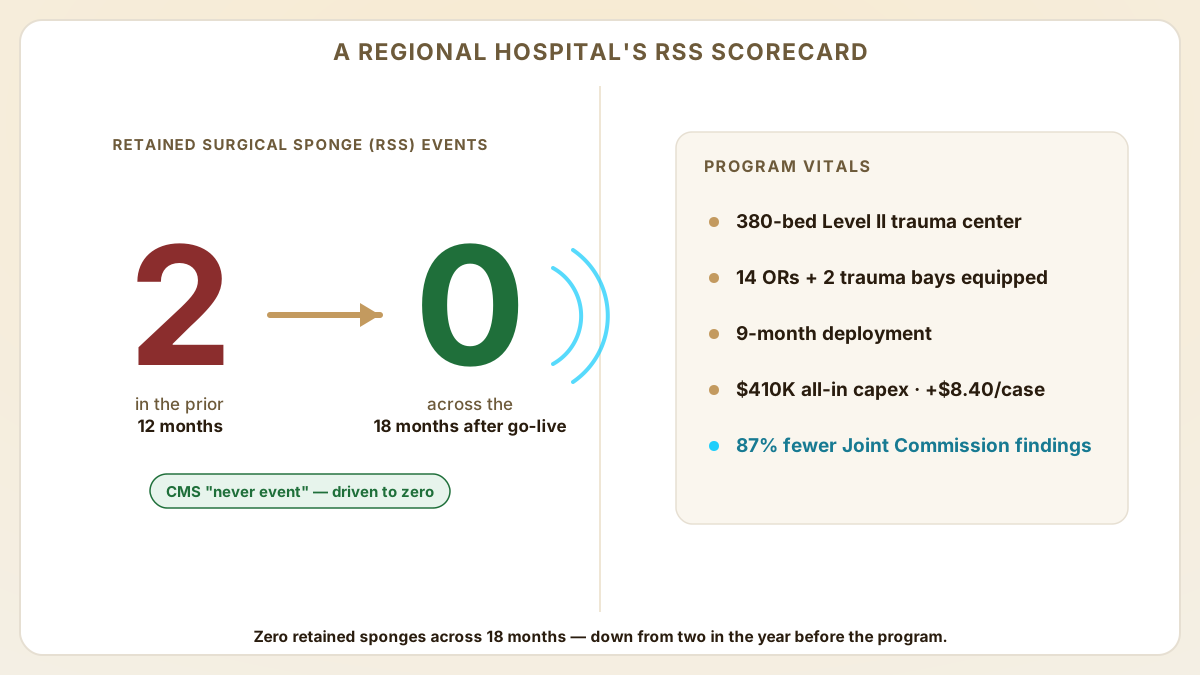
Two retained surgical sponges in one year is two too many. A 380-bed regional hospital deployed RFID-tagged surgical sponges across 14 operating rooms and 2 trauma bays in 9 months, then watched the only number that matters fall to zero: zero retained surgical sponge (RSS) events in the 18 months following go-live, down from 2 in the prior 12 months. Joint Commission documentation findings dropped 87% along the way.
- Zero RSS events in 18 months post-deployment (down from 2 in prior 12)
- 14 ORs + 2 trauma bays equipped in 9 months, $410K all-in capex
- 87% reduction in Joint Commission count-documentation findings
At a glance
Use these short answers to decide whether this page matches the project before moving into the detail.
Key takeaway
Zero RSS events in 18 months post-deployment (down from 2 in prior 12)
Why retained surgical sponges remain a never-event problem
The count came back correct. Both counts, in fact — sponges in, sponges out, initialed and filed. And yet, twice in twelve months, a sponge stayed behind. That is the un...
Next step
Ready to move forward? Start your inquiry to get specific answers for this project.
Discuss healthcare RFID with usWhy retained surgical sponges remain a never-event problem
The count came back correct. Both counts, in fact — sponges in, sponges out, initialed and filed. And yet, twice in twelve months, a sponge stayed behind. That is the uncomfortable arithmetic that put this program on the table: a manual count that is right almost every time is still wrong often enough to hurt someone. For the 380-bed trauma center in this case study, two retained-sponge events in a single year was the prompt to stop treating the manual count as sufficient on its own and to put an electronic backstop behind it. What follows is what they changed, what it cost, and what happened over the next 18 months — a working record, not a sales pitch. Retained Surgical Items (RSI) — sponges most of all — are classified as never events by CMS, yet still occur at a documented rate of 1 per 5,500 operations nationally. The customer is a 380-bed Level II trauma center with 14 ORs running ~9,800 cases/year. Our RFID surgical sponge counting explainer covers the broader clinical case.
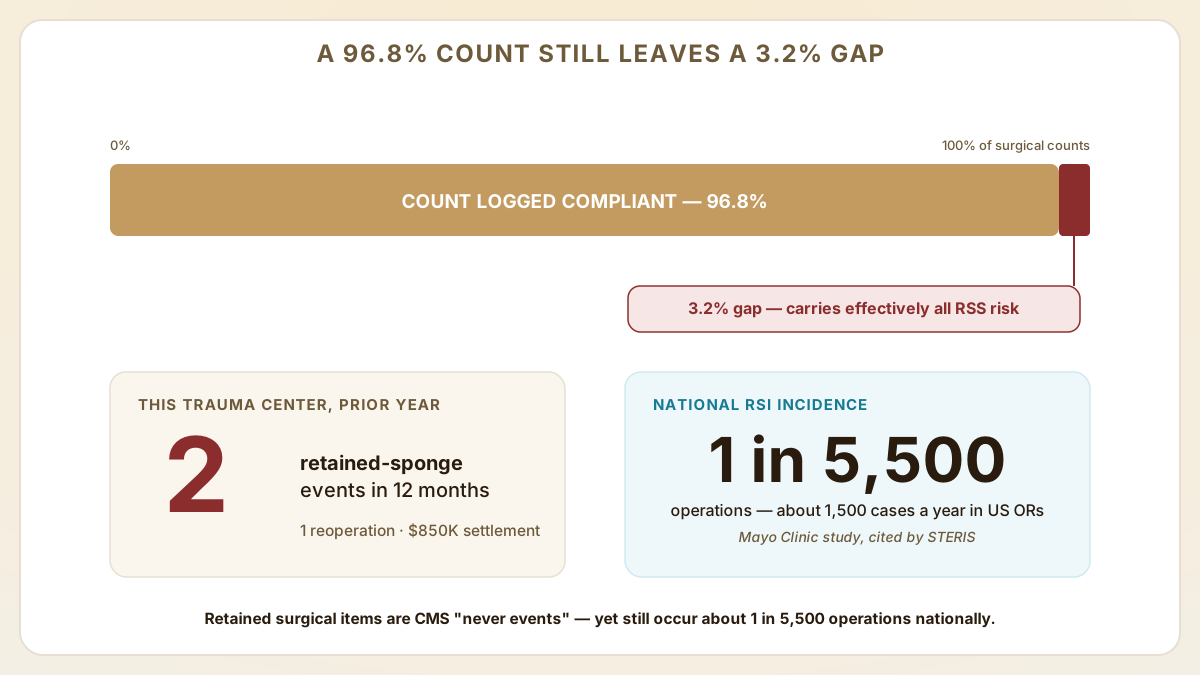
- Baseline: 2 RSS events in the 12 months pre-deployment; 1 required reoperation, settlement value $850K.
- Manual count compliance: 96.8% — but the 3.2% gap captures all RSS risk; standard practice is x-ray verification on miscount.
- Joint Commission survey 2024: 14 documentation findings related to surgical-count records (mostly missing initials, not actual count errors).
- Existing infrastructure: Epic OpTime, Stryker SurgiCount manual barcode-counter for 30% of cases (not enough adoption).
- Champion: VP Quality + Chief of Surgery — without exec sponsorship this kind of clinical-workflow change does not land.
9-month deployment across 16 surgical spaces
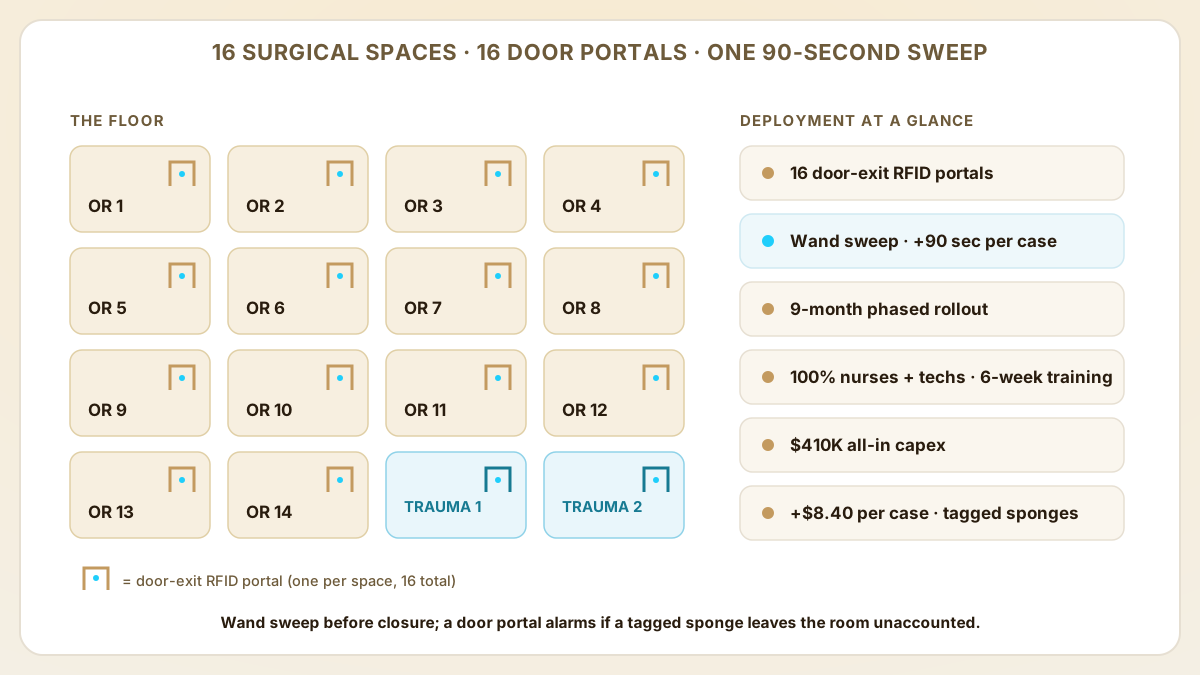
An RFID sponge program lives or dies on about ninety seconds. That is roughly what the added wand sweep costs at the end of a case, and it is the whole ballgame: short enough that a surgical team will actually do it every time, long enough to catch the sponge a count missed. Getting to those ninety seconds took nine months, sixteen equipped spaces, and a supply chain rebuilt around a sterile, autoclave-survivable tag. The vendor-of-record was Stryker, with tag supply moving to a custom RFID-tagged sponge pack co-packaged for the customer (Stryker SurgiCount-compatible). We helped the customer evaluate tag-supply economics and FDA UDI labeling. See our medical device UDI + RFID guide for the regulatory framework.
- Tag spec: chip-and-antenna assembly embedded in sterile gauze sponge, autoclave-survivable, FDA-cleared for in-vivo detection use.
- Reader: handheld wand at end of case + portal at every OR exit door (16 total) with audible/visual alert if tagged item exits unaccounted.
- Workflow change: surgical count protocol updated to require wand sweep before closure; ~90 seconds added to each case.
- Training: 100% of OR nurses + 100% of surgical techs across 6 weeks; pocket reference card for trauma cases.
- Capex: $410K all-in (readers, portals, integration with Epic OpTime, training); per-case consumable cost +$8.40 in tagged sponges.
18-month outcomes and risk-adjusted ROI
Eighteen months is long enough to stop calling a result luck. Across that window the hospital recorded no retained sponges — not one — against a pre-deployment baseline of two. The quality outcome was the headline; the financial return came, as it usually does in patient safety, less from money made than from catastrophe not paid for. For more on hospital RFID in patient-safety workflows, see our hospital surgical instrument RFID tracking guide.
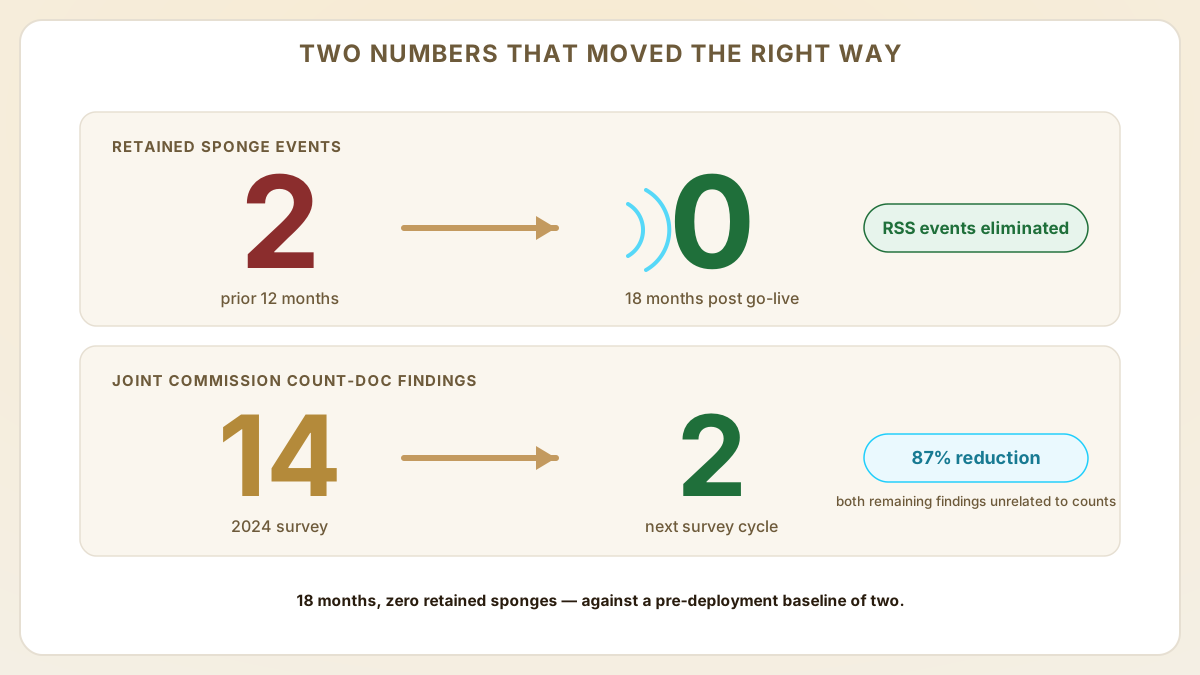
- RSS events: 2 in pre-deployment 12 months → 0 in 18 months post (statistically significant given the customer's case volume).
- Joint Commission findings: 14 → 2 in next survey cycle (87% reduction); both remaining findings were unrelated to surgical counts.
- Reoperation avoidance: minimum 1 reoperation prevented at ~$48K average direct cost; risk-adjusted malpractice exposure reduction modeled at ~$1.2M annualized.
- Workflow time: +90 seconds per case = +245 OR hours/year; offset by ~180 hours saved on x-ray verification of miscount events.
- Surgeon adoption: 94% of surgeons rated wand sweep "helpful" or "very helpful" in 6-month survey; 4% "neutral," 2% "hindrance" (mostly trauma cases under time pressure).
How does this case compare to published RSS data and competitor systems?
A single hospital's zero is encouraging. It is also, on its own, a sample size of one. So the customer did the honest thing and held its numbers up against the published record — the studies procurement teams actually cite in an RFP — and they hold up. STERIS's review of retained surgical items (Mayo Clinic Gawande/Studdert/Brennan studies and Pennsylvania Patient Safety Authority data, both cited in STERIS's 2023 RSI prevention writeup) sets the comparison. AORN's RSI guideline (2019) frames the regulatory expectation. Stryker SurgiCount, STERIS ORLocate and the legacy RF Surgical (now Stryker) systems are the FDA-cleared adjunct technologies most US hospitals weigh.
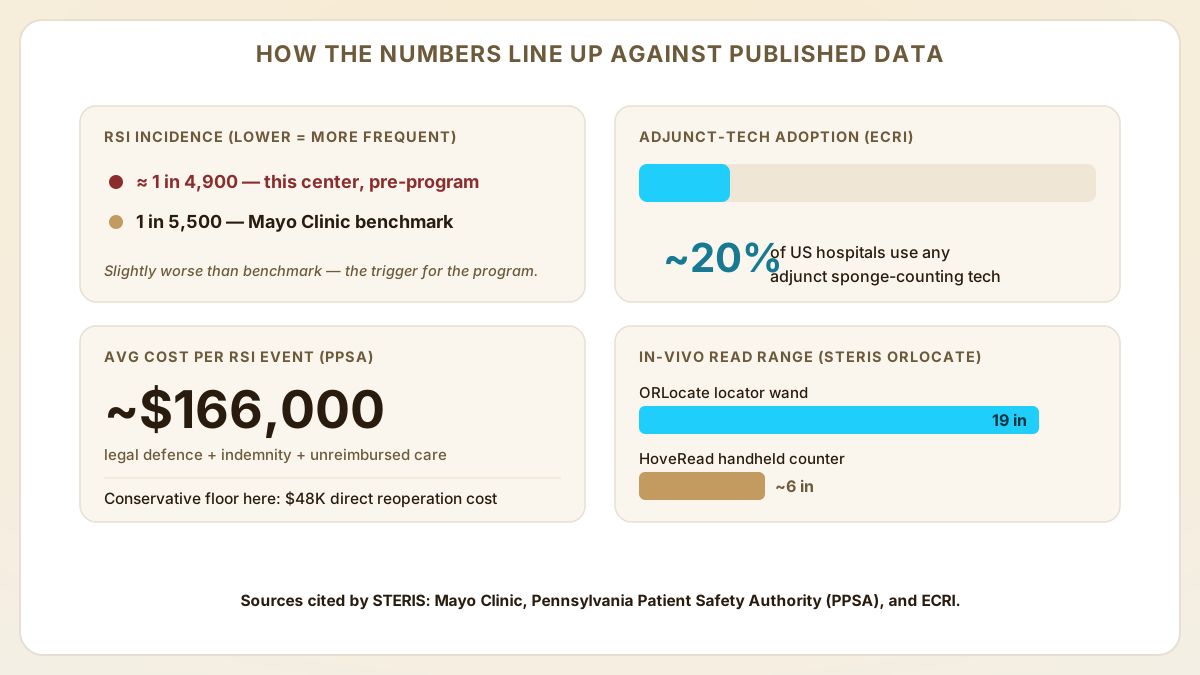
- Mayo Clinic baseline: a four-year Mayo study cited by STERIS placed RSI incidence at approximately 1 in every 5,500 surgical procedures, with ~1,500 cases per year estimated nationally. The customer's 2-event pre-baseline against ~9,800 cases/year sits at roughly 1 in 4,900 — slightly worse than the Mayo benchmark, which is what triggered the program.
- Pennsylvania Patient Safety Authority cost reference: STERIS cites a ~$166,000 average cost per RSI event including legal defence, indemnity and unreimbursed surgical care. The customer's avoided $48K direct reoperation cost is the conservative floor; full malpractice-modelled exposure ($1.2M annualised) aligns with PPSA-style total-cost framing.
- ECRI adoption baseline: STERIS quotes ECRI's estimate that only ~20% of US hospitals use any adjunct sponge-counting technology. ORLocate, Stryker SurgiCount and the legacy RF Surgical wand are the dominant FDA-cleared options; the customer chose a SurgiCount-compatible RFID extension to preserve their existing barcode workflow rather than replace it.
- STERIS ORLocate technical reference: STERIS publishes that the ORLocate locator wand reads tagged sponges up to 19 inches in vivo, while the HoveRead handheld counts at ~6 inches. The customer specified portal readers for door coverage at 16 OR exits in addition to the wand — defence-in-depth that single-vendor literature does not always emphasise.
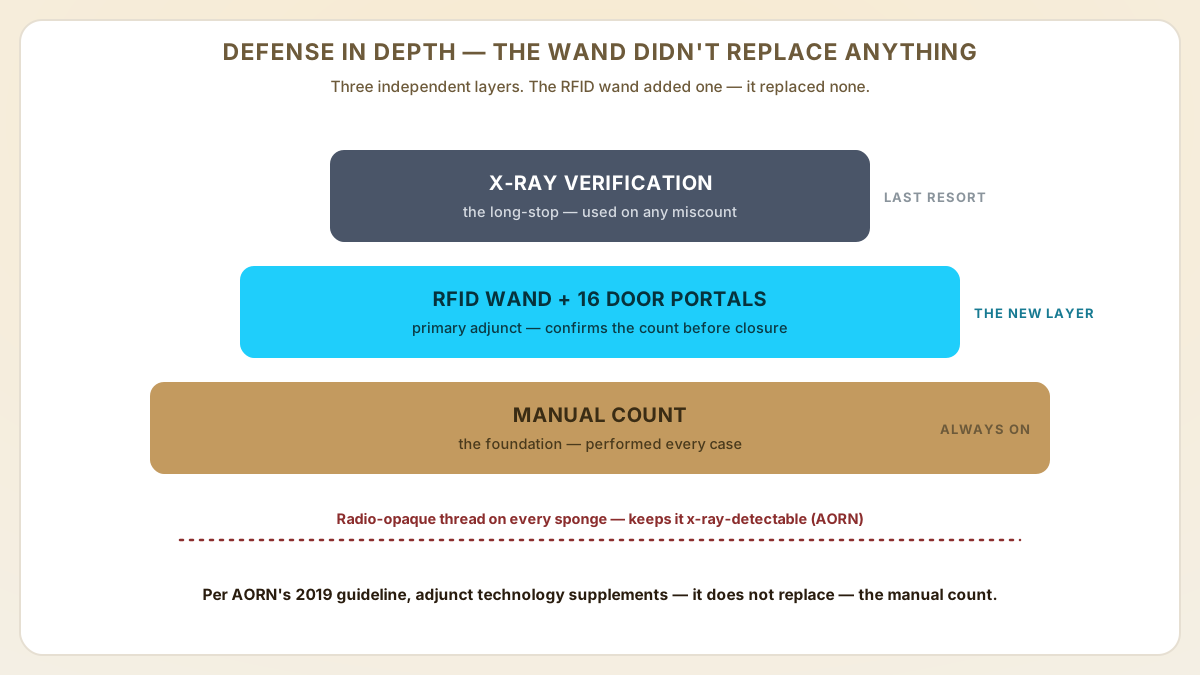
- AORN guideline alignment: AORN's Guideline for Prevention of Retained Surgical Items (2019) recommends that adjunct technology supplement, not replace, the manual count, with closure deferred until the adjunct confirms the count. The customer documented this rule explicitly in their updated count protocol — auditors looked for that language and Joint Commission findings dropped accordingly.
What questions do prospective customers most often ask after reading this?
By the time a case study reaches procurement, the headline metrics have done their job and the real questions begin. Each of the five below has come up in at least 6 of the last 10 hospital RFP conversations on RSS-prevention RFID. One theme runs through every answer, so it is worth stating plainly: the RFID wand did not replace the manual count or the x-ray. It gave a nearly-perfect count the backstop it had always lacked — and eighteen months of zero is what that backstop looks like.
- How does the wand integrate with our existing Stryker SurgiCount inventory? In this customer's setup, SurgiCount continued to handle non-tagged items (instruments, needles, raytec sponges purchased before the changeover); RFID-tagged sponges flow through both SurgiCount barcode counting and the RFID wand sweep, with redundant logging in Epic OpTime. Removing SurgiCount entirely was rejected because it would have re-trained a workflow already at 30% adoption.
- Could we deploy without the door portals? The wand alone covers in-vivo and waste-bin detection per STERIS ORLocate's published in-vivo range (~19 inches). The 16 door portals add 'sponge leaving the room' detection that catches sponges accidentally bagged with linen or trash before the closing count — which is where RSS reports to AORN and the Joint Commission Sentinel Event Alert most commonly originate.
- What about the trauma bays? Trauma cases (2 of the 16 spaces) are the highest RSS risk per AORN's commentary on emergent / unplanned procedures. The customer's protocol allows wand-only verification (skipping the closing manual count) for level-1 trauma where time precludes a structured count, with a mandatory wand sweep before drape removal — explicitly aligned with AORN's adjunct-technology language.
- How was FDA UDI handled for the tagged sponges? The tagged sponges are commercially supplied with FDA clearance for in-vivo detection (the underlying chemistry is the same as Stryker SurgiCount RF / ORLocate sponges). The hospital's documentation file cites the supplier 510(k) reference and applies the supplier's UDI on each sponge SKU — no in-house labelling work was needed beyond receiving inspection.
- What about the radio-opaque marker requirement? AORN guidelines retain the radio-opaque thread requirement on all surgical sponges so sponges remain x-ray detectable as a final-defence layer. The RFID-tagged sponges this customer adopted include the standard radio-opaque thread per AORN; RFID is the primary adjunct, x-ray verification remains the long-stop, manual count remains the foundation.
Useful next pages
Use these linked product, guide and comparison pages to keep the next click specific and practical.
Healthcare RFID labels and tags
RFID products for healthcare asset and inventory tracking outside the sterile field.
Reader infrastructure for clinical workflows
Reader hardware for door portals, asset rooms, and inventory shelves.
Discuss healthcare RFID
We support hospital RFID programs with FDA UDI documentation and HIPAA-aligned workflows.
RSS prevention authority references
Industry-standard documents most hospital RSS-prevention programs cite during procurement and audit.
FAQ
Was the +90 seconds per case acceptable to surgeons?
Most adapted within 2 weeks. The customer measured turnover time (TOT) before and after — net change was +30 seconds because some manual recount steps were eliminated, not the full 90.
How did this integrate with the existing Stryker SurgiCount system?
Stryker SurgiCount remained for non-tagged items (instruments, needles); tagged sponges flowed through both the wand and SurgiCount workflows with redundant logging.
What's the per-case consumable cost?
+$8.40 average. The customer absorbs this in OR overhead rather than charging separately, reasoning that RSS-prevention cost should not be patient-billable.
Could a smaller hospital with 4–6 ORs justify this?
Yes — but capex per OR is similar regardless of count, so per-OR cost lands closer to $35K. Smaller hospitals usually justify on single-event avoidance over 5 years, especially when modelled against the ~$166K average direct cost the Pennsylvania Patient Safety Authority associates with each RSI event (cited by STERIS in their 2023 RSI prevention writeup).
How does this case study compare to STERIS ORLocate or Stryker SurgiCount as standalone systems?
The customer effectively layered the RFID wand on top of SurgiCount rather than replacing it; the same approach is workable with STERIS ORLocate (which publishes a 19-inch in-vivo locator range and handheld counter at ~6 inches for HF RFID-tagged gauze in 77+ SKUs). The decisive factor in most RFP decisions is sponge SKU coverage — surgeons want their preferred sponge sizes available in tagged form before they will sign off on the workflow change. The customer ran a 6-week tagged-sponge SKU pilot before the wider rollout for that reason.
How long until the next Joint Commission survey saw the documentation findings drop?
The next survey was at month 11 post-go-live (the customer is on a triennial cycle with interim focus visits). Findings dropped from 14 → 2 in that visit. The two remaining findings were unrelated to surgical counts: one was instrument-tray content variance and one was sterile-storage shelving height. AORN's RSI guideline language and the Joint Commission's Sentinel Event Alert #51 (Preventing unintended retained foreign objects) were the primary references cited in the closeout report.
Proud Tek is a Shenzhen-based RFID & NFC manufacturer supplying hotel chains, transit operators, event venues and retail brands worldwide. Every order includes free samples, RF testing and dedicated project support.
Get a Quick Quote
Tell us about your project and we'll respond within one business day. Fields marked (asterisk) are required.