
Healthcare Operations
Hospital Surgical Instrument RFID Tracking
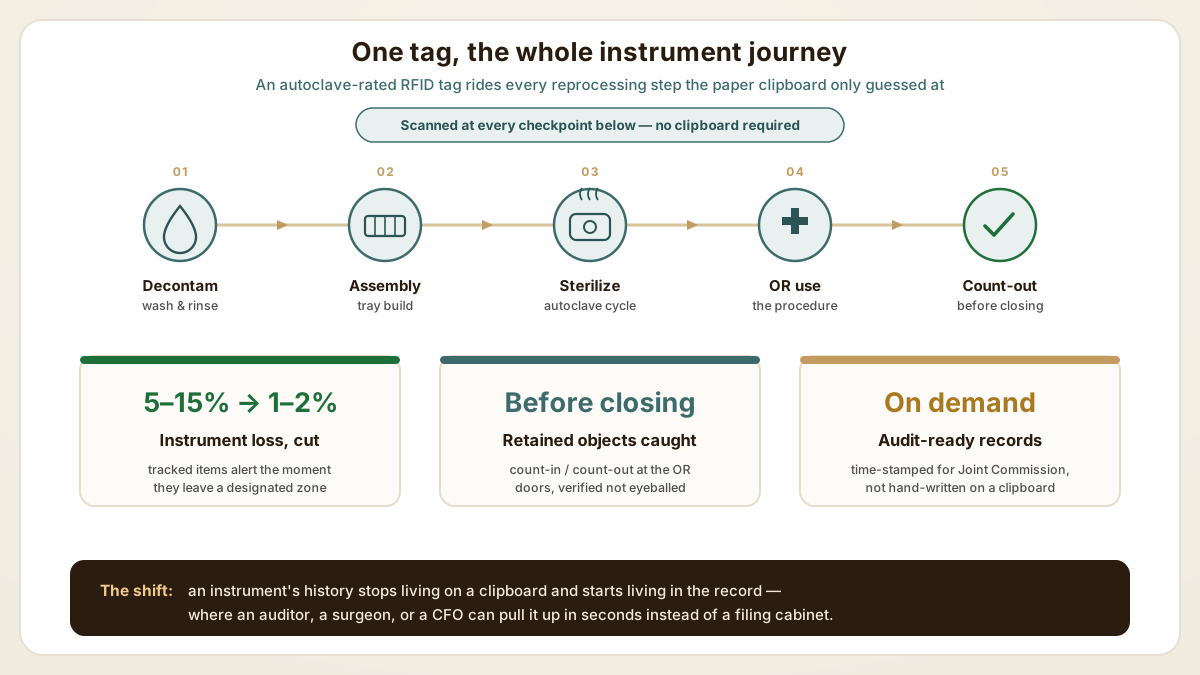
Quick answer
A surgical instrument's whole life is thousands of trips through the autoclave and the OR — and in most hospitals a paper clipboard is asked to keep score. RFID surgical instrument tracking retires the clipboard for Joint Commission audit-ready records, catches retained foreign objects (RFO) before a patient is closed, and curbs the instrument-loss rates that quietly cost hospitals $1-3M annually.
- Surgical instrument loss rate runs 5-15% per year per OR without tracking, costing a 10-OR hospital $500K-2M annually in replacement and rework.
- RFID-tagged instruments enable per-procedure verification (count-in/count-out), reducing retained foreign object (RFO) events that average $200K+ in malpractice cost each.
- ISO 13485-certified RFID systems plus Joint Commission audit-ready dashboards transform sterile processing from manual paper logs to defensible electronic records.
At a glance
Use these short answers to decide whether this page matches the project before moving into the detail.
Key takeaway
Surgical instrument loss rate runs 5-15% per year per OR without tracking, costing a 10-OR hospital $500K-2M annually in replacement and rework.
Why do hospitals need RFID instrument tracking?
Somewhere in every hospital is a clipboard — or its spreadsheet descendant — where a technician hand-tallies surgical instruments tray by tray, several thousand times a...
Next step
Ready to move forward? Start your inquiry to get specific answers for this project.
Get hospital instrument RFID quoteWhy do hospitals need RFID instrument tracking?
Somewhere in every hospital is a clipboard — or its spreadsheet descendant — where a technician hand-tallies surgical instruments tray by tray, several thousand times a week. It is careful work done by careful people, which is exactly what makes it a fragile place to keep a safety-critical record: accuracy depends on no one ever being tired, rushed, or interrupted. Sterile processing departments push thousands of instruments through dozens of trays a day, and a manual count-and-record system quietly does three things wrong — it drifts into error, it loses instruments, and it fails Joint Commission audits. RFID takes all three off the clipboard's shoulders.
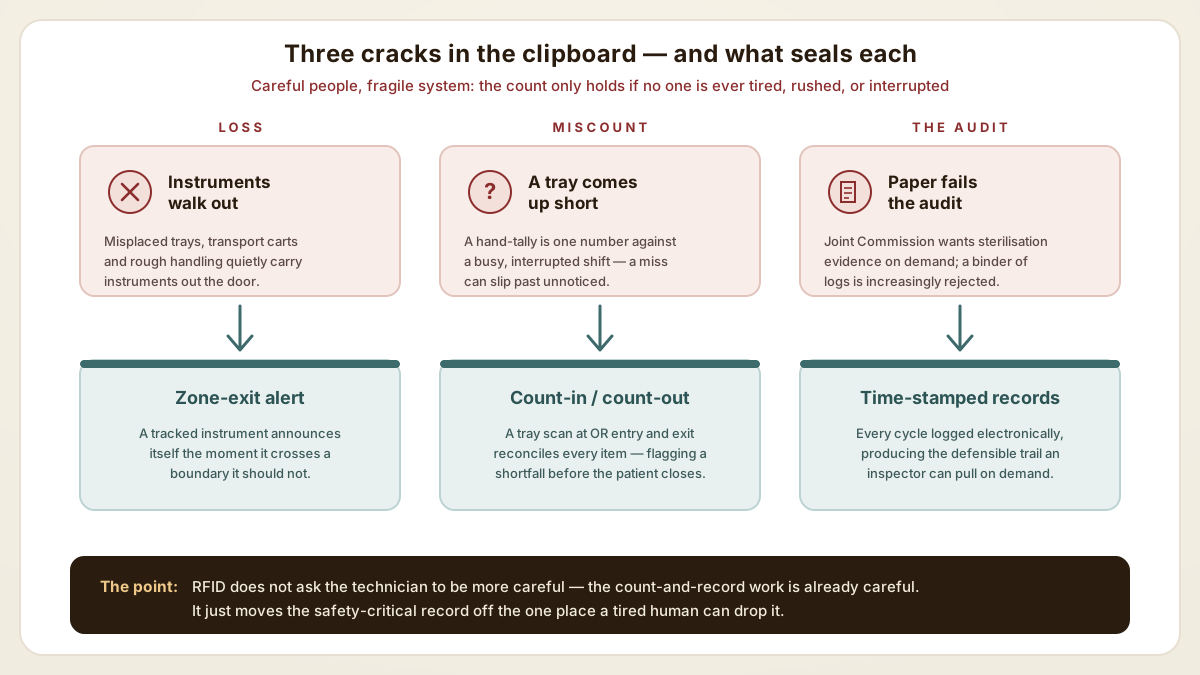
- Loss prevention: untracked instruments walk out of OR via misplaced trays, transport carts and broken handling. Tracked instruments alert when leaving designated zones.
- Sterilization compliance: each instrument logged through every autoclave cycle creates an audit trail proving sterilization. Joint Commission inspectors expect this evidence on demand.
- Procedure efficiency: pre-procedure count via RFID tray scan takes 30 seconds vs 5-15 minutes manual. Post-procedure count similar speed-up; combined saving 1-2 OR-staff hours per case.
- Retained foreign object prevention: RFID scan-in/scan-out at OR entry/exit catches missing instruments before patient closure. RFO events cost hospitals $200K+ each in legal and clinical cost.
- Lifecycle and maintenance: each instrument's usage cycles tracked individually. Predictive replacement before failure rather than reactive after surgical complication.
What chip and tag work for surgical instruments?
Ask an RFID tag to ride a warehouse pallet and it will last years without complaint. Bolt it to a surgical instrument and you have handed it the hardest job in the catalog. Surgical instrument RFID tagging is one of the most demanding RFID environments there is: tags must survive autoclaving (134°C steam), washer-disinfectors (chemicals + ultrasonic), bone-cutting forces, and decade-plus instrument lifespans — over and over, several times a week.
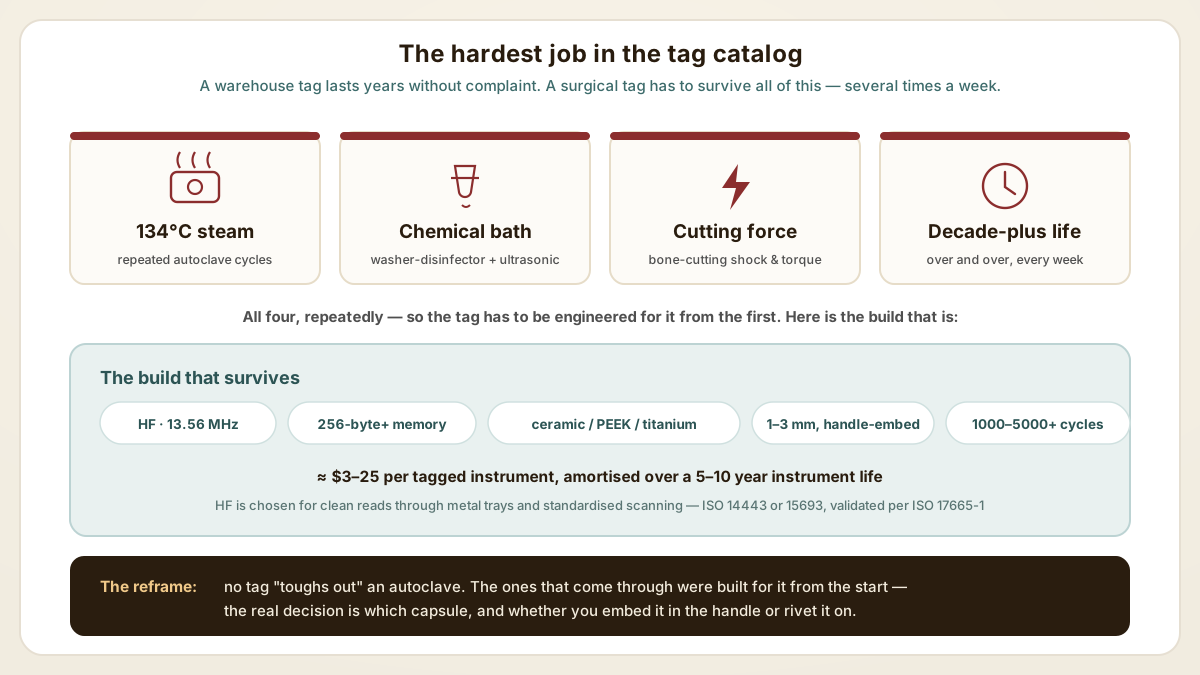
- Frequency: HF (13.56 MHz, ISO 14443 or 15693) preferred over UHF for instrument tagging. Better metal performance + standardized read at trays without read-collision.
- Chip technology: passive HF chip with 256-byte memory or larger; MIFARE Ultralight family or ICODE SLIX2 work well. Ceramic-package chips for autoclave durability.
- Tag form factor: laser-welded titanium or PEEK ceramic capsule, 1-3mm diameter, embedded in instrument handle or attached via stainless-steel rivet. Surface-mount inlays do not survive sterilization.
- Autoclave rating: minimum 1000 sterilization cycles at 134°C, validated per ISO 17665-1. Premium tags survive 5000+ cycles for full instrument lifespan.
- Cost: $3-15 per tagged instrument including encoding and attachment. Premium ceramic tags $10-25. Cost amortizes over 5-10 year instrument life and is justified by single avoided RFO event.
How do you implement instrument RFID in a hospital?
If tagging one instrument is a hardware problem, tagging a whole hospital is a choreography problem — and it is usually the choreography that sinks a project, not the chips. Surgical instrument RFID is operationally one of the most complex hospital RFID deployments. The five-step sequence below mirrors the successful 2024-2026 rollouts at large teaching hospitals, in the order that actually holds up.
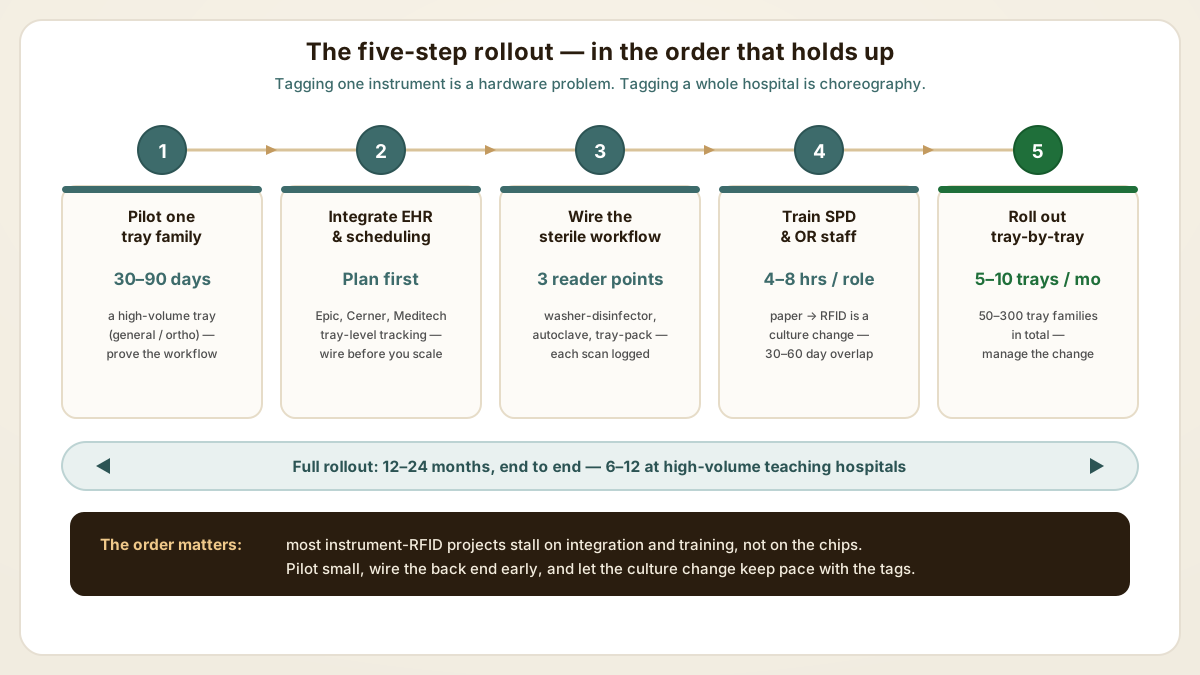
- Pilot one OR tray family: choose a high-volume tray (general surgery, ortho) and RFID-tag every instrument in that family. 30-90 day pilot validates workflow before scaling.
- Integrate with OR scheduling and EHR: Epic, Cerner and Meditech all support tray-level instrument tracking integration. Plan the integration before scaling tag deployment.
- Design sterilization workflow integration: RFID readers at washer-disinfector outlet, autoclave outlet, and tray-pack station. Each scan logged with cycle parameters.
- Train sterile processing and OR staff: shifting from paper count to RFID-validated count requires culture change. Plan 4-8 hours of training per role plus 30-60 day side-by-side workflow.
- Roll out tray-by-tray: typical large hospital has 50-300 tray families. Tag 5-10 trays/month after pilot to manage operational change. Full rollout 12-24 months.
What ROI do hospitals see from instrument RFID?
The business case does not hang on one hero number; it stacks up from three fairly unglamorous places. Hospital instrument RFID ROI comes from instrument-loss reduction, retained foreign object prevention, and OR staff time saved. The benchmarks below come from public ASHE and AORN reporting plus 2024-2026 case studies — the kind of numbers a CFO can check rather than take on faith.
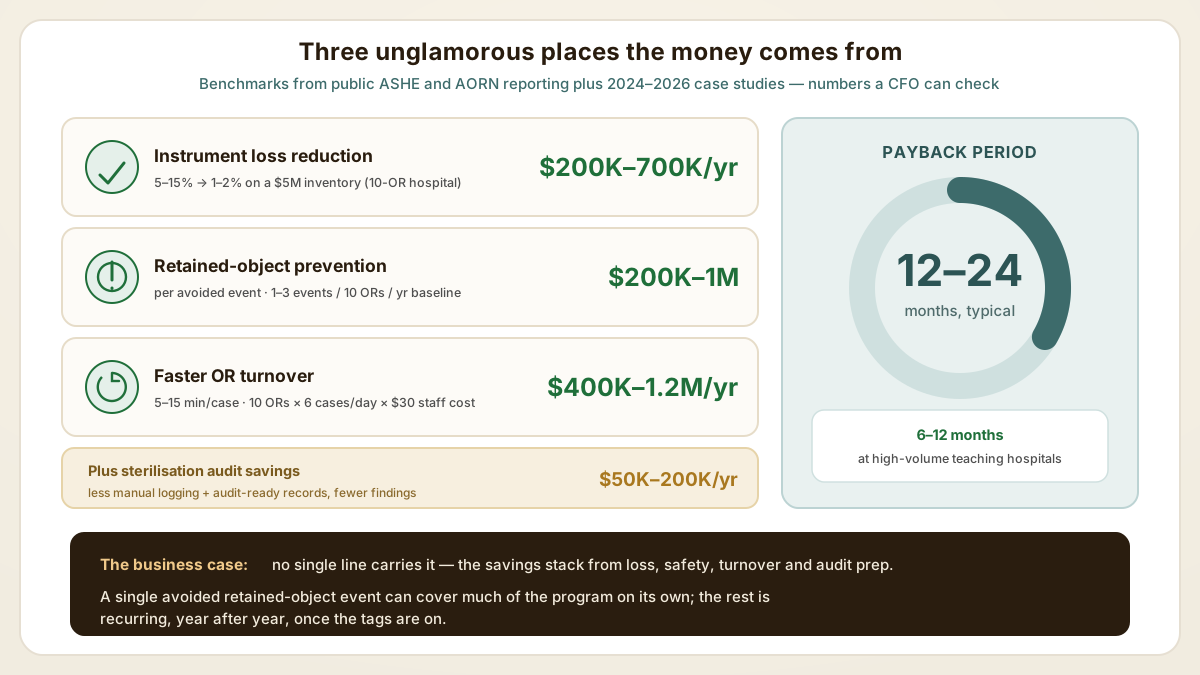
- Instrument loss reduction: 5-15% annual loss baseline → 1-2% post-RFID. For a 10-OR hospital with $5M instrument inventory, this is $200K-700K/year saved.
- RFO event prevention: 1-3 RFO events per 10 ORs per year is industry baseline. Avoided event saves $200K-1M each in legal, clinical and reputation cost.
- OR turnover speed: instrument count automation cuts 5-15 min per case. At 10 ORs × 6 cases/day × $30 OR-staff cost, this is $400K-1.2M/year operational saving.
- Sterilization audit savings: reduced manual logging effort + audit-ready electronic records. Avoid $50K-200K annual audit prep cost plus reduced findings risk.
- Payback period: typical 12-24 months for full instrument-RFID program, faster (6-12 months) at large teaching hospitals where volume drives savings density.
What does the published industry case material say?
Hospital instrument RFID is one of the better-documented corners of healthcare RFID — which is a polite way of saying you do not have to take any single vendor's word for it. The most-cited public references are Mayo Clinic Saint Mary's Hospital (one of the earliest RFID instrument-tracking deployments), Rush University Medical Center, the Medical Design Briefs explainer 'RFID for Medical Device and Surgical Instrument Tracking', published SPD-vendor perspective writeups, and the PubMed Central study 'Measuring intraoperative surgical instrument use with radio-frequency identification' (PMC8827029). Together they surface five claims worth putting in any procurement business case.
- Mayo Clinic and Rush case material (cited in Medical Design Briefs and SPD-vendor literature): leading hospitals deployed RFID across SPD/CSSD to track equipment, surgical instruments and staff, with autoclavable tags 'qualified in the field to withstand repeated decontamination and sterilisation cycles with no damage'. The takeaway for buyers: the tag-survival data is now mature, not theoretical.
- Per-instrument lifecycle attributes: Medical Design Briefs and SPD-vendor literature both emphasise that RFID-tagged instruments carry a documented record of image, name, manufacturer, manufacturer's catalog number, date of purchase, number of sterilisation cycles, repair history and current location. SPD WMS platforms (Censis, Mobile Aspects SpaceTRAX, SPM, Materials Management Microsystems) consume this data to drive replacement timing.
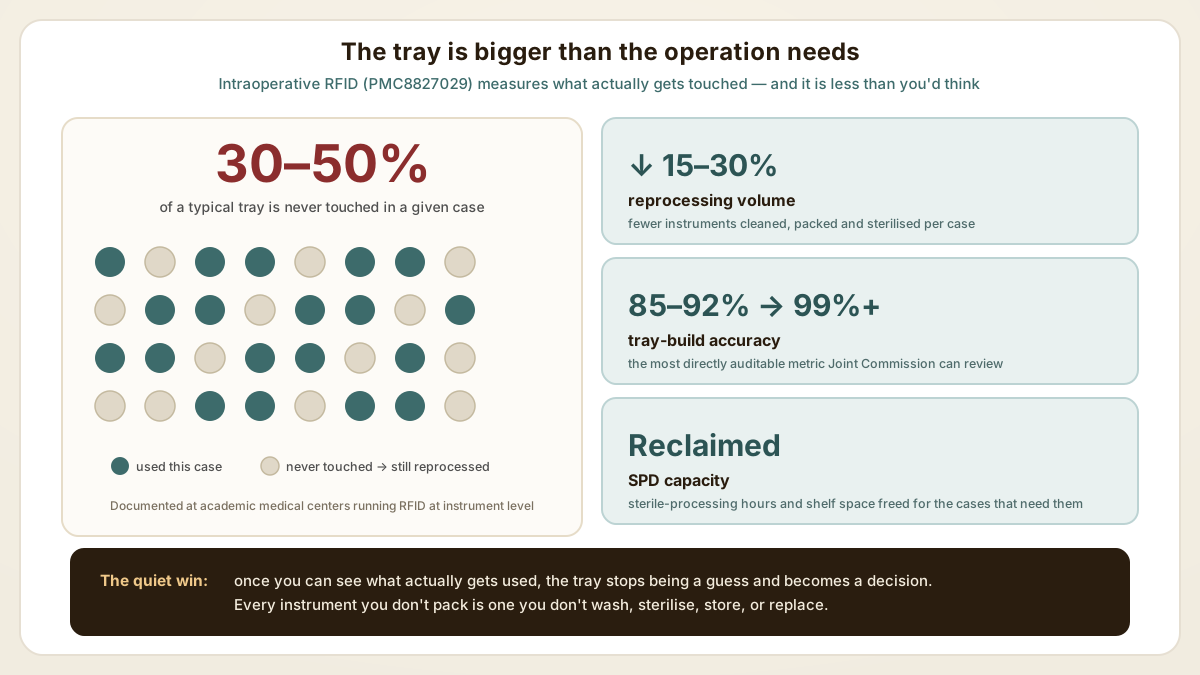
- Tray-build accuracy: published SPD-vendor perspectives note RFID assists 'tray or kit building' by automating the manual count and check used to confirm tray accuracy. Industry benchmarks reported by SPD vendors put manual tray-build accuracy at ~85-92% pre-RFID and 99%+ post-RFID, which is the most directly auditable metric Joint Commission can review.
- Time-stamped reprocessing checkpoints: by scanning at decontamination, assembly, sterilisation, storage and OR delivery, hospitals get accurate time-stamped records of each step. This is what Joint Commission and CMS Conditions of Participation now expect when evidence of sterilisation lifecycle is requested — paper-only logs are increasingly rejected.
- Intraoperative utilisation studies (PMC8827029 and follow-on work): RFID-driven intraoperative-use measurement consistently shows that 30-50% of instruments in a typical surgical tray are never used in any given case, opening the door to right-sizing tray contents, reducing reprocessing volume by 15-30% and reclaiming SPD capacity. This is a documented outcome at academic medical centers running RFID at instrument level.
How does instrument RFID intersect with FDA UDI?
Surgical instruments are not merely tracked objects; they are themselves medical devices, regulated under 21 CFR 801 (UDI Labeling) and 21 CFR 830 (Unique Device Identification). RFID is one of the FDA-permitted Automatic Identification and Data Capture (AIDC) carriers — alongside 1D and 2D barcode — that can carry the UDI. Link the two and you get a defensible chain that runs from the manufacturer's GUDID record all the way to a single procedure. Get the linkage right and every instrument tells its own story on demand; get it wrong and you have merely built a faster way to fail an audit.
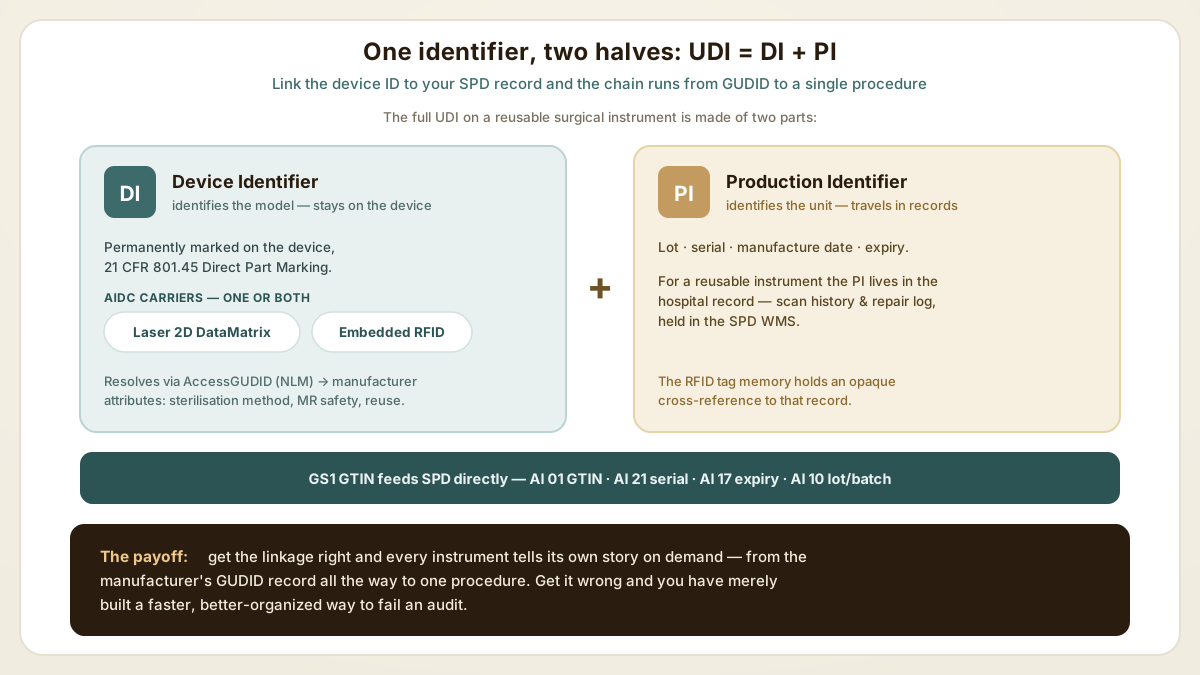
- Direct Part Marking requirement: 21 CFR 801.45 requires the UDI to be permanently marked directly on a device that is intended for more than one use and intended to be reprocessed before each use — the canonical reusable surgical instrument case. Laser-marked 2D DataMatrix is most common; RFID embedded in the handle is the AIDC alternative that survives bone-cutting forces and autoclaving.
- GUDID submission: each Device Identifier (DI) that the manufacturer assigns to an instrument model goes into the FDA Global Unique Device Identification Database (GUDID); the public face is AccessGUDID maintained by the National Library of Medicine. Hospitals can resolve the DI to manufacturer attributes (sterilisation method, MR safety class, single-use vs reusable) via AccessGUDID's web service.
- UDI = DI + PI: the full UDI is Device Identifier + Production Identifier (lot, serial, manufacture date, expiry). For a reusable surgical instrument, the DI carries on the device while the PI typically lives in hospital records (scan history, repair log). RFID tag memory holds an opaque cross-reference to the SPD WMS where the PI lives.
- Issuing Agency: FDA accredits GS1, HIBCC and ICCBBA. The vast majority of surgical-instrument manufacturers (Stryker, Aesculap/B. Braun, Medline, Symmetry/Integra, KLS Martin) use GS1 GTIN; SPD systems should ingest GS1 application identifiers (AI 01 for GTIN, AI 21 for serial, AI 17 for expiry, AI 10 for lot/batch) directly from the DataMatrix or RFID payload.
- EU MDR overlap: EU MDR (Regulation 2017/745) requires UDI registration in EUDAMED with a Basic UDI-DI grouping. Multinational instrument programs maintain a single GS1-based identifier scheme that satisfies both FDA and EU UDI; the same identifier travels on the RFID-tagged instrument across regions, with country-specific gateway logic in the SPD platform.
Useful next pages
Use these linked product, guide and comparison pages to keep the next click specific and practical.
Surgical instrument RFID supply
Autoclave-rated ceramic tags, sterile-processing readers and EHR integration support.
SPD RFID authority and case references
Public references for hospital SPD RFID procurement and implementation teams.
Related reading
More healthcare RFID resources from the blog.
FAQ
Can RFID tags survive autoclave sterilization?
Yes — purpose-built ceramic-encapsulated HF tags rated for 1000-5000+ sterilization cycles at 134°C. Standard PVC or paper inlays cannot survive even one autoclave cycle. Always specify autoclave-rated tags for surgical instruments.
How much does it cost to RFID-tag a surgical instrument?
Tag itself: $3-15 (standard) to $10-25 (premium ceramic). Encoding and attachment labor: $5-15 per instrument. Total: $8-40 per instrument as one-time cost. Amortizes over 5-10 year instrument lifespan.
Will RFID tags interfere with surgical instruments?
No — not when the tag sits where it belongs (handle, non-cutting surface). A modern HF passive tag is 1-3mm and clinically invisible: the instrument cuts, clamps and grips exactly as it did before.
Does instrument RFID integrate with our existing EHR?
Yes — Epic, Cerner, Meditech, Allscripts all support tray-level instrument records. Integration is via HL7 messaging or API. Plan 8-16 weeks for first-time integration; subsequent OR/department additions are faster. Most hospitals also keep an SPD-specific WMS (Censis, Mobile Aspects SpaceTRAX, SPM) between RFID readers and the EHR rather than writing reads directly into Epic/Cerner.
How does instrument RFID interact with FDA UDI Direct Part Marking?
21 CFR 801.45 requires the UDI to be permanently marked directly on instruments that are reused and reprocessed. Laser-marked 2D DataMatrix (most common) and RFID (embedded in the handle) both qualify as Automatic Identification and Data Capture (AIDC) carriers under the FDA UDI Rule. Many hospitals deploy both: the DataMatrix carries the manufacturer DI for FDA traceability, and the RFID tag carries an internal SPD identifier that resolves to the same instrument record.
What about 21 CFR Part 11 for the SPD electronic records?
Once a hospital retires paper sterilisation logs in favour of an electronic SPD record, 21 CFR Part 11 (electronic records / electronic signatures) governs how those records are maintained, signed and audited — particularly when those records support FDA-regulated activities such as recall traceability or adverse-event reporting. Vendor SPD platforms (Censis, Mobile Aspects, SPM) publish Part 11 conformance statements; the practical requirements are time-stamped audit trails, role-based authentication and tamper-evident export — all of which RFID-driven scan logs naturally produce.
Proud Tek is a Shenzhen-based RFID & NFC manufacturer supplying hotel chains, transit operators, event venues and retail brands worldwide. Every order includes free samples, RF testing and dedicated project support.
Get a Quick Quote
Tell us about your project and we'll respond within one business day. Fields marked (asterisk) are required.