
Healthcare Operations
RFID Surgical Sponge Counting
FDA and AORN
Quick answer
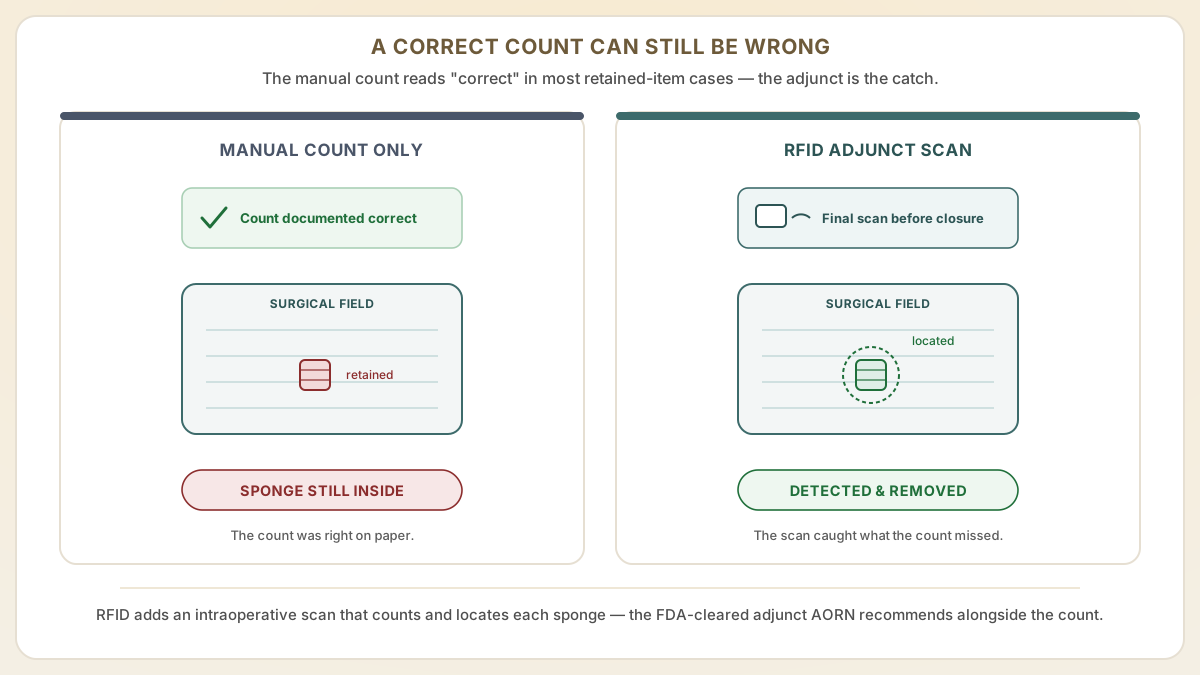
A surgical sponge count can read "correct" and still be wrong: missed sponges cause the majority of retained-item events, at roughly $166,000-200,000 per incident. RFID-tagged sponges add an intraoperative scan that counts and locates each sponge inside the patient — the FDA-cleared adjunct AORN recommends alongside the manual count.
- Retained surgical sponges occur in 1 of 5,500 operations on average — and account for 70% of all retained foreign object cases costing hospitals $200K-1M each.
- FDA cleared RFID sponge-counting systems (Stryker SurgiCount Safety-Sponge, Haldor Advanced Technologies) since 2006; AORN guidelines now recommend adjunct technology for at-risk procedures.
- Total program cost runs $5-15 per case in incremental sponge cost; payback typically <12 months from a single avoided RSS event.
At a glance
Use these short answers to decide whether this page matches the project before moving into the detail.
Key takeaway
Retained surgical sponges occur in 1 of 5,500 operations on average — and account for 70% of all retained foreign object cases costing hospitals $200K-1M each.
What is the retained surgical sponge problem?
A retained surgical sponge (RSS) is a gauze, lap pad, or kittner left inside a patient after the wound is closed — and it is the leading cause of retained foreign object...
Next step
Ready to move forward? Start your inquiry to get specific answers for this project.
Get a sponge-counting RFID quoteWhat is the retained surgical sponge problem?
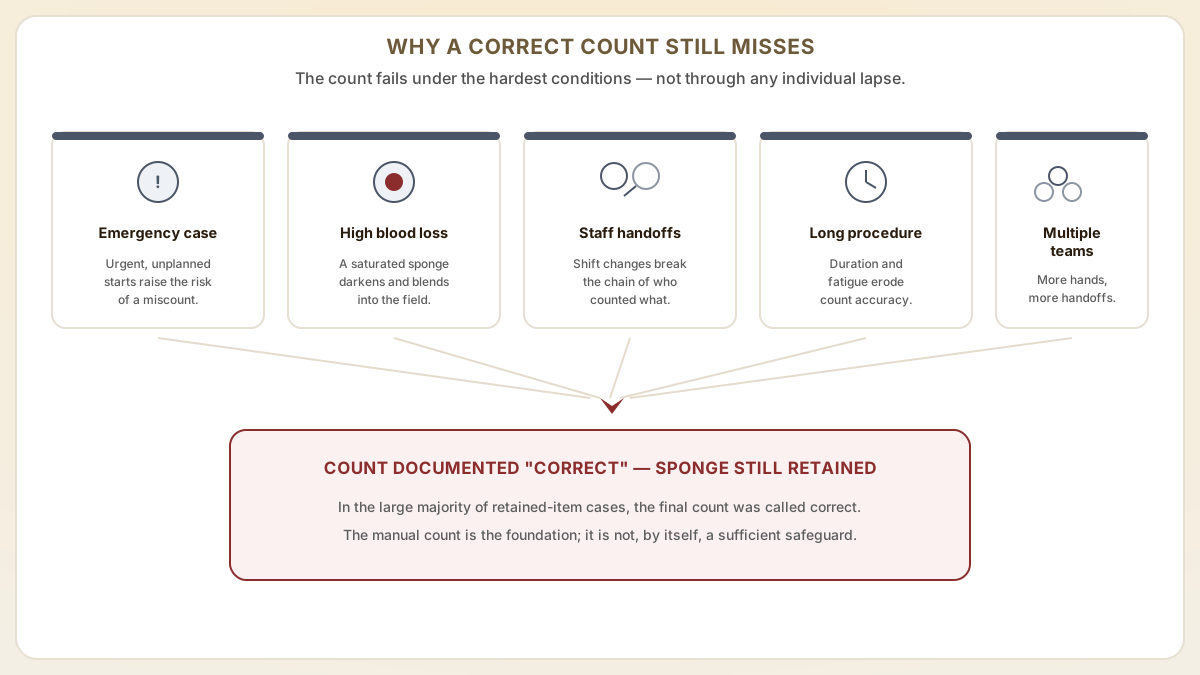
A retained surgical sponge (RSS) is a gauze, lap pad, or kittner left inside a patient after the wound is closed — and it is the leading cause of retained foreign object (RFO) events in the operating room, occurring in roughly 1 of 5,500 operations even though AORN requires a manual count on every case. It is almost never carelessness. It is a long trauma case, heavy blood loss, a shift change mid-procedure, a sponge soaked dark and pressed against tissue — and a count, conducted exactly as protocol requires, that still comes out wrong. The teams this affects are skilled and diligent; the failure is in asking human counting to be perfect under the hardest possible conditions. That gap is what an electronic adjunct exists to close — the same RFID approach hospitals use to track surgical instruments.
- Definition: a surgical sponge (gauze, lap pad, or kittner) left inside a patient after wound closure. Detection often delayed weeks to months until imaging or symptoms.
- Manual count failure modes: count distraction in trauma cases, sponges saturated with blood obscuring count, multiple count handoffs between OR staff, sponges adherent to tissue.
- Clinical consequences: infection, fistula, abscess, pain, additional surgery for removal. Mortality rare but morbidity high.
- Financial consequences: per-event cost $200K-1M (additional surgery, extended LOS, malpractice settlement). Aggregate US RSS cost estimated $1B+ annually.
- Hospital reporting requirements: many state laws require RSS event reporting to state health department. Joint Commission tracks as 'never event' in patient safety scoring.
How does RFID sponge counting work?
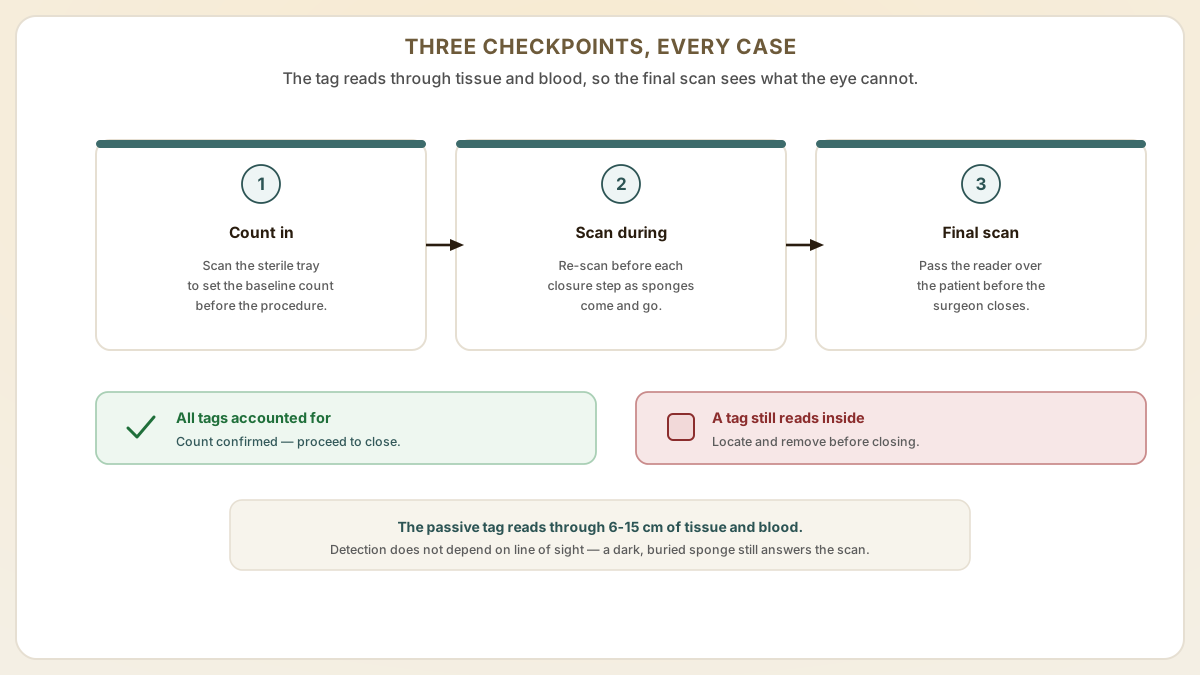
RFID sponge-counting systems embed a small passive RFID tag in each sterile surgical sponge. The tag reads through tissue and blood, allowing intraoperative scanning to detect any sponge inside the patient before closure. The workflow below runs the same checkpoints every case — a count in before the procedure, scans during it, and a final scan over the patient before the surgeon closes.
- Tag specification: 1-2cm passive UHF RFID inlay sealed within the sponge construction. Survives sterilization and intraoperative use.
- Read range: handheld scanner reads sponges through 6-15cm of tissue depending on sponge construction and tissue density. Adequate for typical surgical depths.
- Workflow: pre-procedure count via tray scan; intraoperative scans before each closure step; final scan over the patient before final closure.
- Detection alarm: scanner alarms if any sponge is detected inside the patient. Surgeon then localizes and removes the sponge.
- Data logging: every scan logged with timestamp and surgeon ID. Provides audit trail for quality improvement and Joint Commission survey.
What does an RFID sponge program cost?
RFID sponge program cost has three components: incremental sponge cost, scanner hardware and ongoing operational integration. Hospitals running active programs report $5-15 per case all-in. The breakdown below shows where that money goes, from the per-sponge premium up to the first-year program total.
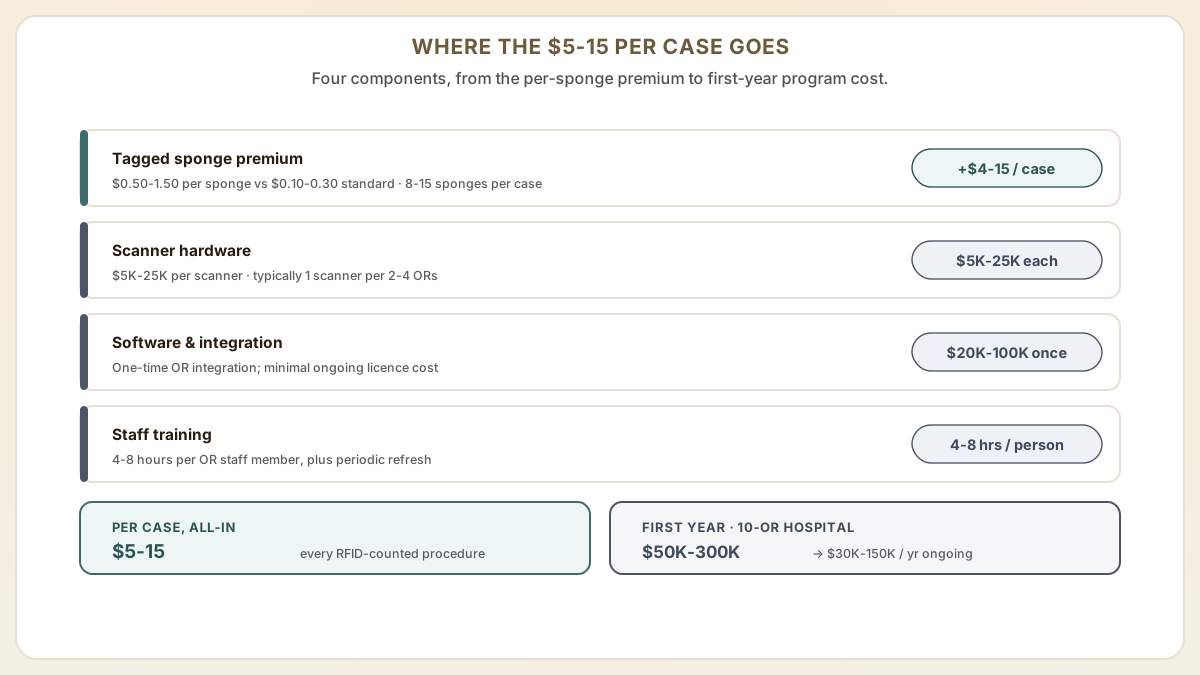
- Incremental sponge cost: $0.50-1.50 per RFID-tagged sponge vs $0.10-0.30 for standard. Average case uses 8-15 sponges, adding $4-15 per case.
- Scanner hardware: $5K-25K per scanner. Typical OR needs 1 scanner per 2-4 ORs depending on case mix and turnover.
- Software and integration: $20K-100K one-time for OR integration; minimal ongoing license cost. Some vendors include software with sponge purchase contracts.
- Staff training: 4-8 hours per OR staff member, plus periodic refresh. Sterile-processing staff also need training on RFID-tagged sponge handling.
- Total program cost: $50K-300K first-year for typical 10-OR hospital, dropping to $30K-150K/year ongoing as scanner hardware amortizes.
What ROI does RFID sponge counting deliver?
RFID sponge-counting ROI is dominated by a single line item: the retained-sponge event that never happens. The five dimensions below capture both the savings a CFO can put on a spreadsheet and the risk reduction that is harder to quantify but matters more.
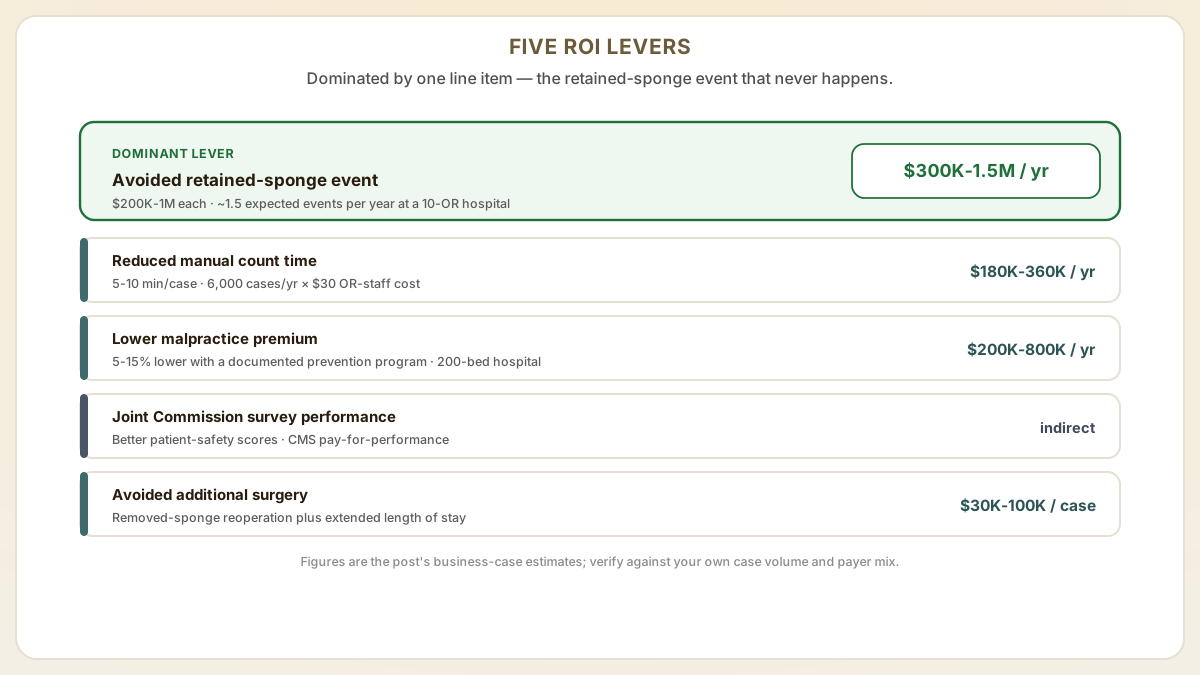
- Avoided RSS event cost: single event averages $200K-1M. A 10-OR hospital with 1.5 expected RSS events per year (statistical baseline) saves $300K-1.5M annually.
- Reduced manual count time: RFID scan replaces 5-10 minutes of manual count per case. At 6,000 cases/year × $30 OR-staff cost, this is $180K-360K/year operational savings.
- Malpractice premium reduction: hospitals with documented RSS-prevention programs negotiate 5-15% lower malpractice premiums. For a 200-bed hospital this is $200K-800K/year.
- Joint Commission survey performance: documented RFID program improves patient safety scores. Indirect benefit through reputation and CMS pay-for-performance.
- Avoided additional surgery: removed-sponge patients require additional procedure costing $30K-100K plus extended LOS. Avoided cost falls to insurer but hospital reputation benefits.
What does the published industry data say about RSS rates and adjunct adoption?
RSS prevention is one of the most heavily documented areas of perioperative safety. STERIS's 2023 'How to Prevent Retained Surgical Items' explainer, the Joint Commission's Sentinel Event Alert #51 (Preventing unintended retained foreign objects, October 2013), AORN's Guideline for Prevention of Retained Surgical Items (2019 edition), and the Pennsylvania Patient Safety Authority all converge on a consistent set of numbers worth citing in any business case. The figures that recur across all of them are collected below.
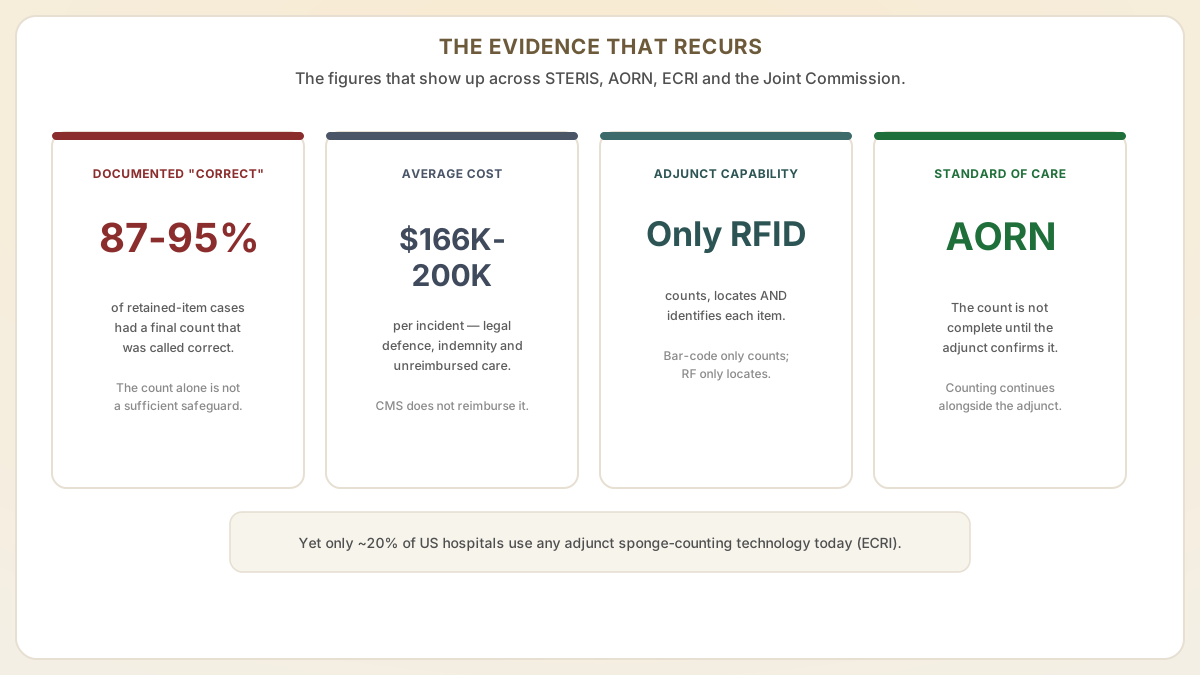
- Mayo Clinic incidence rate: a four-year Mayo Clinic study (Gawande, Studdert, Brennan, NEJM 2003) cited by STERIS placed RSI incidence at approximately 1 in 5,500 surgical procedures, with ~1,500 cases per year estimated nationally. Surgical sponges account for nearly 70% of all RSIs.
- Cost reference: STERIS cites the Pennsylvania Patient Safety Authority average of approximately $166,000 per RSI event including legal defence, indemnity payments and unreimbursed surgical care. Other published reviews place medical and liability costs at $200,000+ per incident; CMS designates 'foreign object retained after surgery' as a non-reimbursable Hospital-Acquired Condition (HAC).
- Manual count failure mode: STERIS notes that 'as many as 95% of RSIs happen in a case where a count was documented and verified', echoed by Steelman et al. (Patient Saf Surg 2018) which documented 87% of administrative-penalty cases where the final sponge count was called 'correct'. The manual count alone is not sufficient — adjunct technology is now the standard of care.
- ECRI adoption baseline: STERIS quotes ECRI Institute's estimate that only ~20% of US hospitals use any adjunct sponge-counting technology to supplement the manual count or detect missing sponges. Cost analyses cited by ECRI place tagged-sponge incremental cost at roughly $12 per procedure plus less than 1 minute of additional procedure time — versus an estimated 18 minutes to locate a missing sponge or hundreds of thousands of dollars in unreimbursed RSI cost.
- AORN guideline language: AORN's Guideline for Prevention of Retained Surgical Items recommends adjunct technology that is FDA-cleared (or deemed exempt from premarket notification) for the detection of surgical soft goods. Counting must continue alongside the adjunct, and the count cannot be considered complete until the adjunct confirms the final count.
How do FDA-cleared sponge-detection systems compare?
Three categories of FDA-cleared adjunct technology dominate the US market: bar-code-counting systems (Stryker SurgiCount Safety-Sponge), RF (radio-frequency, distinct from RFID) sponge-detection wands (formerly RF Surgical Detection System, now Stryker following acquisition), and RFID sponge-counting and detection systems (STERIS ORLocate). Each makes different trade-offs and AORN treats them differently in the prevention guideline. The matrix below lines them up on the axis that matters: can the system count, can it locate a sponge in the patient, and can it identify each sponge uniquely?
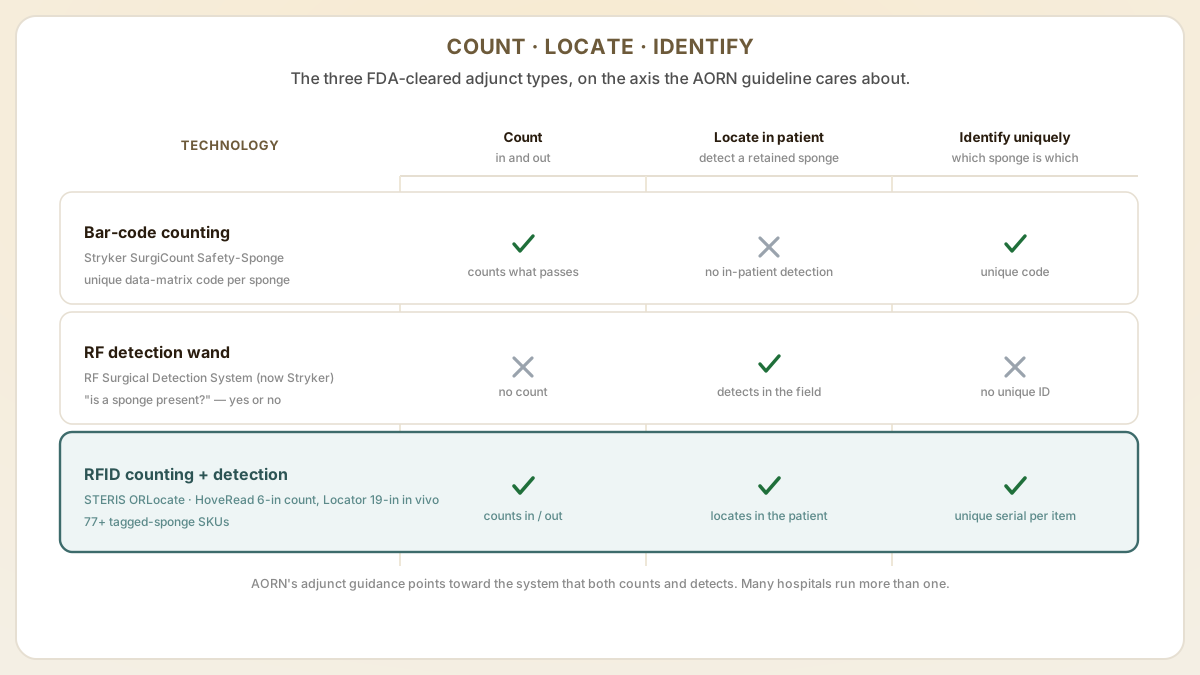
- Stryker SurgiCount Safety-Sponge: FDA-cleared bar-code-counting system; each sponge carries a unique data-matrix code. Counts in and out via handheld reader. Strong adoption in US hospitals, but bar-code systems do not detect a sponge inside the patient — they only count what passes the reader.
- RF Surgical Detection System (now Stryker): FDA-cleared RF wand that detects whether any tagged sponge is present in the surgical field, but does not provide a count or unique sponge identity. AORN's RSI guideline historically referenced this as 'detection' technology rather than 'counting' technology.
- STERIS ORLocate: FDA-cleared HF RFID system that both counts (HoveRead handheld counter, ~6-inch read distance) and detects (Locator wand, up to 19 inches in vivo). 77+ tagged-sponge SKUs at the time of STERIS's published catalogue. The combined count + detection capability is what AORN's adjunct-technology guidance points toward.
- Workflow integration: SurgiCount and ORLocate both integrate with the existing OR closing-count protocol — count cannot be declared correct until the adjunct confirms. RF wands are typically used at the end of the case as a final-defence sweep when the manual count is in dispute or the patient is high-risk.
- Hybrid deployments: many US hospitals run more than one system because no single SKU library covers every sponge size. A common pattern is SurgiCount for bar-code-counted Raytec-style sponges plus ORLocate or an equivalent RFID layer for laparotomy pads and vaginal packing — the case study deployment in /blog/case-study-regional-hospital-rfid-surgical-sponge-rss-prevention/ runs this kind of layered configuration.
Useful next pages
Use these linked product, guide and comparison pages to keep the next click specific and practical.
Surgical sponge RFID supply
Sponge-embedded RFID tags, intraoperative scanners and OR integration support.
RSS prevention authority references
Primary regulatory and clinical-society sources cited during sponge-program design and audit.
FAQ
Do RFID-tagged sponges affect surgical performance?
No clinical performance difference vs standard sponges in independent studies. The embedded RFID tag is small (1-2cm), flexible and does not interfere with absorbency or handling. FDA cleared since 2006.
Can RFID sponges be used in MRI patients?
RFID sponges contain small amounts of metal (chip + antenna) and are not MRI-compatible during imaging. Standard practice removes all sponges before MRI; same applies for RFID-tagged variants. Not a clinical limitation if standard sponge-counting protocol is followed.
Are RFID sponges single-use?
Yes — surgical sponges are single-use disposables regardless of RFID status. After use they are bagged with the surgical waste and incinerated. No re-use or reprocessing.
Will RFID sponge counting replace manual counts?
No — AORN's Guideline for Prevention of Retained Surgical Items and the Joint Commission still require manual sponge counts. RFID and other adjunct technologies catch errors the manual count misses. AORN explicitly states the count cannot be considered complete until the adjunct confirms; the manual count is the foundation, the adjunct is the final defence.
What is the difference between RF detection (Stryker / formerly RF Surgical) and RFID counting?
RF detection systems (the legacy RF Surgical Detection System, now part of Stryker) read whether any tagged sponge is present in the surgical field, but do not count or uniquely identify each sponge — they answer the question 'is there a sponge in the patient?' but not 'which sponge?'. RFID counting systems (STERIS ORLocate, Stryker SurgiCount-RFID) read each tagged sponge's unique identifier, supporting both an in-vivo locator wand and a count-in/count-out handheld scanner.
What does the FDA's regulatory pathway look like for RFID-tagged sponges?
Tagged surgical sponges are regulated as Class II medical devices under 21 CFR 878.4760 (sponge or sponge holder for use in surgery) with the RFID detection system also requiring FDA 510(k) clearance. The FDA has cleared multiple devices in this category since 2006, including the Safety-Sponge bar-code system, the RF Surgical Detection System and STERIS's ORLocate RFID system. AORN's guideline specifies that adjunct technology should be FDA-cleared (or deemed exempt from premarket notification).
Sources & references
Primary standards, OEM datasheets and regulatory documents cited by this article. All URLs were verified on the access date shown below.
- STERIS — What are Retained Surgical Items? (Prevention and Solutions)
Clinical explainer: manual counts err even when documented correct, average cost ~$166,000-200,000 per incident, and RFID uniquely counts, locates and identifies items where bar-code only counts and RF only locates.
- STERIS — ORLocate Surgical Counting and Detection System
FDA-cleared HF RFID adjunct: HoveRead handheld counter (~6-inch read) plus Locator wand (up to 19 inches in vivo), 77+ tagged-sponge SKUs, aligned to AORN adjunct-technology guidance.
Proud Tek is a Shenzhen-based RFID & NFC manufacturer supplying hotel chains, transit operators, event venues and retail brands worldwide. Every order includes free samples, RF testing and dedicated project support.
Get a Quick Quote
Tell us about your project and we'll respond within one business day. Fields marked (asterisk) are required.