
UHF Components
UHF RFID Inlay
Roll-to-Roll Tag Component

Quick answer
UHF RFID inlays are the chip-on-antenna passive component supplied on PET film at 2,000-20,000 inlays per roll for label converters and tag makers. They ship wet (PSA + release liner) for label lamination or dry (no adhesive) for rigid-housing embedding, on dogbone, near-field, square and web-44 antennas. Every roll is 100% RF-tested and ships with a per-lot sensitivity histogram, yield report and GS1 SGTIN-96 EPC manifest for Walmart T2/T3, Target, Macy's and Auburn ARC programmes.
- Full chipset range — Impinj M730 / M750 / M770 + Monza R6, NXP UCODE 8 / 8m / 9, Alien Higgs-9 — with chip-substitution policy: exact chip confirmed pre-production, no swaps without written approval.
- Wet (PSA + release liner) and dry (no adhesive) on PET; roll format 2,000-20,000 inlays / 3″ core; pitch ±0.5 mm + chip position ±0.3 mm tolerance for 50-150 m/min converting lines.
- 100% RF-tested at production speed; per-lot sensitivity histogram + yield report + GS1 SGTIN-96 EPC manifest in CSV/XML — Auburn ARC + Walmart T2/T3 / Target / Macy's audit-ready.
Used in these industries
Deployments where this product is referenced on our industry landing pages.


At a glance
Use these short answers to decide whether this page matches the project before moving into the detail.
Where this inlay sits in the UHF stack
Inlay = chip + antenna on 50 µm PET film. Sub-component, not a finished label. This SKU is the chip-and-antenna agnostic umbrella — chip choice + antenna geometry + roll...
Chip silicon — sensitivity, memory, programme fit
Impinj M770 — read sensitivity -22.7 dBm, write -16 dBm, Autopilot tuning. Premium retail + cold-DC. Impinj M750 — fastest encoder 96-bit EPC; high-speed converting and...
Next step
Ready to move forward? Start your inquiry to get specific answers for this project.
Request UHF inlay quoteCommercial terms
- MOQ
- Varies by SKU — stock items from 100 pcs; custom production typically 200-1,000 pcs
- Lead time
- Production 2-3 weeks after artwork and encoding sign-off; reorders on a 3-4 week cycle
- Samples
- Free samples and RF test report with every order; courier at customer cost
- Payment
- 50% T/T deposit, 50% before shipment; Net 30/60 for established accounts; LC for large orders
- Shipping
- FOB Shenzhen / Yantian; DHL, FedEx or EMS air freight; sea LCL / FCL for volume
- Response
- Itemized quote within one business day, Mon-Fri (UTC+8)
What a UHF inlay actually is
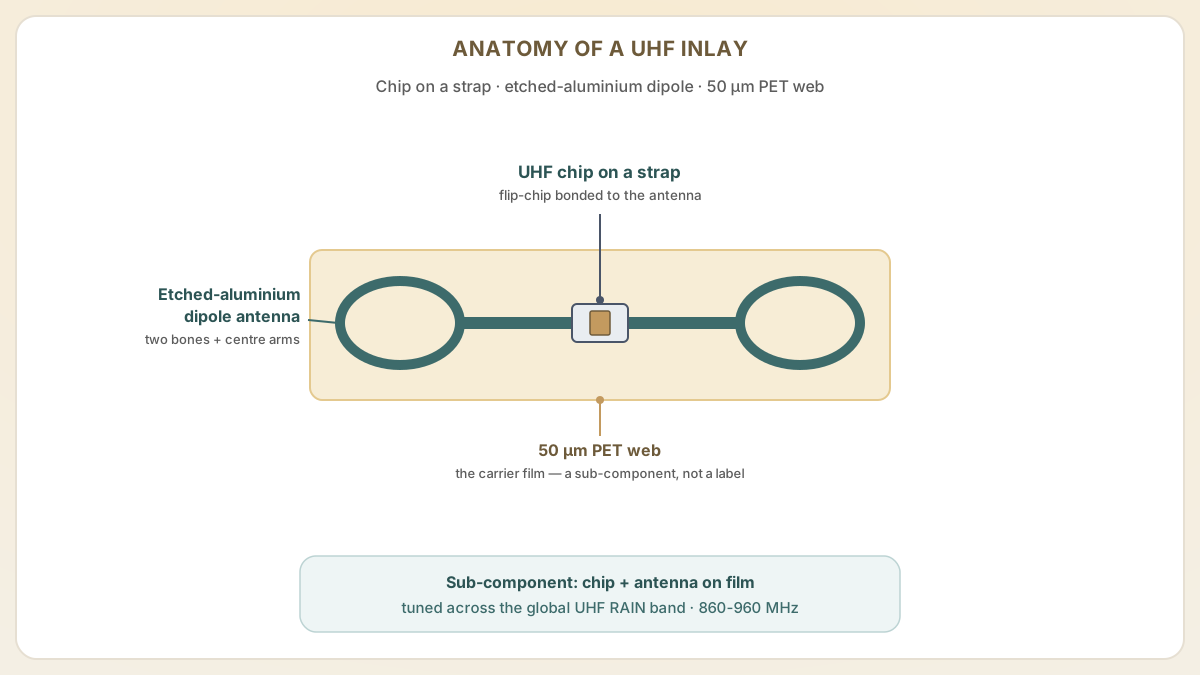
Strip away the face stock, the print and the die-cut and what actually answers the reader is deceptively small: a UHF chip flip-mounted onto a metal strap, bonded to an etched-aluminium dipole antenna on a 50 µm PET web. That is the inlay — a sub-component, not a finished label — resonating across the global UHF RAIN band of 860-960 MHz that each region then carves into its own narrower window. The silicon barely changes between programmes; the antenna is the part you actually specify, and it ships in six standard geometries.
- Dogbone 96 × 22 mm — apparel hang tag + shipping label workhorse.
- Rectangular 70 × 18 mm — carton labels and mid-size tags.
- Short dipole 50 × 12 mm — product labels + compact tags.
- Near-field 27 × 10 mm — pharma vial + jewelry + cosmetic.
- Square 50 × 50 mm — on-metal with spacer + general purpose.
- Web 44 × 44 mm — retail price label + library shelf.
Wet, dry, converted: one chip, three finish states
The same chip and antenna leave the line in one of three finish states, and which one you order is dictated entirely by the process waiting downstream. A dry inlay is the bare core; a wet inlay adds the pressure-sensitive adhesive and release liner a label converter laminates from; a converted inlay is that inlay already built into printed face stock — at which point it has stopped being a component and become a finished label.
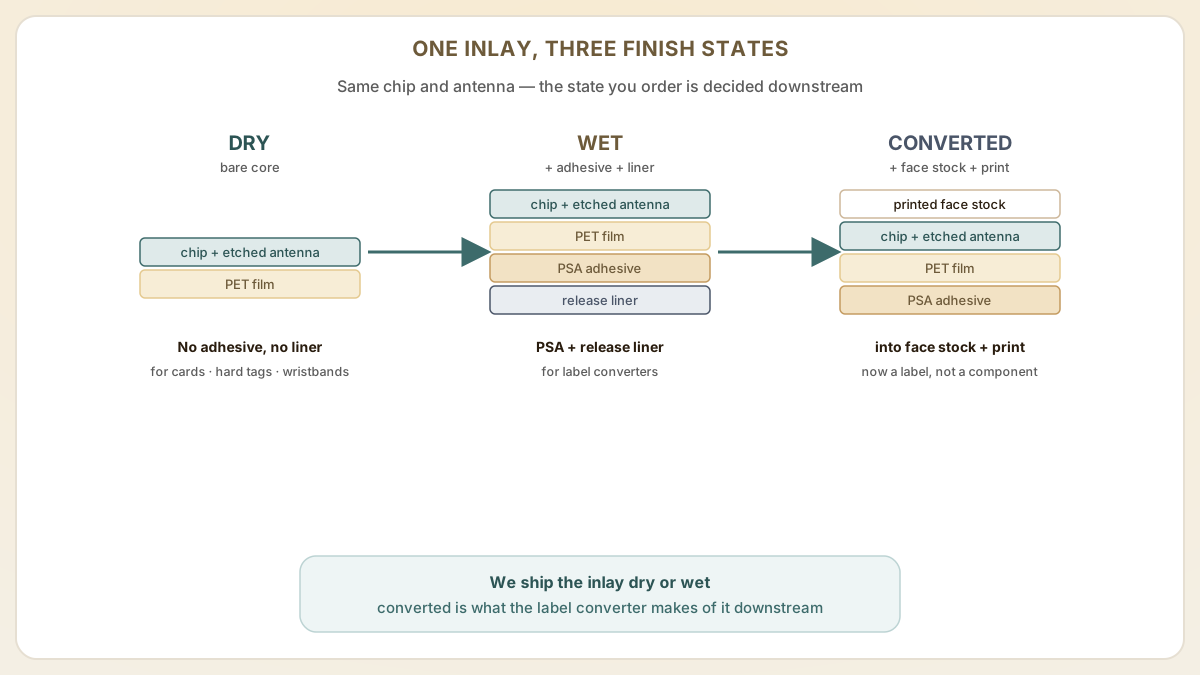
- Wet inlay — PSA layer + silicone-coated PET release liner; for converters laminating into thermal-transfer / direct-thermal / synthetic label stock.
- Dry inlay — no adhesive, no liner; for embedding into ID-1 / CR-80 PVC card body, hard ABS / polycarbonate housings, over-molded silicone wristbands, RTI tags.
- Same chip + antenna available in either format — choice is downstream-process driven.
Why programme procurement standardises on inlay-stage sourcing
- Buying inlay stage instead of finished tag — converters keep face stock, top-coat and printing margin in-house.
- Hard-tag, card and wristband manufacturers can specify dry inlays without adhesive interference.
- Specialty antenna designs (near-field 27 mm, square 50 mm, web 44 mm) accessible at 10K MOQ instead of 1M+ chip-mfr direct.
Commodity inlay supplier vs Auburn ARC + Walmart-T2/T3 audit-ready inlay
Commodity / mid-market inlay supplier
- Mid-production chip substitution without written approval — programme audit fails.
- Pitch tolerance ±1.5-2.0 mm — converter encoder mis-read, first-pass yield drops to 80-90%.
- No per-lot sensitivity histogram → retailer audit re-run, 2-4 week delay.
- EPC manifest absent or in vendor-proprietary CSV → label-print correlation breaks.
- Specialty antenna designs (near-field, square, on-metal) require 16-20 week chip-mfr lead time at 1M+ MOQ.
Audit-ready inlay (ARC + Walmart T2/T3 + Target + Macy's)
- Chip + antenna confirmed in writing pre-production; no swaps without written approval.
- Pitch ±0.5 mm + chip position ±0.3 mm; 99%+ first-pass encoding at full converter speed.
- Per-lot sensitivity histogram + yield report + COA; ARC + retailer audit signed first submission.
- GS1 SGTIN-96 EPC manifest in CSV/XML keyed to roll position; correlates to printed GTIN + serial.
- Specialty antennas available at 10K MOQ + 4-6 week lead time.
- Auburn ARC ratings inform retailer-spec language (ARC-G2 = general purpose, ARC-W = apparel, ARC-Q = high-volume).
- Walmart T2 mandate covers apparel + home + hardlines; T3 expands to grocery + pharma.
- Target SUPPLIERS portal flags non-conforming RFID at receiving; the EPC manifest is the dispute-resolution artifact.
Chip + antenna selection — the decision matrix programmes use
- Cold-DC + freezer programmes — UCODE 9 + dogbone 96 mm + cryo-grade adhesive on wet inlay.
- Apparel hang tag — M730 or UCODE 8 + dogbone 96 mm; pre-encoded SGTIN-96 in CSV manifest.
- Pharma vial + jewelry — UCODE 9 or M750 + near-field 27 mm; UID-only no GTIN.
- Tier-1 OEM tire / on-metal — Monza R6-P + square 50 mm with spacer; 170-200 °C cure-survivable variant separate.
Where inlay-stage sourcing earns its margin — the application inventory
- Label converters — laminate wet inlay into thermal-transfer / direct-thermal / synthetic label stock at 50-150 m/min.
- Hang-tag manufacturers — embed dry inlay into cardboard or synthetic hang-tag composite for retail apparel programmes.
- Card manufacturers — laminate dry inlay into ID-1 (CR-80) PVC / PET / paper card body for UHF-enabled access + loyalty + gift card.
- Wristband producers — over-mold dry inlay into silicone / TPE / PVC + fabric wristband housings.
- Hard-tag assembly — embed dry inlay into ABS / polycarbonate / nylon housings for reusable security tag, RTI tag, anti-metal tag.
- Specialty tag manufacturing — laundry tag (PPS / silicone), tire tag (cure-survivable), library tag (HF analog uses different chip).
- On-metal label conversion — dry inlay + ferrite spacer + anti-metal face film for IT-asset / pipe-valve / equipment.
- Pharma + medical — UCODE 9 + near-field 27 mm + indirect-food-contact adhesive for vial + blister + secondary pack.
From EPC Class-1 Gen2 to GS1 EPCIS 2.0 — milestones that shaped UHF inlay supply
- 2004
Walmart RFID mandate kicks off — Class-0 + Class-1 Gen1 inlays specified for top-100 supplier pallet + case tagging.
- 2007
EPC Gen2v1 + ISO/IEC 18000-6C (now ISO/IEC 18000-63) ratified — universal UHF air-interface; chip sensitivity baseline -15 dBm.
- 2013
EPC Gen2v2 published — adds anti-cloning + privacy-preserving features; M-series + UCODE-series chips designed against this.
- 2016
Auburn University RFID Lab launches ARC certification; retailers begin specifying ARC categories (W, Q, G, X, L, M) in supplier mandates.
- 2018
Impinj M700 series + NXP UCODE 9 launch — read sensitivity crosses -22 dBm; freezer + dense-reader tunnel + 18 m range become viable.
- 2021
GS1 EPCIS 2.0 (ISO/IEC 19987:2021) published — Commission, ObjectEvent, AggregationEvent become standardised across retailer + 3PL platforms.
- 2023
Walmart T3 + Target + Macy's expand RFID mandates to grocery + pharma; converters scale inlay procurement to 100M+ pieces / programme.
- 2026 — Today
Cross-buyer reference experience on retail-apparel-source-tag, cold-chain-frozen-DC, pharma-serialisation, automotive-tier1-cure, library-iso-28560 and brand-protection-luxury-uhf programmes shows.
The reference facts, at a glance
Everything a converter or programme reviewer cross-checks against the datasheet — roll format, frequency and regulatory caps, tag QA, reader compatibility, EPC pre-encoding, retailer readiness, procurement and the not-this list — gathered into one scannable block.
Roll format & converter compatibility
Standard rolls — 2,000 / 5,000 / 10,000 / 20,000 inlays on 3″ (76.2 mm) core. Web width — 50 / 85 / 110 mm (matches Mark Andy P5/P7, Nilpeter FA-17, MPS EF-Symjet, Edale FL3). Pitch — 14, 18, 22, 25, 30, 35 mm or custom centre-to-centre on the web. Pitch tolerance ±0.5 mm; chip position ±0.3 mm — the spec converting lines need to hold first-pass encoding at 99%+.
Frequency & regulatory framework
FCC Part 15.247 — 902-928 MHz unlicensed (US, Canada, Mexico, parts of LATAM); 4 W EIRP cap. ETSI EN 302 208 — 865-868 MHz (EU + UK + Norway + Switzerland); 2 W ERP cap. MIC Japan — 916.7-923.5 MHz; 1 W EIRP. ACMA Australia — 920-926 MHz; 4 W EIRP cap. Each chip is regional-tuned — antenna designs available for Region 1 (EU), Region 2 (Americas), Region 3 (Asia-Pacific) or universal.
Tag QA — Auburn ARC + GS1 EPCIS
Auburn University RFID Lab ARC categories — Q (high-volume retail), W (apparel), X (cold-DC), G (general purpose), L (logistics), M (RTI / metal-near). ARC-spec assessment runs each antenna design through 60-cm + 6-m anechoic chamber tests with population sweep. GS1 EPCIS 2.0 (ISO/IEC 19987:2021) downstream event capture — Commission, ObjectEvent, AggregationEvent. GS1 TDS 2.0 SGTIN-96 + SSCC-96 + GIAI-96 + GRAI-96 EPC schemes pre-encoded per programme.
Retailer programme readiness
Walmart Tier 2 + Tier 3 — apparel, footwear, home, hardlines, toys, jewelry, beauty. Target — apparel, accessories, home; SUPPLIERS portal compliance. Macy's, Nordstrom, Dick's, Lululemon — item-level RFID mandates. Decathlon — global apparel + sporting-goods RFID since 2014. ROI Audit + GS1 EPCIS event capture for Walmart Connect + Target + Sam's Club.
Reader hardware compatibility
Impinj Speedway R700 + R420 — 4-port fixed reader, 4 W EIRP; default for dock-door portal. Zebra FX9600 + FX7500 — fixed; FX7500 IP-65 rated for cold-DC. Impinj xSpan / xArray — overhead grid; retail floor + warehouse mezzanine. Handheld — Zebra RFD8500 (sub-zero spec), Impinj R1000, CipherLab RS35, Honeywell IH40. Reader middleware — Impinj ItemSense, Zebra ATR7000 / Savanna, NORDID, IDmicro, Pyramid Solutions Mosaic.
EPC pre-encoding service
Sequential — counter-up serial, customer-supplied GTIN-14 prefix. Random — non-sequential serial, customer-supplied prefix. Customer-supplied list — full EPC list provided as CSV; manifest-keyed to roll position. Lock bits + access password armed per programme spec. Per-roll EPC manifest in CSV or XML for downstream label-print correlation.
Procurement reality
MOQ 10,000 inlays / chip + antenna combo; 50,000 for fully-custom antenna design. Lead time 12-18 business days for stock chip / 4-6 weeks for fully-custom antenna. Unit price USD 0.04-0.18 ex-works depending on chip + antenna size + EPC pre-encoding + roll length. Per-roll quality pack — sensitivity histogram + yield report + EPC manifest + COA — included for orders ≥50,000.
What this inlay is NOT
Not a finished label — has no face stock, print, die-cut or top-coat. Not a HF NFC inlay — for tap-to-page consumer use, see nfc-dry-inlay / nfc-wet-inlay (NTAG21x). Not a UHF reader — pair with Impinj Speedway / Zebra FX9600 / handheld reader hardware. Not a temperature sensor — pair with Murata SL900A / Sensitech / ELPRO logger if cold-chain monitoring required.
Useful next pages
Use these linked product, guide and comparison pages to keep the next click specific and practical.
Sister inlay SKUs
Wet vs dry, and per-chip flagship inlays.
Finished UHF products built from these inlays
Ready-to-use UHF RFID products built from these inlays.
Chip-level technical reference
Deep-dive specifications and chip-family comparisons relevant to this SKU.
Industry applications
Industry deep-dives where this SKU is commonly specified.
FAQ
Which chip should I choose for retail apparel tagging?
For retail apparel, default to Impinj M730 (or its M750 high-encoding-speed variant) or NXP UCODE 8. Both are the dominant 2024-2026 choices, both are Auburn ARC-W certified at default antenna sizes, both support GS1 SGTIN-96 EPC pre-encoding, and both are listed in the Walmart Tier 2/3, Target SUPPLIERS, Macy's, Nordstrom, Dick's, Lululemon and Decathlon vendor-compliance specifications. For premium / cold-DC programmes where 12-18 m read range matters, NXP UCODE 9 (best-in-class -23.5 dBm sensitivity) is the upgrade. For reusable hard-tag retail security, Impinj Monza R6-P remains the proven 5+ year workhorse. Send us your retailer mandate + Auburn ARC category and we match the chip + antenna combo + per-lot quality pack to that audit.
What is the difference between wet and dry UHF inlays?
Wet inlays include a pressure-sensitive adhesive layer + silicone-coated PET release liner — they peel and stick directly onto a surface, or laminate into label stock at the converter (Mark Andy P5/P7, Nilpeter FA-17, MPS EF-Symjet). Dry inlays have no adhesive and no liner — they are designed for embedding into rigid housings (hard tags, ID-1 / CR-80 PVC cards, key fobs, RTI tags) via heat lamination, ultrasonic welding, ABS injection over-mold, or mechanical assembly. Same chip + antenna available in either format — choice is downstream-process driven. See the dedicated rfid-wet-inlay and rfid-dry-inlay SKUs for format-specific specs.
Can you match a specific inlay used by our current supplier?
Yes. Send us a sample (3-5 pieces) or provide the inlay part number + roll spec sheet, and we identify the chip silicon (M730 / M750 / M770 / UCODE 8 / 8m / 9 / Monza R6 / R6-P / Higgs-9), antenna geometry (dogbone / rectangular / short-dipole / near-field / square / web), pitch + chip position, web width and core size. We produce a compatible replacement inlay with equivalent or better Auburn ARC performance category. We maintain a library of industry-standard antenna designs compatible with major label converting platforms (Mark Andy, Nilpeter, MPS, Edale, Bobst, OMET) so equipment changeover is minimal.
What pitch tolerance and web registration do converting lines running at 50-150 m/min require from inlay rolls?
Hold inlay pitch to ±0.5 mm and chip position to ±0.3 mm, or first-pass yield drops from ~99% to 80-90%. High-speed rotary label converting and print-and-apply lines (Mark Andy P5/P7, Nilpeter FA-17, MPS EF-Symjet, Edale FL3 at 50-150 m/min) need inlay pitch (centre-to-centre) held to ±0.5 mm and chip position within ±0.3 mm of nominal, otherwise encoder antenna coupling windows drift out of alignment and first-pass encoding yield collapses from ~99 % to 80-90 %. Our rolls are produced on flexo converting presses with servo-driven web registration and inline optical pitch verification; each roll ships with a measured pitch-distribution plot so converters can dial in their unwinder tension and encoder gantry position to the exact inlay geometry before production. Web widths: 50, 85, 110 mm; pitch options: 14, 18, 22, 25, 30, 35 mm or custom; core size 76.2 mm (3″).
What incoming-quality documentation do retailer RFID programmes expect on every inlay lot?
Expect three artifacts per lot: a sensitivity histogram, a yield report and a GS1 SGTIN-96 EPC manifest. Programmes audited against Auburn University RFID Lab ARC categories and the retail RFID mandates (Walmart Tier 2/T3, Target SUPPLIERS, Macy's, Nordstrom, Dick's, Lululemon, Decathlon) increasingly require per-lot sensitivity histograms, yield reports and EPC pre-encoding manifests in CSV or XML aligned to the GS1 TDS 2.0 SGTIN-96 / SSCC-96 / GIAI-96 / GRAI-96 schemes. We provide all three with every shipment: the sensitivity histogram shows the dBm distribution across the 100 %-tested roll, the yield report states rejects-removed count + roll-position of removed inlays, and the EPC manifest is the full serialised list keyed to roll position so downstream label printers can correlate printed GTIN + serial to the encoded EPC for traceability. This documentation set is the dispute-resolution artifact at retailer receiving when DC-portal read rates fall below mandate thresholds.
Sources & references
Primary standards, OEM datasheets and regulatory documents cited by this article. All URLs were verified on the access date shown below.
- GS1 — EPC Tag Data Standard (TDS) 2.0 — SGTIN-96, SSCC-96, GIAI-96, GRAI-96 encoding
Authoritative spec for the EPC binary encoding patterns retailers + 3PL programmes require on every UHF inlay; SGTIN-96 covers retail + apparel + cold-chain.
- ISO/IEC 18000-63:2015 — RAIN RFID EPC Gen2v2 air-interface (UHF)
International ISO standard codifying EPC Class-1 Gen2v2 — the air-interface every UHF inlay implements; replaces ISO/IEC 18000-6C.
- Impinj — M700 Series (M730 / M750 / M770) Tag Chip Family Datasheet
M730 -22.7 dBm + M750 fastest encoder + M770 -22.7 dBm with Autopilot tuning; the chip family that anchors retail + cold-DC inlay procurement in 2024-2026.
- NXP Semiconductors — UCODE 9 SL3S1205/15 UHF RFID IC Datasheet (rev 3.4)
UCODE 9 -23.5 dBm best-in-class sensitivity, 96-bit EPC + 0-bit user (UCODE 9xe variant 128-bit EPC; UCODE 9xm up to 496-bit EPC + 752-bit user), anti-tamper; the dense-reader + freezer + 18 m range chip.
- Impinj — Monza R6 / R6-P Tag Chip Datasheet
Monza R6 / R6-P -20.5 dBm proven 5+ year workhorse; widely Auburn ARC audited; the established platform for hard-tag and reusable security.
- Auburn University RFID Lab — ARC Tag Performance Test Methodology + Category Specifications
ARC categories (Q, W, G, X, L, M); the audit framework Walmart T2/T3, Target SUPPLIERS, Macy's, Nordstrom, Dick's, Lululemon, Decathlon vendor-compliance reference.
- FCC Part 15.247 — unlicensed 902-928 MHz UHF operation (4 W EIRP cap)
Region 2 (Americas) UHF allocation that frames antenna tuning + reader power for inlays sold into US, Canada, Mexico, parts of LATAM.
- ETSI EN 302 208 V3.3.0 — 865-868 MHz European UHF RFID + 2 W ERP cap
Region 1 (EU + UK + Norway + Switzerland) UHF allocation; antenna geometry tuning differs from FCC band so dual-region inlays use universal-tuned antennas.
- GS1 — EPCIS 2.0 + Core Business Vocabulary (CBV) 2.0 (ISO/IEC 19987:2021)
Standardised event-capture model — Commission, ObjectEvent, AggregationEvent — that downstream retailer + 3PL platforms consume from inlay pre-encoded EPCs.
- GS1 — Sunrise 2027 Programme: 2D Barcodes + RAIN RFID at Point-of-Sale
31 Dec 2027 deadline for retailers to scan 2D codes + RAIN RFID at POS; aligns inlay procurement with GS1 Digital Link + EPC dual-encoding strategy.
Proud Tek is a Shenzhen-based RFID & NFC manufacturer supplying hotel chains, transit operators, event venues and retail brands worldwide. Every order includes free samples, RF testing and dedicated project support.
Get a Quick Quote
Tell us about your project and we'll respond within one business day. Fields marked (asterisk) are required.