
RFID Dry Inlays
RFID Dry Inlay (UHF)
No-Adhesive Lamination Stock

Quick answer
RFID dry inlays are bare chip-on-antenna assemblies on 23-50 µm PET film with no adhesive and no release liner. They are engineered for heat-press card lamination, ultrasonic bonding and 200-280 °C injection over-mold, with 75 µm polyimide / PEN grades for high-temperature presses. Chips span UHF (Impinj M730 / M750 / M770, NXP UCODE 8 / 9, Monza R6), HF (NTAG213/215/216, NTAG 424 DNA, MIFARE Classic / Plus / DESFire, ICODE SLIX2) and LF (EM4100, T5577).
- No adhesive + no liner — clean PET / polyimide substrate engineered for heat-press lamination, ultrasonic bonding and 200-280 °C injection over-mold without char, outgas or contamination.
- PET 23-50 µm for ISO 7810 PVC card press (140-160 °C / 15-20 kg/cm²) + polyimide / PEN 75 µm for ICAO 9303 polycarbonate passport press (180-200 °C / 25-40 kg/cm²).
- Full chip family — UHF (M730 / M750 / M770 / UCODE 8 / 9 / Monza R6) + HF (NTAG21x / NTAG 424 DNA / MIFARE / DESFire / ICODE) + LF (EM4100 / T5577 / HID Prox).
Used in these industries
Deployments where this product is referenced on our industry landing pages.


At a glance
Use these short answers to decide whether this page matches the project before moving into the detail.
What dry inlay is + what it is not
Dry inlay = chip + antenna on PET / polyimide / PEN film. NO adhesive. NO release liner. NO face stock. Designed to be sandwiched between card / tag / housing layers and...
Substrate and chip-attach options
PET 23 µm — standard for ISO 7810 PVC card press; aluminium-etched antenna; ACP (anisotropic conductive paste) chip-attach. PET 50 µm — enhanced handling for sheet-fed p...
Next step
Ready to move forward? Start your inquiry to get specific answers for this project.
Request quote and samples- Typical pricing
-
USD 0.15–0.25 @ 1k · 0.05–0.10 @ 100k+ (typical FOB Shenzhen range) — firm quote in one business day.
Commercial terms
- MOQ
- Varies by SKU — stock items from 100 pcs; custom production typically 200-1,000 pcs
- Lead time
- Production 2-3 weeks after artwork and encoding sign-off; reorders on a 3-4 week cycle
- Samples
- Free samples and RF test report with every order; courier at customer cost
- Payment
- 50% T/T deposit, 50% before shipment; Net 30/60 for established accounts; LC for large orders
- Shipping
- FOB Shenzhen / Yantian; DHL, FedEx or EMS air freight; sea LCL / FCL for volume
- Response
- Itemized quote within one business day, Mon-Fri (UTC+8)
What a dry inlay actually is
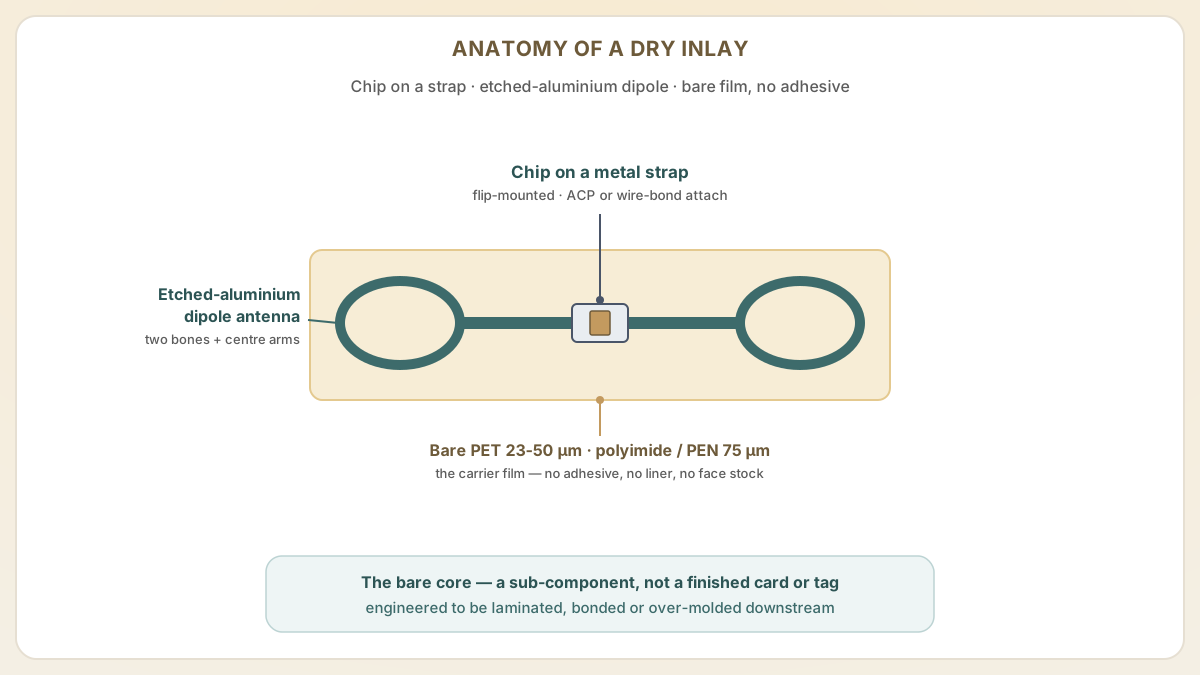
Peel back everything a finished card or tag adds — the PVC body, the print, the emboss, the housing — and the part that actually answers the reader is startlingly thin: a chip flip-mounted on a metal strap, bonded to an etched-aluminium dipole antenna, carried on a bare PET, polyimide or PEN film with no adhesive, no release liner and no face stock. That is the dry inlay. Because it carries no pressure-sensitive adhesive layer, it disappears into the ISO 7810 card thickness budget instead of eating into it — which is the whole reason card laminators and over-mold shops specify dry rather than wet.
- ISO 7810 ID-1 card body = 85.60 × 53.98 mm × 0.76 ± 0.08 mm.
- 5-layer PVC stack: 100 µm face → 100 µm overlay → 280 µm core (with inlay) → 100 µm overlay → 100 µm face = 680 µm + tolerances.
- Inlay budget — 23-50 µm substrate + ≤25 µm chip bump area + ≤10 µm antenna copper = ≤85 µm total.
- Embossed-text card requires deeper recess in core layer; antenna placement must avoid emboss zone.
Dry, wet, converted: one component, three finish states
The same chip and antenna leave the line in one of three finish states, and which one you order is set entirely by the process waiting downstream. This SKU is the dry inlay — the bare core. Add a pressure-sensitive adhesive and a release liner and it becomes a wet inlay for label converters; laminate that core into a printed card body or housing and it becomes a converted, finished card or tag. Order dry when the next step is heat, pressure, ultrasonic bonding or over-mold — not peel-and-stick.
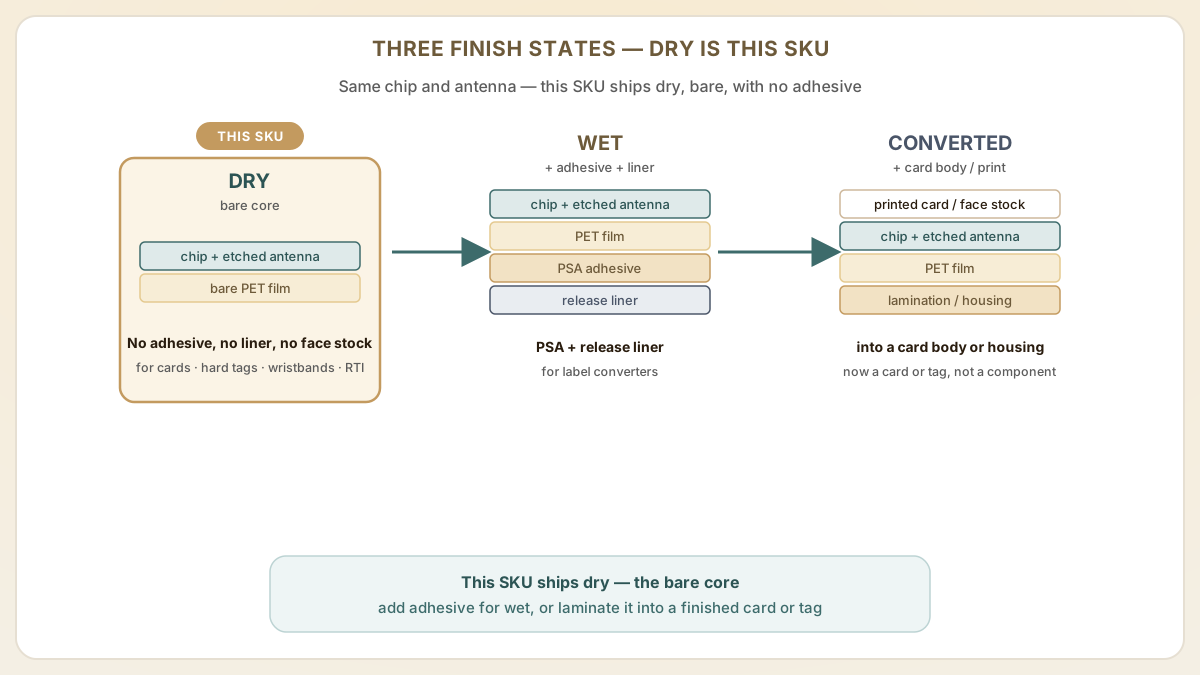
- Dry inlay — this SKU: bare chip + antenna on PET / polyimide / PEN, with no adhesive, no release liner and no face stock, built to be sandwiched between card or housing layers and bonded under heat and pressure, ultrasonic or over-mold.
- Wet inlay — the sister rfid-wet-inlay: the same chip + antenna plus a pressure-sensitive adhesive and a silicone-coated PET release liner, for label converters laminating into label stock.
- Converted — the dry inlay laminated into an ID-1 / CR-80 card body, a hard-tag housing or an over-molded silicone wristband: at that point it has stopped being a component and become a finished card or tag.
Why dry inlay (no adhesive) — the format converters and card laminators standardise on
- Wet inlay PSA layer adds 25-50 µm thickness, melts unpredictably at PVC press temperatures and produces air-bubble + delamination defects between PVC layers.
- Card thickness budget already constrained by ISO 7810 0.76 ± 0.08 mm — adhesive eats the budget.
- Injection over-mold + ultrasonic bond + ICAO 9303 PC press all reject adhesive-backed inlays for char + outgas reasons.
Wet inlay vs dry inlay — when to use which
Wet inlay (rfid-wet-inlay)
- Pressure-sensitive adhesive + silicone-coated PET release liner.
- For label converter laminating into thermal-transfer / direct-thermal / synthetic label stock.
- Peel-and-stick application for finished pressure-sensitive labels.
- PVC / polycarbonate card press will char the PSA + cause air-bubble + delamination defects.
- Web converter formats — Mark Andy P5/P7, Nilpeter FA-17, MPS EF-Symjet.
Dry inlay (this SKU)
- Bare PET / polyimide / PEN substrate — no adhesive, no liner.
- For ID-1 / CR-80 PVC + PC card lamination, hard-tag housing assembly, RTI over-mold.
- Heat-press, ultrasonic bond, injection over-mold, ICAO 9303 PC press.
- PET 23-50 µm for PVC card press; polyimide 75 µm for PC + ICAO 9303; epoxy-encap for over-mold.
- Card press equipment — Mühlbauer CL, Melzer CLX, HID FARGO HDP, Matica MX, Atlantic Zeiser DigiLine.
- Same chip + antenna available in either format — choice is downstream-process driven.
- Polyimide-grade dry inlay costs 30-60% more per unit than PVC-grade PET; specify by press temperature target.
- Dual-interface card production requires polyimide + wire-bond + coupling-frame antenna — strictly polyimide-grade dry inlay.
ID-1 (CR-80) PVC card lamination — the temperature + pressure + time matrix
- Chip-attach: ACP (anisotropic conductive paste) for PET-substrate PVC inlays; thermocompression / wire-bond for polyimide PC inlays.
- Antenna: aluminium-etched on PET (PVC press); copper-etched + protective overcoat on polyimide (PC press).
- Inlay registration: pitch ±0.5 mm + chip position ±0.3 mm — same converter spec across PVC + PC.
- Press equipment: sheet-fed (Mühlbauer CL, Melzer CLX, Matica MX) vs roll-fed inline (Mark Andy P5/P7, Atlantic Zeiser DigiLine).
Where dry inlay-stage sourcing earns its margin — the application inventory
- ISO 7810 ID-1 PVC card — hotel key, transit ticket, retail loyalty, gift card, employee badge, university ID, library card, membership card.
- Polycarbonate ICAO 9303 passport + national eID — dual-interface contact + contactless module on polyimide substrate.
- UHF-enabled card — IATA Resolution 753 baggage tag, hardhat tag, warehouse / yard credential.
- Hard ABS / polycarbonate tag — reusable security tag, RTI tag, anti-metal tag, tool tag.
- Over-molded silicone wristband — hospital patient ID, water-park cashless, fitness / health-tech.
- Injection over-mold polypropylene RTI / pallet tag — reusable returnable transit item.
- On-metal label conversion — dry inlay + ferrite spacer + anti-metal face film for IT-asset / equipment.
- Dual-frequency LF + HF / UHF migration — co-laminated 125 kHz HID Prox + 13.56 MHz DESFire on same PET sheet.
From magnetic stripe to ICAO 9303 + UHF dual-interface — milestones that shaped dry-inlay supply
- 1980
ISO/IEC 7810 first published — defines ID-1 (CR-80) card 85.60 × 53.98 × 0.76 mm; sets the thickness budget every dry inlay must fit.
- 1996
ISO/IEC 14443 published — 13.56 MHz proximity card air-interface; the standard MIFARE Classic + DESFire + ICODE all implement.
- 2005
ICAO 9303 Doc 1-3 (sixth edition) — polycarbonate Machine Readable Travel Document (e-passport) defined; polyimide-substrate dry inlay becomes a regulated component.
- 2008
Garcia et al. publish CRYPTO-1 cryptanalysis (ESORICS 2008); MIFARE Classic deemed unsuitable for new high-security deployments — shift to MIFARE Plus + DESFire EV2.
- 2014
Apple Pay launches ISO/IEC 14443 contactless EMVCo at scale; dual-interface card production becomes mainstream.
- 2018
Impinj M700 series + NXP UCODE 9 launch; UHF card lamination viable at -23 dBm sensitivity for hardhat + IATA + warehouse credential.
- 2023
EU Digital Identity Wallet pilot (eIDAS 2.0) drives polyimide-substrate dry inlay demand for national eID at >100M / year scale.
- 2026 — Today
Operating-playbook notes for hotel-key-pvc-card, corporate-access-desfire, government-eid-icao9303, retail-loyalty-magstripe-combo, library-iso28560 and uhf-baggage-iata753 programmes.
The reference facts, at a glance
Everything a card laminator, hard-tag assembler or credential programme cross-checks against the datasheet — lamination windows, production equipment, over-mold limits, dual-interface standards, the UHF / HF / LF chip menu, supply formats and the not-this list — gathered into one scannable block.
ID-1 card lamination — temp / pressure / time
PVC card press (Mühlbauer CL-series, Melzer CLX): 140-160 °C, 15-20 kg/cm², 15-20 min total cycle. PET-G card press: 130-150 °C, 12-18 kg/cm², 12-18 min total cycle. Composite (PVC + PET-G) press: 145-155 °C, 15-20 kg/cm², 15-20 min total cycle. Polycarbonate (PC) ICAO 9303 press: 180-200 °C, 25-40 kg/cm², 20-30 min total cycle. Yield <0.3% loss when registration accuracy held to ±0.3 mm; ACP/wire-bond chip-attach must be qualified at the press temperature.
Card production equipment
Mühlbauer CL-series + KP-series — sheet-fed PVC + PC card press; standard for high-volume bank + government cards. Melzer CLX-series — sheet-fed PVC + PC press; mid-volume access + ID card. HID FARGO HDP / DTC — desktop PVC card press for low-volume / on-demand. Matica MX series — mid-volume PVC + PET card press. Atlantic Zeiser DigiLine — inline digital print + lamination for mid-volume. Bührmann Bobst Visión — sheet-fed PVC + composite for retail loyalty + gift card.
Hard-tag and over-mold manufacturing
ABS / polycarbonate hard-tag — heat-press or ultrasonic bond at 80-120 °C; PET 23-50 µm inlay survives. Silicone over-molded wristband — 150-180 °C compression mold, 5-15 min cycle; polyimide / PEN inlay required. Polypropylene injection over-mold tag — 200-260 °C melt + 500-1,000 bar pressure + <10 s residence; epoxy-encapsulated chip on polyimide. Polyamide / nylon injection over-mold — 230-280 °C; same epoxy-encapsulated polyimide spec. Reusable RTI tag — over-molded polypropylene or polyethylene housing; UHF inlay + chemical-resistant antenna spec.
ICAO 9303 + dual-interface cards
ICAO 9303 — Machine Readable Travel Documents; polycarbonate card body lamination at 180-200 °C. ISO/IEC 7816 — contact-interface IC card spec; dual-interface module wire-bonded to ISO/IEC 14443 antenna. Antenna coil winds connect to contact module via wire-bond pads or coupling frame. Typical chip — NXP JCOP, Infineon SLE78 — supplied as bare die or contact-module package. Inlay must be polyimide-substrate to survive PC press; PVC-grade PET delaminates.
UHF chip + antenna
Impinj M730 — read sensitivity -22.7 dBm; default for ID-1 UHF card + hardhat tag. Impinj M770 — Autopilot tuning; environment-shift compensation for cold-DC + warehouse mezzanine. NXP UCODE 9 — best-in-class -23.5 dBm; dense-reader portal + 18 m range. Monza R6-P — proven 5+ year hard-tag installed base. Antenna: web 44 mm for ID-1 card; square 50 mm for on-metal hard-tag with spacer; near-field 27 mm for jewelry / vial.
HF / NFC chip options
NTAG213 / 215 / 216 — basic NDEF tap-to-page; access card simple use. NTAG 424 DNA — AES-128 SUN; access card + brand-protection + IP-defended. MIFARE Classic 1K / 4K — legacy access; CRYPTO-1 broken since 2008 — not for new security deployments. MIFARE Plus SE — drop-in Classic replacement with AES-128. MIFARE DESFire EV2 / EV3 — AES-128 + 3DES + DES; default for corporate access + closed-loop payment. ICODE SLIX2 — ISO 15693 vicinity card for library / asset / DESCO.
LF chip options
EM4100 — read-only 64-bit; legacy proximity card. EM4305 — rewritable 512-bit; pet ID + animal ear tag. T5577 — rewritable; HID Prox / EM4100 / Indala emulation; field programming. HID Prox-compatible — 26-bit / 35-bit / 37-bit format; hospitality + corporate legacy. Dual-frequency LF + HF / UHF — co-laminated 125 kHz + 13.56 MHz on the same PET sheet for migration deployments.
Procurement and supply formats
Trays — die-cut individual inlays for sheet-fed card presses. Carrier tape — for SMT-style automated placement; mid-volume inline lamination. Continuous roll on 3″ core — for roll-fed inline lamination + label converting (Mark Andy P5/P7, Nilpeter FA-17). Pre-positioned A4 / custom gang carrier sheets — for sheet collation systems. MOQ 5,000 (UHF) / 10,000 (HF NFC) / 1,000 (specialty); lead time 12-18 business days for stock chip + standard antenna.
What this product is NOT
Not a self-adhesive inlay — for label converter PSA + release-liner format see rfid-wet-inlay. Not a finished card or tag — has no PVC body, no print, no embossing, no contact module unless dual-interface. Not a UHF reader — pair with Impinj Speedway / Zebra FX9600 / handheld reader hardware. Not a temperature sensor — pair with Murata SL900A / Sensitech / ELPRO logger if cold-chain monitoring required.
Useful next pages
Use these linked product, guide and comparison pages to keep the next click specific and practical.
Sister inlay SKUs
Wet vs dry, generic UHF, and per-chip flagship inlays.
Card and credential applications
Finished card SKUs that consume dry inlays.
Chip-level technical reference
Deep-dive specifications and chip-family comparisons relevant to this SKU.
FAQ
What lamination temperature and pressure do dry inlays withstand?
Standard PET-substrate dry inlays (23-50 µm) are rated for ISO 7810 PVC card lamination at 140-160 °C and 15-20 kg/cm² for 15-20 minutes — the standard process parameters for Mühlbauer CL-series and Melzer CLX presses. PET-G card press runs slightly cooler at 130-150 °C / 12-18 kg/cm² / 12-18 min. Composite (PVC + PET-G) press runs 145-155 °C / 15-20 kg/cm² / 15-20 min. Polycarbonate (PC) card lamination for ICAO 9303 passport / national eID requires polyimide (Kapton) or PEN substrate (75 µm) and wire-bonded / thermocompressed chip-attach (ACP melts at PC press temperature) — rated for 180-200 °C / 25-40 kg/cm² / 20-30 min. Injection over-mold tag production at 200-280 °C / 500-1,000 bar / <10 s residence requires epoxy-encapsulated chip on polyimide substrate. Specify the press temperature target and we match the inlay grade.
How are dry inlays supplied for automated card production?
Dry inlays ship in four formats: trays, carrier tape, continuous rolls or pre-positioned gang carrier sheets. (1) Individual die-cut inlays in trays suit sheet-fed card presses (Mühlbauer CL, Melzer CLX, Matica MX). (2) Carrier tape suits SMT-style automated placement on mid-volume inline lamination lines. (3) Continuous rolls on 3″ (76.2 mm) core suit roll-fed inline lamination + label converting (Mark Andy P5/P7, Nilpeter FA-17, Atlantic Zeiser DigiLine). (4) Pre-positioned A4 or custom-gang carrier sheets match customer card collation patterns for sheet-fed press collation systems. We match the supply format to your specific card production equipment (Mühlbauer, HID FARGO, Matica MX, Atlantic Zeiser DigiLine, Bührmann Bobst Visión).
Can dry inlays be used for dual-interface (contact + contactless) smart cards?
Yes. We supply dry inlay modules with antenna coils that connect to separate contact-chip modules via wire-bonding pads or coupling-frame coupling. This enables dual-interface card production where the same card supports both ISO/IEC 7816 contact-reader and ISO/IEC 14443 contactless-reader communication — the standard architecture for EMVCo banking payment cards (Visa contactless, Mastercard PayPass), government eID, ICAO 9303 passport and corporate access cards. Dual-interface mandates polyimide substrate (PVC press or composite PVC + PET-G works), wire-bonded chip-attach and a coupling-frame antenna structure. NXP JCOP and Infineon SLE78 are the dominant chip choices for dual-interface bank + government cards.
What's the difference between a PVC card inlay and a polycarbonate card inlay?
The two differ primarily in substrate and chip-attach tolerances required to survive the lamination cycle. PVC card inlays use 23-50 µm PET substrate with ACP-attached chips and are rated for 140-160 °C PVC press cycles (suitable for hotel keys, access cards, transit cards, loyalty cards, retail gift cards). Polycarbonate card inlays use polyimide (Kapton) or PEN substrate (75 µm) with wire-bonded / thermocompressed chips and must survive 180-200 °C PC press cycles (required for ICAO 9303 passports, national eID and machine-readable travel documents under ISO/IEC 7501). Using a PVC-grade inlay in a PC press causes antenna delamination, ACP melt and chip detachment. Using a PC-grade polyimide inlay in a PVC press works but costs 30-60% more per unit than necessary. Specify the press target temperature and intended card body resin (PVC, PET-G, composite, polycarbonate) and we match the inlay grade.
Can I laminate a UHF dry inlay into an ISO 7810 card?
Yes — UHF RAIN inlays (Impinj M730 / M770 / NXP UCODE 9 / Monza R6-P) can be laminated into ISO 7810 ID-1 cards (85.60 × 53.98 mm), with three caveats. (1) UHF antennas are physically larger than HF/NFC antennas — the card body usually accommodates a slot/loop-tuned antenna rather than a rectangular loop; web 44 mm or square 50 mm is typical. (2) UHF read range on a card held in the hand is reduced by the hand's dielectric loading; expect 1-3 m in practice versus the datasheet 6-8 m for the same chip + antenna. (3) For cards intended for use inside wallets with other metal-backed cards (credit cards), specify a card-body antenna tuned for proximity to metal or accept significant range loss. Card manufacturers typically reserve UHF-inlay cards for IATA Resolution 753 baggage tags, warehouse hardhat tags, yard / depot credentials and long-range inventory rather than general access-control use — for access control HF MIFARE DESFire / NTAG 424 DNA / iCLASS Seos remain the dominant choice.
Sources & references
Primary standards, OEM datasheets and regulatory documents cited by this article. All URLs were verified on the access date shown below.
- ISO/IEC 7810:2019 — Identification cards — Physical characteristics (ID-1 card 85.60 × 53.98 × 0.76 ± 0.08 mm)
ID-1 card thickness budget that every dry inlay must fit; the substrate + chip-bump + antenna copper budget is ≤85 µm of the 280 µm core layer in a typical 5-layer PVC stack.
- ISO/IEC 14443-3:2018 — Contactless IC proximity cards — Part 3: Initialization and anticollision
13.56 MHz HF proximity-card air-interface implemented by MIFARE Classic / Plus / DESFire / NTAG21x / NTAG 424 DNA / ICODE.
- ISO/IEC 7816 — Identification cards — Integrated circuit cards (contact interface) — Part 1-15
Contact-interface IC card spec referenced by every dual-interface card module wire-bonded to ISO/IEC 14443 antenna; required for ICAO 9303 passport + national eID.
- ICAO Doc 9303 — Machine Readable Travel Documents (MRTD) Part 1-13 (eighth edition 2021)
Polycarbonate passport card lamination spec; mandates polyimide / PEN substrate dry inlay for the 180-200 °C PC press cycle.
- NXP AN12343 — DESFire EV3 features including Secure Unique NFC (SUN) messaging
Reference for DESFire EV3 corporate-access + closed-loop payment + brand-protection use; the dominant chip choice for HF dry-inlay credentials in 2024-2026.
- NXP AN10922 — Symmetric key diversifications (CMAC-AES key derivation for DESFire / NTAG 424)
Key-diversification reference for DESFire / NTAG 424 DNA card key management programmes.
Proud Tek is a Shenzhen-based RFID & NFC manufacturer supplying hotel chains, transit operators, event venues and retail brands worldwide. Every order includes free samples, RF testing and dedicated project support.
Get a Quick Quote
Tell us about your project and we'll respond within one business day. Fields marked (asterisk) are required.