
NFC Components
NFC Dry Inlays
Adhesive-Free PET for Lamination

Quick answer
NFC dry inlays are bare chip-and-antenna assemblies on 50 µm PET film with no adhesive layer and no release liner — the inlay-stage flagship product for card bureaus, key-fob manufacturers, wristband converters and injection-mould integrators. Survives standard PVC card lamination 140-150 °C / 200-300 psi / 15-25 minute dwell on Bürkle / Wickert / Agfa hydraulic platen presses. Polycarbonate-grade variant for high-security ID cards (160-180 °C). Available with the full NXP HF chip range. NTAG213/215/216, MIFARE Classic 1K/4K, MIFARE DESFire EV2/EV3, MIFARE Ultralight C/EV1, ICODE SLIX2 — plus prelam sheet service that eliminates one lamination step on high-speed lines.
- No adhesive layer — designed for heat lamination into PVC card bodies, ultrasonic welding into housings, or embedding during injection moulding.
- Ultra-thin 50 µm PET substrate (±2 µm thickness control) — survives card lamination temperatures up to 150 °C (PVC) / 180 °C (polycarbonate high-security ID).
- Available with all major NXP HF chips — NTAG213/215/216, MIFARE Classic 1K/4K, DESFire EV2/EV3, Ultralight C/EV1, ICODE SLIX2 — chip-type certificate per delivery.
Used in these industries
Deployments where this product is referenced on our industry landing pages.

At a glance
Use these short answers to decide whether this page matches the project before moving into the detail.
Construction
Aluminium or copper antenna on 50 µm PET film No adhesive, no release liner — bare inlay-stage substrate
Chip silicon options
NXP NTAG213/215/216 (NFC Forum Type 2 Tag, 144 / 504 / 888 B) NXP MIFARE Classic 1K / 4K — legacy access control
Next step
Ready to move forward? Start your inquiry to get specific answers for this project.
Request dry inlay quote- Typical pricing
-
USD 0.15–0.25 @ 1k · 0.05–0.10 @ 100k+ (typical FOB Shenzhen range) — firm quote in one business day.
Commercial terms
- MOQ
- Varies by SKU — stock items from 100 pcs; custom production typically 200-1,000 pcs
- Lead time
- Production 2-3 weeks after artwork and encoding sign-off; reorders on a 3-4 week cycle
- Samples
- Free samples and RF test report with every order; courier at customer cost
- Payment
- 50% T/T deposit, 50% before shipment; Net 30/60 for established accounts; LC for large orders
- Shipping
- FOB Shenzhen / Yantian; DHL, FedEx or EMS air freight; sea LCL / FCL for volume
- Response
- Itemized quote within one business day, Mon-Fri (UTC+8)
What an NFC dry inlay actually is
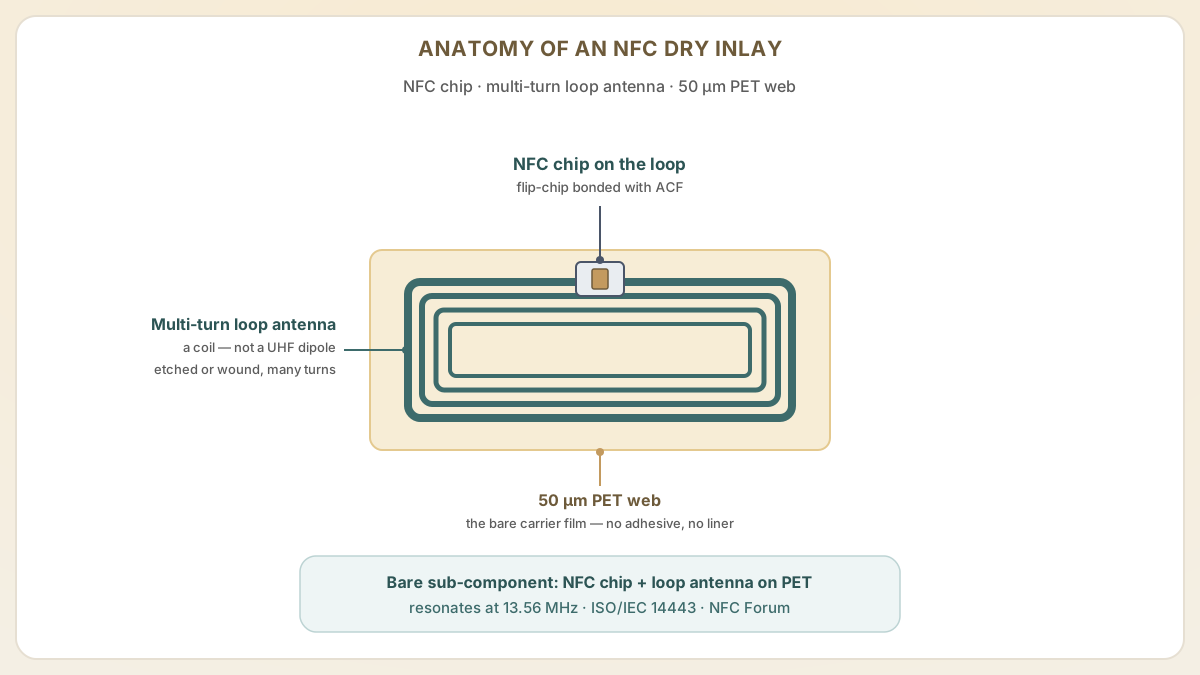
Peel back the printed card, the overlay and the lamination and what actually answers the phone is deceptively small: an NFC chip flip-chip bonded onto a fine multi-turn loop antenna, etched or wound onto a 50 µm PET web. That is the inlay — a bare sub-component, not a finished card — resonating at 13.56 MHz across the ISO/IEC 14443 and NFC Forum HF band. The loop is a coil, not a UHF dipole; the silicon barely changes between programmes, and the antenna geometry is the part you actually specify for the CR-80 card body.
- ISO CR-80 card-size: 86 × 54 mm (±0.5 mm)
- Custom antenna patterns — circular / rectangular / wing / mode-tuned
- Antenna optimised for CR-80 card geometry + ISO 14443 Type A or B
- Custom dimensions from MOQ 10,000 with antenna design service
Dry, wet, converted: one inlay, three finish states
The same NFC chip and loop antenna leave the line in one of three finish states, and which one you order is dictated entirely by the process waiting downstream. A dry inlay is the bare feedstock; a wet inlay adds the pressure-sensitive adhesive and release liner a label converter laminates from; a converted inlay is that inlay already built into a finished card, tag or label — at which point it has stopped being a component. This page is the dry state: adhesive-free PET, ready for the lamination press.
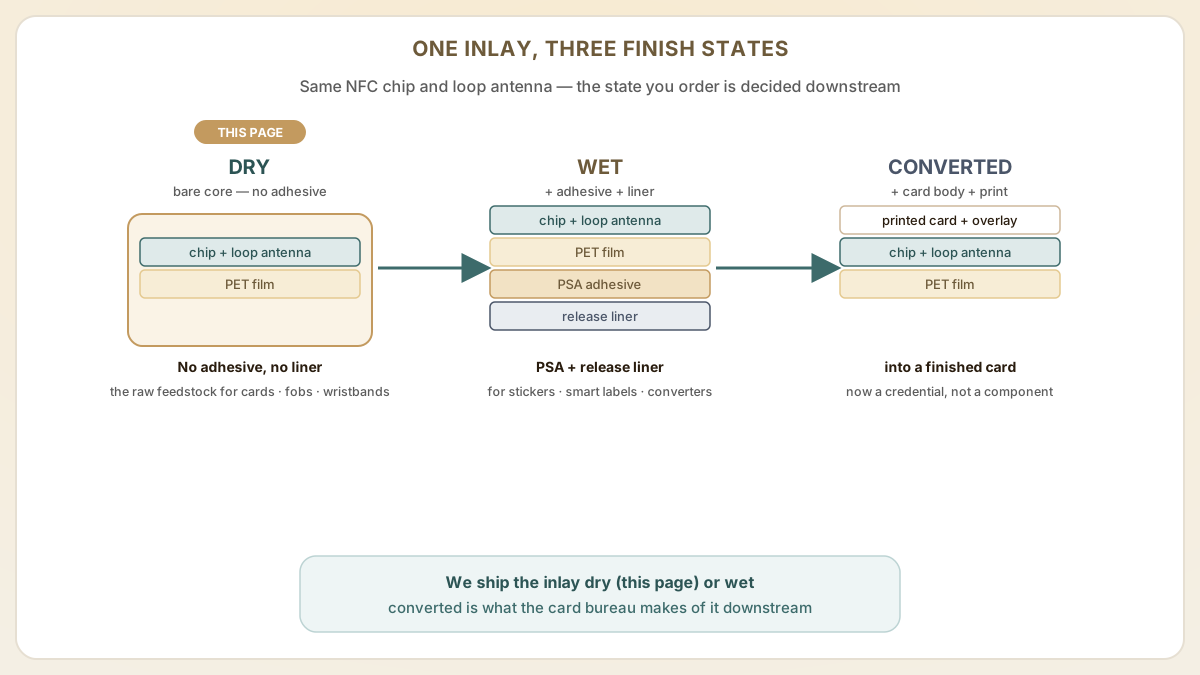
- Dry inlay — this page: bare PET film, no adhesive and no release liner; the adhesive-free feedstock a card bureau or moulder builds a finished credential from.
- Wet inlay — the same chip and antenna plus a pressure-sensitive adhesive layer and a release liner; a converter peels or laminates it into label stock.
- Converted — the inlay already embedded in a finished PVC card, key fob or wristband; at that point it is a credential, not a component.
- Same NFC chip and loop antenna in every state — the downstream process, not the silicon, decides which you order.
Challenges card manufacturers face when sourcing NFC dry inlays
- Lamination delamination at temperature. A card bureau laminating at 140 °C and 200 psi discovers that competitor dry inlays use an adhesive tie layer that softens and shifts at this temperature, causing chip misalignment in 3-5% of cards and a wave defect in the card surface.
- Inlay thickness variation causing uneven card surface. A ±5 µm thickness variation in the PET substrate creates a visible 'bump' over the chip area in the finished card, failing the ISO 7810 surface planarity requirement for bank card production.
- Pre-encoding incompatibility with card lamination. Buyers who want pre-encoded inlays discover that some chips require an elevated write voltage that exceeds what the encoding station can supply on a thin dry inlay substrate before lamination.
- No prelam sheet option for high-speed lines. A card manufacturer running a high-speed lamination line needs prelam sheets (inlay already sandwiched between two PVC overlays) to reduce handling steps; most dry inlay suppliers only supply bare inlays.
- Chip type not confirmed at delivery. A buyer ordering MIFARE DESFire EV3 dry inlays receives a batch where 8% of inlays are EV2 chips substituted by the supplier without notice; the firmware difference causes authentication failures during card personalisation.
How Proud Tek solves NFC dry inlay sourcing problems
Generic dry-inlay supplier — no lamination QA / no chip cert / no prelam
- Adhesive tie layer softens at 140 °C — chip misalign in 3-5% of cards + wave defect
- ±5 µm substrate variation — visible 'bump' over chip area, fails ISO 7810 planarity
- Pre-encoded inlays fail elevated write voltage on thin substrate before lamination
- No prelam option — extra lamination step on high-speed line, manual handling
- 8% EV3-for-EV2 chip substitution — firmware authentication fail at personalisation
Proud Tek dry inlay with lamination report + chip-cert + prelam (this page)
- No adhesive tie layer — bare PET substrate stable at 140-150 °C lamination
- ±2 µm substrate thickness control — ISO 7810 planarity compatible
- Pre-encoding via benchtop encoders calibrated for thin-substrate inlays
- Prelam sheet service — inlay between two 100 µm PVC overlays, one step eliminated
- Chip-type certificate per delivery — manufacturer cert + IC read log
- Lamination qualification testing: all dry inlays are tested at 130-150 °C and 150-300 psi before release; buyers receive a lamination test report showing chip read success, surface planarity, and delamination resistance before production begins.
- Substrate thickness controlled to ±2 µm: our 50 µm PET inlay substrate is within ISO 7810 planarity tolerance for standard PVC card lamination; we provide substrate thickness measurement data in the shipment documentation.
- Pre-encoding available on dry inlays: UID inventory, NDEF data, or DESFire application keys are written before shipment using benchtop encoders calibrated for thin-substrate inlays; 100% read-back verification included.
- Prelam sheet service: Proud Tek laminates the dry inlay between two 100 µm PVC overlay sheets to produce a prelam ready for your final lamination press. One step eliminated, yield improved.
- Chip type certification: every delivery includes the chip manufacturer's certificate of conformance and a chip identifier read log confirming the exact chip type on every inlay in the batch.
Per-tap data published from a Proud Tek NFC dry inlay (post-lamination)
- Bare-inlay read distance: ~5-7 cm at consumer phone (no card body loading)
- Post-lamination read distance: 3-5 cm consumer phone / 5-8 cm dedicated reader
- Antenna detune ≤±5% from PVC dielectric — design tuned for finished card body
- ISO 14443 Type A / Type B per chip family — DESFire EV3 / NTAG21x / Ultralight C
- Per-buyer lamination qualification report — exact press parameters validated
Wet inlay vs dry inlay
| Feature | Wet inlay | Dry inlay (this page) |
|---|---|---|
| Adhesive | Yes — pressure-sensitive PSA + release liner | No — bare PET substrate |
| Use case | Stick onto surfaces, laminate into labels | Embed into cards, housings, products |
| Typical application | NFC stickers, smart labels, packaging | PVC cards, key fobs, wristbands |
| Temperature resistance | Limited by adhesive (~80 °C) | Up to 150 °C (PVC) / 180 °C (polycarbonate) |
| Thickness | 75-100 µm (with adhesive) | 50 µm (bare PET) ±2 µm |
Applications
- PVC card manufacturing — laminate between PVC sheets to produce RFID cards, hotel key cards, access badges.
- Key fob production — embed into ABS or silicone key fob housings during assembly or injection moulding.
- Wristband integration — insert into silicone, PVC or fabric wristband structures.
- Smart product embedding — integrate into consumer electronics, toys, packaging inserts or promotional items.
- Credential production — card bureaus and personalisation centres use dry inlays as the starting substrate for finished cards.
Card-size inlay specifications
Our most popular dry inlay format is the ISO card-size (86 × 54 mm) for direct lamination into CR-80 card bodies.
| Parameter | Specification |
|---|---|
| Inlay dimensions | 86 × 54 mm (±0.5 mm) |
| Antenna dimensions | Optimised for CR-80 card geometry |
| Chip placement | Centre or offset per card design |
| Substrate | 50 µm white PET (±2 µm) |
| Read range (in card body) | 3-5 cm (phone), 5-8 cm (dedicated reader) |
| Lamination compatibility | PVC, PET-G, polycarbonate |
Ordering
- Sheet format — individual inlays for manual card production or low-volume assembly.
- Roll format — continuous web for high-speed card lamination lines.
- Tray format — stacked inlays in anti-static trays for automated pick-and-place.
- Pre-encoding available — UID inventory list, NDEF data or custom binary.
- 100% HF testing with UID logging — every inlay verified before shipment.
NFC dry inlay timeline — from PVC card factory to programmable credential
- 1985 — ISO 7810 first edition
ISO 7810:1985 establishes the CR-80 card dimensions (85.60 × 53.98 × 0.76 mm) and surface planarity baseline that has governed payment + ID + access cards for 40+ years.
- 1996 — MIFARE Classic + ISO/IEC 14443
Philips (now NXP) launches MIFARE Classic 1K — first widely deployed 13.56 MHz HF contactless smartcard chip; ISO/IEC 14443 Type A air interface ratified internationally.
- 2001 — NFC Forum founded
NXP, Sony and Nokia found the NFC Forum to standardise short-range tag-based interaction on the same 13.56 MHz frequency family — bridging contactless smartcards and consumer NFC tags.
- 2008-2013 — NTAG family + DESFire EV1/EV2 launch
NXP introduces NTAG203 → NTAG213/215/216 (NFC Forum Type 2 Tag) and DESFire EV1 → EV2 (AES-128 cryptographic) — full HF chip range that drives demand for adhesive-free dry inlays in card manufacturing.
- 2014 — Apple Pay + global contactless payment
Apple ships iPhone 6 with NFC for Apple Pay; EMVCo Book D contactless specification matures + contactless-payment-card (DESFire / EMV) volume scales globally.
- 2017 — NFC Forum Type 4 Tag + Apple Core NFC
Apple iOS 11 introduces Core NFC framework — NFC Forum Type 4 Tag reading on iPhone 7+ becomes consumer-grade. NTAG21x dry inlays in printed-NFC-card form factor see explosive growth.
- 2020-2024 — NFC business cards + healthcare credentials
NTAG216 dry inlays become default for NFC business cards (Linq / Popl / Mobilo / dot.) — full vCard 4.0 fits without truncation. Healthcare patient-info cards + smart packaging adopt dry inlays at scale.
- 2026 — Today: NFC dry inlay chip-family-anchor for card lamination
Operating notes from bank-card-bureau, hotel-key-card-manufacturer, corporate-access-badge, key-fob-injection-mould and silicone-wristband-converter programmes converge on NTAG21x / DESFire EV3 / Ultralight C dry inlays + prelam sheet service + chip-type certificate as the default card-lamination architecture.
The reference facts, at a glance
Everything a card bureau or credential reviewer cross-checks against the datasheet — substrate control, lamination window, read distance, pre-encoding, prelam sheets, application verticals, chip-type QA, standards and procurement — gathered into one scannable block.
Substrate + thickness control
50 µm PET film — standard card-lamination grade. Thickness tolerance ±2 µm — ISO/IEC 7810 surface planarity compatible. 75 µm PET — extended-thickness for embedding without lamination. PEN substrate option — high-temperature variant. Anti-static tray packaging for automated pick-and-place.
Lamination compatibility
Standard PVC: 140-150 °C / 200-300 psi / 15-25 min dwell. Polycarbonate high-security ID: 160-180 °C / longer dwell. PET-G card body: 130-145 °C. Hydraulic platen presses: Bürkle, Wickert, Agfa. Per-buyer lamination qualification testing report included.
Read distance + RF tuning
In CR-80 PVC card body: 3-5 cm (consumer phone), 5-8 cm (dedicated reader). Antenna detune ≤±5% from PVC dielectric. ISO 14443 Type A / Type B per chip family. Q-factor optimised for finished card body, not bare inlay.
Pre-encoding services
UID inventory list with every inlay delivery. NDEF data write — URL / vCard / Wi-Fi / custom binary. MIFARE DESFire application creation + AES key provisioning. MIFARE Classic sector key + access-condition write. 100% read-back verification before shipment.
Prelam sheet service
Inlay laminated between two 100 µm PVC overlay sheets. Ready for buyer's final lamination press. Eliminates one lamination step on high-speed card lines. Yield improvement + reduced operator handling. MOQ 10,000 sheets.
Application verticals
PVC card manufacturing — bank cards / hotel keys / access badges. Key-fob production — ABS / silicone injection moulded housings. Wristband integration — silicone / PVC / fabric structures. Smart-product embedding — consumer electronics + toys + packaging. Credential personalisation — card bureaus / government ID issuers.
Chip-type certification + QC
Chip manufacturer's certificate of conformance per delivery. Chip identifier (manufacturer code) read-log per inlay batch. Capability container byte verification per chip type. Anti-substitution: zero EV2-for-EV3 / NTAG215-for-NTAG216 incidents. 100% HF read-test before release.
Standards + compliance
ISO/IEC 7810:2019 — CR-80 card dimensions + surface planarity. ISO/IEC 7816 — contact interface compatibility. ISO/IEC 14443 Type A / B — 13.56 MHz HF proximity air interface. ISO/IEC 15693 — vicinity HF (ICODE SLIX2). EMVCo Contactless Book D — payment-card contactless certification. ICAO Doc 9303 — machine-readable travel document (high-security ID). GlobalPlatform Card Specification — DESFire application management.
Procurement
MOQ 5,000 inlays (standard CR-80, common chip types). Custom antenna / non-standard chip MOQ 10,000+. Lead time 10-15 business days standard, 20-25 for custom antenna. Sheet / roll / tray format — per buyer's lamination line. RoHS / REACH compliant materials.
Useful next pages
Use these linked product, guide and comparison pages to keep the next click specific and practical.
Related products
Finished card and tag products using these inlays.
FAQ
Can dry inlays survive PVC card lamination?
Yes. Our dry inlays are designed for standard PVC lamination at 130-150 °C and 150-300 psi. The PET substrate and chip bonding are rated for these conditions. We recommend testing with your specific lamination press and cycle parameters before production runs — we provide pre-qualification testing reports at the buyer's exact press parameters.
What is the minimum order for card-size inlays?
Minimum order is 5,000 inlays. For custom antenna designs or non-standard chip types, minimum may be higher (10,000+). Contact us with your specifications for an exact quote.
Do you supply prelam sheets (inlay already laminated between PVC layers)?
Yes. We can supply prelam sheets — the dry inlay already laminated between two thin PVC overlay sheets, ready for your final lamination with printed PVC panels. This reduces your production steps and improves yield. MOQ 10,000 sheets.
Which standards govern PVC card construction and NFC / HF chip selection for payment, ID and access credentials?
ISO/IEC 7810:2019 defines the CR-80 card dimensions (85.60 × 53.98 × 0.76 mm) and surface planarity; ISO/IEC 7816 covers contact interface; ISO/IEC 14443 Type A / B defines the 13.56 MHz HF proximity air interface used by MIFARE Classic / DESFire and NTAG families; ISO/IEC 15693 defines vicinity (ICODE SLIX2). For payment cards, EMVCo Contactless Book D adds additional test and certification requirements. Our dry inlays are supplied in CR-80 geometry with antenna designs tuned for ISO 14443 Type A or Type B as specified, and we can provide inlays qualified for EMVCo Book D contactless payment card builds on request.
How do card bureau lamination cycles (temperature, pressure, dwell) affect chip survival and NDEF retention?
Standard PVC lamination runs 140-150 °C at 200-300 psi for 15-25 minutes dwell on hydraulic platen presses (Bürkle, Wickert, Agfa); polycarbonate lamination for high-security IDs runs hotter (160-180 °C) with longer dwell. NXP NTAG and MIFARE chips are rated for these cycles per the datasheets, but pre-encoded NDEF or DESFire application keys must be written after lamination curing if the cycle exceeds the chip's data-retention reflow spec. We pre-qualify our dry inlays at the buyer's exact press parameters and supply a lamination compatibility report; for pre-encoded programmes we recommend post-lamination encoding via the card personalisation line.
Sources & references
Primary standards, OEM datasheets and regulatory documents cited by this article. All URLs were verified on the access date shown below.
- ISO/IEC 7810:2019 — Identification cards, physical characteristics
CR-80 card dimensions (85.60 × 53.98 × 0.76 mm) + surface planarity tolerance — baseline for dry-inlay substrate ±2 µm thickness control.
- ISO/IEC 14443 — proximity cards 13.56 MHz HF air interface
Type A / Type B air interface — used by MIFARE Classic / DESFire / NTAG21x / NTAG 424 DNA chip families on dry inlays.
- NXP MIFARE DESFire EV3 product datasheet
AES-128 + DES + 3DES cryptographic credential chip — typical option for high-security ID / access control / contactless payment dry inlay builds.
- NXP NTAG213/215/216 NFC Forum Type 2 datasheet
NTAG21x family datasheet — 144 / 504 / 888 byte tier for NFC business card / smart packaging dry-inlay applications.
- NFC Forum Type 2 Tag Technical Specification
T2T command set + memory model — basis for NTAG21x dry-inlay NDEF mapping.
- EMVCo Contactless Specifications Book D — communication protocol
Contactless payment card certification framework — additional test + certification requirements for payment-card dry inlay builds.
- ICAO Doc 9303 — machine-readable travel documents (PC/PET card construction)
Machine-readable travel document spec — high-security ID polycarbonate card construction (160-180 °C lamination) used for ePassport / national-ID dry inlay builds.
- GlobalPlatform Card Specification — DESFire application management
Card application management framework — DESFire application creation + AES key provisioning workflow at dry-inlay encoding stage.
- ISO/IEC 15693 — vicinity HF (ICODE SLIX2)
Vicinity HF air interface — ICODE SLIX2 chip family for library / inventory / asset-tracking dry inlay applications.
- Bürkle hydraulic platen press technical reference
Industrial hydraulic platen press reference — typical card-bureau lamination cycle 140-150 °C / 200-300 psi / 15-25 min dwell. Lamination qualification testing at buyer's exact press parameters.
Proud Tek is a Shenzhen-based RFID & NFC manufacturer supplying hotel chains, transit operators, event venues and retail brands worldwide. Every order includes free samples, RF testing and dedicated project support.
Get a Quick Quote
Tell us about your project and we'll respond within one business day. Fields marked (asterisk) are required.