
M730 Retail Source-Tag Inlay
Impinj M730 UHF Inlay
Retail Source Tagging

Quick answer
This Impinj UHF inlay family (Monza R6 silicon class) is the volume retail workhorse of the M700 family — 96-bit EPC, ISO/IEC 18000-63 / EPC Gen2v2, factory-serialised TID, no user memory, no AUTHENTICATE. Engineered for the lowest practical silicon ASP at billion-tag scale. Proud Tek supplies M730 inlays in dry / wet / converted-label form for global retail apparel source tagging, footwear, accessories, and high-volume FMCG serialisation programmes that need SGTIN-96 EPC encoding without paying for user memory or chip-level cryptographic features. Retail loss-prevention, source-tagging, and apparel item-level deployments use this as the chip / sensitivity / SGTIN-encoding / Walmart-mandate / converter-ecosystem reference.
- Cost-optimised for billion-tag scale — sub-cent silicon ASP at multi-million-piece annual volumes makes M730 the standard chip for global retail source-tagging programmes encoding 10-50 billion items per year (Walmart, Target, Macy's, Inditex, Nike, Lululemon mandates).
- 96-bit EPC + 96-bit serialised TID (E280-1160 prefix) — sufficient for full SGTIN-96 / SSCC-96 / GRAI-96 / GIAI-96 encoding per GS1 TDS 2.0; factory-serialised TID provides inventory deduplication and anti-cloning audit trail. 0 bits user memory keeps silicon cost minimal.
- Universal reader compatibility — fully ISO/IEC 18000-63 + EPC Gen2v2 compliant; every fixed reader (Impinj R700, Zebra FX9600), handheld (Zebra MC3300xR, Impinj IPJ-R0510), and printer-encoder (Printronix T8000, Zebra ZT411, SATO CL4NX) reads and writes M730 with no firmware change. Standard antenna designs from Avery Dennison / Smartrac / Arizon / HID / Beontag / SML in 2-4 week ex-stock turnaround.
Used in these industries
Deployments where this product is referenced on our industry landing pages.

At a glance
Use these short answers to decide whether this page matches the project before moving into the detail.
Chip silicon and lineage
Impinj M730 = rebranded Monza R6 silicon under the M700-family naming refresh; datasheets, EPC behaviour, and TID prefix (E280-1160) unchanged. Existing readers, encoder...
Memory architecture
96-bit EPC — sufficient for full SGTIN-96, SSCC-96, GRAI-96, GIAI-96 encoding per GS1 Tag Data Standard 2.0. 96-bit serialised factory-programmed TID (E280-1160 prefix)...
Next step
Ready to move forward? Start your inquiry to get specific answers for this project.
Request M730 inlay quote and samples- Sensitivity and read range
-
- Read sensitivity: −22.6 dBm typical (datasheet); 0.9 dB below M770 / on par with M750 in retail-floor environments.
- Write sensitivity: −16.7 dBm typical — sufficient for printer-encoder throughput at 1,000+ tags / minute.
- Free-air bench: 8-10 m on paper hangtag with Impinj R700 at +30 dBm EIRP. Real-world: 6-8 m apparel hangtag, 1.5-2.5 m on-metal with foam spacer, 1.0-2.0 m on-liquid with foam-isolated label.
- Air interface and standards
-
- ISO/IEC 18000-63:2015 + EPC Gen2v2 air interface (basic inventory and read/write commands).
- GS1 EPC Tag Data Standard (TDS) 2.0 SGTIN-96 / SSCC-96 / GRAI-96 / GIAI-96 encoding.
- Frequency: 860-960 MHz across FCC + ETSI + Japan ARIB + China sub-bands.
- RAIN RFID Alliance certified; ARC Master List spec category compliant.
- Why M730 dominates retail source-tagging
-
- Silicon ASP — Impinj sells M730 wafer at the most competitive UHF chip pricing globally because the feature set is intentionally minimal: 96-bit EPC, factory TID, no user memory, no AUTHENTICATE.
- Encoder throughput — supports standard EPC Gen2v2 BlockWrite; tolerates high-temperature, high-RF-density retail printer-applicator (Printronix T8000, Zebra ZT411) running at 1,000+ tags / minute.
- Inlay ecosystem — every major converter (Avery Dennison / Smartrac, Arizon, HID, Beontag, SML, Trace ID) maintains M730 reference inlays in catalogue antenna designs (AD-227, AD-237, AD-661 and equivalents). New SKU rollouts typically 2-4 weeks ex-stock.
- Reader compatibility — fully ISO/IEC 18000-63 + EPC Gen2v2 compliant; every fixed reader (Impinj R700, Zebra FX9600), handheld (Zebra MC3300xR, Impinj IPJ-R0510), and printer-encoder reads/writes M730 with no firmware change.
- Walmart RFID mandate alignment
-
- Walmart RFID source-tag mandate requires SGTIN-96 EPC encoding per GS1 TDS 2.0 — M730 is the volume chip for source-tag compliance across apparel, home, electronics, beauty, hardline.
- Adjacent retail mandates: Target, Macy's, Inditex, Nike, Lululemon, Kohl's all run on the same SGTIN encoding stack and accept M730-class chips.
- Walmart accepts ARC Master List spec category certification — Auburn University RFID Lab benchmarks at the procurement reference.
- Where M730 is NOT the right fit
-
- Brand-protection / anti-counterfeiting: M730 doesn't implement on-chip crypto. For cryptographic chip-authenticity programmes, mainstream UHF Gen2v2 silicon does NOT implement on-chip AES — specify Impinj M775 (PRESENT-80 on-chip crypto per ISO/IEC 29167-11) or pair the UHF tag with an HF NTAG 424 DNA / UCODE DNA companion tag. M750 / M770 do not have on-chip crypto either.
- Pharmaceutical serialisation with on-tag user data: M730 has 0 bits user memory. DSCSA / EU FMD encoded data must live in backend database keyed by EPC; for on-tag data choose M750 (32-bit user), Higgs-9 (688-bit user), or UCODE 9 (32-224 bit configurable).
- EU Digital Product Passport (DPP): typically requires user memory + chip-level authentication — M730 is insufficient on memory. For URL pointer + user memory, specify UCODE 9 or M750. For per-tap cryptographic authentication, specify M775 or pair with HF NTAG 424 DNA.
- Sensor / specialty applications: no sensor variant in M730 line; cold-chain moisture sensing requires UCODE 9xe; tamper detection at UHF requires different specialty silicon.
- Standard antenna configurations
-
- Far-field general-purpose (~70 × 14 mm): retail and supply-chain reference inlay for hangtags, pallet labels, carton labels.
- Compact retail (~44 × 14 mm): jewellery, eyewear, accessories, small-item apparel — fits inside 50 × 25 mm hangtag.
- On-metal (with foam spacer or specialty antenna): 1.5-2.5 m read on metal; M750 specified instead when on-metal margin is critical.
- On-liquid (foam-isolated label, optimised for cosmetics and beverage): 1.0-2.0 m; cost-optimised choice for high-volume FMCG.
- Custom antenna designs: 6-10 weeks from spec to first samples; production tooling adds 2-4 weeks.
- Form factors — dry, wet, converted-label
-
- Dry inlay: bare antenna + chip on carrier substrate, no adhesive — for label converters laminating into their own construction.
- Wet inlay: pressure-sensitive adhesive on release liner, ready to apply directly.
- Converted label: printed face stock + adhesive + inlay = finished branded label ready for end-use application.
- Encoding and printer-applicator compatibility
-
- Printronix T8000-class, Zebra ZT411 / ZE521-class, SATO CL4NX-class printer-encoders write M730 inlays at 1,000+ tags / minute.
- BlockWrite + Reserved-area programming for SGTIN-96 + access password + kill password in single pass.
- Compatible with retail-grade encoder workflows from FineLine Technologies, Avery Dennison Janela, SML EcoTech, ChainPoint.
- Procurement and lead times
-
- MOQ 10,000 pieces for stock antenna designs (general-purpose far-field, compact retail, on-metal, on-liquid, windshield).
- Custom antenna designs: MOQ 50,000-100,000 pieces depending on tooling depth.
- Sample sets of 100-500 pieces available for evaluation; lead time 3-4 weeks for stock antenna, 6-10 weeks for new antenna tooling.
- Compliance posture
-
- EPC Gen2v2 (ISO/IEC 18000-63:2015) air-interface compliance.
- GS1 TDS 2.0 SGTIN encoding — Walmart RFID mandate compatible.
- ARC Master List spec category compliant when paired with certified antenna designs.
- Reader-side regulatory compliance: FCC 47 CFR Part 15.247 (US 902-928 MHz), ETSI EN 302 208 (EU 865-868 MHz), ARIB STD-T106 (Japan).
- Typical pricing
-
USD 0.15–0.25 @ 1k · 0.05–0.10 @ 100k+ (typical FOB Shenzhen range) — firm quote in one business day.
Commercial terms
- MOQ
- Varies by SKU — stock items from 100 pcs; custom production typically 200-1,000 pcs
- Lead time
- Production 2-3 weeks after artwork and encoding sign-off; reorders on a 3-4 week cycle
- Samples
- Free samples and RF test report with every order; courier at customer cost
- Payment
- 50% T/T deposit, 50% before shipment; Net 30/60 for established accounts; LC for large orders
- Shipping
- FOB Shenzhen / Yantian; DHL, FedEx or EMS air freight; sea LCL / FCL for volume
- Response
- Itemized quote within one business day, Mon-Fri (UTC+8)
Why M730 dominates retail source-tagging
- Lowest practical silicon ASP in the M700 family — feature set intentionally minimal (96-bit EPC, factory TID, no user memory, no AUTHENTICATE) so nothing on the silicon doesn't directly serve high-volume SGTIN-96 retail encoding.
- Walmart RFID mandate volume tier — apparel since 2020, expanded home / electronics / beauty / hardline 2022-2024; M730 is the chip behind the source-tag programmes at scale.
- Universal reader / encoder / converter compatibility — no firmware change required across the entire retail supply-chain RFID ecosystem.
M730 vs M750 / M770 — when to specify which
M730 (Monza R6) — cost-optimised retail source-tag
- 96-bit EPC, 96-bit serialised TID, 0 bits user memory
- No on-chip crypto, no Untraceable command response
- Lowest silicon ASP in M700 family
- Retail apparel + general-merchandise volume use case
- Pure-EPC handle into cloud item master
M750 (Monza R6-P) / M770 — user memory + Protected Mode / mixed-surface AutoTune
- M750: 96-bit EPC + 32-bit user memory + Protected Mode (Gen2v2 Untraceable command response, NOT AES challenge-response)
- M770: 128-bit EPC + 64-bit user memory + Protected Mode + AutoTune
- ~30% silicon-ASP premium vs M730
- Use cases: on-tag lot/date/serial, mixed-surface mounting, retail privacy via Untraceable. NOT on-chip crypto — for that specify M775 (PRESENT-80 per ISO/IEC 29167-11) or HF NTAG 424 DNA.
- Same antenna designs as M730 — switching variants doesn't require antenna re-tune
What M730 is NOT the right fit for
- On-chip cryptographic chip authentication: choose M775 (PRESENT-80) or pair UHF with HF NTAG 424 DNA / UCODE DNA — M730 / M750 / M770 do NOT carry on-chip crypto.
- Pharmaceutical with on-tag batch / expiry: choose M750 (32-bit user) or Higgs-9 (688-bit user) — M730 has 0 bits user memory.
- EU Digital Product Passport: choose UCODE 9 or M750 — DPP needs URL pointer + user memory. For per-tap crypto verification add HF NTAG 424 DNA.
- Sensor applications: choose UCODE 9xe — no sensor variant in M730 line.
From Monza R6 launch 2014 to M730 as retail-volume floor
- 2014
Impinj Monza R6 silicon launches as the cost-optimised volume retail UHF chip; sensitivity floor and feature minimisation engineered for billion-tag-scale source-tagging programmes.
- 2020
Walmart RFID source-tag mandate scales to apparel across all suppliers; Monza R6 emerges as the volume retail-floor chip behind the mandate. Adjacent mandates from Target, Macy's, Inditex, Nike align on the same silicon class.
- 2018-2021
ARC Master List benchmarks at Auburn University RFID Lab establish the procurement-reference performance envelope; Monza R6 inlay designs from Avery Dennison / Smartrac / Arizon / HID / Beontag / SML achieve ARC certification across spec categories.
- 2022
Impinj rebrands Monza R6 silicon as M730 under the M700-family naming refresh — datasheet, EPC behaviour, TID prefix unchanged. Existing inventory and ecosystem fully interoperable.
- 2022-2024
Walmart mandate expands to home / electronics / beauty / hardline — M730 ships into 5+ new retail-floor categories simultaneously. Daily M730 production volume scales to billion-tag-class.
- 2024
Impinj M800 launches with cryptographic AUTHENTICATE and improved sensitivity; pin- and protocol-compatible upgrade path lets M730 inlays migrate without antenna re-tune. Most retail mandates remain on M730 for cost economics; pharmaceutical / luxury / spare-parts upgrade to M800.
- 2026 Today
Field-reference patterns drawn from retail-apparel-source-tag, footwear-item-level, beauty-product-shelf, electronics-retail, and omnichannel-DC programmes converge on M730 (Monza R6) silicon + ARC-certified antenna design + 96-bit SGTIN encoding per GS1 TDS 2.0 + standard EPC Gen2v2 reader / encoder / printer-applicator workflow as the operator-side template. M750 / M800 upgrade path runs in parallel for programmes that add brand-authentication or DPP requirements.
Inside the M730 inlay — dipole, strap, and a die stripped for cost
A UHF inlay is deliberately unglamorous hardware: a stamped metal dipole, a die about the size of a coarse grain of sand flip-chipped onto a strap, and a substrate to hold the two flat. Almost none of the unit cost hides in the antenna — it hides in that speck of silicon, which is why choosing between chip families is a memory-and-sensitivity argument rather than an antenna one; walk the full UHF chip comparison before you commit a programme. The same M730 inlay then ships in three finishes depending on who laminates the label, and the rest of the RFID label range covers the housings built around it.
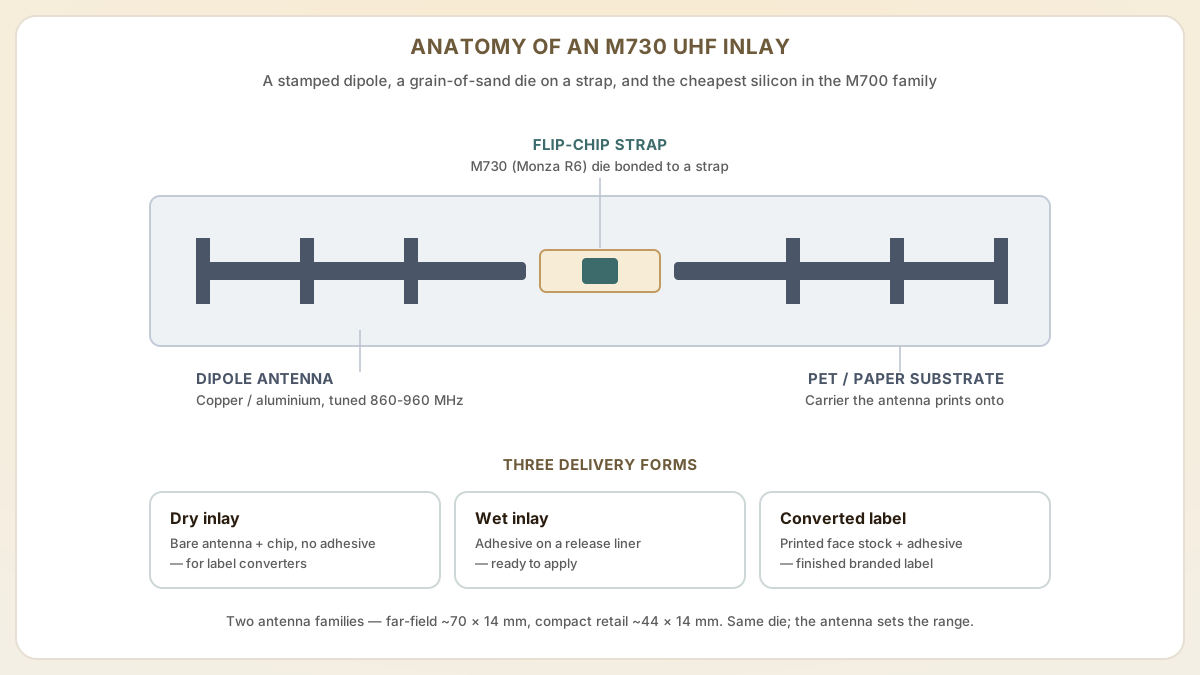
- Dipole antenna: stamped or etched copper / aluminium, tuned across the 860-960 MHz UHF band — this, not the chip, is what sets read range.
- Flip-chip strap: the M730 (Monza R6-class) die is bonded to a small strap first, which is what lets a single die drop into dozens of catalogue antenna designs without re-bonding.
- Substrate: a PET or paper carrier the antenna is printed onto — paper for disposable retail hangtags, PET film where the label has to survive handling.
- Two stock antenna families cover most retail: far-field general-purpose (~70 × 14 mm) for hangtags, cartons and pallet labels, and compact retail (~44 × 14 mm) for jewellery, eyewear and small-item apparel.
| Delivery form | What ships | Who finishes it | Typical retail use |
|---|---|---|---|
| Dry inlay | Bare antenna and M730 die on the carrier, no adhesive | Label converters laminating their own construction | Custom-printed apparel and carton labels |
| Wet inlay | Adhesive on a release liner, ready to apply | Brand owners and 3PLs applying directly to the item | Hangtags, pallet and carton labels |
| Converted label | Printed face stock plus adhesive plus inlay | Ships finished, branded and end-use ready | Source-tagged apparel, footwear, accessories, FMCG |
How far an M730 reads — set by the surface, not the silicon
The most common buyer question is read range, and the honest answer points at the mounting surface, not the datasheet. The M730 die never changes, yet a paper hangtag in free air behaves nothing like the same inlay foam-spaced off a steel shelf edge or floated over a bottle of shampoo. The ranges below are what you can plan against per surface, measured on an Impinj R700 at +30 dBm EIRP — the same numbers behind the retail apparel and Walmart source-tag deployments. If a programme needs on-tag user memory or a harder on-metal margin, that is the cue to step up to the M750.
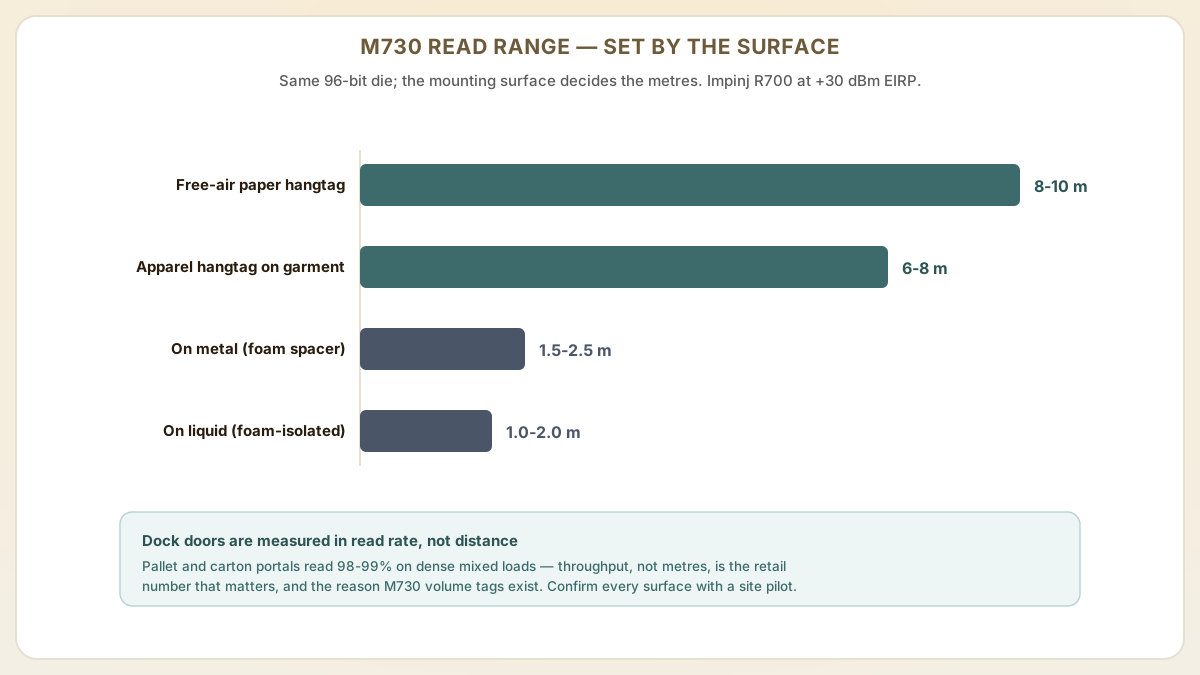
- Read range is an antenna-and-surface property, not a chip spec: the same M730 die spans 8-10 m in free air and 1.0-2.0 m over liquid.
- Pallet and carton dock-door portals are graded on read rate, not distance — 98-99% on dense mixed loads is the retail throughput target.
- On metal and on liquid both detune the antenna; a foam spacer or a dedicated on-metal antenna design buys back the 1.5-2.5 m and 1.0-2.0 m figures in the table above.
- Always confirm with an on-site pilot before committing volume: reader power, antenna gain, tag orientation and the tagged product itself all move these numbers.
| Mounting surface | Typical read range | Antenna approach | Planning note |
|---|---|---|---|
| Free-air paper hangtag | 8-10 m | Standard far-field inlay | Best-case bench and open-floor reads |
| Apparel hangtag on garment | 6-8 m | Standard far-field inlay | The workhorse retail source-tag case |
| On metal (shelf edge, hardware) | 1.5-2.5 m | Foam spacer or specialty antenna | Margin is tight; pilot before rollout, or M750 |
| On liquid (cosmetics, beverage) | 1.0-2.0 m | Foam-isolated label | Cost-optimised FMCG; validate per bottle geometry |
Useful next pages
Use these linked product, guide and comparison pages to keep the next click specific and practical.
Related M700-family inlays
Compare the M730 against the rest of the M700 family and the M800.
Cross-vendor UHF alternatives
Other silicon families at the same price / performance point.
Chip-level technical reference
Deep-dive specifications and chip-family comparisons relevant to this SKU.
Industry applications
Industry deep-dives where M730 is the volume choice.
FAQ
What is the difference between Impinj M730 and M750?
M730 (Monza R6 class) is the cost-optimised variant: 96-bit EPC, no user memory, no EPC Gen2v2 AUTHENTICATE or Untraceable. M750 (Monza R6-P class) adds 32 bits of user memory + full AUTHENTICATE and Untraceable + Hide-EPC at ~30% silicon-ASP premium. Choose M730 for pure SGTIN-96 retail volume; choose M750 for brand authentication, retail-privacy at POS, on-tag user memory, or any cryptographic verification requirement.
Is M730 the same chip as Monza R6?
Yes — Impinj rebranded Monza R6 silicon as M730 under the M700-series naming refresh. Datasheets, EPC behaviour, and TID prefix (E280-1160) unchanged. Existing readers, encoders, and inlays branded as Monza R6 fully interoperable with M730 inlays.
What read range can I expect from a Proud Tek M730 inlay?
Free-air on a paper hangtag with Impinj R700 reader at +30 dBm EIRP: 8-10 m. Apparel hangtags: 6-8 m. On metal with foam-spaced specialty antenna: 1.5-2.5 m. On liquid (cosmetics / beverage) with foam-isolated label: 1.0-2.0 m. Pallet portal read rates: 98-99% on dense loads. Real numbers depend on antenna design, reader power, and deployment substrate. Always validate with on-site pilot before committing.
Can M730 be used with my existing Impinj R700 / Zebra FX9600 reader fleet?
Yes — fully ISO/IEC 18000-63 + EPC Gen2v2 compliant. Every standards-compliant fixed reader, handheld, and printer-encoder reads/writes M730 with no firmware change. The advanced EPC Gen2v2 commands (Untraceable, AUTHENTICATE, Hide-EPC) that M750 / UCODE 9 implement are not available on M730 — but basic inventory and read/write commands work identically.
What MOQ does Proud Tek offer for M730 inlays?
10,000 pieces for stock antenna designs (general-purpose far-field, compact retail, on-metal, on-liquid, windshield). For custom antenna designs MOQ is typically 50,000-100,000 pieces depending on tooling depth. Sample sets of 100-500 pieces available for evaluation; lead time 3-4 weeks for stock antenna designs, 6-10 weeks for new antenna tooling.
Does M730 meet the Walmart RFID mandate?
Yes — the dominant chip behind Walmart RFID source-tagging compliance. Walmart requires SGTIN-96 EPC encoding per GS1 TDS 2.0 with ARC Master List spec category certification on the inlay design. M730 + ARC-certified antenna meets both requirements. Walmart's mandate has expanded from apparel (2020) to home / electronics / beauty / hardline (2022-2024); M730 ships into all categories. Adjacent mandates (Target, Macy's, Inditex, Nike, Lululemon, Kohl's) accept the same M730 + ARC-certified-antenna stack.
Sources & references
Primary standards, OEM datasheets and regulatory documents cited by this article. All URLs were verified on the access date shown below.
- Impinj M700 series chip family data sheet (M730 / M750 / M770)
Authoritative chip-level reference for M730 sensitivity (-22.6 dBm), 96-bit EPC, factory-serialised TID, and absence of user memory / AUTHENTICATE.
- Impinj Monza R6 product brief — M730 silicon class
Original Monza R6 silicon brief — pre-rebrand reference for M730 chip behaviour and TID prefix lineage.
- GS1 EPC Tag Data Standard (TDS) 2.0 — SGTIN-96 encoding
EPC encoding standard governing SGTIN-96 / SSCC-96 / GRAI-96 / GIAI-96 encoding on M730 inlays for Walmart and adjacent retail-mandate compliance.
- ISO/IEC 18000-63:2015 — RAIN RFID EPC Gen2v2 air interface
UHF RFID air-interface standard for M730 + every modern RAIN RFID deployment.
- EPC Gen2v2 UHF Air-Interface Protocol 2.1
Protocol-level specification of basic inventory and read/write commands supported by M730.
- Auburn University RFID Lab — ARC Master List specifications
Procurement-reference benchmark for retail-grade UHF inlay performance under Walmart-aligned ARC Master List specifications.
- RAIN Alliance — retail source-tagging industry briefs
Industry-alliance reference for retail source-tagging deployment patterns and chip / antenna selection guidance.
Proud Tek is a Shenzhen-based RFID & NFC manufacturer supplying hotel chains, transit operators, event venues and retail brands worldwide. Every order includes free samples, RF testing and dedicated project support.
Get a Quick Quote
Tell us about your project and we'll respond within one business day. Fields marked (asterisk) are required.